Backlink budgeting: monthly vs quarterly planning templates
Backlink budgeting made simple: compare monthly vs quarterly planning and use easy templates to keep purchases steady, avoid spikes, and track progress.
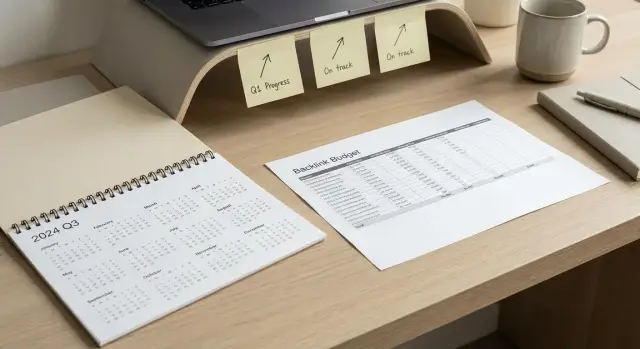
Why backlink spending often turns into spikes and gaps
Erratic backlink buying usually follows the same loop: a burst of links after a traffic dip (or when a competitor jumps ahead), then weeks or months of doing nothing. When rankings stall again, the cycle repeats.
That stop-start rhythm makes progress hard to read. If you buy a lot at once, it’s difficult to tell which placements helped and which didn’t. If you pause for too long, any momentum gets buried under other changes like new pages, seasonality, or algorithm updates.
Spikes and gaps usually come from a few predictable triggers:
- Budget decisions happen only when there’s “extra cash,” not on a schedule.
- Buying is driven by panic (a bad month) or excitement (a good month).
- There’s no set pace, so every purchase feels like starting over.
- Reporting is irregular, so improvement is hard to spot.
- The plan depends on one person’s attention, so it slips.
A steady process is boring in the best way. Instead of spending $600 in one week and then nothing for two months, you might allocate $200 per month for three months and review results on the same date each time. That consistency makes patterns easier to see and changes easier to justify.
What a backlink budget is actually for
A backlink budget isn’t just “money for links.” It’s a plan for building trust and visibility without random bursts of spending. A good budget connects spend to outcomes you can track, like lifting a small set of pages that matter to the business: a main service page, a product category, a high-margin landing page, or a guide that already converts.
The real tradeoff is speed vs stability vs risk tolerance. Buying fast can feel productive, but it often creates messy reporting, scattered targeting, and regret when results don’t match expectations. Going too slowly is safer, but progress can be hard to see month to month. The best pace is the one you can repeat.
It helps to pick one primary goal and use it as your filter for every decision:
- Steady authority growth with predictable spend
- A focused push for a priority page for a defined window (like a launch)
- Ranking protection by keeping link velocity consistent
- Test and learn: small spend, tight tracking, then scale
Most budgets fail because of boring constraints people ignore. Before you set numbers, map what can actually happen inside your business: when cash arrives, how approvals work, when leadership expects reporting, and who will track results. If your company plans quarterly and reports monthly, build your backlink plan the same way.
Monthly vs quarterly planning: how to choose
The best cadence is the one you’ll follow. Backlink budgeting breaks when the plan looks good on paper but doesn’t match real-life cash flow and team habits.
Monthly planning fits when budgets are tighter, results are reviewed often, or you’re still learning what types of placements and target pages perform best. It gives you more control and faster course corrections.
Quarterly planning fits when spending needs approvals, invoices move slowly, or work happens in campaign cycles. It reduces repeated decision-making and can be easier for teams that review marketing performance once per quarter.
The total can stay the same. Only the timing changes. For example, an annual budget of $3,600 can be split as:
- Monthly: $300 each month
- Quarterly: $900 each quarter
A rule that prevents spikes and gaps: pick a cadence you can repeat for 6 to 12 months without breaking your cash flow or your internal process. If you know you’ll miss months, go quarterly. If a big quarterly bill will force you to go silent afterward, go monthly.
Inputs to collect before you set numbers
Before you pick a budget, get a clear picture of what “normal” looks like for your site. Backlink planning works best when it’s grounded in your current pace and your ability to manage it.
Start with a baseline: how many new referring domains you typically earn per month (even if it’s only a few). That’s your starting line. If you usually add 3 to 5 referring domains and suddenly plan for 30, it will feel “behind” immediately, which often triggers panic buying.
Next, choose the pages you actually want to lift. Pick 3 to 5 priority pages, such as a main service page, a pricing page, and one to three high-intent guides. If you can’t name these pages, pacing will fall apart because every purchase becomes a last-minute debate.
Collect these inputs in one place:
- Baseline: average new referring domains per month over the last 3 to 6 months
- Priority pages: 3 to 5 URLs and the keyword theme for each
- Capacity: who owns targeting, page readiness, and tracking (and how many hours they realistically have)
- Budget range: the minimum you can sustain for 3 to 6 months
- Guardrails: your “no” list (industries, tactics, or site types you won’t touch)
Sanity-check capacity at the end. If one person can only update two pages a month, don’t plan links to eight different URLs.
Simple monthly backlink budget template
Monthly planning works well when you want steady progress and fewer surprises. The point isn’t to buy whenever you feel like it. It’s to keep a predictable pace so rankings have time to respond.
Use this as a one-page doc or spreadsheet.
Monthly backlink budget template (copy/paste fields)
| Field | What to write |
|---|---|
| Month | e.g., March 2026 |
| Total budget cap | The max you will spend this month |
| Planned placements | Number of placements you aim to secure |
| Target pages | 2 to 5 pages you want to strengthen |
| Anchor note | Simple rule like “mostly brand or natural text” |
| Vendor/source | Where placements will come from |
| Pacing rule | How you will spread purchases across the month |
| Buffer (optional) | Reserved amount for rare opportunities |
| Notes | Seasonality, launches, pages updated |
Pick a tier with a clear cap
Choose one level and keep it for at least 2 to 3 months before changing. The exact label doesn’t matter. The cap does.
A simple approach:
- Starter: smaller cap, fewer placements, focus on 1 to 2 priority pages
- Standard: moderate cap, consistent placements, focus on 3 to 4 pages
- Aggressive: higher cap, more placements, still paced (not “all at once”)
Add a buffer with rules
A buffer prevents last-minute decisions. Set aside a small amount (often 10 to 15% of your monthly cap). Use it only when a placement clearly fits your target pages and you can still follow your pacing rule. If you don’t use it, roll it into next month instead of spending it just to spend it.
Simple pacing rule: split purchases weekly (or every 10 days). If you plan 4 placements, schedule 1 per week.
Simple quarterly backlink budget template
A quarterly plan works well when you want steady progress but don’t want to make decisions every week. It also helps you avoid the common pattern of buying heavily in month one, then going quiet when priorities shift.
Start with one number for the quarter, then decide how you’ll split it across the three months. That’s the heart of budgeting: you plan the pace, not just the total.
Use this template:
- Quarter (Q2 2026): ____
- Total quarter budget: $____
- Split type (even or ramp): ____
- Month 1 budget: $____ | planned placements: ____
- Month 2 budget: $____ | planned placements: ____
- Month 3 budget: $____ | planned placements: ____
- Target pages (2 to 5 URLs): ____
- Anchor style note (brand, mixed, generic): ____
- Review date (mid-quarter checkpoint): ____
- Final review date (end of quarter): ____
For the split, pick one and stick with it:
- Even split (33/33/33) when pages are ready and you want consistency
- Ramp split (25/35/40) when month one is for prep (content updates, on-page fixes, domain selection) and you want more placements later
Add a mid-quarter checkpoint (often week 6). Don’t use it to restart the plan. Keep the total quarter budget the same and only move money between months if something concrete changed (a delayed launch, a real priority shift, or a temporary cash flow squeeze).
How to pace purchases so growth stays steady
The easiest way to break a plan is to buy a lot of links in one burst, then stop for weeks. Spreading purchases makes it easier to see what’s working without guessing. It also reduces the urge to “fix” a bad week with a spending spike.
Pick a rhythm you can repeat. For many teams, 1 placement per week (or 2 if the budget supports it) is enough to stay consistent and keep reporting clean.
A pacing setup that stays steady:
- Choose a weekly target (example: 1 placement every Tuesday).
- Set mix caps so your sources don’t get too concentrated (example: no more than half from one source category).
- Keep a small buffer to replace a failed placement, not to add extra volume.
- Review results on a fixed day each month and adjust slowly, not daily.
Decide in advance what you won’t do. Write it down: no last-minute doubling because rankings dipped, no end-of-month shopping spree to “use up” budget, and no switching target pages every few days. If you want to scale, scale in steps (like +1 placement per month), then hold steady long enough to read the outcome.
Build your plan in 30 minutes
You don’t need a complicated spreadsheet. You need a simple routine you’ll actually follow.
- Pick a cadence and a number you can sustain. Monthly if cash flow is tight or you want frequent check-ins. Quarterly if approvals or operations make monthly unrealistic.
- Choose 2 to 4 priority targets. A money page, a core product page, a high-converting post, a local landing page. If you try to boost everything, you usually boost nothing.
- Set a placement target, then pace it. Example: 4 placements per month becomes roughly 1 per week.
- Create a tracking table (five columns is enough). Date, source/domain, target URL, status (planned/ordered/live), notes (anchor idea, page goal, follow-up).
- Review once per month and change only one thing. If results are slow, either improve target pages or change the budget. Don’t change budget, targets, and pace all at once.
Mini-example
Say you can spend $600 per month for the next three months. You choose two priority pages: a main service page and one guide that already ranks on page two.
You plan 12 placements in 90 days, paced at about one per week. You pre-assign 7 to the service page and 5 to the guide, then only adjust if one page clearly starts pulling ahead.
Example scenario: a steady 3-month plan
Imagine a small SaaS with one main feature page (the money page) and a blog that brings in most early traffic. You want consistent improvement, not a rush of links in week 1 and nothing in week 8.
Two ways to fund the same pace and annual total:
- Option A (monthly): $150/month
- Option B (quarterly): $450/quarter (same $1,800/year)
Same schedule. Different payment timing.
12-week schedule (1 placement per week)
| Week | Target page | Simple note |
|---|---|---|
| 1 | Feature page | Start with the core page |
| 2 | Blog guide #1 | Support top-of-funnel |
| 3 | Pricing page | Add conversion support |
| 4 | Feature page | Reinforce primary target |
| 5 | Blog guide #2 | Build a second entry point |
| 6 | Feature page | Keep steady pressure |
| 7 | Homepage | Brand + trust signal |
| 8 | Feature page | Back to the core page |
| 9 | Blog guide #1 | Strengthen a winner |
| 10 | Pricing page | Repeat what converts |
| 11 | Blog guide #3 | Expand topical coverage |
| 12 | Feature page | Close the quarter consistently |
To avoid constant changes, keep one rotation rule for the full quarter:
- 50% of placements to the feature page
- 30% to 2 to 3 blog guides
- 20% to pricing or homepage
Common mistakes that create erratic buying patterns
Erratic link buying usually starts with a feeling, not a plan. Rankings dip, traffic looks flat, or a competitor jumps ahead, and the response is to spend everything right now. Then cash gets tight, and the next month is zero.
The most common patterns:
- Panic spending: using the whole budget in a single week because positions moved
- Constant page switching: changing target URLs so often that nothing builds enough signal
- Forgetting cash flow: committing to big buys and then pausing for months to recover
- No purchase log: not recording what was placed, where, when, and what it points to
- One-note buying: repeating the same placement style every time and calling it a strategy
A simple fix: commit to 1 to 3 target pages for a full month (or quarter). Only adjust if there’s a clear reason, like a page being removed or a campaign ending.
Documentation is the boring part that saves you later. A basic spreadsheet is enough. Record the source, cost, target URL, and a quick note (for example, “brand homepage” vs “money page”).
Quick checklist before you spend
Before you place an order, confirm these five items. It keeps budgeting predictable and makes results easier to interpret.
- Budget is locked for at least 3 months. Even with monthly buying, decide the next 90 days now.
- Weekly pacing is written down. Number of placements per week and the day you’ll do it.
- Target pages are stable. A short list plus a simple rotation rule.
- Tracking sheet exists before you buy. Date, source, target URL, status, notes.
- Next review date is scheduled with one decision rule. Example: if things are flat after two reviews, change targets or improve pages, but keep the pace.
When these are set, buying stops feeling emotional. You know what you’re buying, when you’re buying it, and what you’ll change next time (and what you won’t).
Next steps: make the plan repeatable
Pick one template (monthly or quarterly) and run it for a full cycle. Don’t chase the perfect number. Build a routine you can keep.
Fill the template with real constraints: how much cash you can commit, how often you can pay, how many placements you can add without creating spikes, and who owns the task. If certain months are always chaotic (launches, holidays, conference season), plan around that instead of pretending they’ll be calm.
After the cycle ends, do a short review: what improved, what stayed flat, and what felt inconsistent (timing, tracking, page readiness, vendor delays). Then standardize the basics for the next cycle: a fixed purchase pace, one primary metric, and a budget tier you can repeat without stress.
If execution is your main source of inconsistency, it can help to separate planning from fulfillment. For example, SEOBoosty (seoboosty.com) offers subscription-based backlinks from highly authoritative websites via a curated domain inventory, which can make it easier to keep timing and spend steady once your targets and pacing rules are set.
FAQ
How do I stop the cycle of buying links in bursts and then going silent?
Start by picking a pace you can repeat for 6–12 months without skipping. Then decide a fixed review date and keep the same target pages long enough to see a pattern. Consistency makes results easier to attribute and reduces panic spending.
When should I use a monthly backlink budget instead of quarterly?
Monthly planning is better when cash flow is tighter, you want frequent check-ins, or you’re still learning what works for your site. It gives you more chances to adjust without blowing up the plan. The key is to keep the monthly cap stable for at least a few months.
When does quarterly backlink budgeting make more sense?
Quarterly planning fits when approvals take time, invoices move slowly, or your company reviews marketing in campaign cycles. You still want a steady pace inside the quarter, not a big spend in month one. A mid-quarter checkpoint helps you rebalance timing without changing the total.
How do I choose a budget number I can actually sustain?
Pick a number that you can pay even in a “boring” month, not just when revenue is up. A practical rule is to choose a minimum you can sustain for 3–6 months and treat anything above that as optional. Stability beats occasional big spends for clean tracking.
How many pages should I target with backlinks at once?
Choose 3–5 pages that matter to the business and can realistically improve rankings and conversions, such as a core service page, a pricing page, and one to three high-intent guides. If you can’t name the targets in advance, every purchase becomes a debate and pacing breaks. Keep the set stable for a full month or quarter.
What’s a good anchor text rule for a steady backlink plan?
Anchor text should be simple and safe by default, usually leaning toward brand or natural phrasing. Write down one rule and follow it consistently so you don’t over-optimize during a push. If you want to experiment, change only one variable at a time and track it.
Should I set aside a buffer budget for “rare opportunities”?
A buffer stops you from making last-minute decisions and lets you replace a failed placement without breaking pace. Keep it small and controlled, and only use it when a placement clearly matches your target pages and rules. If you don’t use it, roll it forward instead of spending it to “use it up.”
What’s the simplest way to pace backlink purchases during the month?
Pick a rhythm like one placement per week or every 10 days and put it on the calendar. Spreading placements makes reporting clearer and reduces the urge to react to short-term ranking swings. If you want to scale, increase gradually and then hold steady long enough to evaluate.
What should I log for each backlink so reporting stays clean?
Track the date, the source/domain, the target URL, the status (planned to live), and a short note about intent. This is enough to connect spend to outcomes and avoid repeating mistakes. The goal is to make your next review decision based on facts, not memory.
How can I keep execution consistent if my team keeps dropping the ball?
Separate planning from fulfillment so execution doesn’t slip when priorities change. A subscription-style setup can help keep timing and spend consistent, as long as you still control target pages, pacing, and tracking. For example, SEOBoosty offers subscription-based backlinks from a curated inventory, which can reduce delays and help you stick to your schedule.
Share