Backlink co-citation planning for stronger topical relevance
Learn backlink co-citation planning to build topical association by picking nearby entities, standards, and terms, even when using branded anchors.
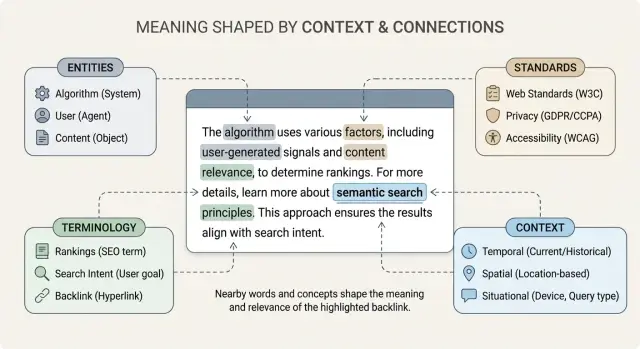
Why co-citation matters when the anchor is branded
Topical association is what Google and real readers learn about your site from the words and ideas around your link. Not just the anchor text, but the nearby terms, the other brands mentioned, and the theme of the page.
A backlink is a vote of trust, but it doesn't fully explain relevance. If a page links to you while discussing cloud security, SOC 2, and incident response, your brand gets grouped with that topic. If the same kind of link appears in a page about recipe prep and kitchen knives, the authority might still help, but the relevance signal gets muddy.
That's why branded anchors aren't useless for relevance. A branded link like “Acme” doesn't say much on its own. The surrounding context does the work. With smart co-citation planning, you can keep a clean branded anchor and still steer the topic by choosing the right “neighbors” in the text.
What tends to matter most is the immediate context: the entities nearby (products, tools, companies), any standards or frameworks mentioned (ISO 27001, HIPAA, PCI DSS), the plain-language terms buyers use, the page section the link sits in, and which other sources are cited right next to you.
A simple example: a SaaS brand gets a link with the anchor “NorthPeak.” If the paragraph also mentions “single sign-on,” “SAML,” “Okta,” and “SOC 2,” the link reads like a security and identity reference even though the anchor is just the brand.
Set expectations. You're guiding signals, not forcing outcomes. Search engines combine many hints over time: page quality, site history, internal content, and more. Co-citation is one of the few hints you can influence directly when you choose placements on purpose.
Co-citation vs co-occurrence (no jargon)
Co-citation is straightforward: your brand gets mentioned or linked near other names that already mean something to search engines. Those nearby “neighbors” can be products, companies, standards, tools, or well-known problems. Over time, that neighborhood helps shape what your brand is associated with.
Co-occurrence is different. It's about repetition across many pages. When the same words and entities keep appearing near each other across the web, search engines can treat that pattern as a stronger hint that the topics belong together.
A useful way to separate them:
- Co-citation is about one page and one specific context.
- Co-occurrence is about many pages and a repeating pattern.
This matters more when your anchor is branded. If the anchor text doesn't explain the topic, search engines lean harder on the surrounding sentence, paragraph, and page theme to understand what the link is “about.”
A simple mental model: imagine your link as a person at a dinner table. The people sitting next to them affect how newcomers describe them later.
If a branded link appears in a paragraph that also mentions “SOC 2,” “ISO 27001,” “SSO,” and “audit logs,” your brand starts to feel connected to security and compliance. If it appears next to vague startup buzzwords, the association gets fuzzy.
The building blocks: entities, standards, and terminology
Co-citation planning is mostly deciding what your brand will be seen next to. That context helps search engines understand the linked page, even if the anchor text is only your company name.
Entities: the “who” and “what” around you
Entities are recognizable things: brands, products, tools, organizations, people, and places. In practice, they're your neighbors. If your branded link sits near the same kinds of entities your audience expects in your niche, the topical signal gets clearer.
One practical way to choose entities is to start with what your ideal customer already brings up in conversations. For a security tool, that often includes common vendors, well-known attack types, and the teams that own the problem (SOC, IT, compliance).
Standards and frameworks: the “rules” and “methods” that define the topic
Standards and frameworks add specificity because they anchor a discussion to shared labels. A privacy product mentioned near “SOC 2” or “ISO 27001” reads very differently than the same product mentioned near generic “best practices.”
Terminology is the plain language people use when they search: category terms, key features, and problems being solved. Good terminology is specific without turning the paragraph into a keyword pile.
Before you approve a placement, sanity-check the surrounding terms against the destination page. Make sure the copy uses category terms your page actually targets, references features you truly explain, and matches the problems the page addresses early on. If standards are mentioned, they should be ones you genuinely support or clearly address. Avoid name-dropping.
Example: if your page is about passwordless authentication, context that mentions “WebAuthn,” “FIDO2,” and “phishing-resistant MFA” fits. Context about “SSO pricing” or “VPN encryption” might be adjacent, but it blurs what the page is really about.
Pick your topical target before you pick placements
With a branded anchor, the surrounding context does the heavy lifting. That only works if you decide upfront what you want search engines to associate your page with.
Start with a one-sentence statement anyone on your team can understand. Keep it plain, not marketing-heavy. Example: “This page explains how to automate SOC 2 evidence collection for SaaS teams.”
From that sentence, build a small “association set” you want to see near your brand name in other articles. Keep it tight:
- Core terms that describe the topic (features, use cases, problems solved)
- A handful of supporting entities (tools, roles, vendors, well-known platforms)
- Only a couple of standards or frameworks, and only if they truly belong
- A short “do not mention” list (common wrong categories)
- One simple audience label (who it's for)
That “do not mention” list matters. If you sell passwordless login, you probably don't want the surrounding copy framing you as “VPN” or “antivirus.” Those nearby words can quietly pull your brand into the wrong bucket.
A quick reality check: imagine a reader sees your brand mentioned with no link at all. Would the surrounding sentence still make them guess the right topic? If the answer is “maybe,” tighten the target.
Step-by-step: a simple co-citation planning workflow
Co-citation planning gets easier when you treat each backlink like a small editorial mention: what page is being referenced, and what else should be mentioned nearby so the reference makes sense.
A 15-minute workflow you can reuse
Start with the page you're linking to. Write down the one thing that page should rank for, and the intent behind it: learn, compare, buy, or troubleshoot. A homepage and a “how it works” page usually need very different context.
Next, pull seed terms from your own site: headings, feature names, FAQ questions, and the phrases customers use in support tickets. This keeps you aligned with your real positioning instead of random keyword ideas.
Then narrow the brief:
- Pick 1 or 2 must-have associations (core entities, standards, or close alternatives you want mentioned nearby).
- Pick 3 to 5 nice-to-have terms (supporting concepts, metrics, job titles, or use cases).
- Decide anchor style by placement type: branded for high-authority editorial mentions, and occasional partial-match anchors only where it reads naturally.
- Write a short context brief for the paragraph around the link: what the page helps with, who it's for, and 2 or 3 terms to include.
- Add one “do not say” note to prevent risky or awkward phrasing.
Keep the brief flexible. It's not a script. It's guardrails.
Finally, track what actually got published. A simple sheet is enough: destination URL, site, anchor used, whether the must-have entities appeared, and which terms showed up in the final copy.
How to shape the surrounding text without overdoing it
A branded anchor can still carry a strong topic signal if the text around it points clearly to the same subject. Think “good neighborhood”: a few nearby words mention the right concepts, the right known names, and the same plain-language terms people use when they talk about your topic.
Good context usually uses a few strong signals, not a pile of keywords. Aim for 2 to 4 clear associations that naturally belong together. Beyond that, the paragraph starts to read like a checklist, and weaker extra terms can blur the meaning.
In practice, strong surrounding copy often includes a clear category phrase (like “SOC 2 compliance” or “inventory forecasting”), one or two relevant entities (a standard, method, tool type, or vendor), one practical intent term (“audit evidence,” “incident response,” “demand planning”), and a simple benefit or use case that connects the dots.
Placement matters more than stuffing. The strongest option is the same sentence as the branded anchor, since that's where readers and search engines connect ideas fastest. If that feels unnatural, use the same paragraph, ideally within a sentence or two. Headings can help when they fit, but a heading packed with terms looks forced quickly.
Example (natural, not noisy): “Teams using AcmeCloud for SOC 2 compliance often centralize audit evidence and access logs to reduce review time.”
Example: planning co-citations for a branded SaaS backlink
A SaaS brand often has to use a branded anchor (the company name) but still wants Google to connect that brand with a specific topic.
Scenario: a help desk SaaS called HelpHive wants to rank better for “help desk automation” and “ticket routing rules,” even when the backlink anchor is just “HelpHive.”
Start with a small set of entities that belong in the same conversation. For HelpHive, that might be Zendesk, Intercom, Salesforce Service Cloud, Shopify, and (only if it's real and relevant) SOC 2.
Then choose terminology real buyers use: help desk software, ticket routing, automation rules, SLA policies, knowledge base. You can add a couple of natural supporting terms where they fit, like CSAT, live chat, and omnichannel support.
Two example paragraphs that keep the anchor branded while building clear context:
“Teams migrating off legacy tools like Zendesk or Intercom often discover their biggest bottleneck isn't volume, it's consistency. HelpHive helps support leads set up repeatable workflows across Shopify and other sales channels, so tickets follow the right rules from the start.”
“For help desk automation, the basics matter: reliable ticket routing, clear SLA policies, and easy-to-maintain automation rules. Add a searchable knowledge base and track CSAT over time, and you can improve response quality without adding headcount. For security-minded buyers, SOC 2 expectations should be part of the evaluation.”
These read like advice, not a keyword list. The entities and terms show up only where they belong, inside a coherent point (migration, workflows, evaluation).
Common mistakes that weaken topical signals
Co-citation works best when the surrounding context feels natural and focused. Most weak results come from trying to force meaning into a placement instead of earning it with clear, consistent clues.
Mistakes that quietly cancel out your signal
Packing one paragraph with every related keyword you can think of is a common problem. It reads like a checklist and makes the topic less clear. A few well-chosen entities and terms usually beat a long pile.
Mixing categories in the same context is another issue. If the linked page is about email marketing tools but the sentence around your brand suddenly mentions payment fraud, cloud hosting, and medical privacy, the reader (and search engine) doesn't know what to associate you with.
Be careful with standards and compliance names. Dropping in ISO, SOC, HIPAA, PCI, or GDPR just because they sound authoritative can backfire if your product doesn't actually align. It can also make the writer sound unreliable.
Repeating the exact same entity bundle across every placement is also risky. If every backlink mentions the same competitors and the same standard, it starts to look manufactured. Variety helps, as long as the meaning stays consistent.
Here are quick red flags to check before you approve copy:
- The sentence tries to cover more than one main topic.
- The writer name-drops standards your business doesn't claim.
- The paragraph is overloaded with tools, acronyms, or buzzwords.
- The same set of entities appears in most placements.
- The anchor text looks optimized, but the nearby text is vague.
Quick checklist before you approve a placement
Before you say yes to a backlink, read the sentence and the surrounding paragraph as if you've never heard of your brand. If it doesn't clearly tell you what the linked page is about, the topical signal will be weak, even if the site is high authority.
Five things to verify:
- The topic is stated in plain words near the link.
- The nearby names and concepts belong together.
- The branded anchor fits the sentence.
- Nothing in the context sends the wrong signal.
- It isn't a copy-paste paragraph you've used before.
A quick read-aloud test helps: read the paragraph out loud and answer, “If I click, what will I get?” If the answer is fuzzy, ask for a rewrite.
How to tell if your co-citation plan is working
The goal isn't to rank for one keyword. It's to get your page associated with a topic cluster so search engines feel more confident about what you cover.
Watch rankings across a small set of related terms (5 to 15 is enough). Mix head terms and long-tail questions. When it's working, you usually see gentle movement across several terms, not one dramatic spike.
Also watch Search Console trends over 4 to 8 weeks. Co-citation often shows up first as broader visibility: more impressions for queries that share the same entities and terminology you planned around.
What to monitor weekly:
- Impressions and clicks for related queries (not only the main query)
- New queries your page starts appearing for
- Average position changes across the cluster
- Which page is ranking (make sure it's the intended URL)
- Branded vs non-branded query mix
If results are flat, don't assume the link context is wrong. Check your on-page clarity first. Does the target page actually explain the same entities and standards your co-citations mention? If not, tighten headings, add a short glossary, or expand one key use case.
After that, adjust future placements. Test different entities, swap in a more specific standard (only if it's true), or refine the terminology. Keep notes on each placement so you can learn what tends to move the needle.
Next steps: turn your plan into consistent placements
Consistency beats perfection. A few well-planned mentions across different sites usually builds a clearer topical signal than one “perfect” write-up that never gets repeated.
Start small: pick your top one or two pages and write down one topical target for each. Don't keep it vague (“marketing”). Make it specific (“email deliverability for SaaS,” “SOC 2 compliance for startups,” “zero trust network access”).
Then build a short reusable library for each topic: the key entities, any standards that truly apply, and the everyday terminology people use. That library becomes your guardrail so the placement stays on-topic even if the anchor is branded.
If you're using an inventory-based placement service, ask for the exact draft paragraph before anything goes live so you can check the “neighborhood” around the link. For example, SEOBoosty (seoboosty.com) focuses on securing placements on authoritative sites, but you still want to control the surrounding context so the mention supports the page you're building relevance for.
Track it like a routine: update your library monthly, note what language publishers accept, and adjust your entity set as your market changes.
FAQ
What does “co-citation” mean in simple terms?
Co-citation is what your brand is mentioned or linked next to on a specific page. With a branded anchor, the anchor text doesn’t explain the topic, so the nearby entities and terms do most of the relevance work.
What’s the difference between co-citation and co-occurrence?
Co-citation is about one placement and its immediate context. Co-occurrence is about patterns across many pages where the same terms keep appearing together, which can strengthen the association over time.
Can a branded anchor still help with topical relevance?
Yes, often. A branded anchor can still send a clear topical signal when the same sentence or paragraph mentions the right category terms, entities, and standards that match the page you’re linking to.
What parts of the page matter most for co-citation?
Focus on the closest text to the link first: the same sentence, then the rest of the paragraph. Also consider the section theme and which other sources are cited right next to you, because those “neighbors” shape how the mention is interpreted.
How do I choose the right entities to place near my link?
Pick entities your buyers already connect to the problem: common tools, platforms, teams, and well-known vendors in your niche. Aim for a few that naturally belong together rather than a long list that reads like name-dropping.
When should I mention standards like SOC 2 or ISO 27001 near a backlink?
Only include standards you genuinely support or clearly address on the destination page. If you can’t back up the claim with real product capability or documentation, skip it, because misaligned compliance mentions can weaken trust and muddy relevance.
How do I set a clear topical target before I build links?
Start with a one-sentence topical target for the exact page you’re promoting, then build a small set of must-have and nice-to-have terms. Add a short “do not mention” list to prevent the placement from drifting into the wrong category.
How do I shape the surrounding text without keyword stuffing?
Use 2 to 4 strong associations that fit naturally in one coherent point: a clear category phrase, one or two relevant entities, and a practical intent term. If the paragraph starts to feel like a checklist, you’ve likely added too many terms.
How can I tell if my co-citation plan is working?
Track each placement with the destination URL, the site, the anchor used, and whether your must-have terms actually appeared near the link. Then watch movement across a small cluster of related queries and impressions in Search Console over several weeks.
If I’m buying placements (like through SEOBoosty), what should I control?
Ask to review the exact draft paragraph before it goes live and check the “neighborhood” around your link. Services like SEOBoosty can help you secure authoritative placements, but you still need to verify the surrounding context matches the page you want to build relevance for.
Share