Backlink decay modeling: predict SEO loss and replace links
Backlink decay modeling helps estimate SEO loss from link removals and content drift, so you can replace links before rankings and traffic fall.
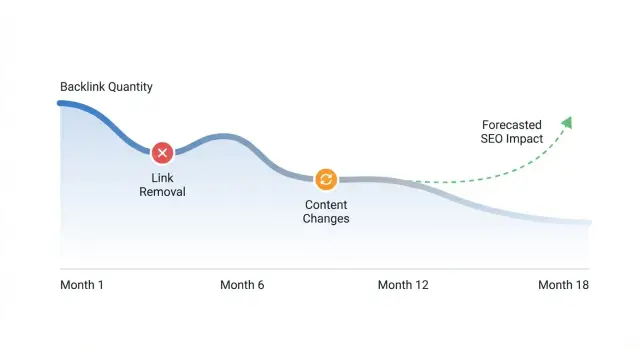
What backlink decay is and why it catches teams off guard
Backlink decay is the gradual loss of SEO value from links you already earned. Sometimes the backlink still exists but helps less than it used to. Other times it disappears entirely. Either way, your site ends up with weaker authority signals pointing to your pages.
It catches teams off guard because backlinks feel like a one-time win: you get the mention, you move on. But links live on other people’s pages, and those pages change. Editors refresh posts, companies redesign resource hubs, and older pages get cleaned up. Your backlink profile can shrink or weaken without anyone touching your site.
Decay usually shows up in two ways. First, link removal: the page is deleted, the link is edited out, a paywall blocks access, or the URL changes and the link breaks. Second, content drift: the page stays online, but the content around your link shifts away from your topic, or the page is repurposed so your mention becomes less relevant.
The painful part is timing. A link can be removed today, but the traffic drop often shows up weeks later. Search engines need time to recrawl the page, process the change, and adjust rankings. If you only react after you see a dip, you’re already behind.
That’s what backlink decay modeling is for. Instead of staring at rankings and guessing, you estimate how much link value you’re likely to lose over time and when that loss may start to matter. It turns link management from panic into planning.
A simple model doesn’t need heavy math. It should answer a few practical questions: which links are most likely to disappear or weaken, which pages would get hit first, and how many replacements you need (and how soon).
Example: a SaaS company gets featured on a popular “best tools” list. Three months later, the publisher refreshes the post and cuts the list in half. Your mention is removed, but your traffic looks fine for a while. Modeling forces you to treat that link as temporary value, set a replacement target early, and avoid a slow slide in rankings.
If you use premium placements, modeling still matters. Even strong placements can change over time, and tracking decay risk helps you protect the value you’ve paid for. If you’re using a provider like SEOBoosty (seoboosty.com) to secure placements on authoritative sites, this kind of monitoring helps you spot risk early and plan replacements before it shows up in analytics.
Link removals vs content drift: the two decay patterns
Backlink decay modeling starts with a simple idea: links stop helping the way they used to. That happens in two main ways. One is obvious (the link is gone). The other is quiet (the link is still there, but it matters less).
Pattern 1: Link removal (hard decay)
A removal is when the source page no longer sends usable value to you. Sometimes the page disappears. Other times it stays online, but your link stops counting the way it did before.
Common “removal” outcomes include the linking page returning a 404, a redirect that drops your link in the new version, a switch to noindex, an edit that removes your mention, or a change in link attributes (for example, from follow to nofollow, sponsored, or ugc).
These events are usually easy to confirm with a quick check of the source URL. The problem is that you often notice late, after rankings or traffic slip.
Pattern 2: Content drift (soft decay)
Content drift is when the source page becomes a worse match for the keyword and intent that originally made the link valuable. The link still exists, but the page is no longer strong for the topic you care about.
Drift can happen when a page shifts to a new audience, the title and headings change, a guide turns into a product page, heavy updates dilute the section you were mentioned in, or the page fills up with outgoing links and your mention becomes less prominent.
Decay can also be partial. Your link might get pushed lower on the page, moved from the main content into a footer, or changed to a less relevant anchor text. None of these removes the link, but each can reduce its impact.
A practical note: changes like follow vs nofollow matter most when you rely on the link for ranking strength. Even if you’re confident in your placements, it’s still smart to monitor “soft” changes so you can replace value before performance drops.
Signs your site is paying an SEO cost already
Backlink decay rarely looks like a site-wide crash. More often, it shows up as small, uneven losses that are easy to brush off as seasonality or algorithm noise. If you spot patterns early, modeling becomes less about guessing and more about preventing the next drop.
One common sign is rankings sliding on a handful of important pages while the rest of the site looks stable. These are often revenue or lead pages that depend on a small set of strong links. When one of those links disappears, gets nofollowed, or loses relevance, the page can drift down without any obvious technical issue.
Another early signal is impressions dropping before clicks. Many sites see Search Console impressions fall first, then clicks follow a week or two later. That can mean Google is testing you lower on the page or showing you for fewer keyword variations, even if your average position looks “fine.”
You might also notice competitors “suddenly” outranking you. It feels sudden because the cause is often gradual: your links weaken or vanish, their links hold, and the gap finally becomes visible.
Watch traffic quality, too. A page can keep getting visits while converting less because it now ranks for broader, less relevant queries. The page is still alive, but it’s bringing the wrong people.
A few checks tend to reveal decay faster than broad dashboards:
- Compare the last 28 days vs the previous 28 for your top landing pages by conversions.
- Look for pages where impressions drop, then clicks drop even more.
- Review keyword groups where you lost positions 3 to 10 (the “near the top” zone).
- Check whether pages losing ground have fewer referring domains than the pages beating them.
- Re-check the handful of links you rely on most for those pages.
Example: your pricing page holds position 4 for a high-intent term, then slips to 7. Total traffic only drops a bit, but demo requests fall sharply. That’s often what link removal SEO impact looks like in real life: small visibility loss, big business loss.
What to track so you can model decay (simple inputs)
A decay model doesn’t need fancy tools. It needs a clean, repeatable set of inputs you can update every week or month. If you can answer “what links do we have, what do they point to, and are they still helping?”, you’re most of the way there.
Start with a single source of truth: a backlink list. For each link, capture basics you can re-check later: the referring page URL (the exact page where the link lives), the linking domain (root domain), your target URL, anchor text, and a first-seen date.
Then add lightweight context so you can estimate which links are fragile and which ones tend to keep passing value even when pages are edited. Keep this simple: a domain quality tier (your own scale is fine), page/topic relevance (high, medium, low), placement type (in-body, bio, sidebar, footer, resources list), and any link attribute notes you can confirm (follow vs nofollow, plus sponsored/ugc labels).
The most important field for decay modeling is “last seen.” Each time you check a link, update the date and assign a clear status. A small set of statuses is enough: live (present and correct), removed, changed (anchor/placement/attribute changed), and redirected (the link points somewhere else or your target now redirects).
Finally, group links by what they support. Decay hurts most when many links prop up the same high-value page. Tag each target page with a role (homepage, product or service page, key blog post, comparison page) so you can roll up risk quickly.
Example: if a service page has 40% of its supporting links last checked more than 60 days ago, that’s an early warning. You can start a backlink replacement plan before rankings slide.
A simple way to estimate link value and decay risk
You don’t need a perfect formula. You need a consistent score that helps you sort links into “watch closely” vs “probably fine.” Backlink decay modeling works best when it’s repeatable, even if the first version is rough.
Step 1: Give each link a quick value score
Pick a small set of factors and rate each one 1 to 3, then add them up. Keep it fast so you’ll maintain it. Useful factors include source quality, relevance, placement, traffic potential (could real people click it?), and target importance (is the link pointing at a page that matters for leads, sales, or your main keywords?).
A link with a high total isn’t just “nice.” It’s expensive to lose.
Step 2: Assign a decay risk level
Add a simple label: stable, medium risk, or high risk. You’re estimating how likely it is to disappear or weaken.
Stable links often sit on maintained sites with real editorial processes. High-risk links are common on pages that change constantly, like frequently refreshed lists, resource pages that get pruned, or sites that redesign often.
Step 3: Estimate the loss if it disappears
For each important target page, translate link loss into small, medium, or large impact. Use your value score as the starting point, then adjust for concentration. If a page only has a few strong links and one does most of the heavy lifting, losing it is a large expected hit even if your site overall has many links.
Step 4: Add a “link half-life” assumption
Group links by how quickly they tend to decay and assign a rough half-life, such as “fast” (months) vs “slow” (years). This becomes your planning clock. A fast group should trigger earlier replacement targets.
Start with ranges, then tighten them after one or two review cycles. Each cycle, compare your labels to what actually happened and adjust.
Step by step: build a basic backlink decay model
Start small. A decay model works best when it focuses on the pages that pay the bills: top money pages, top lead pages, and a few “ranking drivers” that bring steady organic traffic.
First, pick 5 to 15 key pages and write down the main keywords you care about for each. Keep it simple: 1 to 3 keywords per page is enough.
Next, list the backlinks that matter most and map each one to a page and a purpose. A purpose can be basic: supports rankings for a keyword, builds trust, or sends referral traffic. This mapping is what turns a pile of links into a model you can act on.
Track link status over time. Each month, mark what changed: still live, edited (anchor text changed, moved location, nofollow added, content rewritten), or removed. Content drift is often the sneaky one: the page is still there, but your link is now surrounded by unrelated text, pushed far down, or the topic shifted.
To start, you only need a handful of columns: the page you want to protect, the referring link (page or domain), why it matters, current status, and an estimated value score.
Turn changes into a monthly “lost value” per page. Example: if a page has 20 total link points and 3 points are removed or weakened this month, your lost value is 3 and your remaining value is 17. You can also track a percentage: 3/20 = 15% decay for the month.
Then set thresholds that trigger action before rankings slide. For instance, any page losing 10% of link value in a month, or 25% over a quarter, needs replacements queued.
Review monthly and adjust assumptions based on outcomes. If a 2-point loss keeps causing ranking drops for one page, your scoring was too low. If nothing changes even after bigger losses, your scoring was too high. Over time, the model becomes easier to trust.
Common mistakes that make decay models useless
A decay model only helps if it matches how search engines treat links. The most common failure is treating every backlink like a simple point you can count. Ten weak links don’t equal one strong editorial link on a trusted site, and a model that overweights volume will point you toward the wrong fixes.
Another blind spot is assuming a link is safe because it still exists. Content drift can quietly erase value: the page gets rewritten, your mention becomes generic, the link moves to a low-visibility area, or the topic shifts so the link no longer makes sense. Your spreadsheet says the link is “live,” but the ranking lift fades anyway.
One more issue is lumping all target pages together. A homepage link often supports brand queries and overall authority, while deep pages carry specific keyword themes. If your model doesn’t separate these, you’ll replace the wrong links and wonder why the pages that matter still drop.
Five mistakes that usually make backlink decay modeling unreliable:
- Scoring links by count first and quality second.
- Tracking only whether the link exists, not whether the surrounding content still matches your topic.
- Using one average decay rate for every page instead of separating homepage, category pages, and key articles.
- Waiting for a traffic drop before replacing links.
- Skipping a change log, so you never learn which sources tend to disappear or drift.
The change log matters more than it sounds. If you don’t record when a link moved, changed anchor text, or when the linking page was updated, you can’t improve your assumptions. Your model stays a guess.
Example: a product page relies on three high-quality links. Two stay live, but one linking article gets rewritten and your link is pushed into a “resources” footer. Your model should treat that as a risk increase even though the URL still returns 200.
Example: predicting impact before traffic drops
Picture a SaaS company with three money pages: a pricing page (high intent, highest revenue per visit), an integrations page (mid intent, lots of assisted conversions), and a security page (high trust, helps close deals).
Their model is simple: each important backlink gets a value score (based on site strength and topical fit) and a decay risk (how likely it is to be removed or weakened). They combine those into an “expected loss” number. It’s not fancy, but it forces clear decisions.
In one month, monitoring shows three changes before any traffic chart looks scary.
A key backlink pointing to the pricing page is gone (404 on the linking page). Two other backlinks still exist, but they drifted: the linking articles were updated and the context changed. One moved the SaaS from a top recommendation to an “also mentioned” line, and the other removed the exact anchor text and replaced it with a generic brand mention.
The model flags the pricing page as urgent even though clicks haven’t dropped yet. The removed link had both high value and a low chance of coming back on its own. The drifted links are still passing some value, but less than before.
The team prioritizes like this:
- Pricing page: replace immediately (largest expected loss, direct revenue impact).
- Integrations page: watch closely and plan a replacement if drift continues.
- Security page: lower priority because it supports deals but doesn’t usually drive first-click signups.
A realistic replacement target isn’t “get 10 new links.” It’s “replace the missing value.” In this case, they set a target of one top-tier editorial link to the pricing page (similar authority and tight relevance), plus one supporting link from a solid industry publication to reduce single-link risk.
Quick checklist for monitoring and replacement planning
Backlink decay modeling only helps if you keep inputs fresh. The goal is simple: catch losses early, estimate what they cost, and have a replacement ready before rankings slide.
A lightweight routine is usually enough:
- Weekly (15 minutes): spot-check 5 to 10 important links pointing to your highest-value pages.
- During the check: look for redirects, newly added noindex, a follow-to-nofollow change, anchor changes, or a topic shift that makes the link less relevant.
- Monthly (30 to 60 minutes): total up lost value (by your scoring), then compare it to your replacement pipeline.
- Quarterly: re-rate assumptions using what actually happened and update risk levels.
Also set a clear “replace by” date for any high-risk loss. If a high-value link looks unstable because of redesigns, ownership changes, or repeated edits, treat it like a deadline and assign an owner.
Next steps: set replacement targets and keep the model alive
A decay model only matters if it turns into actions you can schedule. Translate predicted loss into a replacement backlog: which pages need support, how much link value you need to add back, and when it needs to go live.
Set targets in plain numbers. For each important page, decide the minimum link value you want to maintain, then compare it to what you expect after decay. The gap is your replacement target. Put a deadline on it that’s earlier than your risk window, not after rankings fall.
Keep the backlog small and specific: which page is at risk, how much value you need to replace (using your model’s units), a date, an owner, and the replacement type.
Speed vs quality is the constant trade-off. If a high-value link is likely to drop next month, waiting three months for a perfect replacement is still a loss. A practical approach is to fill urgent gaps quickly with dependable placements, then upgrade over time by adding stronger links or improving relevance.
Treat your model like a living doc. Every time you replace a link, record what happened: how long it took, whether the link stuck, and whether rankings or traffic stabilized. Those notes make your forecasts less guessy and your SEO link monitoring more useful over time.
FAQ
What is backlink decay in plain terms?
Backlink decay is when existing links stop giving you the same SEO lift over time. Sometimes the link is removed or breaks, and sometimes it stays live but becomes less relevant or less visible, so it passes less value.
Why does backlink decay catch teams off guard?
Links live on other people’s pages, and those pages get edited, redesigned, pruned, or moved. Because the change happens off your site, you often don’t notice until rankings or conversions start slipping.
What’s the difference between link removal and content drift?
Link removal is “hard” decay where the link stops working as intended, such as a deleted page, a broken URL, a noindex change, or a follow link turning into a tagged or non-passing link. Content drift is “soft” decay where the page stays online but shifts topic, structure, or prominence so your mention matters less.
How do I start modeling decay without complicated tools?
Start with the few pages that drive revenue or leads, then list the handful of links those pages rely on most. Update a simple “last seen” date and a status each time you check so you can spot changes before performance drops.
What data should I track for each backlink to model decay?
Track the referring page URL, linking domain, your target URL, anchor text, first-seen date, and last-seen date. Also note placement type, topical relevance, and any link attribute changes, because those are common sources of hidden value loss.
How can I estimate a backlink’s “value” in a simple way?
Use a consistent, small scoring system so you can compare links week to week. A good default is to rate source quality, topical relevance, placement visibility, and how important the target page is to your business, then sum the scores and keep the method the same over time.
How do I estimate which links are most likely to decay?
Give each link a risk label based on how often the source changes and how stable the site is. Frequently refreshed “best tools” pages and resource hubs tend to be higher risk than maintained editorial articles, so treat them as more temporary value.
What are the early signs decay is already hurting my SEO?
Look for small, uneven losses rather than a site-wide crash. Common early hints are impressions dropping before clicks for specific pages, positions sliding from near-top results, or a money page losing conversions even when traffic doesn’t fall much.
What mistakes make a backlink decay model unreliable?
The most common mistake is tracking only whether the link exists, instead of whether it still helps. Another is treating all links as equal and replacing volume rather than replacing lost quality and relevance to the specific page that’s slipping.
Do I still need decay modeling if I buy premium placements like SEOBoosty?
Modeling still matters because even premium placements can be edited, moved, or context-shifted over time. If you use a provider like SEOBoosty, you still want monitoring and a replacement plan so you can protect the value you paid for before analytics shows a decline.
Share