Backlink impact lag forecasting for realistic SEO timelines
Backlink impact lag forecasting helps you set realistic SEO timelines using keyword difficulty, crawl frequency, and page age before you buy links.
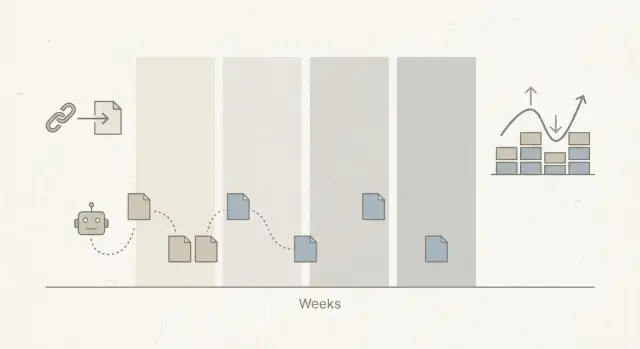
Why backlink results rarely show up right away
People often expect rankings to move in a few days because paid ads work that way. You flip a switch, traffic appears, and the dashboard updates fast. SEO is slower. Google has to find the change, process it, and then decide whether the results should reorder.
A backlink isn't a direct "rank up" button. It's one new signal among many, and it needs time to be discovered and trusted enough to matter, especially in competitive searches.
A realistic outcome usually looks like gradual movement, not miracles. You might first notice more crawling, then impressions rising, then a small shift in average position. On harder keywords, the first visible change can be minor and still be a good sign.
Forecasting the lag between a new backlink and results helps you set a time range before you spend money. When expectations are clear, you're less likely to panic on day 10, overbuy too early, switch targets midstream, or label a good placement as a failure just because it hasn't had time to work.
A healthy early timeline often looks like this:
- Week 1-2: crawling and indexing catch up, tracking shows tiny shifts
- Weeks 3-6: impressions and average position begin to move (faster on easier terms)
- Weeks 6-12: clearer ranking changes, stronger effects on more competitive keywords
Sometimes the right move is to hold off on links. Pause if the page doesn't match search intent, the content is thin, the page isn't indexable, or you can't measure outcomes (no Search Console access and no baseline rank tracking). Also pause if the target keyword keeps changing week to week. Without a stable target, you can't tell what's working.
If you're using a service like SEOBoosty to secure high-authority placements, the timing conversation matters even more. The placement can be excellent, but the page still needs time and basic readiness for the impact to show.
The basics of the impact lag: discovery to re-ranking
A new backlink doesn't change rankings the moment it goes live. Search engines have to notice it, recrawl pages, process the new information, and then update results. That gap is the impact lag.
It helps to think of it as a chain. If any part is slow, the outcome is delayed.
The four steps that create the lag
Most timelines follow the same order:
- Discovery: the linking page has to be found (often when Google crawls that site).
- Crawling: Google needs to recrawl the linking page to see the link, and crawl your target page so the signal can be applied.
- Indexing: the data has to be processed and stored. Indexing issues stretch this step.
- Re-ranking: rankings update after recalculation, usually in batches rather than instantly.
Example: you place a backlink on a well-known tech blog. The link may be discovered quickly, but if your target page is rarely crawled or has weak content, Google might not revisit and reassess it soon. The ranking change can lag even if the link is strong.
Why early progress can be hard to see
Even when a link is counted, the results can be noisy. Competitors publish new pages, earn links, change titles, or improve their content. Algorithm testing can also move results around. That volatility can hide early progress, so it helps to watch more than a single exact position.
If you track impressions, average position, and a small set of close keyword variants, you often see hints of movement before the main keyword visibly climbs.
Inputs that shape time to impact
A good forecast isn't about predicting one exact day. It's about knowing what tends to slow Google down (or speed it up) for your specific page.
1) Competition signals (keyword difficulty)
Keyword difficulty isn't a stopwatch. It's a proxy for how strong the current top results are, and how much proof Google needs before it reorders them. If the top pages have years of links, strong brands, and tight content, a new link may need more time, and sometimes additional support, before the change is visible.
2) Crawl and re-crawl behavior (crawl frequency)
Google has to find the link, then revisit your page. Pages that get crawled often (popular sites, frequently updated sections, pages with strong internal linking) tend to show changes sooner. Pages that are rarely crawled can feel stuck, even when the work is solid.
3) Page age and trust (page age)
New pages can move quickly once discovered, but they can also bounce around while Google tests where they belong. Older pages usually move more steadily, but they may need stronger signals to break out of a stable ranking pattern.
Starting position matters, too. If you're already on page one, small link changes can show up as quick shifts. If you're buried past page five, it can take longer just to enter a range where movement is noticeable.
Before you buy, capture a simple snapshot: current rank and volatility, the strength and relevance of the pages above you, how often Google seems to revisit your page, whether the page matches intent, and whether internal links make it easy to reach. Also note link context: relevance, placement location, and surrounding text. That context is often underestimated. A relevant editorial placement in a visible area can be picked up and valued sooner than a weak, off-topic mention.
Turning keyword difficulty into a timeline range
Keyword difficulty is useful, but only if you treat it as a risk signal, not a promise. A difficulty score won't tell you exactly when you'll rank. It tells you how crowded the results are and how hard it is to push other pages down.
Pick one SEO tool and stick with it. Different tools score difficulty differently, and mixing numbers ruins your baseline.
A simple translation (assuming the page is indexed and matches the keyword intent well):
- Low difficulty: about 2-6 weeks to see movement, often 3-10 positions
- Medium difficulty: about 6-12 weeks, often 2-6 positions
- High difficulty: about 3-6+ months, often 0-3 positions unless you add more support
These are ranges, not targets. Low difficulty isn't fast if your page is thin or rarely crawled. High difficulty isn't impossible, but the timeline is longer and outcomes are less predictable.
For harder keywords, one strong backlink to one page often isn't enough. Supporting content can help: a small cluster that answers related questions, links internally to the main page, and shows topical depth. If you're trying to rank a "best payroll software" guide, supporting pages could cover pricing, setup steps, and comparisons, all pointing back to the main guide.
Estimating crawl frequency with simple signals
Crawl frequency is the quiet variable that can make or break your timeline. Even a great link can't help much if Google doesn't revisit the page.
Signals you can check quickly
You don't need perfect data. You need a reasonable estimate you can explain.
Look at what you already have: recent cache or freshness signals, Search Console crawl patterns, and (if available) server logs for Googlebot hits on the exact URL. Also use common sense about site structure: pages linked from the homepage or top navigation usually get crawled more often. If recent edits show up in search quickly, crawl frequency is likely higher.
Internal links are the simplest lever you control. If your target page is buried, add a few relevant internal links from pages Google already visits often.
Pages that change often also get revisited more often. A pricing page updated monthly, an inventory page that changes daily, or a blog post refreshed quarterly tends to earn more frequent crawls than a set-and-forget page.
A simple low-medium-high crawl rating
Classify the page before you buy links, then use it in your forecast:
- High: crawled at least weekly
- Medium: crawled every 2 to 6 weeks
- Low: crawled less than every 6 weeks
If your page is "low," a premium placement can still be worthwhile, but plan for a longer wait unless you also improve internal linking and update the page to encourage recrawling.
How page age and page readiness change the lag
A backlink can only help after Google can crawl the page, understand it, and decide it deserves a different spot. Page age and page readiness affect each step.
New pages often take longer to settle. They can bounce around while Google tests user response, and they may not get crawled often yet. If the page is thin, off-topic, or missing key signals, a strong link may get discovered quickly but still not move rankings because the page isn't ready to win.
Older pages often respond faster when they already get steady crawls and have a clear history. If Google visits regularly and the topic is stable, new link signals can be processed sooner.
Before you forecast anything, check the basics:
- Does the title and snippet match what the searcher wants?
- Is the content genuinely helpful (not a placeholder)?
- Can users and crawlers reach it easily through internal links?
- Does it match the intent of the top results?
- Is it indexable and crawlable?
Indexability is the hard stop. If a page is blocked (noindex, access restrictions, or technical issues), don't forecast backlink impact at all. The link has nowhere meaningful to land.
If you're buying high-authority placements through a provider like SEOBoosty, think of the link and the page as one system. SEOBoosty can help with access to authoritative referring domains, but crawl timing and on-page readiness still decide when you see the effect.
Step by step: build a time-to-impact forecast before you buy
Forecasting is mostly about writing down what you already know, then adding a buffer for what you can't control (crawling, indexing, and re-ranking).
Use a simple worksheet with one row per (page, keyword):
- Choose a small keyword set and record today's baseline: current rank, the ranking URL, and a quick note on intent.
- Tag each target page with two labels: page age (new, established, old) and crawl bucket (high, medium, low).
- Assign each keyword a difficulty bucket (low, medium, high) and attach a time range you will reuse.
- Add three scenarios: best case, expected case, worst case.
- Decide what you will check weekly so you don't overreact to noise: rankings, impressions, and clicks to the page.
Tie ranges to decisions. For example, if a keyword is high difficulty, don't promise visible change in a few weeks even with great links. And if you're buying placements from a curated inventory like SEOBoosty, keep the structure of the forecast the same. Only adjust inputs you can justify, such as the authority and relevance of the referring domain.
Example forecast for one page and one keyword
Imagine you have a service page for "IT compliance consulting" and want to move it up for a medium difficulty keyword. You're considering one strong backlink and want a realistic window before spending.
Assumptions:
- Current ranking: positions 18-30
- Page age: 9 months, indexed, already getting some impressions
- Crawl frequency: weekly-ish
- Link quality: one relevant, high-authority editorial placement
Separate early signals from real movement:
- Weeks 1-2: discovery and indexing signals. The source page may get indexed, impressions may tick up, and crawling may increase. Rankings usually look noisy.
- Weeks 3-4: first re-evaluation window. If the page is ready, you might see a small jump (around 2-5 positions).
- Weeks 5-7: stronger movement becomes possible, like moving from the 20s into the mid-teens if competition stays steady.
- Weeks 8-10: the real test. If you can't break past a stubborn range (often 11-15), you may need more support or better page alignment.
- Weeks 11-14: stabilization. Rankings either hold gains, climb slowly, or slide if competitors improve.
If the page is brand new, extend the whole timeline by 2-6 weeks. If it's rarely crawled (monthly or less), extend by 4-8 weeks, or plan a small internal update and better internal linking before judging results.
Common mistakes that make forecasts look wrong
Most "wrong" forecasts aren't truly wrong. Inputs changed, the page wasn't ready, or tracking hid the effect.
A common issue is assuming a backlink can help before the target page is in good shape. If the page is blocked, slow, thin, or mismatched to intent, Google can discover the link and still hold back on re-ranking.
Another issue is messy attribution. If you change titles, rewrite content, update internal links, and add multiple backlinks in the same week, you might still win, but you won't know what caused the lift.
Mistakes that most often distort timelines:
- Treating a range like a deadline, then calling it a miss when movement lands later
- Tracking only one exact keyword instead of a small set of close variants
- Forgetting the linking page has its own crawl rhythm
- Checking rankings daily and reacting to normal noise
- Pointing links to a page with weak relevance or unclear query match
If you're using a service like SEOBoosty, placements can be secured quickly, but results still depend on crawl timing, indexing, and page readiness. Lock the page down for a few weeks and measure a small group of related queries for a cleaner read.
Quick checklist for setting expectations
Forecasting works best when everyone agrees on what progress looks like and when you expect to see it.
Before you start: lock the basics
- Record baseline data (rank, impressions, clicks, average position).
- Confirm the page can be indexed, matches intent, and has a clear main topic.
- Add a few relevant internal links so crawlers and users can reach it easily.
- Choose a keyword difficulty bucket and write down why.
- Choose a crawl frequency bucket based on the signals you can see.
Then agree on measurement. For many teams, a 2-4 week trend tells the truth better than daily movement.
Set a timeline everyone can repeat
Use three ranges so nobody fixates on one date:
- Best case: fast discovery and re-ranking
- Expected case: normal crawl and steady movement
- Worst case: slow crawl, tougher competition, or no visible change
Decide what happens if there's no clear change by the worst-case date. Typical next actions are re-checking indexability, improving on-page alignment, strengthening internal links, or adjusting the keyword target.
If you're buying placements (including subscriptions to pre-arranged editorial placements, like those SEOBoosty focuses on), document the launch date for each link so the timeline is tied to real events.
Next steps: use the forecast to choose links with less guesswork
A forecast matters only if it changes what you do next. Treat it as planning: which pages to test first, which keywords to pursue now, and what "on track" looks like before rankings move.
Start small and keep the test clean. Pick 3 to 5 pages and a small set of keywords where you can measure change without major redesigns or rewrites during the window. If your "4 to 10 weeks" range keeps turning into "16 weeks," your crawl assumptions were too optimistic, or the page wasn't ready.
Choosing links for your timeline
Match link buys to the timeline you can live with:
- Need faster impact: prioritize pages that are crawled often and already rank on page 2 or 3
- Need bigger lifts: accept longer timelines and wider outcome ranges
- Limited budget: focus on one page closest to re-ranking instead of spreading links thin
- Stakeholder deadline: pick lower-difficulty keywords and pages with strong basics
If outreach delays are your bottleneck, curated placements can make the buying step more predictable. SEOBoosty, for example, is built around subscribing to placements from a curated inventory rather than waiting on back-and-forth negotiations.
How to judge progress early
Report two types of results: leading indicators and final outcomes.
Leading indicators include the linking page being indexed, increased crawling, rising impressions, and small rank movement. Final outcomes are stable ranking lift, more clicks, and measurable conversions.
When you present your forecast, show the range, the earliest signs you expect, and the decision point (for example: "If impressions don't rise by week 6, we reassess crawl frequency and page readiness").
FAQ
How long does it usually take for a new backlink to affect rankings?
Most backlinks need time because search engines must first find the linking page, recrawl it to see the link, process that information, and then refresh rankings. Even if the link is live, your target page may not be revisited and re-evaluated right away.
What should I watch for before rankings visibly move?
Look for leading indicators first: the linking page getting indexed, more crawling activity on your target URL, and impressions rising in Search Console. Small movement in average position across a few close keyword variants can be a better early sign than one exact keyword jumping.
Why do rankings look volatile even after I build a good link?
Search results are noisy because competitors publish new content, gain links, and adjust pages while algorithms also test changes. That background movement can hide your early gains, so you need to judge trends over weeks, not daily snapshots.
How does crawl frequency change the backlink timeline?
Crawl frequency controls how quickly search engines revisit both the linking page and your target page. If your target page is crawled rarely, a strong link can be “real” but still take longer to show impact because the system hasn’t refreshed its view of your page yet.
When should I hold off on buying backlinks?
If the page can’t be indexed or doesn’t match search intent, pause, because link equity won’t translate into better rankings. Also pause when your tracking is missing basics, like Search Console access or a baseline rank snapshot, because you won’t be able to judge progress cleanly.
How should keyword difficulty change my expectations for timing?
Higher difficulty usually means the top results have stronger history, brands, and link profiles, so a single new signal tends to shift the order more slowly. A practical expectation is a longer window and smaller early moves, even if the placement is high quality.
Does my current ranking position affect how fast I’ll see results?
A page that’s already near page one can show smaller shifts faster because it’s already in a competitive range where re-ranking is visible. If you’re far back, it can take longer just to reach positions where improvements are noticeable, even when the link is helping.
Do new pages respond to backlinks faster or slower than older pages?
New pages can jump around because they’re still being tested and may not be crawled consistently yet, while older pages can move more steadily if they’re visited regularly and have clear topical history. Either way, the page still needs to be indexable and aligned with the query for a backlink to matter.
What’s a simple way to forecast time-to-impact before I buy a link?
Start by writing down your baseline rank, impressions, and the exact page you’re targeting, then bucket the keyword difficulty, crawl frequency, and page age. Turn those inputs into best-case, expected, and worst-case ranges so you have a decision point for when to reassess rather than panic early.
If I use SEOBoosty, will I see results faster?
SEOBoosty can make the placement step predictable by letting you subscribe to high-authority domains from a curated inventory instead of waiting on outreach. The impact timeline still depends on your page’s readiness, crawl timing, indexing, and whether the page truly deserves to rank higher for the intent.
Share