Backlink placement types: in-content, sidebar, bio, resources
Learn backlink placement types (in-content, sidebar, author bio, resource pages) and compare SEO impact, risk, and best uses for each.
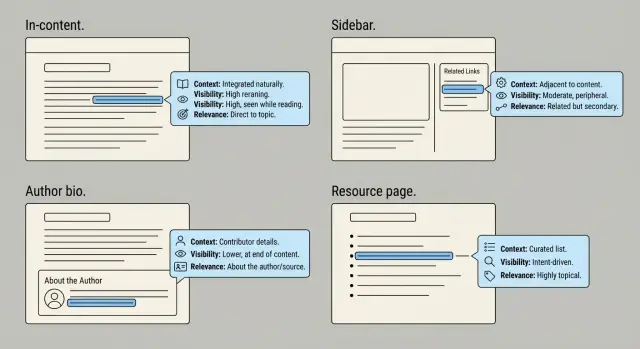
What backlink placement means (and why it matters)
Backlink placement is where your link sits on another website's page. The same site can pass very different value depending on whether your link appears inside the main article, in a sidebar, in an author bio, or on a resource page.
Placement matters because search engines and readers don't treat every part of a page the same. A link surrounded by relevant text usually sends a clearer signal about what your page is about than a link tucked into a repeating template area. It also changes how people behave. Readers are far more likely to click a link that feels like a natural next step than one that looks like a random add-on.
It affects trust, too. Links that read as editorial (part of the content) often feel more credible than links that look like a widget or a paid block. Widget-style links aren't automatically bad, but you want the placement to match your goal.
This guide covers four common backlink placement types: in-content links, sidebar links, author bio links, and resource page links.
No placement wins every time. In-content links are usually best when you need strong topical relevance. Sidebars can provide steady visibility. Bio links can support credibility and brand recognition. Resource pages can work well when you want a clear "this belongs in this category" signal.
In-content backlinks: usually the strongest context
An in-content backlink sits inside the main text of an article, right where the topic is being discussed. Ideally, it appears in a sentence that already mentions the problem, tool, or idea your page covers.
This placement tends to work well because search engines can read the surrounding words and understand what the link is about. When the mention fits naturally, in-content links are often the most reliable option for SEO.
They shine when you need topical support, not just eyeballs. Think cornerstone guides, key landing pages, or product pages that match clear intent (like "pricing," "comparison," or "how to").
The main risk is forcing it. A link shoved into an unrelated paragraph can look paid or manipulative. The same goes for repeating the same keyword-heavy anchor across multiple placements, or writing a sentence that reads like an ad.
Before you agree to an in-content placement, get clarity on a few specifics: where the link will appear (the full sentence, not just the anchor), whether the surrounding paragraph is actually about your topic, and whether the anchor will be natural (brand, product name, or a descriptive phrase). Also watch for paragraphs packed with multiple outgoing links.
Example: if you sell an email warmup tool, a strong in-content link belongs in a section about deliverability, with a sentence that explains when warmup matters. A weak one is dropped into a generic "marketing tools" paragraph with no real connection.
Sidebar links: high exposure, often lower context
A sidebar link appears in a block next to the main content. It might be labeled "Partners," "Recommended tools," or a banner-like module that shows across many pages.
The upside is exposure. The downside is context. Search engines often treat sidebar links as less descriptive than links placed inside a relevant paragraph, because they usually don't have specific surrounding text. In practice, sidebar placements often trade relevance for reach.
Where sidebar links can work well
Sidebar links make the most sense when they function like navigation or attribution, not an editorial recommendation. Common examples include sponsors, local partners, associations, and references readers may want to find again.
Example: a regional web design agency sponsors a local tech meetup, and the meetup site lists the agency in a "Sponsors" sidebar across event pages. That can be a natural placement because it matches the site's purpose.
Risks to watch (and quick checks)
Sidebar placements can create a noticeable footprint because the same link repeats across many pages. Repetition isn't always harmful, but it can look unnatural when the sidebar is unrelated, crowded, or clearly designed to sell links.
Before committing, do a fast quality check:
- Topic fit: does the sidebar block match the site and the section where it appears?
- Link clutter: is the block already packed with external links?
- Intent: does it read like "Partners/Resources," or like a paid link box?
- Scope: is it sitewide, or limited to a relevant category?
- User value: would a real reader click it for a useful reason?
Avoid sidebars that look like a random list (casino, pills, unrelated SEO tools) or sites that obviously sell widget links at scale.
Author bio links: good for brand and trust signals
An author bio link appears near the byline, author box, or author profile. It often points to the author's website, a company homepage, or a "work with me" page.
Compared to other backlink placement types, bio links are usually more about credibility than topical relevance. Search engines can still crawl and count them, but the surrounding text is short and often repeated, so SEO impact varies by site.
When bio links shine
Bio links fit well when you're building trust, not only rankings. They're especially useful for founders, consultants, agencies, and anyone growing a personal brand alongside a business.
They also help in situations where readers naturally check "who wrote this?" before deciding whether to contact you or remember your name.
Example: a startup founder writes a guest post about hiring engineers. A bio link to the founder's company makes sense, even if the article isn't selling anything.
Risks and quality signals to check
Bio links look spammy when they feel mass-produced. Common red flags include boilerplate bios pasted everywhere, authors with no real profile or history on the site, bio links pointing to unrelated pages, and over-optimized anchors like "best cheap CRM software" inside the bio.
Better signs include an author page that looks real, multiple articles on related topics, and a bio that matches the content.
For anchor text, keep it branded or plain: your name, your company name, or something simple like "Website." That reads clean and avoids unnecessary risk.
Resource page backlinks: curated lists with clear intent
A resource page backlink is placed on a page built to collect helpful references. It might be titled "Resources," "Recommended tools," "Further reading," or "Helpful links," and it usually groups items by category.
The upside is clarity. The page exists to cite sources, so your link has an obvious reason to be there. If the page is well-maintained and tightly focused, the surrounding context can be strong and the placement can feel very natural.
Resource pages work best when you're offering something people genuinely reference: a tool, a practical guide, original research, a definition page, or a community hub. They can also send real referral traffic because readers arrive ready to click.
A quick gut-check for quality:
- The list feels curated (not endless).
- The topic stays tight (one niche, not "everything we like").
- The page shows signs of maintenance (recent updates, removed dead links).
- Nearby links look legitimate and relevant.
The risks are mostly quality-related. Some resource pages are abandoned, stuffed with broken links, or expanded into link farms. Others are basically paid directories with little editorial judgment, which can dilute value.
Before committing, confirm where you'll be placed (which category) and scan the links nearest yours. If you're a "Beginner's guide to payroll compliance," you should sit next to compliance references, not unrelated coupons or generic lists.
SEO impact and risk: a practical comparison
When people compare backlink placement types, they often start with authority. A better order is relevance first (does the page and surrounding text match your topic?), then visibility (will real readers notice it?), then authority (how strong is the site and page?).
| Placement | Context strength (SEO) | Click likelihood | Risk (if overused) | Longevity |
|---|---|---|---|---|
| In-content | Highest. The link sits inside related text, so search engines understand why it's there. | Medium. Readers click when it supports a point. | Medium. Risk rises if anchors look forced or every post links out the same way. | Medium. Edits happen, but good articles often stay stable. |
| Resource page | High. Clear intent (a list of tools or references) can be very relevant. | Low to medium. People browse, but many treat it like a directory. | Low to medium. Safer when the page is curated, risky when it's a "links for everyone" dump. | High. These pages change less often. |
| Author bio | Low to medium. Limited topical context, but strong for brand and identity. | Low. Many readers skip bios. | Low. Usually looks natural if it's consistent with the author profile. | Medium. Bio templates change during redesigns. |
| Sidebar | Low. Same link repeated across many pages, with little topical support. | Medium. High visibility, but easy to ignore. | High. Sitewide patterns can look paid or manipulative. | Low to medium. Sidebars are often redesigned or removed on mobile. |
A simple way to spot risk is to look for patterns that feel mechanical: identical exact-match anchors across many sites, sitewide sidebars that exist mainly to sell links, resource pages with hundreds of unrelated listings, or bios that don't match the author's role.
If you're buying placements through any channel, prioritize what makes sense to a human reader first. When the link helps the article or the reader's decision, SEO benefits usually follow.
How to choose the right placement (step by step)
Choosing among backlink placement types gets easier when you start with one clear goal. Different placements behave differently, even on the same site.
A simple step-by-step process
- Name the goal in one sentence. Examples: "Rank this product page," "Build trust for my brand," "Bring referral traffic," or "Make my link profile look more natural."
- Pick the right target page. Use a specific landing page when you want rankings or conversions. Use the homepage when the goal is brand discovery and credibility, or when your site is new and you don't have many strong pages yet.
- Match placement to the goal. In-content usually supports rankings because the link sits inside a relevant paragraph. Bio and resource placements are often better for brand and consistency. Sidebars can increase visibility but are usually weaker for relevance.
- Choose an anchor style that fits your risk level. Branded anchors and plain URLs are safer. Partial-match anchors can help, but keep them limited and natural. Avoid repeating the same keyword-heavy anchor across many links.
- Sanity-check topic fit before you commit. Read the surrounding text and ask: would a real reader click this and feel it makes sense?
After you decide, plan how you will mix placements over time. Relying on one format only (all in-content, or all bio links) can look unnatural and leaves you exposed if that type stops working.
Quick mapping (use it as a starting point)
- Want rankings for a specific page: prioritize in-content links on tightly related articles.
- Want brand trust and identity signals: lean on author bio links and a few resource page mentions.
- Want diversification: combine in-content with a smaller share of resource and bio links.
- Want some referral traffic: choose placements where readers are already looking for options (often in-content or resource pages).
Example: if you're promoting a "CRM for freelancers" page, one in-content link from a business tools article can build relevance, while a branded bio link elsewhere helps keep your profile balanced.
Common mistakes that reduce value or raise risk
Most backlink problems aren't about the idea of a link. They're about how the link looks and behaves on the page. Search engines and people notice patterns fast, especially when the same approach repeats across many sites.
A useful rule: when you mix placement types and keep everything relevant, your links look more natural and tend to hold value longer.
Mistakes that show a pattern (or waste the context)
These issues turn decent placements into weak ones, or risky ones:
- Building only one placement style at scale (for example, all sidebar links or all author bios).
- Repeating exact-match anchors everywhere, especially in bios and sidebars.
- Chasing strong domains while ignoring topic match.
- Treating in-content links as "set and forget" without checking the surrounding text.
- Picking resource pages that are basically link dumps.
Mistakes that shorten a link's lifespan
Stability matters as much as authority. Sidebars change, templates get redesigned, and old articles get refreshed.
Before you commit, ask: will this link still be here in 6-12 months? If the placement depends on a rotating widget, a temporary slot, or a page that gets cleaned up often, your results can vanish.
Example: a SaaS brand buys 20 author bio links with the same exact anchor like "best project management software." A month later, several sites update author pages, remove external links, or switch templates, and the remaining bios look overly optimized. A smaller mix (a few in-content mentions with natural anchors, plus a couple of high-quality resource pages) usually holds up better.
Quick checklist before you commit to a placement
Before you pick one of these backlink placement types, do a quick gut-check. A link can look fine in isolation and still be a bad fit for your page, your anchors, or your long-term plan.
- Match the topic, not just the domain. The page linking to you should be closely related to the page you're promoting.
- Make sure it reads naturally on the page. Avoid links that look stuffed, repeated, or hidden in a strange block.
- Check the outbound link area. If there's a links section, it should feel small and curated.
- Keep anchor text safe for your current profile. If you already have many exact-match anchors, add variety. If you're newer, avoid starting with aggressive money keywords.
- Think about page stability. A maintained page is usually worth more than a short-lived post that gets pruned.
Also: balance your mix over time. Don't put all your bets on one placement style.
Example: if you're promoting a pricing page, a tightly related in-content mention can work well. Later, you might add a resource page link for steady, evergreen intent.
Example scenarios: picking placements for real goals
Choosing among backlink placement types gets easier when you start with one question: what page are you trying to help, and what would a real reader click?
A placement that's perfect for a detailed guide can be a poor fit for a homepage, and vice versa.
-
Scenario 1: A new SaaS site needs early trust. Start with a mix of author bio links and a few in-content backlinks. Bio links can help your brand look legitimate early on, especially when they point to your homepage or About page. Then add a small number of in-content links pointing to one core page, where the surrounding text can explain what you do.
-
Scenario 2: A mature blog wants one guide to rank. Put most effort into in-content backlinks to the exact guide you want to rank, plus one resource page backlink where it fits as a citation. In-content works because the topic match is obvious. A resource page mention can help because readers on those pages are already browsing options.
-
Scenario 3: A local service business wants more brand searches. Use author bio links to build name recognition, and add selective sidebar links only when the site is clearly relevant to your city or niche. Sidebar links can increase exposure, but usually carry less topic context, so aim them at your homepage or a simple Services page.
Next steps: build a balanced placement mix
Start small, measure, then scale. Pick a mix that matches your goals (rankings, traffic, brand), not just what's easiest to get.
Track three signals: search impressions, rankings for the pages you care about, and referral clicks. Give changes time to settle. A few weeks is often the minimum to see a clear trend.
Keep a simple log so you can audit later: placement type, target page, anchor text, the source page and date, and notes on results.
If outreach is your main bottleneck, services like SEOBoosty (seoboosty.com) are built around a curated inventory approach: you select authoritative domains, subscribe, and point the backlink to the page you want without the usual back-and-forth.
A simple 3-month cadence
Aim for consistency and variety, not volume spikes.
- Month 1: Add a small mix (for example, one in-content plus one resource or bio). Track baseline impressions and rankings.
- Month 2: Repeat what showed early promise, and add one different placement type to diversify.
- Month 3: Strengthen your best-performing target page with one more contextual link, and support it with a second placement that brings visibility (resource or sidebar, depending on fit).
Keep the mix natural: different pages, different anchors, and different placement types over time. That's how you build momentum without taking on unnecessary risk.
FAQ
What exactly does “backlink placement” mean?
Backlink placement is the specific spot where your link appears on another page, such as inside the main article text, in a sidebar block, in an author bio, or on a dedicated resources page. That location affects how much context surrounds the link, how credible it looks to readers, and how likely someone is to click it.
Are in-content backlinks always the best choice for SEO?
In-content links usually perform best for SEO because the link sits inside relevant sentences and paragraphs that explain the topic. That surrounding text helps search engines understand what your page is about and makes the link feel like a natural reference instead of a random add-on.
What’s the real value of a sidebar backlink?
A sidebar link is placed in a template area next to the main content and can show across many pages. It can bring visibility because it repeats, but it often has weaker topical context, so it’s typically less effective for ranking a specific page than a well-matched in-content mention.
When does a sidebar backlink make sense to get?
Use a sidebar link when it genuinely behaves like sponsorship, partnership, navigation, or attribution on a relevant site. It’s usually a better fit for brand visibility than for pushing one keyword-focused page, and it should make sense to a human visitor at a glance.
What is an author bio backlink, and what is it good for?
An author bio link is the link in the byline area or author box that points to the author’s site or company. It’s commonly more helpful for brand credibility and recognition than for strong topical relevance, since the bio text is short and often repeated across multiple posts.
What anchor text should I use for an author bio link?
Keep bio anchors simple and natural, like your name, your brand, or a plain “website”-style reference. Over-optimized keyword anchors in bios can look spammy quickly because the same template repeats and stands out as intentional SEO manipulation.
What is a resource page backlink, and why can it work?
A resource page link lives on a page that exists to list helpful tools, references, or further reading in categories. It can be valuable when the page is curated and closely aligned with your niche, because the intent of the page is to recommend resources, so the link feels justified.
How can I tell if a resource page is high quality?
A good resource page looks maintained and selective, with a focused topic and a reasonable number of relevant entries. If it looks abandoned, stuffed with unrelated categories, or packed with low-quality outgoing links, the placement is more likely to be diluted or risky.
How do I choose the right placement for rankings vs. brand vs. traffic?
Choose based on your goal first, then match the placement to it: in-content for ranking a specific page, bio for credibility and name recognition, and resource pages for “this belongs in this category” intent and evergreen references. Sidebars are best used sparingly and only when the site and section are clearly relevant.
What mistakes make backlink placements risky or less effective?
The most common mistakes are forcing in-content mentions into unrelated paragraphs, repeating the same keyword-heavy anchor everywhere, and relying on one placement type at scale. A balanced mix with natural wording and strong topic fit usually holds up better and looks more believable to both readers and search engines.
Share