Backlink pricing explained: what you are really paying for
Backlink pricing can vary wildly. Learn how authority, traffic, editorial rules, and placement type change cost so you can compare offers confidently.
What backlink pricing actually means
Backlink pricing isn't a simple "pay X, get Y rankings" deal. It's closer to paying for the right to be mentioned on a site that already has trust, rules, and something to lose. That's why two links that look similar on the surface can cost $10 in one place and $1,000+ in another.
What many buyers assume is missing from a lot of offers. People often think the price reflects one number (like Domain Authority) or a promise of traffic. In reality, the price usually bundles a few less-visible costs: access to the site, the work needed to meet its editorial bar, and the risk the publisher takes by linking out.
The core idea is simple: you're paying for access and lower risk.
Access means getting a real placement on a real site without months of outreach or a personal relationship. Lower risk means avoiding spammy networks, fake metrics, link removals, or placements that never go live. You're also paying for lower friction: fewer back-and-forth emails, revisions, and negotiations.
Here’s a concrete example. A cheap offer might place your link on a page created mainly to host links, with little oversight and a high chance it gets deleted later. A higher-priced offer might require stricter review, place your link inside a legitimate article, and keep it on a stable site where the publisher protects their reputation.
Pricing alone can’t guarantee results. A pricey link can still be a poor fit if it’s irrelevant, buried, or placed in a low-visibility section of the page. And a cheaper link can still be useful if it’s relevant, clean, and stable.
Treat price as a clue about what’s included, then verify the details before you pay.
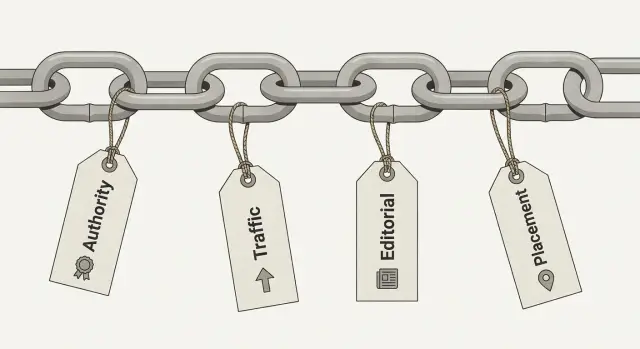
The four drivers behind most backlink prices
Backlink pricing isn’t a random number. Most offers are built from a few predictable inputs. Once you know them, you can compare two deals without guessing and spot when something feels off.
1) Authority and trust of the site
This is the reputation cost. A link from a well-known, tightly managed site is harder to get and riskier for the publisher to sell, so it costs more.
Authority metrics can be useful as a quick filter, but they’re not proof of quality by themselves. A high score paired with thin content, sloppy site structure, or suspicious outbound links should make you cautious.
2) Real readers and topic fit
A link is worth more when it sits in front of the right people. That usually means the site gets real traffic and the page topic matches your business.
A cybersecurity tool getting a link inside a relevant security article can do more than a "bigger" site that only vaguely mentions software.
3) Editorial standards and the effort to publish
Quality control raises price. If a publisher reviews claims, checks sources, edits for tone, and protects their audience, there’s more human work involved. That work is part of what you’re paying for.
If the process looks instant, with no review and no rules, expect quality to be inconsistent.
4) Placement type and how long it lasts
A contextual link inside an existing article (often called a niche edit) is priced differently than a new guest post. And homepage/sidebar style placements are a different category again.
Duration matters too. One-time, permanent, and subscription-based placements change the value. Extras like who writes the content, whether images are needed, how many approvals you get, and how strict the publisher is about link limits can all move the price.
Authority: what you are paying for (and what you are not)
A big slice of backlink pricing is authority. That usually means the general strength of the site linking to you, and the chance that search engines will treat that site as trustworthy.
Most sellers point to third-party scores like DA (Domain Authority) or DR (Domain Rating). These are useful for quick comparisons, but they are not Google metrics. They can miss things that matter more, like whether the site has real editorial control, whether its pages rank, and whether the link will sit in a context that makes sense.
A high-authority site can still be a bad link for you. A top-tier tech blog might have strong metrics, but if your business is local home services, the audience and context may be a mismatch. The link might look random, get ignored by readers, and be less likely to drive meaningful traffic.
Authority is also not a promise of results. You’re not buying rankings. You’re paying for a higher likelihood that the link is respected, indexed, and durable.
Trust signals worth checking beyond DA/DR include the site’s brand history (a consistent identity over time), clean content that reads edited (not spun or keyword-stuffed), real search visibility (pages that rank for relevant terms), and reasonable outbound linking.
Outbound links matter because they can dilute attention and trust. A page with 5 to 10 relevant references usually looks natural. A page with 50 outbound links, especially to unrelated niches, can signal link selling and reduce the value.
Paying more for authority can make sense when you’re building credibility in a competitive space, launching a new domain that needs trust quickly, or trying to close the gap with stronger competitors.
Traffic and audience fit: the part many offers skip
A lot of backlink pricing talks about authority scores but skips the simple question: does this site reach people who could actually care about your topic? A link on a site with the wrong audience can look impressive on paper and still do almost nothing for your business.
You can sanity-check traffic claims without fancy tools by looking for basic consistency. Does the site publish regularly? Do articles show real signs of life, like credible author bylines, consistent topics, and current writing (not a pile of thin posts from years ago)? None of this proves traffic, but it quickly exposes many inflated claims.
Topical relevance often beats raw numbers. A smaller site focused tightly on your niche can send better signals than a bigger general site where your link sits in unrelated content. Think of it like placing a flyer: 500 random people in a mall isn’t always better than 50 people already browsing the exact shelf.
Signs the audience is real and relevant are usually visible in the content. Articles are specific (not generic filler), headlines match search intent (how-to, comparisons, problem-solving), outbound links make sense in context, and the site has a clear editorial identity with consistent tone and categories.
Audience intent matters because these are the readers who might click and convert. A low-traffic site can still be worth paying for if it’s tightly aligned with what you sell, ranks for niche terms, or reaches decision-makers. In those cases, you’re paying to be shown in the right room, not just buying a link.
Editorial standards: why quality control affects price
"Editorial review" can mean very different things.
On one site, it’s a real editor checking claims, tone, and whether the link makes sense. On another, it’s a form that accepts anything as long as you pay.
The stricter the rules, the higher the cost, because you’re paying for time, reputation, and risk control. Publications that protect their brand usually limit topics, reject salesy writing, and care about where outbound links point. They also tend to be picky about anchors and may require sources or real author details.
Common standards that change pricing include topic limits (not "write about anything"), external link rules (few links allowed, or only to high-quality sites), link policy (follow vs nofollow, and whether it’s negotiable), content checks (originality, factual review, anti-spam screening), and how revisions are handled.
Stricter publications cost more because they turn down more submissions. That rejection rate is part of what keeps their pages trusted, which is also why links from them tend to hold up longer.
By contrast, pay-to-publish pages with no oversight are cheaper, but you take on hidden risks: your link may sit next to low-quality content, the page may get deindexed, or the site may later sell the same page to dozens of buyers.
Response time is a clue. A fast "approved in 10 minutes" can signal no review. A slower timeline with clear feedback and one or two revision requests often signals real quality control.
Example: you submit a short SaaS article. Site A accepts it instantly with five outgoing links allowed. Site B takes three days, asks you to remove two promotional sentences, and limits you to one relevant link. Site B usually costs more, but you’re paying for standards that protect the placement.
Link placement types: guest post, niche edit, and other options
Placement type is a big part of backlink pricing because it affects how much work goes into publishing, how natural the link looks, and how likely it is to stay live.
Guest post (new article)
A guest post usually includes writing, editing, and publishing a brand-new page. You’re often paying for content creation, an editor’s time, and a fresh URL.
The upside is control: you can shape the topic, add context around your link, and sometimes earn more than one relevant mention. The downside is that low-end sellers cut corners with thin articles or off-topic posts that don’t match the site’s usual style.
Niche edit (link insertion)
A niche edit adds your link to an existing article. This can be a good fit when the page already ranks, already gets readers, and your link genuinely helps that article.
It’s not a fit when someone inserts links into random old posts, forces awkward anchor text, or uses pages that were never meant to be updated. In those cases, the edit can look suspicious and may disappear when the site refreshes content.
Other common placement types are worth treating carefully. Homepage, sidebar, or footer links are often rented, easy to remove, and sometimes applied sitewide (which can create unwanted patterns). Resource pages and listicles can be solid if they’re actively maintained and not stuffed with unrelated entries. Sponsored mentions inside a real editorial article are typically pricier, but can blend better if the site clearly labels sponsorships and still enforces standards.
Before you pay for any placement, ask a few basics in plain language:
- Is the link expected to stay live for a minimum period (for example, 12 months)?
- What happens if the page is updated, redirected, or deleted?
- Can the link move from the main body to an author bio or a partners section?
- Will you get proof of placement and the exact page where it appears?
Link attributes that change cost
Not all links are priced the same, even when they come from the same site. A big part of backlink pricing is in the fine print: how the link is tagged, how it’s written, where it sits on the page, and how long it’s expected to stay live.
A follow link usually costs more than a nofollow link because it’s more likely to pass ranking value. Nofollow can still be useful for credibility and referral clicks, but if a seller charges follow-level prices for a link tagged nofollow or sponsored, that’s a mismatch.
Anchor text affects both risk and price. Branded anchors (your brand name or URL) are the safest. Partial-match anchors can work when they read naturally. Exact-match anchors are often sold at a premium because sellers know buyers want them, but they also increase over-optimization risk.
A few attributes commonly move the price:
- Follow vs nofollow (and whether it’s marked sponsored)
- Anchor type (branded, partial match, exact match)
- How many outbound links are already on the page
- Link location (main body near the top vs lower vs author bio)
- What "permanent" really means (if anything)
Link count matters because a page packed with outbound links can dilute attention and trust. Placement location matters for the same reason: a contextual link in the main text is usually valued more than an author bio link.
Be careful with the word "permanent." In practice, it often means "as long as the page stays live and the publisher doesn’t update it." If you’re paying a premium, ask what happens if the page is edited, moved, or removed later.
Common traps and red flags when comparing offers
Backlink offers often look similar on the surface. The fastest way to avoid bad deals is to watch for patterns that suggest the site exists mainly to sell links, not to publish real content.
One big trap is the "pretty metric, empty site" setup. A domain can show decent authority metrics while having thin articles, no real readers, and a suspicious link profile. If the content feels generic and the categories are packed with near-identical posts, you’re likely paying for a number, not value.
Red flags that should make you pause:
- PBN footprints: same design across many sites, reused author bios, no real brand pages, unnatural content volume
- Unrealistic promises: instant rankings, guaranteed traffic, or "Google-proof" links
- Hidden fees: extra charges for writing, publishing, faster turnaround, or even an added cost to make the link follow
- Sponsored dumps: pages stuffed with outbound links to unrelated industries, with little context around each mention
- Vague offers: no domain preview, no example placements, no clarity on where the link will sit (homepage vs blog, new post vs existing page)
A simple test: ask for a clear preview of the domain and the exact placement type. If the seller won’t share basics until after payment, that risk is on you.
How to compare backlink offers step by step
Comparing backlinks is hard because offers mix different things: authority, traffic, editing standards, and placement type. If you treat it like simple backlink pricing, you’ll overpay for weak links or pass on links that are actually worth it.
Start by getting clear on what you want and what you’ll accept.
Write your goal in one sentence: rank one page, lift overall authority, or diversify your link profile. Define acceptable site types and topics (and what’s off-limits). Then request specifics in writing: the exact domain, placement type, whether it’s follow/nofollow, and any anchor text rules.
Now you can do a fast quality check before you compare prices.
Scan for quality signals: real authors, consistent publishing, clear topics, and a clean feel (not thin pages stuffed with random keywords). Look for risky patterns: too many unrelated outbound links, obvious paid-link pages, or content that changes topic every post.
If you want something more structured, use a simple scorecard (0-2 points each): authority fit, audience fit, editorial quality, placement type, and risk level. The winner is usually the link with the best total, not the lowest price.
Finally, buy small, then judge with patience. Do a test purchase first (even one or two links), track rankings and organic traffic for the target page, and re-check the placement after a few weeks to confirm it stayed live and unchanged.
Example: choosing between two backlink deals without guessing
Imagine you run a B2B SaaS site that sells a time-tracking app for agencies. You have budget for one link this month, and two offers look tempting. This is where backlink pricing can feel confusing unless you compare the same things.
Offer A is a very high-authority general tech site. The seller promises quick publishing and minimal edits. The article topic is broad (something like "Top productivity tools"), and your link sits in a long list.
Offer B is a smaller site focused on agency operations and workflow. Their metrics are lower, but they require a specific angle, real examples, and editor review. The link sits inside a detailed section about tracking billable hours.
To estimate likely value and risk before you pay, ask:
- Relevance: will the reader naturally care about your product in that exact paragraph?
- Placement strength: is your link in the main body with context, or buried in a list?
- Editorial control: does the site actively edit and reject low-effort posts?
- Longevity: does the page look like it will stay updated, indexed, and useful next year?
- Brand risk: would you feel comfortable showing this placement to a customer or investor?
A reasonable decision is to choose Offer B if your goal is steady rankings for agency-focused keywords and you want a link that makes sense to a human reader. Even with lower authority, strong topical fit and stricter editorial rules often mean lower removal risk and better on-page context.
Choose Offer A only if you already have decent relevance covered elsewhere and you’re paying mainly for a brand-level mention.
Quick checklist before you pay for a link
Before you compare prices, make sure you’re comparing the same thing. A cheap offer can be expensive if the page disappears, the site is weak, or the placement isn’t what you thought.
Five checks that prevent most bad buys
- The site looks real and maintained: recent posts, working navigation, consistent topics, no obvious "everything about everything" content.
- The topic matches your page: the article should make sense for your audience, not just include your link as an excuse.
- You know the placement type and link status: guest post vs niche edit (or another format), plus whether the link is follow or nofollow.
- Anchor text rules are clear: you know whether you can use a brand name, a URL, a descriptive phrase, and whether exact-match keywords are restricted.
- You understand the durability terms: what happens if the article is updated, moved, noindexed, or removed, and whether replacement is offered.
After that, decide how you’ll track results. At minimum, note the publish date and target page, then watch three simple signals over the next few weeks: search impressions, clicks, and main keyword positions. If nothing moves, it doesn’t always mean the link was bad, but it does mean you should pause before buying more of the same.
Building a simple, repeatable backlink buying process
If backlink pricing has felt random, the fix isn’t a magic metric. It’s a small process you can repeat, so each purchase teaches you something.
Split your budget into two buckets: testing and scaling. Testing is where you try a few sites and placement types to see what actually moves rankings for your pages. Scaling is where you put more money behind what already worked.
A simple workflow looks like this:
- Pick 1-2 target pages and one clear goal (rank for a term, lift a category page, or support a new product page).
- Buy a small mix of placements, not ten of the same thing.
- Keep anchors natural. Use more brand and plain URL anchors, and only a light touch of keyword anchors.
- Track results on a calendar, not just "did it work."
- After 4-8 weeks, repeat what performed and pause what didn’t.
Documentation is what turns guessing into learning. For every link you buy, record the domain, the exact page, the date placed, the placement type, the anchor used, any terms, and a quick note on outcomes (ranking change, traffic change, or no movement).
If you already know the quality level you want, using a curated inventory can save time versus negotiating placements one by one. For example, SEOBoosty (seoboosty.com) offers premium backlinks from authoritative websites, where you select from a curated inventory and subscribe, which can reduce uncertainty when you’re testing and scaling.
FAQ
Why can one backlink cost $10 and another $1,000+?
Backlink pricing is mostly paying for access to a real site and lower risk that the placement is spammy, removed, or never published. Metrics like DA/DR matter, but the price also reflects editorial effort, site reputation, and how hard it is to get a legitimate mention there.
Does paying more for a backlink guarantee better rankings?
No. A backlink is a signal, not a purchase order for rankings. A higher-priced link usually increases the chance the site is trusted and the placement is durable, but relevance, placement quality, and your on-page SEO still decide whether rankings move.
Are DA/DR scores enough to judge if a backlink is worth the price?
Use DA/DR as a quick filter, then check real-world trust signals: the site’s consistency over time, whether its pages rank, whether the content reads edited, and whether outbound links look reasonable. If the site feels like it exists mainly to host links, the metric alone isn’t enough.
Why does topical relevance sometimes beat “bigger authority” sites?
Because relevance and reader intent can outweigh size. A smaller niche site that matches your topic can send clearer signals and drive more meaningful clicks than a big general site where your link looks random or gets buried in a long list.
What does “editorial review” usually include, and why does it change pricing?
Often the “review” is either real editing and standards, or it’s just a form that accepts anything. If a publisher actually checks claims, limits outbound links, and requests revisions, that time and risk control usually raises the price and improves placement stability.
What’s the practical difference between a guest post and a niche edit?
Guest posts create a new article, so you’re often paying for writing, editing, and a fresh URL you can shape. Niche edits add your link to an existing article, which can be great when the page already ranks and your link genuinely fits the paragraph.
How do follow, nofollow, and sponsored tags affect backlink price and value?
A follow link generally costs more because it’s more likely to pass ranking value. If the link is marked nofollow or sponsored, it can still bring credibility and clicks, but it shouldn’t be priced like a clean follow placement.
What anchor text should I ask for if I want results without extra risk?
Exact-match anchors are often sold as “premium,” but they can raise over-optimization risk if overused. Default to branded or plain-URL anchors, then use partial-match anchors sparingly when they read naturally in the sentence.
What are the biggest red flags when comparing backlink offers?
Watch for unrealistic promises, vague details, and sites that look built to sell links. If the seller won’t share the domain or placement type upfront, or the page is stuffed with unrelated outbound links, the low price can hide a high removal or deindexing risk.
What’s a simple step-by-step way to compare two backlink deals?
Get specifics in writing: exact domain, placement type, link attribute (follow/nofollow), expected duration, and where on the page the link will appear. Then buy small, track changes for a few weeks, and only scale what proves stable and relevant.
Share