Backlink strategy by business model: SaaS, eCommerce, local
Learn backlink strategy by business model with practical guidance for SaaS, eCommerce, and local services: what pages to link, which sources to target, and why.
Why your business model changes your backlink plan
A backlink isn’t “just a backlink.” The same approach won’t work for a SaaS product, an online store, and a local service business because they make money in different ways.
A practical backlink strategy comes down to two choices you make every time:
- Which page gets the link (where people and search engines land)
- Which site the link comes from (the audience and context around the mention)
A “good” link is the one that helps revenue, not the one that only bumps up a metric. For SaaS, that usually means more demo requests, trials, or qualified leads. For eCommerce, it means shoppers landing on a page that can convert now. For local services, it means more calls, form fills, and bookings in a specific area.
Backlinks support growth, but they won’t save a weak page. If the landing page doesn’t match what the visitor expects, or the source site doesn’t match who you sell to, results get slow even if your SEO numbers look better.
How SaaS, eCommerce, and local services make money
All three business types may “want more traffic,” but they earn revenue differently. That difference should decide where you point links and which sites you pursue.
SaaS usually converts in steps. People research, compare, and return before they start a trial or book a demo. A link that lands on a page with a clear next step often beats a link to a generic homepage.
eCommerce makes money when shoppers find the right item fast and feel confident enough to buy. Category pages, product pages, and evergreen collections matter because demand shifts with seasons, trends, and promotions.
Local services win when someone needs help nearby and takes action quickly. “Near me” intent is strong, so service and service-area pages often outperform broad, general pages.
Landing pages: choose pages that can actually convert
A backlink isn’t only a vote for your domain. It’s also a real click path. If the page doesn’t deliver on the promise of the mention, you lose both the visitor and the value of the link.
Homepages are often a weak default. They try to speak to everyone, offer too many paths, and rarely answer one specific question fast. Pages that make one clear promise usually convert better.
When you’re picking link targets, match intent to page type:
- Early research: a clear guide, glossary, or explainer that leads to one next step
- Comparison: a “vs” page, alternatives page, or category overview
- Ready to buy: pricing, product, service, checkout-ready category, or “book a demo” page
- Local urgent need: a service-area page with hours, coverage, and an easy booking/call option
A quick way to sanity-check any link is this: source audience -> landing page promise. If the article talks about a specific problem, send readers to the one page that solves that exact problem.
It’s also fine to point links at informational content first when the offer is expensive or high-commitment. The difference between “helpful” and “wasted” is whether the page still guides people to a clear next step.
SaaS landing page picks that fit the funnel
A SaaS backlink pays off when it turns curiosity into a signup, trial, or demo request. The best targets usually answer “why this tool, and why now?” in a few seconds.
In practice, SaaS links often work best when they point to:
- Use-case or feature pages tied to a specific job (automate invoices, track bugs, record meetings)
- Integration pages that match how teams already work (for example, a Slack integration)
- Comparison pages where buyers are close to choosing
- Pricing pages, but only when they explain plans clearly and reduce doubt
Blog posts can still be good targets when the search is problem-aware and early stage. The key is to make the path obvious: the post builds trust, then funnels to one primary feature, use case, or comparison page.
Be cautious with linking straight to gated pages (trial and demo forms). Cold visitors often bounce if the first thing they hit is a form. A safer pattern is an ungated page that explains the outcome, shows proof, and then offers the trial or demo.
eCommerce landing page picks that drive revenue
Most stores have hundreds (or thousands) of URLs. If you want backlinks to turn into sales, point them at pages that can rank for buying intent and still make sense when a shopper lands there.
Category pages are usually the strongest starting point because they match broader searches and funnel visitors to multiple products. After that, focus on products with steady availability and strong margins, plus evergreen collections like best sellers or gifts under $50.
Avoid pushing link equity to out-of-stock or discontinued product pages. If a product is gone for good, point links toward the closest category or the current replacement. If it’s temporarily unavailable, the page should clearly offer alternatives and route people back to the category.
Seasonal pages can work when you can reuse the same URL each year. When you create a new seasonal URL every year, old links often end up powering a page that becomes irrelevant later.
Supporting content is the quiet multiplier. “How to choose” guides often attract links more easily, then pass value to the categories that actually generate revenue.
Local services landing page picks that win calls and bookings
For local businesses, the best backlink targets are pages that turn intent into a call, form fill, or booking.
Start with core service pages. Keep them specific (one service per page) and end with one clear action. “Water heater repair” usually outperforms a generic “Services” page because it matches what the customer is searching for.
Strong local targets often include:
- A core service page with one job, one promise, and one main call to action
- A location page that reflects the real area you serve (not a copy-paste template)
- A booking or “request an estimate” page that removes friction
- A local FAQ or guide when the query is informational (pricing, timelines, permits)
Thin “city pages” where only the city name changes tend to underperform and can feel spammy to real customers. If you need location pages, write them like real landing pages with unique details, real service boundaries, and proof you can stand behind.
A simple rule holds up well: each page should answer one question and ask for one action.
Link sources: what “good websites” look like for each model
A “good” backlink source is a mix of authority and relevance.
- Authority: the site is trusted and established.
- Relevance: the site reaches the same people who might buy from you.
If you chase authority without relevance, you can end up with impressive-looking links that drive the wrong visitors (or no meaningful visitors at all).
As a general guide:
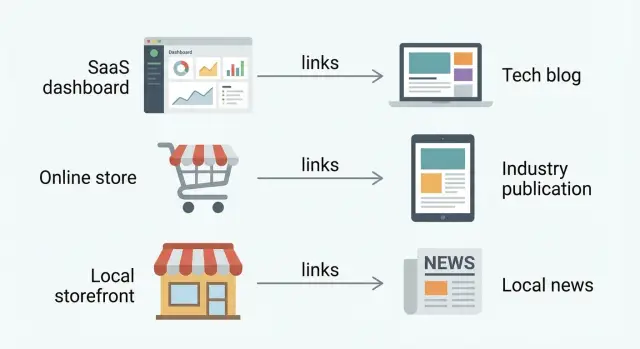
- SaaS: tech blogs, engineering pages, product roundups, and B2B publications where buyers compare tools
- eCommerce: niche publications, review sites, buyer guides, and lifestyle outlets where people discover products
- Local services: local news sites, community organizations, chambers of commerce, and local bloggers
A roofing company getting a link from an unrelated tech roundup might look good on paper, but it rarely leads to calls. The same goes for a SaaS tool getting links from irrelevant directories.
Build a backlink plan in 60 minutes
You don’t need a huge spreadsheet to start. You need one clear goal, a short list of pages that can convert, and a source list that matches your buyers.
Try this 60-minute setup:
- Pick one revenue goal for the next 30 days (trial starts, purchases, or calls/bookings).
- List 5-10 pages that directly support that goal.
- Write down a short list of source types based on audience (not just “DR”).
- Decide a simple anchor mix: mostly brand and plain URL, with a smaller number of descriptive anchors.
- Choose a cadence you can sustain, then review every 30 days.
Keep the scope tight. A few well-matched links pointed at pages that can convert usually beat a scattered set of links aimed at “important” pages.
Anchor text and positioning: keep it natural
Anchor text is the clickable words in a link. It’s also one of the fastest ways to make a backlink look natural or forced.
For most links, “boring” is good. Brand names, plain URLs, and page-title-style anchors usually blend in best. Save descriptive anchors for a small set of pages where you truly need relevance.
Also watch repetition. If many different sites use the exact same keyword anchor, it stops looking like real editorial writing.
Where the link sits matters, too. A link placed in a real sentence, surrounded by related terms, usually carries more meaning than a random “resources” list.
How to measure results without overthinking it
Backlinks are easy to count. What matters is whether the linked page moved closer to making money.
Start with the page you built links to and check three things over the next 2 to 6 weeks:
- Rankings for the main query
- Organic clicks to that page
- What visitors did after landing (trials, orders, calls, assisted conversions)
SaaS teams should watch trials, demo requests, and assisted conversions. eCommerce teams should look at category-level lift and revenue per landing page. Local services should track calls, form fills, and service-page rankings (plus map visibility if that’s a core channel).
A simple weekly check is enough: page rankings, page clicks, and one business metric that the team actually cares about.
Common mistakes that waste backlinks
The fastest way to waste links is to point them at pages that can’t rank or convert. If a page is thin, outdated, or unclear about the next step, the link may lift traffic without lifting revenue. Tighten the page first: clear headline, proof, and one main action.
Another common trap is buying only “high authority” while ignoring buyer fit. Authority helps, but relevance is what turns a visit into a customer.
Avoid building links to temporary pages that disappear or change completely (short promos, one-off seasonal URLs, limited-time offers). Use evergreen pages and route visitors internally to the current offer.
Don’t forget internal links. If a strong link lands on a blog post that never points to a product, service, or signup page, the value often stops there.
Quick checklist before you pick pages and sources
Before you invest time or money into links, check the target page first. A backlink can bring the right visitors, but a confusing page wastes the opportunity.
Minimum bar for a target page:
- The offer is clear above the fold
- It loads fast on mobile and doesn’t jump around while loading
- There’s one obvious next action (buy, book, start trial, request quote)
- The page matches intent (no bait-and-switch)
- You can track the goal (form submit, checkout, call click)
Then vet the source site:
- Real audience overlap with your buyers
- The link fits the editorial context (not a random sidebar)
- Clear topical match
- The page and site look maintained and credible
Balance your targets over time: a small number of links to the homepage, most to key money pages, and some to supporting content that makes selling easier.
Example: three businesses, three different backlink choices
A solid backlink strategy starts with one question: where does revenue come from, and what page helps a visitor take the next step?
SaaS (B2B analytics tool): Point links to a use-case page (for example, “Analytics for Shopify teams”) or a demo page that answers objections and shows proof. Choose sources where buyers compare tools, such as tech blogs, SaaS review content, and comparison articles.
eCommerce (specialty coffee store): Point links to a high-margin category page (for example, espresso beans) or a best-sellers collection that can convert without extra education. Choose sources like food and lifestyle publications, gift guides, and review-driven content.
Local service (plumbing company): Point links to a service-area page like “Emergency plumber in Austin” or a booking page with clear hours and a strong call option. Choose sources locals trust, such as community publications, chambers of commerce, and local news sites.
Next steps: make it a simple monthly routine
Pick one business model to focus on first. Trying to cover SaaS, eCommerce, and local all at once usually creates scattered links and unclear results.
Choose 2-3 priority pages that can convert, then commit to a consistent mix of sources for 30-90 days. Give it long enough to see what moves rankings and what drives leads or sales.
A simple monthly rhythm:
- Plan: confirm your 2-3 pages and the topics they support.
- Place: get 1-3 links that match your model and your target pages.
- Measure: track one ranking change and one business metric.
- Adjust: swap pages or source types based on what actually improved.
If you want access to harder-to-get placements without long outreach cycles, SEOBoosty (seoboosty.com) offers a curated inventory of premium backlinks from authoritative websites, with subscribers selecting domains and pointing links to the pages they want to grow.
Keep it boring. Consistency beats big one-off bursts.
FAQ
Why does my business model matter for backlinks?
Start with how you make money. SaaS usually needs qualified leads and signups over multiple visits, eCommerce needs purchase-ready traffic to categories/products, and local services need calls or bookings in a specific area. Your business model tells you which pages can convert and which sites have the right audience.
What makes a backlink “good” beyond SEO metrics?
Because a backlink is also a click path. If someone clicks and lands on a page that doesn’t match the promise of the mention, they bounce and you lose both the visitor and most of the practical value. Always match the source audience to a landing page that answers the same question and offers one clear next step.
Should I stop sending backlinks to my homepage?
Usually, yes. Homepages try to speak to everyone, so they rarely match one specific intent quickly. A focused page like a use-case page, category page, or service page often converts better because it makes one clear promise and one clear action easier to take.
Which pages should SaaS businesses build links to?
Point links to use-case or feature pages tied to a specific job, integration pages that match existing workflows, and comparison pages when buyers are close to choosing. Pricing pages can work if they explain plans clearly and remove doubts. Avoid sending cold clicks straight to a form-first demo or trial page; an ungated page that builds confidence first often performs better.
Which pages are best for eCommerce backlinks?
Start with strong category pages because they match buying intent and help shoppers find the right item fast. Then add links to evergreen collections like best sellers or giftable sets, and to products with steady stock and good margins. Use supporting guides to attract links and then funnel people into the categories that generate revenue.
What pages should local service businesses build links to?
Focus on specific service pages and real service-area pages that reflect where you actually work. Make it easy to call or book, and keep each page centered on one job and one action. Thin “city pages” that only swap the city name tend to underperform and can hurt trust with real customers.
What should I do about backlinks to out-of-stock or discontinued product pages?
Don’t build links to pages that will become irrelevant. If it’s discontinued, point efforts to the closest category or replacement product. If it’s temporarily out of stock, the page should clearly offer alternatives and route visitors back to a category so clicks don’t dead-end.
Are seasonal landing pages a good backlink target?
Use seasonal pages only if you can reuse the same URL each year and keep it updated. When you create a new seasonal URL every year, older backlinks often end up pointing at pages that stop mattering. Evergreen pages are safer, and you can route visitors internally to the current seasonal offer.
How do I choose the right websites to get backlinks from?
Authority plus relevance. A high-authority site that reaches the wrong people may look impressive but won’t drive revenue. Aim for sources where your buyers already read and compare: tech and B2B publications for SaaS, niche and review-driven outlets for eCommerce, and local/community sites for local services.
What anchor text should I use so links look natural?
Use mostly brand names, plain URLs, and natural page-title-style anchors. Add a smaller number of descriptive anchors only where you truly need topical relevance. Repeating the same keyword anchor across many sites can look forced, and links placed inside a real sentence with related context usually work better than random lists.
Share