Backlink subscription procurement SOP for recurring SEO buys
Use a backlink subscription procurement SOP to align marketing, finance, and legal on approvals, invoices, renewals, and risk checks for recurring spend.
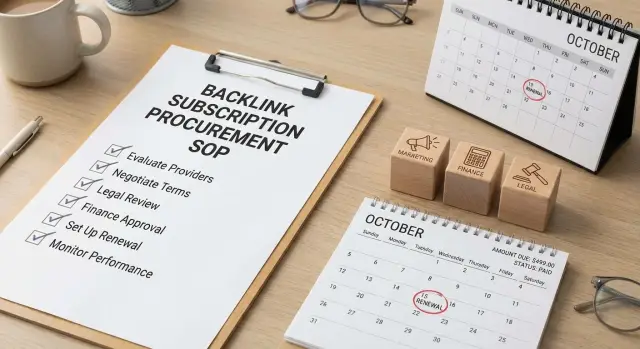
Why recurring backlink subscriptions need a clear SOP
Recurring backlink subscriptions can create quiet, expensive surprises. A renewal hits the card, no one remembers who owns it, and marketing expects one thing while finance and legal assumed something else.
These subscriptions also feel different from one-time marketing spend. You're not paying for a project you can close out. You're paying for an ongoing placement or access that renews on a schedule. The value depends on details like the target URL, the domain, the term length, and what happens when you cancel.
A clear backlink subscription procurement SOP prevents the common headaches: surprise renewals, unclear ownership, mismatched expectations about what was bought, and invoices that don't match the request. It also helps when someone new joins and needs to understand why the company is paying for a recurring SEO item.
A simple SOP should do four things without slowing work down: collect the minimum details up front, define approvals, make invoice handling predictable, and put renewals under control.
Example: marketing starts a yearly backlink subscription, but the invoice shows a different term or an auto-renew setting no one expected. With an SOP, there's a single owner, a paper trail, and a reminder to decide early rather than reacting after the charge posts.
Define the purchase: scope, owner, and budget rules
A backlink subscription is a recurring paid plan where your company pays monthly or yearly for ongoing access to one or more backlink placements, with renewal unless you cancel. Treat it like any other subscription: it creates repeat spend, renewals, and vendor risk.
Be specific about what's included. Typical inclusions are plans where you select a domain (or a placement tier), pay on a schedule, and point the backlink to a target page. Exclusions might include one-time PR placements, content writing, ad spend, or tools that only report backlinks (no placement).
Assign a single business owner responsible for outcomes and day-to-day decisions. This is usually the SEO lead or growth marketing manager. Also name a backup owner so renewals, cancellations, and invoice questions don't stall when someone is out.
Then set budget rules finance can apply without guessing. Decide the cost center (for example, Marketing - SEO) and who owns the budget line. Put simple rules in writing for where the expense sits (subscription vs professional services) and what evidence is required to book it correctly (invoice, subscription term, and what was purchased).
Standard request vs exception
Most requests should be "standard" so they move fast. Define exceptions that trigger extra review.
A standard request usually fits the approved monthly cap, uses an approved vendor category, and targets an allowed page type (homepage, product page, or a key content hub). An exception is anything that adds risk or commitment, such as a new vendor model, unusually high spend for authority, targeting restricted or claims-heavy pages, or a commitment longer than 12 months. Also treat prepaid annual spend above a set threshold as an exception, and be cautious with any auto-renewal paired with a short cancellation window.
This definition turns a document into a repeatable decision. Example: marketing wants a yearly subscription for two placements. If it fits the SEO cost center and stays under the cap, it stays on the standard path. If it creates a multi-year commitment or introduces a new vendor type (for instance, selecting from a curated inventory), it follows the exception path.
Intake: what marketing submits before any purchase
A good intake form prevents two problems: buying the wrong subscription and paying for it twice. It also keeps the process repeatable when teams change.
Require a short, complete request from marketing. Focus on what finance and legal need to decide, not SEO theory.
Minimum fields to submit every time:
- Goal and audience: the business outcome this supports
- Target page and intent: the exact URL to point to, plus one sentence on why that page matters
- Timing: requested start date and any deadlines that make the request urgent
- Subscription details: term length, billing cadence, expected cost, and number of placements included
- Vendor snapshot: vendor type (marketplace, publisher-direct, agency, or a provider such as SEOBoosty) and a plain-English placement description
Success criteria should be measurable and realistic. Avoid promises like "we will hit #1 for X" because no one can guarantee that.
Use outcomes you can check at renewal time, such as referral visits to the target page, directional improvements in organic sessions, confirmation that the link is live by a specific date, and a basic quality check (relevant topic, visible placement, no obvious spam signals).
Add internal notes for finance and legal in plain language: estimated risk (low, medium, high), urgency (what breaks if delayed), and anything unusual (prepay required, auto-renewal, or restrictions on cancellation). That short context saves days of back-and-forth.
Vendor and placement due diligence for backlink subscriptions
Treat "who is the vendor" and "where the link will live" as two separate checks. One can be clean while the other is risky.
Start with basic vendor identity so finance and legal aren't guessing later. Confirm the legal business name (the billing entity on the invoice), the payment method, and one support contact who can handle billing changes and placement issues. If the brand name differs from the billing name, record both.
Next, check brand fit and reputation for the placement(s). Use a simple rule: you should be comfortable showing the link source to a customer or your CEO. Watch for signs of low quality, like unrelated content, pages that exist only to host links, or a site overwhelmed by ads.
If you're using a service with a curated inventory, get clarity on what types of sites are included and whether your team can choose or change domains. For example, SEOBoosty is a subscription-style provider where customers select domains and point the backlink to a chosen target page. Even with that structure, you still want the key facts documented: what was selected, where it will appear, and what happens if availability changes.
Keep compliance lightweight but real. Confirm whether any data is shared (usually none beyond billing), whether sponsored disclosures apply, and what tax details finance needs (VAT/GST fields, W-9/W-8 info, or local equivalents).
To avoid slow paperwork, capture evidence in one place. A short checklist is enough:
- Vendor legal name and billing email
- Primary support contact
- Placement type and topic fit notes (1-2 sentences)
- Any disclosure or policy constraints noted by legal
- A saved copy of the offer terms and the approved order details
That creates a clear trail without turning due diligence into a research project.
Approval flow: a step-by-step process you can reuse
A repeatable approval flow prevents surprise renewals and keeps marketing moving. The goal is simple: one owner, clear checks, and a recorded yes or no. Use the same workflow every time you buy a new backlink subscription, even if the spend feels small.
A clean five-step path:
- Marketing request + manager sign-off: Marketing submits the request with target domain(s), cost, purpose, start date, and who owns tracking. A manager confirms it fits the SEO plan and the landing page is ready.
- Finance review: Finance checks budget availability, approves the payment method (card vs invoice), assigns the GL code, and confirms the subscription term (monthly vs annual) and any prepay requirements.
- Legal review: Legal confirms the terms match your risk tolerance, including renewal language, cancellation window, deliverables, refund policy, and any restrictions on how links are placed or disclosed.
- Final approval + purchase authorization: The designated approver gives the go-ahead and names the purchaser.
- Record + notify: Log the decision in your tracker, attach key docs, and notify marketing, finance, and legal of the start date, renewal date, and owner.
Example: marketing wants a subscription from SEOBoosty. Finance confirms the billing cadence and coding. Legal flags a 30-day cancellation notice. The approver authorizes purchase only after the renewal date and notice deadline are added to the tracker and a reminder is assigned to the owner.
If you need speed, define a fast-track threshold (low spend with no custom terms). Still keep the record-and-notify step every time.
Legal review points that matter for recurring SEO spend
Legal review for recurring SEO subscriptions is mostly about removing surprises. Standardize a small set of clauses so marketing can move quickly without taking hidden risk.
Start with billing and renewal terms. Recurring subscriptions often include auto-charge language, automatic renewal, and short cancellation windows. Make sure the terms state:
- Renewal type (monthly or annual)
- When the price can change
- How far in advance you must cancel to avoid the next charge
Next, define what "delivery" means. Deliverables should be described in plain terms (for example, a link placed on a specified domain, pointing to a specified target URL). Also spell out what isn't guaranteed, such as rankings, traffic, or lead volume.
Placement language matters because real websites change. Confirm acceptable wording around substitutions (what happens if a domain becomes unavailable), placement downtime (if a page is removed or edited), and remedies (replacement link, credit, or extension). This is especially important with premium providers that source rare placements.
Core clauses to confirm before approval:
- Auto-renewal, auto-charge, and the exact cancellation notice period
- Deliverables definition vs performance promises (rankings are not a deliverable)
- Substitution and make-good policy for removed links or unavailable placements
- Liability limits and indemnity scope
- Dispute and refund terms, including escalation steps
If any of these are unclear, pause and get written clarification before finance sets the vendor up for recurring payments.
Invoice handling and accounting: clean, repeatable steps
Recurring SEO spend gets messy when invoices land in different inboxes or the billing period isn't clear. A simple routine keeps it from turning into a monthly fire drill.
Start by choosing a default payment method. A company card is often fastest, but it can hide details if receipts are weak. Invoicing is usually better when finance needs clear terms, tax treatment, and a stronger paper trail, especially for annual subscriptions. Pick one default and allow exceptions only with explicit approval.
Require invoices to include the same minimum fields so accounting can match them to the approved request:
- Vendor legal name and tax details
- Subscription period (start date and end date) and billing frequency
- Clear line items (plan name, quantity, any setup fees)
- Currency, taxes, and total due
- Internal reference (PO number or approval ticket ID)
Coding is where budgets stay honest. Each invoice should be coded to a department (usually marketing), a campaign or project (for example, Q2 organic growth), and a vendor category (for example, SEO subscriptions). Marketing can suggest coding, but finance should apply the final codes.
If the invoice doesn't match what was approved, don't pay first and ask questions later. Common mismatches include a different billing period, add-on fees, or a renewal that started early. Route it back to the request owner to confirm one of three outcomes: correct the invoice, update the approval, or cancel the charge.
Keep recordkeeping simple: store the approval, invoice, and proof of payment in one place. Log the subscription start and end dates, plus the exact domain and target URL(s). That way renewal decisions are based on facts, not memory.
Renewal triggers, changes, and offboarding
A recurring SEO subscription is easy to forget until the renewal invoice arrives. Treat renewals like a planned decision, not an automatic default.
Keep one shared renewal calendar with the subscription owner, renewal date, current plan level, and the exact action required (renew, change, or cancel). Then set trigger points that give the team time to act:
- 60 days before renewal: marketing prepares a short performance note and recommended action
- 30 days before renewal: finance confirms budget availability and any cost center changes
- Budget cycle trigger: flag renewals that land after the next budget cutoff
- Quarterly review: pre-label subscriptions that require a deeper renewal review
Changes should follow the same discipline as a new buy, just faster. If marketing wants to upgrade the subscription level or add more domains, require three things: a reason tied to a goal, the incremental cost and term, and confirmation that vendor terms haven't changed.
If you're using a service like SEOBoosty where teams select domains and subscribe, define who can approve adding domains, and when legal must re-check terms (for example, if the term length changes or new restrictions appear).
When cancelling, use a short offboarding checklist:
- Confirm the cancellation date and stop billing (get written confirmation)
- Remove it from the renewal calendar and procurement tracker
- Update finance records (vendor master, GL mapping, accruals if needed)
- Notify marketing of the stop date and any reporting impact
- Archive approvals, invoices, and the final decision note for audit
Controls that prevent surprises without slowing work
The best controls are the ones people can follow without extra meetings. Your SOP should make it easy to buy what you intended, pay the right amount, and avoid renewing something nobody uses.
Start with clear spending limits. Give marketing a monthly cap per team or channel, and require extra approval only for exceptions. Most purchases move quickly, while large or unusual spends get attention before money leaves.
Separation of duties reduces mistakes. One person requests the subscription, another approves it, and a third pays it. If the team is small, at least separate approval from payment so the same person isn't grading their own homework.
Keep controls simple:
- Set a default per-subscription limit, and require a short exception note above it
- Keep a single source of truth for vendor, plan, price, billing cycle, and renewal date
- Standardize proof of delivery (what evidence shows you got what you paid for)
- Use a renewal reminder window so someone must confirm "keep" or "cancel"
Proof of delivery should stay consistent. For recurring backlinks, that can be a monthly check showing the live placement, the target URL, and the anchor text, plus a short note if anything changed. If you buy through a provider where you select domains and point the backlink, your proof can be the chosen domain plus a verification that the link is live.
Urgent requests happen, but they should have a safe fast path. Allow same-day approval only when it's under the default limit and includes the business reason, the plan and billing terms, and a follow-up review date within 7 days to confirm delivery and update records.
Example SOP run: a recurring backlink subscription from request to renewal
A realistic run shows where the SOP actually saves time.
Marketing wants a 12-month subscription for premium backlinks from SEOBoosty, pointing to a product landing page. They want three placements on specific authoritative domains from a curated inventory, with the option to add more later if results look good.
From request to go-live
Marketing submits a single intake packet: target URL, desired domains, expected start date, and why a subscription (not a one-off buy) fits the SEO plan. They name the internal owner who will verify placements and report outcomes.
Finance checks the basics that prevent billing chaos later: is it annual upfront or monthly, does it auto-renew, what cost center applies, and what approval limit is required.
Legal focuses on the recurring parts and what counts as delivery. They confirm renewal and cancellation language, what happens if a placement can't be delivered, whether credits or replacements apply, and any restrictions on how links can be placed or changed.
A simple flow many teams use:
- Day 1: Marketing submits intake and proposed domains
- Day 2: Finance confirms budget, term, invoice requirements, and payment method
- Day 3: Legal approves renewal and cancellation terms, plus deliverables language
- Day 4: Procurement records approvals and places the order
- Day 5: Marketing verifies placements and logs proof of delivery
Renewal and mid-term changes
Save approvals in one place (request, finance sign-off, legal sign-off, and delivery proof). Set two reminders: 60 days before renewal to decide, and 30 days before renewal to cancel or confirm.
If marketing wants to expand mid-term to additional domains, treat it like a change order:
- Confirm the added domains and incremental price
- Confirm whether the change resets the term or shifts the renewal date
- Reconfirm who approves the higher spend
- Capture a short legal note if terms change
- Update reminders to match the new commitment
Growth becomes easy, and surprises stay rare.
Quick checklist you can copy into your procurement template
Use this as the final gate before starting any recurring backlink subscription.
Write down the renewal facts in plain language: the auto-renew date, the cancel-by deadline, and where that policy is stated (contract, order form, or email confirmation). If no one can find the cancellation window later, it effectively doesn't exist.
Make ownership real. Assign one accountable owner and one backup. Record names, roles, and the email used for vendor logins and billing.
Before submitting anything to finance, confirm the money details match how your company buys subscriptions: the approved amount, the cost center, and who approved it.
Copy-ready checklist
- Renewal date and cancel-by deadline documented in the procurement record
- Primary owner and backup owner assigned, with access notes
- Budget limit, billing frequency, and cost center confirmed and approved
- Invoice requirements validated on the first invoice (legal entity name, subscription period, tax fields, internal reference)
- Renewal review scheduled far enough ahead of the cancel-by deadline to act
Even if you buy through a curated provider such as SEOBoosty, keep the same checklist. The vendor may reduce outreach work, but billing, renewals, and ownership still need clear records.
Next steps: finalize the SOP and run a simple pilot
Your first version should fit on one page. If it takes longer to read than to follow, people will ignore it.
Start with a small pilot: one recurring subscription, one team, one month. Pick something that matters but isn't so big that it becomes a political fight. Run the workflow end to end, then tighten the steps that caused delays or confusion.
Set up the minimum templates
Before the pilot starts, create three reusable documents so every purchase looks the same:
- Intake form: goal, target pages, budget cap, term length, and expected impact
- Approval record: who approved, when, and which exceptions (if any) were used
- Renewal tracker: renewal date, notice window, owner, and action (renew, change, cancel)
Write them so a new hire can complete them without guessing.
Decide your vendor fit rules
Agree up front which vendors are allowed for recurring SEO spend. Keep it simple: define a budget threshold, acceptable payment terms, and a short risk checklist (who publishes, what you're buying, and what happens if the placement changes).
If your team uses a subscription provider like SEOBoosty (seoboosty.com), add one practical rule for domain selection and targeting: marketing proposes the domains and the exact pages the backlinks should point to, finance confirms the subscription cost and renewal date, and legal signs off on the terms. During the pilot, confirm the targets still match current campaigns, not last quarter's priorities.
After 30 days, update the one-pager based on what actually happened, then expand to the next subscription type.
FAQ
Why do backlink subscriptions need a different process than one-time SEO spend?
Treat it like a subscription because it creates repeat spend, renewals, and cancellation deadlines. If you don’t capture the term, auto-renew rules, and owner up front, the value and the risk are easy to misunderstand later.
Who should own a recurring backlink subscription internally?
Make the SEO lead or growth marketing manager the primary owner, and assign a backup owner who can act on renewals and billing questions. Put both names in the tracker so finance and legal know who can approve changes or request cancellation.
What are the minimum details marketing should submit before purchasing?
Collect the exact target URL, the expected start date, the term length, billing cadence, expected cost, and how many placements are included. Add a short vendor snapshot in plain English so finance and legal can review the same facts marketing is buying against.
How do we decide what counts as a “standard” request vs an “exception”?
A standard request fits your preset spend cap, uses an approved vendor category, and targets an allowed page type with no unusual claims risk. An exception is anything that increases commitment or risk, like unusually high annual prepay, multi-year terms, short cancellation windows, or a new vendor model your company hasn’t used before.
What due diligence actually matters for backlink subscriptions?
First verify the vendor identity that will appear on the invoice, including the legal business name and a billing support contact. Then separately review the placement quality and brand fit, because a legitimate vendor can still offer placements that don’t meet your standards.
What should legal review first for a recurring backlink subscription?
Focus on renewal language, the cancellation notice period, and a clear definition of delivery, such as “a link on a specified domain pointing to a specified URL.” Also confirm what happens if a placement becomes unavailable, including whether you get a replacement, credit, or term extension.
What should we do when an invoice doesn’t match what was approved?
Route it back to the request owner before paying, and resolve it as one of three outcomes: corrected invoice, updated approval, or cancellation. This prevents “silent scope creep,” where a different term or add-on becomes the new baseline just because it got processed once.
How do we stop surprise renewals without slowing the team down?
Use a shared renewal calendar with the owner, renewal date, cancel-by deadline, and the action required. The safest default is a 60-day performance check and a 30-day budget and cancellation check, so you’re deciding before the notice window closes.
What’s the cleanest way to cancel and offboard a backlink subscription?
Get written confirmation of the cancellation effective date and that billing will stop, then immediately update the renewal tracker and finance records. Archive the final invoice and the cancellation note so a future team member can see exactly why it ended and when.
If we use a subscription provider like SEOBoosty, do we still need an SOP?
Yes, if you keep the same documentation discipline: record the specific domains selected, the target URL, the term, and the renewal rules. With a provider like SEOBoosty, the operational work may be simpler, but you still need clear records for billing, ownership, and renewals.
Share