Choose backlink targets by search intent: money vs info pages
Learn how to choose backlink targets by search intent, so links land on the right pages - guides, tools, or money pages - without wasting authority.
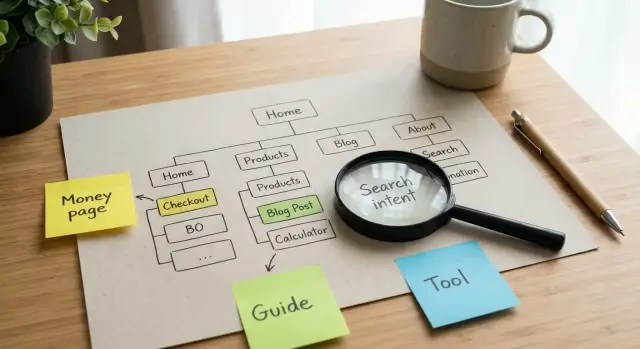
Why search intent should decide where backlinks point
A backlink target is the page on your site the link points to. That decision matters as much as the link itself.
Not every page benefits in the same way. A link to a product or service page can help it rank for buying keywords, but only if the click makes sense to the reader. A link to a guide can build trust, earn shares, and rank for questions, even if it doesn’t convert right away.
One common habit is sending every new link to the homepage “just to be safe.” That usually underperforms because the homepage targets broad terms, while the link context is specific. If the article is about “how to fix slow WordPress,” a homepage link feels random. A link to a speed guide or a performance tool feels like the obvious next click.
The simplest way to pick a backlink target page is to match search intent. In other words: align the destination with what the person expects to find when they click.
A quick way to set expectations before you place a link:
- If the reader wants to buy, point the link to a clear landing page that answers pricing, features, and next steps.
- If the reader wants to learn, point it to a guide that solves the problem fast.
- If the reader wants to do something right now, point it to a tool, template, calculator, or checklist.
A practical view of search intent
Search intent is the reason behind a query. When your backlink target matches intent, the click is more satisfying for the reader and more consistent with what Google is trying to rank.
Most searches fall into four buckets:
- Informational: they want to learn. Examples: “how to fix crawl errors”, “what is domain authority”, “backlink audit checklist”.
- Commercial: they’re comparing options. Examples: “best rank tracking tools”, “Semrush vs Ahrefs”, “top link building services”.
- Transactional: they’re ready to act. Examples: “buy backlinks”, “SEO link building pricing”, “subscribe to backlink service”.
- Navigational: they’re trying to reach a specific place. Examples: “Google Search Console login”, “SeoBoosty pricing”, “Ahrefs keyword explorer”.
Google tends to reward pages that satisfy the intent quickly. That’s why “how to” searches usually rank guides, not sales pages. And why “pricing” searches often surface plan pages, pricing pages, or short summaries that help people decide.
A simple test: read the query and ask, “What would feel like a complete answer in 30 seconds?”
- If it includes “how,” the page should teach.
- If it includes “best” or “vs,” the page should compare.
- If it includes “pricing,” “buy,” or “subscribe,” the page should help someone decide and take the next step.
One site can cover multiple intents across different pages. The goal isn’t to force one page to do everything. It’s to send each backlink to the page that matches the purpose of the click.
Page types: money pages vs guides vs tools
Before you point a backlink anywhere, name what kind of page it is. This makes backlink target page selection much less guessy.
Money pages are built to convert: product pages, service pages, category pages, pricing, demo, or signup pages. They answer, “Can you solve my problem, and what does it cost?” These pages work best when the reader is already close to buying.
Informational pages are built to educate: guides, blog posts, definitions, and comparisons. They answer, “What is this?” and “Which option is better?” They often earn clicks from broader keywords and warm people up for your offer.
Tool and resource pages are built to help someone do a job: calculators, checkers, templates, and free resources. They answer, “Help me do this faster” or “Help me decide.” They can attract mentions because they’re useful even without any sales pitch.
A quick way to tell them apart:
- Money page: sells one thing and asks for a next step (buy, book, start).
- Guide/post: teaches, explains, or compares, usually with multiple sections.
- Tool/resource: gives an input-output result or a downloadable asset.
- Support page: FAQs, shipping/returns, policies. These are rarely good backlink targets unless the link is specifically about that policy.
Example: if someone searches “best CRM for small teams,” a comparison guide fits. If they search “CRM pricing,” send them to pricing. If they search “calculate sales pipeline value,” a calculator is the most believable destination.
Start with goals: what should this link do?
Before you map links to pages, decide what you want this placement to accomplish. A backlink can:
- help a page rank for a specific keyword cluster,
- send ready-to-buy visitors,
- build credibility that lifts other pages over time.
Pick one primary outcome per placement. Otherwise you end up with links that feel good on a report but don’t move results.
Next, choose your must-win pages. Keep it tight: 2 to 5 pages, not 50. These are the pages that, if they improved this quarter, would clearly change revenue or lead flow.
It also helps to think in terms of distance. Pages sitting around positions 8 to 20 (already close to page 1) often respond well to a strong, relevant placement. Pages that are far away usually need groundwork first: better content, clearer intent match, and stronger internal linking.
Finally, separate trust from relevance:
- Some pages mainly need authority (often product and landing pages).
- Others have enough authority but need clearer topical support (often guides and comparisons).
If you write it down, keep it simple: primary outcome, a short list of target pages, and which pages are “near wins.”
Step by step: map intent to the right backlink targets
If you want to choose backlink targets by search intent, use a repeatable mapping process.
-
List the queries and topics you care about. These can be keywords, categories, or the themes you want to own.
-
Label the intent in plain words. “Learn,” “compare,” “fix,” or “buy” is enough. If the query includes “pricing,” “demo,” or “best for,” it’s usually closer to a decision.
-
Match the intent to a page type.
- Learning intent: guide, glossary page, how-to post.
- Comparing intent: comparison page, “alternatives” page.
- Doing intent: tool, checklist, calculator, template.
- Buying intent: landing page, pricing page, product page.
-
Sanity-check the target page before you build the link. The page should answer the question fast, use clear headings, and make the next step obvious.
-
Decide whether the backlink should go direct or support the goal page. Often, a “what is X” mention performs better when it points to a helpful guide that then points readers to the service page. That feels more natural and usually converts better.
A good plan mixes targets. Many sites do best when most placements build topical trust (guides and resources) while a smaller share points to money pages. That mix also tends to look more natural over time.
When backlinks should go to money pages
Point backlinks to money pages when the intent is clearly commercial or transactional. These are pages built to convert: service pages, product pages, pricing pages, and “book a demo” pages.
If someone is searching with words like “pricing,” “quote,” “agency,” “software,” “hire,” or a specific product category, a money page backlink can push them from comparison to action.
A simple rule: if the query suggests they want to buy, not learn, send the link to the page where buying is possible. For example, “B2B SEO backlinks pricing” fits a pricing or plan page better than a beginner guide.
How to keep money page links natural
Money page backlinks work best when the link sits inside a relevant sentence that explains why the page is useful. A random link dropped into a vendor list looks forced.
Before you build links, make sure the page deserves them. Tighten the page so visitors can decide quickly:
- a headline that matches the query (what you do, for whom)
- proof near the top (examples, outcomes, recognizable customers)
- one primary call to action
- clear “how it works” details, and pricing info when appropriate
When not to link to a money page
Skip money page backlinks if the page is thin, vague, or reads like pure ad copy. If it doesn’t answer the searcher’s main question, the click will bounce and the placement won’t do its job.
If your sales page isn’t ready, point the link to a strong guide first, improve the money page, then shift targets once the offer and the page are clear.
When to link to informational pages (guides and posts)
Link to a guide when the search is about learning, not buying. Think “how to,” “what is,” “best practices,” “examples,” and “fix this problem.” In those cases, sending the click to a sales page often feels too soon.
Informational content link building is also a safer way to earn broad, natural mentions. A good guide builds trust and can pass visitors and authority to your money pages through internal links that actually help (for example: “see pricing,” “compare plans,” or “book a demo”).
Before you send a strong backlink to a guide, check the basics:
- the structure is easy to skim (clear headings, short sections)
- the steps still work (updated screenshots, current settings)
- it uses at least one real example
- it ends with one clear next step
- internal links support the topic instead of interrupting it
Example: for “how to reduce cart abandonment,” a step-by-step post is the right target. Inside that post, you can mention your solution as one option and link to the landing page where it’s genuinely relevant.
When to link to tools and resources
Tools earn links because they give people a fast answer. A calculator, template, or grader is easy to share in a Slack thread or a newsletter because it’s immediately useful.
Linking to tools for SEO (and for other topics) works best when the reader wants to do something now, not read a long explanation.
The tools that perform well tend to be simple and specific: quick calculators, short checklists, templates, graders, or a small library of examples.
To make a tool page worth the click, focus on trust and speed:
- plain instructions (what to enter, what you get)
- clear outputs (a result, a file, or next steps)
- one short example so people can sanity-check it
- a clear note on assumptions and limits
A tool is a poor backlink target when it’s behind a login, slow, broken, or confusing. If a visitor can’t use it in 10 seconds, they leave.
Anchor text and context: keep it believable
Anchor text works best when it reads like something a real writer would naturally use. It should match what the reader expects after the click.
Avoid repeating the same exact keyword anchor across many backlinks. That looks forced and can send the wrong signal.
Common anchor styles that usually stay natural:
- brand or site name (good when trust is the main goal)
- descriptive phrases like “pricing details” or “compare plans”
- guide-like anchors such as “step by step checklist” or “beginner guide”
- partial-match phrases that include the topic without sounding like ad copy
- resource anchors like “free calculator” or “template”
Context matters as much as the anchor. The sentence around the link should explain why the page is worth clicking. If the copy makes a specific promise, the target page has to deliver on it.
Common mistakes that waste good backlinks
Most wasted placements come from picking a target out of habit instead of intent.
1) Defaulting to the homepage. It can be fine for pure brand mentions, but it often does nothing for the specific topic that earned the link.
2) Forcing early-stage readers onto a sales page. If a post is about “how to audit broken links” and it points to a “Book a demo” landing page with no audit steps, the reader bounces and the link feels off.
3) Sending links to pages that aren’t ready. Thin content, slow load times, confusing headings, or missing next steps turn a strong mention into a weak result.
4) Targeting based on ego metrics. The page that matters most to you isn’t always the page that matches the reader’s intent.
5) Changing URLs too often. Frequent slug changes and migrations can quietly erase progress.
If you remember one rule: the destination should satisfy the click.
Quick checklist before you choose a backlink target
Before you point a new backlink anywhere, make sure the page earns it.
- Intent match: Would a person feel they landed in the right place within the first sentence?
- Best-fit page: Is this your strongest page for that intent, not the page you wish would rank?
- 10-second clarity: Can a first-time visitor understand the page fast from the headline and the first screen?
- Next step: After they get value, is there a clear action that fits the intent?
- Internal path: If the target is a guide or tool, does it naturally lead to the relevant product or landing page?
Example: if the placement is in an “email deliverability tips” article, pointing to a “Deliverability Checklist” guide often fits better than pointing straight to pricing. The guide can then link to the service page in a way that feels earned.
Example: mapping links for a simple three-page funnel
Imagine a local service business (a home cleaning company) with three key pages:
- Service page: “Home cleaning in Austin”
- Pricing page: “Cleaning prices and packages”
- Guide: “How to choose a house cleaning service (checklist + questions)”
People who search for the guide are still comparing options. People who land on pricing are close to booking. So instead of pointing every backlink at the service page, you split placements by intent.
A simple starting split:
- 50% of links to the guide (informational intent)
- 30% of links to the pricing page (decision intent)
- 20% of links to the service page (core relevance)
The guide shouldn’t be a dead end. Add a few clear internal links from the guide to the service page and the pricing page using natural phrases like “see our pricing” or “what’s included.” That way, guide links can still feed people and authority into your money pages without forcing every external mention to look salesy.
A simple 30-day plan
Week 1: Improve the three pages. Tighten headings, add real FAQs, and make the pricing page easy to understand.
Week 2: Place a first wave of links to the guide.
Weeks 3 to 4: Add links to pricing and the service page. Use fewer, stronger placements here.
Next steps: build a small plan and place links with intent
You don’t need a huge map. Start with 2 to 5 pages, each tied to one clear intent, and decide what each backlink should accomplish.
A simple setup:
- Pick one money page (transactional), one key guide (informational), and optionally one tool/resource page (doing intent).
- For each page, write one sentence: “This page should rank for X and lead to Y.”
- Start with 1 to 2 placements per page, then adjust based on results.
- Track one ranking metric (keywords that match the page’s intent) and one business metric (leads, signups, sales).
If you’re using a placement service, the same rule applies: you’ll get more value when you can choose the destination page per placement instead of sending everything to the homepage. For example, SEOBoosty (seoboosty.com) is built around securing premium backlinks from authoritative sites, and it works best when you point each link to the page that truly matches the intent behind the mention.
FAQ
How do I know which page a backlink should point to?
Start with the sentence around the link and ask, “What is the reader trying to do right now?” If the context is teaching or explaining, send the click to a guide. If it’s comparing options, send it to a comparison/alternatives page. If it’s about pricing or hiring, send it to a pricing or service page that makes the next step easy.
Is it okay to point most backlinks to my homepage?
Usually not. A homepage link can work for pure brand mentions or navigational intent, but it often wastes topical relevance.
If the article is about a specific problem or feature, a dedicated guide, tool, or landing page that matches that topic is almost always a better destination.
What’s the simplest way to match a backlink target to search intent?
Match the query and the wording of the mention. “How to” and “what is” mentions should point to guides that solve the question fast. “Best,” “vs,” and “alternatives” mentions should point to comparison pages. “Pricing,” “quote,” “hire,” or “subscribe” mentions should point to a money page that answers costs, scope, and what happens next.
When should backlinks go to money pages like pricing or service pages?
Link to money pages when the reader is already close to a decision and the page can satisfy them immediately. That typically means the surrounding text mentions buying, pricing, booking, or a specific service.
If the click would land on vague marketing copy or missing details, send the link to a strong guide first and let internal links move people toward the offer.
How do I keep money-page backlinks from looking spammy?
Put the link in a sentence that explains exactly why the destination is useful, and make sure the page delivers on that promise within the first screen. If the anchor implies “pricing,” show pricing. If it implies “features,” show a clear feature summary.
Also avoid pushing every placement to the same sales URL; a mix of relevant guides, tools, and a smaller share of money-page links tends to look and perform more naturally.
Why would I point backlinks to blog posts or guides instead of sales pages?
Use them to capture early-stage and mid-stage searches, then guide visitors to the next step with helpful internal links. A good guide can rank for broader questions, earn more mentions, and build trust before asking for a signup.
Your guide should have a clear purpose, updated steps, and a natural transition to the relevant product or service page once the reader has enough context.
When do tools, calculators, and templates make the best backlink targets?
When the reader wants to do something immediately, like calculate, check, generate, or download. Tools and templates often earn clicks and mentions because they give a fast result.
Only use a tool page as a backlink target if it works instantly and doesn’t block the value behind a confusing flow. If the tool is slow, broken, or locked behind a wall, the click is wasted.
How should I choose anchor text when targeting different pages?
Don’t repeat the same exact keyword anchor across many backlinks. Write anchors that match what the reader expects after clicking, and keep them consistent with the page type.
For example, a guide should be linked with wording that sounds like learning, while a pricing page should be linked with wording that sounds like deciding. The surrounding sentence should make the click feel like the obvious next step.
What are signs I picked the wrong backlink target page?
You’ll see high bounce rates, short time on page, and weak downstream actions (like no internal clicks to key pages). Rankings can also stall because the page isn’t satisfying the intent that the link context implies.
A quick fix is to redirect future placements to a better-matching page, or improve the target page so the promise made by the link is answered immediately.
How can I use SEOBoosty backlinks without wasting them on the wrong pages?
Choose destinations per placement instead of defaulting everything to one URL. With SEOBoosty, that usually means mapping each purchased placement to the page that best matches the mention’s intent, such as a guide for educational contexts and a pricing or service page for decision-ready contexts.
Before pointing a premium link, make sure the target page is “ready”: clear headline, fast clarity in the first screen, and one obvious next step that fits why someone clicked.
Share