Backlinks for AI Search Overviews: Get Cited More Often
Backlinks for AI search overviews: structure pages with clear claims, sources, and summaries so AI systems cite your content and send qualified clicks.
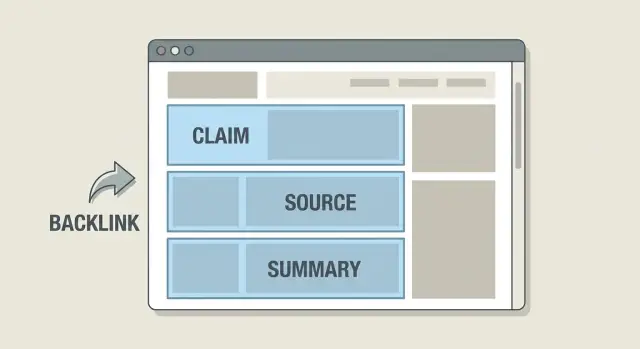
Why AI overviews cite some pages and skip others
AI search overviews are short answers that appear at the top of some search results. Instead of sending people to a single page right away, the system reviews multiple pages, writes a summary, and then cites a few sources as support.
Pages tend to get cited when they make it easy to lift a reliable statement without rewriting it. That usually means:
- One clear idea per section
- Specific details (numbers, names, steps)
- Plain wording that keeps its meaning when quoted
Pages often get skipped when they feel risky: vague language, sweeping claims, heavy sales copy, or statements with no proof.
Citations also work differently than normal blue-link rankings. Rankings reward broad relevance and overall site strength. A citation is closer to being chosen as evidence for one sentence. You can rank well and still not get cited if your content is hard to quote or it’s unclear where the facts came from.
One more practical point: the click you want from an AI overview isn’t just any visit. It’s a reader who clicks your citation and lands on a page that continues the exact topic they asked about, with proof and next steps in the same place.
What AI systems look for before they cite a source
AI overviews usually cite pages that are easy to read, easy to verify, and hard to misquote. Think of the system as trying to avoid getting something wrong. If your page makes the safest option obvious, you’re more likely to be included.
A page becomes more citeable when it has:
- A direct statement that can stand on its own
- A nearby number, reason, or example that supports it
- A named source a reader could check (study, standard, dataset, report)
- Consistent definitions (the same term means the same thing throughout)
- A clean structure with short sections and descriptive headings
Contradictions are a common reason pages get ignored. If you say “most teams save 50% time” and later say “results vary widely,” the system has to guess which version is true. Skipping your page is the safer move.
Authority still matters. When several pages give similarly clear answers, stronger brands, mentions, and high-quality backlinks can act as a trust signal. Authority doesn’t replace good writing, but it can help your page get considered.
Freshness matters mainly when the question demands it (pricing, regulations, fast-changing tools). For timeless explanations, clear sourcing and consistent wording usually beat a newer date.
Page layout that makes your content easy to cite
To earn citations, make the page easy to scan and hard to misread.
Put the main answer near the top in 2 to 4 plain sentences. Write it like the quote you’d want a journalist to copy.
Right after that, add a short “Summary” or “Key takeaways” block. Keep it tight and specific. This helps the system pull a clean recap instead of grabbing a random line from the middle.
Keep paragraphs focused. One idea per paragraph is a simple rule that prevents sentences from being quoted without the context that makes them true.
Use headings that match real questions people ask. Avoid clever headings that hide the point. A heading like “How long does it take?” makes it easier for systems to map your section to a query and cite the right part.
A citation-friendly page usually follows this flow:
- Direct answer near the top
- Short summary
- One section per question
- Proof placed right under each key claim
- A brief recap that repeats the main result
If the page is about earning AI citations, don’t open with a long history of SEO. Start with what helps, what doesn’t, and what the reader should do next.
How to write clear claims AI can quote
AI systems prefer sentences that stand alone. If a claim needs extra context to make sense, it’s easier to skip than to risk misquoting.
Write claims that are specific and checkable. Replace fuzzy words like “better,” “huge,” or “often” with something a reader can verify: a limit, a date, a measured result, a clear comparison, or a defined step.
When you mix facts and opinions, label them. Even simple markers like “Fact:” and “Our take:” help separate evidence from interpretation.
Use numbers carefully. When you include a number, include the scope in the same sentence: who, where, and when.
- Weak: “We grew traffic 40%.”
- Strong: “Organic traffic grew 40% from May to July 2025 on our blog.”
Define terms the first time you use them, especially if they can mean different things.
A simple writing pattern that stays quote-ready:
- Claim (one sentence, one idea)
- Evidence (source, method, or data point)
- Scope (timeframe and sample)
- Caveat (what the claim does not cover)
- Meaning (one plain-language sentence)
Example:
“Fact: A backlink from an authoritative domain can improve how quickly a new page earns trust in search. Evidence: We track ranking changes after new links go live. Scope: pages published in the last 90 days. Caveat: results vary by competition and content quality. What this means: one strong link isn’t a magic fix, but it can shorten the time it takes for good content to be noticed.”
If you sell anything, keep outcome claims modest and bounded. Clear limits get cited more often than big promises.
Sources and citations: how to make them usable
AI systems tend to cite pages that make verification easy. That means sources should sit close to the statement they support and follow a consistent format.
Start with primary sources when you can: official standards, government data, peer-reviewed studies, original datasets, and product documentation. If you use a secondary source (like a news summary), say it’s secondary and point to the original reference it relies on.
A practical habit: place the source immediately after the claim, then add one short line explaining why it supports the statement.
A simple, readable format:
- Claim: one sentence that can stand alone.
- Source: title, publisher or author, date (if available).
- Relevance: one sentence explaining the connection.
Consistency matters more than style. Pick one format and keep it the same across the page.
Also maintain your sources. Remove dead references, replace outdated documentation, and refresh dates when standards change. Strong sourcing helps readers, and it reduces the risk that an AI system avoids your page because it can’t tell what your statement is based on.
Summaries that reduce misquoting and increase citations
AI systems often pull snippets, not full arguments. If your page forces a reader to infer what you meant, it’s easier to misquote or to skip.
Add mini-summaries after dense sections, and keep them neutral. Aim for 5 to 7 lines. Avoid hype and superlatives.
Write summaries that can be quoted safely
Make the summary match the section exactly in meaning. Don’t add new numbers, exceptions, or stronger wording. If the body says “often,” the summary shouldn’t say “always.”
A clean summary structure:
- One sentence: what the section covers
- Two to four sentences: key claims in plain language
- One sentence: the boundary (when it doesn’t apply) or the practical takeaway
Add a small definitions box for tricky terms
If a term can be read two ways, define it once near the top and keep the definition consistent.
Example:
“High-authority backlink: a link from a well-established site with strong trust signals and consistent editorial standards.”
Before the recap at the end, add a final paragraph that only restates the biggest points. Treat it as the quote you’d want someone to copy.
Backlinks that actually help with AI citations
If you want more AI overviews to cite you, focus less on getting any link and more on getting the right kind.
A useful backlink for citations usually has three traits:
- Relevance: the linking site is in, or close to, your topic area
- Precision: it points to the exact page that answers the question (not always the homepage)
- Clarity: the anchor text describes the topic (not “click here”)
Anchor text doesn’t need to be clever. It just needs to describe what the reader will get.
Also, avoid pushing every link to your homepage. If your best, citation-ready page is a guide or FAQ, that’s where the link should land.
If you’re building a small content cluster, keep it simple: one strong “hub” page that answers the main question, plus a few supporting pages that answer nearby questions. Then earn a small set of high-trust, topic-relevant backlinks to the hub page.
Step by step: update one page to be citation-ready
Start with a page you already have. The fastest wins usually come from improving something that already gets impressions, not starting from zero.
Pick 1 or 2 target queries and commit to answering them clearly on that single page. If the page can’t answer the query in one straightforward read, choose a different page.
A simple update flow:
- Lock the target query and the one URL that should be the “best answer.”
- Rewrite the first 5 to 8 lines into a direct answer, then add a short summary.
- Turn key statements into clear claim paragraphs, and place the source right next to each claim.
- Tighten wording: define terms once, remove fuzzy language, and keep numbers and dates explicit.
- Add a short recap and a small FAQ only if it removes common confusion.
Example: if your page says, “AI tools often cite high quality sources,” rewrite it into something quotable: “AI overviews are more likely to cite pages that make one clear claim per section and show the source immediately after.” Then back it up with a nearby reference.
After publishing, treat that page as the “citation target.” Update internal links so other pages point to it naturally, and focus external backlinks on that exact URL.
Common mistakes that reduce your chance of being cited
AI systems pick sources that are easy to trust and easy to quote. The fastest way to get skipped is to make your page hard to scan, hard to verify, or hard to summarize.
A common issue is writing a long essay that never lands on a clear answer. If the takeaway isn’t stated directly, the system will pick a page that says it in one or two sentences.
Another issue is treating sources like decoration. A reference list at the bottom doesn’t help if readers can’t tell which source supports which claim.
Mistakes that signal “not safe to cite”
These problems often reduce citations even when the information is correct:
- Hype language like “guaranteed,” “proven,” or “the best,” without clear conditions.
- One page trying to answer three different questions, so there’s no single quotable point.
- Big claims with no numbers, dates, or definitions.
- Vague sourcing (“studies show”) or sources dumped at the end with no tie-in.
- Low-quality backlinks from irrelevant or spammy sites.
If you’re building backlinks, quality beats quantity. A few strong placements on relevant, trusted sites help more than a pile of random links.
Quick checklist before you hit publish
Do a fast citation-readiness pass before you publish. The goal is simple: make it easy to find the answer, understand what it’s based on, and point readers back to the right page.
Checklist:
- Put the answer at the top in 1 to 2 plain sentences.
- Place a source next to any number, comparison, or firm claim.
- Add a short summary that matches the body (no new claims).
- Use question-style headings and answer each one directly.
- Send authority to the best page on the topic, not a random page.
A quick test: ask someone to scan the page for 20 seconds and tell you what it claims and why they should trust it. If they can’t, an AI system will struggle too.
Example: turning a product explainer into a cited source
A SaaS company publishes a combined pricing and security explainer because prospects keep asking the same questions. The page gets traffic, but AI overviews rarely cite it because it reads like marketing copy. There are few specific claims, and there’s nothing easy to quote.
Before, the page has a long intro, vague sections (like “Secure by design”), pricing tables, and a short FAQ. There are no concrete statements with dates, scope, or supporting documents.
After, they keep the same topic but rebuild the page around proof:
- A short intro that says who it’s for and what the page will prove
- A handful of key claims written as plain sentences
- Evidence under each claim (docs, reports, standards, or clearly described internal measurements)
- Pricing details in plain language (what’s included, limits, renewal terms)
- A summary that mirrors the claims word-for-word
They add sources a reader can validate quickly: security policy, DPA, subprocessors list, status and uptime history, incident response overview, and public product docs. If they have audits or certifications, they name the standard (for example, SOC 2 or ISO 27001) and state the coverage and report period.
Then they concentrate backlinks on the explainer page (the hub that contains quotable claims) and one supporting proof page (like uptime history). The goal is to strengthen the pages that are easiest to cite.
Over the next 30 to 60 days, they track citation mentions and referral clicks, rankings for pricing and security queries, time on page, lead quality, and new referring domains to the hub page.
Next steps: make one page cite-worthy and build authority
Pick one priority page and improve only that page this week. Focused upgrades beat spreading small edits across ten URLs.
Tighten your claims and proof. For each key statement, add what a careful reader would need: a source, a date, and a short note explaining what the source confirms. If your proof is internal, say how you measured it and what period it covers.
A simple one-page plan:
- Write 3 to 5 clear claims as short sentences.
- Add proof under each claim.
- Add a short summary near the top that matches the page.
- Make headings specific and question-shaped.
- Double-check that definitions, numbers, and dates stay consistent.
Once the page is citation-ready, build authority with a small set of relevant backlink targets that match your topic and audience.
If you already have a clean, source-backed page and want to strengthen its trust signals, SEOBoosty (seoboosty.com) offers subscription access to premium backlink placements on authoritative websites so you can point stronger links to the exact page you want cited.
Review performance monthly, update sources that changed, and refresh the summary when the page’s main claims evolve.
FAQ
What’s the difference between ranking well and being cited in an AI overview?
AI overviews are written summaries that pull evidence from multiple pages and cite a few sources to support specific statements. A normal ranking asks “what’s broadly relevant?” while a citation asks “what’s the safest, clearest proof for this one sentence?”
What’s the fastest way to make a page more “citeable”?
Make each section contain one clear, quotable claim, then place the supporting proof right next to it. Put a 2–4 sentence direct answer at the top and follow it with a short summary that repeats the same meaning.
Why do AI overviews skip pages even when the content seems correct?
Vague wording, sweeping promises, and sales-heavy copy make your content risky to quote. Pages also get skipped when key claims lack a nearby source, or when the page contradicts itself in different sections.
How should I write claims so an AI system can quote them safely?
Write sentences that stand alone and keep one idea per sentence and per paragraph. Replace fuzzy terms like “often” or “huge” with specifics a reader can check, such as a timeframe, a limit, a comparison, or a measured result.
Where should I place sources so they actually help with citations?
Put the source immediately after the claim it supports and keep the format consistent across the page. Include enough detail for quick verification, like the source title, author or publisher, and date when available.
What page structure works best for earning AI overview citations?
Lead with the main answer in plain language near the top, then add a tight “Summary” or “Key takeaways” block. Use short sections with question-like headings so a system can match a query to the exact part of your page.
How do I use numbers without making my content easier to misquote?
Use numbers when you can also state the scope in the same sentence: who it applied to, where it happened, and when it was measured. If you can’t define the scope, use a more modest, descriptive statement instead of a precise number.
Do I really need summaries if the article is already detailed?
A summary reduces the chance the system grabs an off-context line from the middle of your article. Keep it neutral and aligned with the body text, and don’t introduce new claims or stronger wording than what you already proved.
What kinds of backlinks help most with getting cited in AI overviews?
Relevance and precision matter more than volume: the best links come from topic-adjacent, trusted sites and point to the exact page that answers the query. Use clear anchor text that describes what the reader will find on the target page.
What’s a simple step-by-step process to update one page to be citation-ready?
Pick one existing page that already gets impressions, choose 1–2 target queries, and rewrite the first lines into a direct answer plus a short summary. Then turn key statements into claim-plus-proof blocks, fix inconsistent definitions, and point internal and external links to that exact URL as your citation target.
Share