Backlinks for Best X Roundups: Strategy for Listicle SERPs
Learn a practical strategy for backlinks for Best X roundups: build comparison-ready pages, target buyer-facing listicle publishers, and measure impact.
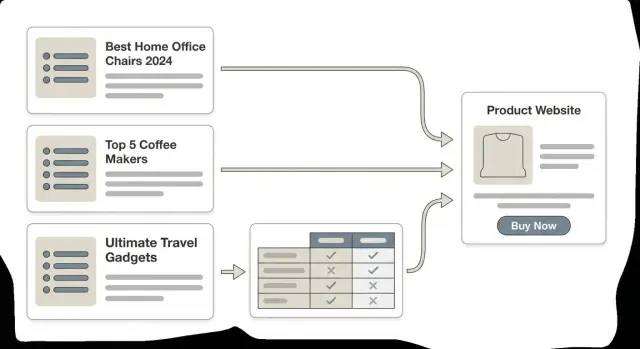
Why “Best X” queries are hard to win
Search “best project management software” (or any “best X” term) and you rarely see a mix of random blog posts. You usually see a wall of roundups: “Best X for Y,” “Top 10 X,” and comparison pages with tables, pros and cons, prices, and “who it’s for.” Even when a brand’s own site shows up, it’s often a dedicated comparison page, not a general article.
That’s because the intent is different. The reader isn’t trying to learn. They’re trying to choose. A how-to post can be well-written and still miss what the query demands: quick options, clear differences, and enough proof that the product is a real contender.
Roundup authors also tend to play it safe. If they’ve never heard of you, they may skip you, even if your product is great. Backlinks matter here in a practical way. They don’t just help you rank. They also make other sites more comfortable mentioning you because they signal that your brand already appears on reputable pages.
Most of what you can control falls into four areas:
- Your page: make it easy to compare (pricing, key features, limits, and ideal use cases).
- Your positioning: pick a clear “best for” angle instead of trying to be best for everyone.
- Your placements: get mentioned on sites that already publish buyer-facing roundups.
- Your proof: show credibility signals (reviews, benchmarks, customer logos) so writers and readers trust the pick.
How roundup SERPs work (in plain English)
When someone searches “best”, “top”, “alternatives”, or “vs”, they’re usually deciding what to buy or try next. Google responds by ranking pages that help people compare options fast, not brand homepages.
You’ll see a few repeating page types: classic listicle roundups (“Best X for Y”), single-product reviews, category pages from marketplaces, and comparison pages built by brands. Any of them can win, but listicles are common because they match the buyer’s mindset: give me options, then help me pick.
A roundup feels trustworthy when it reads like it was written for the reader, not for the vendors. Strong roundups usually show their criteria, include real pros and cons, and provide enough detail that someone can make a decision without opening ten more tabs.
Publishers tend to decide what to include based on fit, proof, reputation, and practicality. They want products that match the angle (budget, enterprise, beginner), have details they can cite, and are easy to understand and validate. Business considerations can matter too, but if the write-up can’t be justified to a reader, it rarely holds up.
This is why “backlinks for Best X roundups” often comes down to being easy to include. If your page makes comparison simple, you reduce the work for the person writing the list.
Example: if a publisher is updating “Best email marketing tools for small stores”, they’ll pick tools they can describe in one tight paragraph with a clear best-for label, a key feature, and a realistic price range. If your site hides that info, you give them a reason to skip you.
Choose the right “Best X” angle to target
Most “Best X” queries look similar, but the winners are built around a clear angle. If your angle is fuzzy, your page and outreach both sound generic, and roundups pass.
Start with one theme that matches what you actually sell and who buys it. If your product is strongest for a specific audience (small teams, regulated industries, agencies), lead with that instead of trying to be “best for everyone.”
A practical way to do this is to map the variations buyers already use when comparing options. You don’t need twenty angles. You need a few that are specific and realistic, such as:
- A use case (teams, beginners, creators, remote work)
- A price tier (budget, mid-range, premium)
- A business type (startups, agencies, enterprise)
- An industry (healthcare, ecommerce, finance)
- A market or compliance need (UK, EU compliance)
Then pick the format that fits your strengths. “Best for” works when you have a clear niche. “Best cheap” only works when price is truly an advantage. “Best enterprise” needs proof of scale, security, or support.
Set a goal that matches where you are today. If your site is newer, the faster win is often getting included in existing listicles rather than trying to rank your own “best” page immediately. If you already have traction and strong proof points, you can do both: earn placements in roundups and build a page that can compete over time.
Example: instead of targeting “best project management tool”, a small-team product might aim for “best project management tool for agencies under 20 people.”
Build a comparison-ready page that roundups can cite
Roundup writers don’t want to guess. They want a page they can skim, pull facts from, and confidently use in a “Best X” list.
Start with clear positioning. Say who the product is for, and who it’s not for. That reduces mismatched clicks (and bad reviews) and helps the writer place you in the right slot, like “best for teams” or “best on a budget.”
A simple comparison table is the fastest way to become citeable. It can be “Us vs typical options” if you don’t want to name competitors.
Also include the details buyers and reviewers look for first: pricing range with real numbers (not just “contact sales”), key limits, setup time, and the top two or three features that match the roundup’s intent. Don’t bury your best points inside a full feature list.
Then add proof that’s easy to verify. Screenshots, a short customer quote with context, and a few basic stats you can stand behind are more convincing than big claims. Avoid “#1” statements unless you can show how you measured them.
Finish with a tight “Why choose us” section written for side-by-side comparison. State what’s different, and be honest about the trade-offs.
Find sites that publish buyer-facing roundups
The easiest wins usually come from sites that already write for people who are about to buy. When you’re pursuing backlinks for Best X roundups, prioritize publishers whose pages are built to help a reader choose.
Start with the sources that most often publish “best” lists: niche affiliate blogs, industry publications with buyer guides, SaaS review sites and directories, agency or consultant blogs that compare tools, and community resource pages that curate tools (not forum threads).
A quick filter helps: if the page reads like a shopping assistant, it’s buyer-facing. If it reads like news, thought leadership, or personal opinion, it’s usually harder to earn a meaningful placement because the format isn’t designed to cite vendors.
Freshness matters. Prefer pages updated recently (even a “last updated” note helps) and clearly targeting “best”, “top”, or “best for” keywords. Those are the pages that keep ranking, which is what makes a placement worth chasing.
Competitor presence is also a good sign. If the roundup already includes companies like yours, you’re arguing “fit and proof,” not “why this category matters.”
Finally, watch for quality red flags. If the page feels template-driven, repeats the same language for every product, or is overloaded with aggressive ads, it may be a weak target. If you wouldn’t trust it as a buyer, don’t build your strategy around it.
Judge placement quality before you chase it
Not every “Best X” mention helps. Before you spend time pitching or paying for placements, decide what you need: authority, relevance, or ideally both.
Start with topical fit. If the site regularly covers your category and speaks to your buyers, the link has a reason to exist. The same roundup on an unrelated site is a warning sign, even if the domain looks big.
Then look at how the roundup is written. Strong roundups show real criteria (pricing, use cases, pros and cons, who it’s for). Weak ones read like generic blurbs with no clear reason any option is included.
Context matters more than people think. A link buried in a list of 50 logos rarely helps as much as a short paragraph that explains why you’re a fit. Ask yourself: would a real buyer click this?
Quick checks that catch most bad opportunities:
- Has the page been updated within the last 12-18 months?
- Are the outbound links mostly on-topic?
- Does the site publish multiple buyer guides, not just one-off posts?
- Is the mention descriptive, not just a name in a table?
- Does the page rank for terms related to the roundup topic?
Example: if you sell accounting software for freelancers, a finance blog that compares invoicing tools with clear criteria can be worth chasing even if the write-up is short.
Plan your placements with a simple tracking system
If you treat placements like random wins, you’ll lose time fast. A basic tracker turns this into a small project with clear inputs and outcomes.
Start by mapping a short set of target keywords to specific ranking roundup pages. Keep it tight: 5 to 10 keywords, and 2 to 4 ranking roundups per keyword. That gives you options without turning research into busywork.
Next, prepare an “inclusion pack” you can reuse. Aim for something an editor can copy quickly: a one-paragraph summary (who it’s for, what it does, what’s different), three differentiators, a couple of clear screenshots, and proof points you can back up. It also helps to include “best fit” and “not a fit” notes. That honesty builds trust and reduces mismatches.
Then choose an acquisition path for each target: direct outreach, partnerships, or pre-arranged placements. Mixing methods is normal, but track them separately so you know what actually works.
A simple spreadsheet is enough. Track the keyword, target page, owner, approach, status, next action date, expected timeline, and your definition of success (for example, a dofollow link to your comparison page, or inclusion in the top section).
Step-by-step: a targeting strategy you can run in a week
Treat Best X work like a short sprint. A week is enough to pick a target, make your page cite-ready, and pursue a handful of placements that match what searchers want.
The 5-step weekly sprint
-
Pick one primary “Best X” query and three close variations. Keep them truly close (same category, same audience, same use case). If the results look different, it’s not a close variation.
-
Build or update one comparison-ready landing page. Put the summary near the top, include pricing or plan info if you have it, and add two or three proof points that are easy to verify.
-
Identify 10 to 20 roundup pages that match the intent. Favor recommendations with pros and cons and “best for” callouts over general explainers.
-
Secure a small number of high-fit placements first. Aim for 2 to 5 placements where you genuinely belong on the list, not “anything that will link to you.”
-
Monitor rankings and conversions, then expand to new angles. After a little time, decide whether to double down on the same query or branch to a nearby angle.
A simple way to stay focused: if a roundup wouldn’t help a real customer decide, skip it.
A realistic example scenario (no jargon)
Say you run a small SaaS called MeetingMinder. It helps remote teams create meeting notes and action items, so you target “best meeting minutes software for remote teams.” People searching that are ready to pick a tool, not just learn.
You publish a comparison-ready page designed for roundups to reference without extra work. It’s not a long essay. It answers the questions a reviewer needs to write a “Best X” post.
That page includes a simple comparison table (key features, integrations, starting price, free trial yes or no), clear pricing snapshots, “who it’s for” and “not for” sections, a short proof block, and a one-paragraph setup guide so reviewers can picture the adoption effort.
Next, you pick roundups to pursue first. Start with niche publications and buyer-facing blogs that already publish “best tools for remote work” posts. They’re often easier to win and can still send qualified visitors. Then move up to larger category sites once you have a few credible mentions.
Success in 30 to 60 days isn’t just counting links. Watch for your comparison page moving up for the main query, a lift in impressions for related “best [category] for [use case]” terms, referral visits from the roundup pages, and more demo starts from visitors who land on the comparison page and keep reading.
Common mistakes that waste time and budget
One of the fastest ways to burn money on listicle SERPs is treating every “Best X” query the same. A broad term like “best project management software” sounds tempting, but if your offer fits a narrower crowd, you’ll look out of place in the roundup and visitors will bounce. Choose an angle where you truly belong.
Another common miss is sending traffic to a generic homepage. Roundups want a page they can cite with confidence. If your page doesn’t compare options clearly, show who it’s for, and answer basic buying questions, editors have little reason to include you and readers have little reason to stay.
It also hurts to chase volume over fit. Ten links from random pages that mention you in passing rarely beat one placement where your product is discussed alongside close alternatives. For Best X roundups, relevance and editorial context usually matter more than raw link count.
Don’t ignore updates. Many “Best X” pages refresh quarterly or twice a year. If you get added once but don’t watch the page, you can get pushed down, replaced, or removed without noticing.
Finally, don’t promise what you can’t back up. Editors and readers are skeptical, and inflated claims make you look risky.
Quick checklist before you invest in backlinks
Before you spend money or time, make sure the “Best X” query is worth it for you. Some listicle keywords look big, but the people searching are only browsing. You want the ones where a reader is close to choosing.
Use this check to avoid chasing placements that won’t move rankings or bring customers:
- Intent match: Do the top results compare products for buyers, and does that “Best X” naturally fit what you sell?
- Page readiness: Does your page show pricing, setup time, key limits, and who it’s for in plain language?
- Target list size: Can you name 10 to 20 relevant roundup sites in your category?
- Reader credibility: Would a normal reader trust the page (clear authorship, realistic recommendations, recent updates)?
- Measurement: Can you track rankings, clicks, and what happens next (signups, demos, purchases)?
A simple gut-check works: if you can’t explain how a placement helps both Google and a human shopper, pause.
Next steps: turn this into a repeatable system
Treat Best X work like a small production line, not a one-off campaign. Start with one or two angles you can realistically support (for example, “best for small teams” or “best budget option”), then reuse the same page structure and outreach brief.
Keep your comparison page fresh. Updating pricing, screenshots, limits, and “who it’s for” sections signals that the page is maintained, which makes editors more comfortable citing it.
For placements, aim for balance. High-authority sites can help rankings, while niche relevance often brings better conversions because the audience is already shopping for your category.
If you want a more predictable way to secure authoritative mentions, SEOBoosty (seoboosty.com) is one option: it focuses on placing premium backlinks from highly authoritative websites, so your brand looks more shortlist-worthy when roundup writers are deciding what to include.
FAQ
Why do “Best X” keywords feel so much harder to rank for than normal blog topics?
Because the searcher is trying to choose, not learn. Pages that win usually make comparison fast with clear options, differences, and proof, while general educational posts often don’t satisfy that decision-focused intent.
How do I pick a “Best X” angle that I can actually win?
Start with what your product is already strongest at, then pick one narrow “best for” angle that matches a real buyer group. If you try to be “best for everyone,” your messaging becomes vague and roundups have no clear slot to place you in.
What page should a roundup link to—my homepage or a dedicated landing page?
Send them to a comparison-ready page, not your homepage. A good target page quickly answers pricing, who it’s for, key features, key limits, and what makes it different so a reviewer can cite it without digging.
What information do roundup writers look for first when deciding whether to include a product?
Keep it simple and skimmable: a short top summary, plain pricing (or a real range), the main use case, and a couple of concrete proof points. The goal is to make it easy for a writer to describe you accurately in one paragraph.
Do I need backlinks before I’ll get included in “Best X” roundups?
Not necessarily, but you need enough credibility signals that you don’t look risky to mention. A few relevant, reputable mentions can make editors more comfortable including you, and can help your own pages compete over time.
How do I find roundup sites that are actually worth pursuing?
Look for pages that read like a shopping assistant: they compare options, explain criteria, and get updated regularly. If the content is off-topic, outdated, or feels like copied filler with no real pros and cons, it’s usually a weak bet.
How can I tell if a placement will help, not just give me a random link?
Prioritize relevance and context over raw domain size. A smaller site that’s tightly focused on your category and gives you a descriptive blurb can outperform a big general site where you’re just a name in a huge list.
What should I include in an “inclusion pack” for editors?
Write a reusable one-paragraph summary (who it’s for, what it does, why it’s different), plus a few proof points you can stand behind. Make it easy to verify and easy to paste, and avoid exaggerated “#1” claims you can’t support.
What’s a realistic one-week plan to start getting traction on listicle SERPs?
Treat it like a short sprint: pick one query and close variations, make one page cite-ready, identify 10–20 fitting roundups, then aim for 2–5 high-fit placements first. Track what you contacted, what changed, and what results you saw so you can repeat what works.
What are the most common mistakes that waste money on “Best X” link building?
The biggest ones are chasing broad terms you don’t fit, sending roundup traffic to a generic homepage, and buying or pitching low-quality listicles that nobody trusts. Another common miss is failing to monitor updates, so you get removed or pushed down without noticing.
Share