Backlinks for brand defense: protect your branded search results
Learn how backlinks for brand defense can help keep your top branded results stable for company, founder, and reviews searches, reducing click-loss risk.
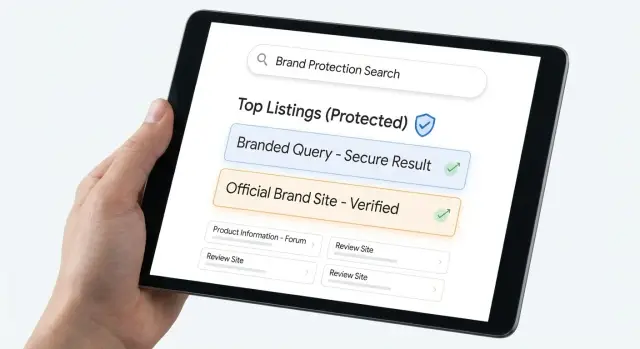
Why brand SERPs need defense
Brand defense means strengthening the pages you want people to see when they search your brand name, your founders, and common trust terms like "reviews" or "pricing". It's not about erasing the web. It's about making your most accurate, helpful pages harder to displace.
Branded searches can shift even when you don't touch your site. A forum thread can start ranking because it gets shared. A directory can refresh its page. A news mention can pick up links. Google also tests different results as it learns what searchers click, and that can move a weak result up or down quickly.
Click loss usually starts when one negative, irrelevant, or confusing result rises into the top three. Most people don't read past the first screen. If a "complaints" page or an outdated profile sits above your official site, you lose clicks you already earned and hand the first impression to someone else.
A simple way to think about backlinks for brand defense: they act like support beams under the results you want to keep stable. When the pages you care about have stronger authority signals, they're more likely to hold their positions when something noisy appears.
A good brand defense approach helps you keep your homepage and key trust pages visible, protect high intent queries (like "Brand reviews" and founder names), and reduce the risk of sudden traffic drops driven by reputation clicks.
Example: a competitor publishes a "Brand reviews" comparison and it starts spreading on social media. If your own reviews or testimonials page has weak authority, that comparison can jump above it and capture the clicks.
The brand queries that usually matter most
Branded search isn't one keyword. It's a small set of query patterns people use when they're close to buying, checking trust, or trying to find the official page. If the wrong page ranks for these terms, you can lose clicks even if your overall SEO looks healthy.
Start with the obvious: your company name, product names, and your domain name. These are navigation searches where people expect to land on your site, your pricing page, or a well-known profile (like a major social account). Spelling variations matter too. People don't type perfectly.
Founder and executive name searches come next. These often spike after podcasts, conferences, hiring news, or funding announcements. The risk is that an old bio, a random directory, or a low-quality post becomes the main result.
Then come trust modifiers. People add words that signal doubt or due diligence, and they often click whatever looks most "independent":
- "reviews" and "pricing"
- "complaints" and "refund"
- "scam" and "legit"
- "alternatives" and "vs"
- "support" and "contact"
If your site doesn't have a clear page that answers these questions, Google fills the gap with forums, thin affiliate pages, or one-off angry posts.
Finally, watch discovery variations tied to where and how people find you. Local intent can show up as "Brand + city" or "near me" if you serve specific regions. App-first brands should also watch app store style searches, where ratings and review snippets can shape clicks even when your main site ranks well.
To prioritize without overthinking it: pull your top branded queries from Search Console, add the trust modifiers above, then check what ranks today and what you want to rank instead.
Set a clear goal for your top results
Before you build backlinks for brand defense, decide what "good" looks like on page one for each branded query. If you don't name the target, you'll end up boosting pages that don't protect you.
A practical goal is simple: the top results should be pages you control, plus a few you trust. For many brands, that means your official site (homepage plus key pages like About, Contact, and Press), your main social profiles, and one or two strong third-party mentions from respected publications.
Define your ideal page-one mix
Pick the branded searches that matter most (brand name, "brand reviews," founder names), then write down the pages you want to see ranking for each.
A clean starting target for many brands looks like this:
- Your homepage plus one deep page (About, Press, or Help)
- Two social profiles you actively maintain
- One trusted third-party article or listing
- One review platform page you can influence with a better profile and consistent responses
Compare that target with what you actually see. Weak spots tend to repeat: thin pages on your own site, old social profiles you forgot about, and third-party pages sitting on low-authority domains that can be pushed around easily.
Separate "unwanted but true" from "wrong or misleading"
Not every negative-looking result is something SEO can "fix." A tough but fair review is unwanted but true. You can still reduce click loss by strengthening your positive and neutral results.
Wrong or misleading is different. In that case, your goal is to outrank it with stronger, more trusted pages and fix the source if possible (request edits, report it, or publish a clarification).
Also be honest about what you can influence. You can usually move pages you own, profiles you control, and third-party coverage you can earn. You often can't move large review platforms quickly, so set goals that match that reality.
How backlinks affect branded search results
Backlinks act like votes of confidence. When trusted sites link to a page about your brand, Google learns that page is worth showing, and it tends to hold its position longer. That stickiness matters for brand terms because you want the same safe set of results to stay on top month after month.
Strong authority signals also help your real pages outrank copycats. If someone publishes a lookalike homepage, a fake support page, or a scraped About page, it can briefly appear for branded searches when your own page is weak. A few high-quality links to your official pages can make it much harder for those copies to compete.
Why third-party pages often win (and how to use it)
For searches like "Brand reviews" or "Brand complaints," Google often prefers independent sources. That means a third-party page can rank above your site even if your site is strong. Instead of fighting that, choose the right third-party pages to support.
In practice, you usually want a mix of assets: your homepage and About page (to own the core brand term), a reviews or testimonials page (to give searchers a safe next click), and one or two reputable third-party profiles or articles that represent you fairly.
What backlinks can and cannot fix
Backlinks can improve rankings and reduce click loss by pushing positive or neutral results higher. They can't remove content, force a site to change a headline, or solve a legal issue.
If a result is defamatory, impersonating your brand, or violating policy, you may need separate actions such as platform reports, legal requests, or PR. Think of backlinks as a ranking tool that helps the best available pages win, not a takedown tool.
Step-by-step: build a simple brand defense backlink plan
A brand defense plan works best as a routine: pick the exact queries you care about, pick the exact pages you want to rank, then support those pages with steady link growth.
1) Start with queries and the current top results
List your priority brand terms (brand name, brand + reviews, founder name). For each one, check what shows up in the top 10 today and note which results you control (site pages, social profiles) and which you don't (review sites, news, forums). This snapshot becomes your baseline.
2) Pick a small set of pages to strengthen
Choose 3 to 6 pages total. Mix owned and third-party pages when it makes sense, but stick to pages that already have a chance to rank.
Good targets usually include your homepage or About page, a dedicated Reviews or Testimonials page, a founder bio page, and one strong third-party profile you can actively maintain.
3) Match each query to one best landing page
Be strict. If the query is "Brand reviews," point most effort to the page that answers reviews, not your pricing page. If the query is a founder name, strengthen the founder bio page, not a random blog post.
4) Build links steadily, then measure weekly
Add links in a predictable rhythm and check movement once a week. Track positions, sitelinks, and which result gets the click. Consistency matters more than constant tinkering.
5) Repeat as separate mini-campaigns
Treat "Brand," "Brand reviews," and founder queries as separate tracks. Each one should have its own target page and progress notes so one problem page doesn't hide another.
Which pages to strengthen (and what to fix first)
Pick link targets based on the exact brand query you're defending.
For plain brand terms, your homepage is usually the safest choice because it matches what people expect to click.
For more specific searches, match intent. An About page often wins for "Brand + company" searches. A Press or News page fits better for "Brand + press," "Brand + funding," or "Brand + announcement." Sending backlinks for brand defense to the wrong page wastes authority and leaves the risky query exposed.
Founder bio pages are worth strengthening if the founder name shows up in autocomplete or gets searched directly. Keep the page complete and current: exact name spelling, role, short background, a clear headshot, and a few credibility signals (speaking topics, notable projects, media mentions). If nicknames or middle initials are common, add an "also known as" line so the page matches variations.
For "Brand reviews" queries, a dedicated Reviews page usually works better than a blog post. Make it helpful, not defensive. Explain how customers use the product, what's realistic, and where people should go for support. If you include testimonials, add context (industry, use case) so it reads like guidance, not a wall of praise.
Before you build more links, tighten what you already control. Make sure your naming is consistent across site and profiles, refresh titles and snippets so they match what people search, keep the target page fast and readable on mobile, and add strong internal links to the target page from obvious places (header, footer, relevant pages). Also claim and update any profiles you own so they support the same naming and message.
Anchor text and targeting without making it look spammy
Anchor text is the clickable words in a backlink. For brand defense, you want anchors that look like something a real editor would use when referencing a company. Plain and consistent usually wins.
A simple rule: make most anchors navigational, not keyword-heavy. If you overdo perfect phrases, your link profile can look manufactured, which is the opposite of what you want when defending branded SERPs.
A natural mix often includes:
- Brand name (exact)
- Brand + a light descriptor (when it fits)
- Naked URL
- Generic navigational anchors like "official site" or "website"
- Product or page names (only when they match the context)
"Reviews" queries need extra restraint. It's fine for some links to mention reviews, but keep it conservative and varied. Editors rarely link with stiff phrases like "Brand reviews 2026." A more believable approach is earning links to pages that genuinely help people evaluate you, such as a press page, case studies, or an FAQ that addresses common concerns.
Avoid putting negative modifiers into anchors, even if you're trying to outrank those terms. Anchors like "Brand scam" or "Brand complaints" can reinforce the association you're trying to reduce.
Targeting matters as much as wording. Point links to pages that deserve to rank: clear ownership, real contact info, strong content, and a good on-page experience.
Common mistakes that backfire in brand defense
Brand defense is mostly about control and consistency. The fastest way to lose both is to treat it like a one-off campaign.
One common mistake is a big link burst followed by months of nothing. That pattern can look unnatural, and it often fails to hold rankings over time. A steady pace is safer and usually works better for branded SERPs.
Another mistake is sending everything to the homepage. If the query is "Brand reviews," the page that should rank is often a dedicated reviews or testimonials page, a press page, or a well-written About page that answers the intent. If you only boost the homepage, you can strengthen the wrong result and still leave the risky query weak.
Anchor text is another easy place to overdo it. If most anchors include "reviews" or other exact-match phrases, it can look spammy. Keep the mix boring.
A quieter problem: trying to outrank major platforms with a thin page. If the top results include big review sites or major social networks, a short, generic page won't compete. Build something worth ranking before you add more backlinks for brand defense.
Quick checklist before you build more links
Before you add backlinks for brand defense, take 15 minutes to check what's already ranking. A little prep prevents you from sending links to the wrong page or strengthening a result you don't control.
Write down the exact searches you care about most (brand name, founder name, and the version that includes "reviews"). Then check the top 10 results for each query in a clean browser (logged out, no personalization) and save the list so you can spot changes later.
As you review, confirm three things:
- You have at least a couple of strong owned pages that could realistically rank for each intent (homepage, About, founder bio, press, reviews hub).
- Your preferred pages are indexable and current (titles, copy, and contact details match reality).
- You're focusing on a small set of high-priority queries first, rather than trying to defend everything at once.
If anything looks off, fix it before you build links. If your founder name search shows an outdated profile, update or publish the right founder page and support that page instead of spreading links across multiple bios.
Set a simple monitoring habit: re-check rankings weekly for a month, then monthly.
Example: defending "Brand reviews" and founder name queries
A common situation: you search your brand name plus "reviews" and a competitor comparison post is above your own page. At the same time, a founder name search shows an old conference bio, a random directory, or a thin profile you don't control. That creates two risks: people click away first, and the results can swing fast when new posts appear.
Pick one home base page for each query. For "Brand reviews," that's usually a reviews hub or a transparent FAQ that answers tough questions directly. For founder queries, it's often a strong founder bio page on your own site with clear credentials and current info.
Before building backlinks for brand defense, make those pages worth ranking. Add proof points that reduce doubt and help the page feel complete: clear support steps, response timelines, screenshots of real workflows (with sensitive info removed), and a straightforward section on how you handle complaints. If you have third-party coverage you can quote, summarize it with context.
Then reinforce the target with links in two layers: links to the main page, plus links to one related supporting page (for example, a "How pricing works" page or a "Security and privacy" page that connects back to the reviews hub). That helps Google see a small cluster of credible pages, not one isolated URL.
Track success with simple signals you can review weekly: rank stability for the key queries (less jumping), click share going to your owned pages, reduced volatility after new competitor content goes live, and fewer surprise results entering the top five.
Next steps: keep your branded results stable
Brand defense isn't a one-time fix. Branded SERPs shift when a new page gets attention, a review site updates its template, or a competitor buys ads on your name. The safest approach is a light routine that keeps your best pages stronger than the alternatives.
A simple 30-day plan is enough to build momentum. Pick a small set of queries (brand name, "brand reviews," founder name), decide which page should win for each, and set a realistic pace. A few high-quality placements usually beat a large burst of low-value links.
This cadence is workable for most teams:
- Week 1: Confirm target pages, fix titles/snippets, and make sure each page clearly answers the query.
- Week 2: Add 1-2 strong links to your highest-priority page.
- Week 3: Add 1 strong link to a second page you want to stabilize.
- Week 4: Re-check rankings and clicks, then repeat what worked at the same pace.
Keep a simple log so you can learn what moves the needle: date, destination page, anchor text, and what changed in rankings and click-through rate after 7-14 days.
If you need a predictable way to secure authority, SEOBoosty (seoboosty.com) offers premium backlinks from highly authoritative websites through a subscription model, which can be useful when you're reinforcing specific brand defense pages that need stronger signals.
FAQ
What does “brand defense” mean in SEO?
Brand defense is the practice of strengthening the pages you want people to see when they search your brand name, product names, founders, and trust terms like “reviews” or “pricing.” The goal is to keep accurate, helpful results stable near the top, not to erase the web.
Why can my branded search results change when I haven’t updated my site?
Because branded SERPs can change even if you do nothing. A forum thread can gain traction, a directory can refresh content, or a competitor post can earn links and jump into the top results, stealing clicks from people who were looking for you.
Which branded queries should I prioritize first?
Start with what already gets searched and clicked: your brand name, common misspellings, your founders’ names, and trust modifiers like “reviews,” “pricing,” “refund,” “support,” and “scam/legit.” Pull real queries from Search Console, then manually check the current top results to see which ones are risky.
How many pages should I build links to for brand defense?
Pick 3 to 6 pages total so your effort isn’t scattered. A strong default set is your homepage, one trust-focused page like About or Contact, a dedicated Reviews or Testimonials page for “reviews” intent, and a founder bio page if founder searches are common.
How do I choose the right page to rank for “Brand reviews” or founder-name searches?
Match the query to the page that best answers it. For “Brand reviews,” send authority to a page that actually addresses reviews and evaluation, not just your homepage; for a founder name, strengthen the founder bio page; for “Brand pricing,” support the pricing page or a “how pricing works” explainer.
What can backlinks fix in brand defense, and what can’t they fix?
Backlinks can help better pages outrank weaker or misleading ones and make your preferred results more “sticky” over time. They can’t delete content, force edits on other sites, or solve legal or policy issues, so pair SEO work with reports, outreach, or PR when needed.
What anchor text should I use so it doesn’t look spammy?
Keep anchors boring and natural: brand name, plain URL-style mentions, or simple navigational phrases like “official site.” Avoid stuffing exact-match anchors like “Brand reviews 2026,” and don’t use negative modifiers in anchors, because that can reinforce the association you’re trying to reduce.
How fast should I build links for brand defense?
Aim for a steady rhythm rather than bursts. For many brands, adding a small number of high-quality links each week for a month, then continuing at a consistent pace, is safer and tends to produce more stable branded rankings than a one-time spike.
How do I measure if my brand defense is working?
Check rankings and click behavior weekly at first, then monthly once things stabilize. Track whether your owned pages stay in the top positions for the key branded queries, whether new “surprise” results enter the top five, and whether clicks shift away from confusing or negative-looking pages.
What are the most common brand defense mistakes that backfire?
Don’t send everything to the homepage, don’t over-optimize anchors with “reviews” phrases, and don’t try to outrank major platforms with thin pages. Also avoid treating it like a one-off campaign; branded SERPs need ongoing maintenance to stay stable.
Share