Backlinks vs content vs technical SEO: where to invest first
Backlinks vs content vs technical SEO: where to invest first, with scenarios for new and stagnant sites, plus a checklist before buying links.
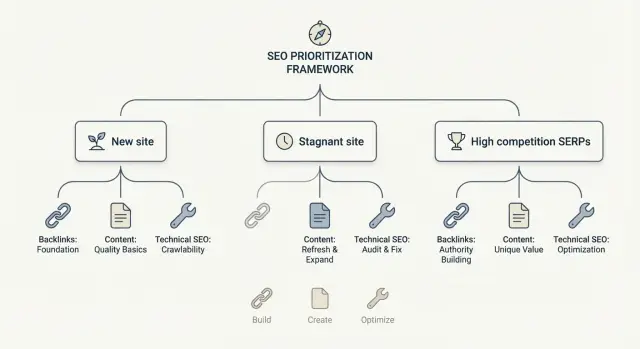
What you are really trying to fix
Before you spend money on content, technical fixes, or links, get clear on the real problem. SEO budgets get wasted when people treat symptoms instead of causes. They buy backlinks when pages aren't getting indexed, or they publish more articles when the site has no authority to compete.
Common symptoms you can spot quickly:
- Traffic is flat or declining even though you keep publishing
- Rankings bounce up and down week to week
- Important pages aren't indexed (or they get indexed, then drop out)
- You rank on page 2-3 but can't break into the top results
- Google shows the wrong page for your main query
Each symptom points to a different bottleneck. Pages not indexed is often technical (crawlability, canonicals, redirects, noindex, internal links). Rankings that bounce can signal weak relevance, thin content, or inconsistent site quality signals. Stuck on page 2-3 often means you're close on content and intent, but you're losing on authority versus the sites above you.
Picking the wrong first move costs more than money. It costs time. If you spend a month writing for pages Google can't reliably crawl, you lose that month twice: once on writing, and again waiting for fixes and reindexing. If you buy links to pages that don't match search intent, you might lift the wrong page, or lift nothing.
A simple decision framework helps. In 15-30 minutes, you should be able to answer three questions:
- Can search engines access and trust the site?
- Does the page deserve to rank for the query?
- Does the site have enough authority to compete?
There are no instant rankings here. The point is to make your next 30-60 days predictable, so your budget goes toward removing the biggest blocker instead of guessing.
Backlinks, content, and technical SEO in plain language
Most people are trying to answer one thing: what will move rankings first with the time and budget they have.
Content is what you publish. It needs to match what people search for and answer it clearly. If your page doesn't match the query, fixing code or adding links won't make it the best result.
Technical SEO is the plumbing. It helps Google crawl your pages, index them, and understand what each page is about. If the plumbing is broken, your best pages might not show up, they might get indexed slowly, or the wrong page might rank.
Backlinks are outside votes of trust. They are links from other sites to yours. In competitive results, links often decide which similar pages deserve to rank higher. Backlinks can lift a page that's already relevant and accessible, but they rarely rescue a page that's off-topic or hard to crawl.
How these three can block each other:
- Great content + weak technical SEO: pages exist, but Google struggles to find, index, or interpret them.
- Great technical SEO + weak content: Google can crawl everything, but nothing strongly matches what people want.
- Great content + great technical SEO + no authority: pages rank for easier terms, then stall when competition is strong.
- Strong backlinks + weak content: you might get a bump, but users bounce and rankings fade.
- Strong backlinks + technical issues: you can waste money pointing authority at pages that don't get indexed properly.
A simple example: you publish a "best project management software" page, but it loads slowly, uses duplicate titles, and Google indexes only part of the site. Even if you buy links, you're boosting a page that still can't compete on relevance and experience. Fix the basics first, then use backlinks as the multiplier.
How to spot the biggest bottleneck fast
Most sites don't need "more SEO." They need one thing fixed first.
If technical issues are the bottleneck
Technical problems usually look like: "we can't rank even with decent pages." Common signs are pages not getting indexed, important pages missing from results, or traffic dropping after a site change.
A strong clue is when you publish or update pages and they don't appear in Google for days or weeks, or they appear and then disappear.
If content is the bottleneck
Content is the bottleneck when Google can crawl and index you, but your pages don't match what searchers want.
In Search Console, you might see impressions without clicks because the title and snippet don't fit the query, or because you're sitting on page 2-5 across many terms. In the search results, the top pages usually answer the topic more fully, match a clearer intent (guide vs product page vs comparison), or cover the practical sub-questions people actually have.
A quick reality check: search your main keyword. If every top result is a how-to guide and your page is a short sales page, intent (and content) is likely the issue.
If backlinks are the bottleneck
Backlinks are usually the bottleneck when you have solid pages that match intent, your site is technically fine, but you can't break into the top results for competitive queries.
A common pattern: you rank for long-tail terms, but you hover at positions 8-20 for the main keywords. When you compare the top pages, they aren't dramatically better than yours, but they belong to sites with stronger authority and more trusted mentions.
A fast triage you can do in one hour
Use this quick check to set your SEO investment priorities without guessing:
- Indexing: are your key pages indexed and stable in results?
- Crawlability: can Google reach them (no accidental blocks, broken templates, endless parameter URLs)?
- Intent match: does your page format match the top 3-5 results for the query?
- Coverage depth: do competitors answer more sub-questions, show clearer examples, or include updated details?
- Authority gap: are the ranking sites broadly more trusted (well-known brands, many quality references)?
Example: a site has 50 pages indexed and no major errors, but most high-intent pages sit at #12-#18 while the top results look similar. That's often an authority gap. Reputable links can help, but only after you confirm the page itself deserves to rank.
If you find yourself saying, "my friend just bought links and it worked," pause. Their site may have had an authority bottleneck, while yours could be technical or intent-related. The symptoms tell you where to spend first.
A step-by-step decision framework (30-60 day plan)
Treat this like a quick diagnosis. The goal isn't to do everything. It's to remove the one thing most likely holding you back right now.
The 5-step plan
-
Confirm pages can be crawled and indexed. Make sure important pages aren't blocked (noindex tags, robots rules, broken redirects, endless duplicate URLs). If Google can't reliably access and store the page, content and links won't help.
-
Confirm you have pages that deserve to rank. Pick 5 to 10 priority queries. Do you have a page that matches the intent clearly (a real guide, a real comparison, a real product page)? If the best page is thin, unclear, or missing key sections, fix that before spending on authority.
-
Check whether competitors win mainly on authority. Compare the top results. If their pages are similar in usefulness but come from much stronger domains with more mentions and links, authority is likely the gap. If their pages are simply better (more complete, more specific), content is the gap.
-
Pick one primary focus for the next 30 to 60 days. Choose the lane most likely to move rankings fastest: technical fixes, content upgrades, or authority building. Do light maintenance on the others, but don't split your main effort.
-
Set 2 to 3 measurable checkpoints. Track things you can verify:
- Priority pages indexed and staying indexed
- 10 tracked keywords moving from page 5+ into pages 2-3
- Click growth to the updated pages (not total site traffic)
A quick example
If you update three key pages and they get indexed but rankings barely move, then you compare the results and see competitors with much stronger domains, your next 30 days can focus on authority.
Scenario 1: a new site with little to no visibility
A new site usually has two problems at once: Google doesn't trust it yet, and there's not enough content for search engines to understand what it should rank for. New sites often get the fastest progress by doing a little of all three, in the right order.
Week 1: do the basics so nothing gets wasted
Before you write more or think about links, make sure the site can be crawled, indexed, and understood.
- Check that important pages are indexable (not blocked by noindex, robots.txt, or a login wall).
- Submit a sitemap and make sure it includes only real, valuable pages.
- Set up clean navigation so every key page is reachable in a few clicks.
- Create a basic internal linking pattern (home -> category/service -> supporting pages).
- Make sure the site works on mobile and loads reasonably fast.
If you skip this, even great content and backlinks can land on pages that don't get indexed or don't pass value through the site.
Minimum viable content set (so Google knows what you are about)
Aim for a small, clear starter set rather than dozens of thin posts. Most new sites should have core pages (Home, About, Contact, and a clear Services or Products page), a small set of category or service pages that match real search intent, and 3 to 5 helpful posts that answer specific questions your customers ask.
Example: if you launch a local accounting site, publish one strong page per service (bookkeeping, tax filing, payroll), plus a few posts like "What records to keep for taxes" or "How payroll deadlines work." Each post should link back to the relevant service page.
When backlinks help (and when they are premature)
Backlinks help once foundations are in place and you have a few pages worth ranking. They're most useful when you already know which pages matter (often category or service pages) and you can point authority there.
They're premature when the site has only a homepage, thin content, or indexing issues. In that case, you're buying attention for pages that can't convert or rank yet.
A practical rule: build the minimum content set first, fix indexing and internal links, then add a small number of high-quality links to your main money pages.
Scenario 2: a stagnant site that stopped growing
Growth usually stalls for one of two reasons: your pages stopped matching what people want (content problem), or competitors with similar pages outrank you because they're trusted more (authority problem). Sometimes it's both.
A quick way to tell is to pick 5-10 important pages and look at what changed:
- If impressions dropped or never recovered after an update, check intent and relevance first.
- If impressions are steady but clicks are down, your titles/snippets may be weak or competitors are answering the query better.
- If rankings are stuck on page 2-3 for strong pages, authority is often the limiter.
- If many pages compete for the same keyword, you likely have cannibalization (a technical + content mix).
Quick content refresh ideas (fast wins)
Refreshing what already ranks is often cheaper than publishing from scratch.
Focus on intent match, structure (clearer headings and a tighter order of sections), missing subtopics (pricing, steps, pros/cons, FAQs), and fresh proof (updated screenshots, stats, examples, and dates where they matter).
Example: a SaaS company has a "project management checklist" post stuck at position 11. A refresh that adds a simple 10-step checklist, answers common questions, and removes fluff often lifts it into the top 10 without any new links.
Technical checks that commonly hurt established sites
Mature sites collect clutter. The usual culprits are duplicate pages (filters, tags, near-identical posts), cannibalization (multiple pages targeting the same term), and internal links that point to the wrong version.
Before you overhaul everything, run a simple test: choose one page that's close to winning (positions 8-20), improve only that page for 2-3 weeks, and watch what happens. If it jumps with better content and cleanup, scale the method. If it barely moves, you may need more authority.
Scenario 3: high-competition SERPs
High-competition results are crowded for a reason. The top pages usually have years of trust, strong brands, and a tight match to search intent. You also tend to see deep topic coverage, clean structure, and plenty of credible sites linking in.
A quick check: search your main keyword and ask, "Are these results clearly better than mine?" If the top pages answer faster, cover more related questions, and look more trustworthy, you're not losing because you need a few tweaks.
Niche down or fight head-on
If you're smaller, the fastest path is often to narrow the angle. Instead of going straight for the biggest term, win a set of tighter queries where you can be the obvious choice.
- Niche down when the top results are major brands and your offer is more specific.
- Fight head-on when you already have a strong product, proof, and a page that can realistically beat the top 3.
- If you can't name a clear advantage, niche down first and build momentum.
Content and backlinks: fewer, stronger, and measured
Content usually works best here as fewer pages, stronger pages. Pick one money page and make it unmistakably useful: a clearer angle, better examples, tighter structure, and sections that answer follow-up questions.
Backlinks matter, but the goal isn't raw volume. This is the phase where links often become the difference maker after your page is already competitive. Look for quality signals: relevant sites, real editorial context, and strong site authority.
Expect slower wins. Track a small set of keywords, watch conversions (not just rankings), and make changes in tight cycles so you can see what actually moved.
What to fix before buying links
If you point backlinks at a page that Google can't properly crawl, understand, or trust, you're paying to amplify the wrong thing. Make sure the page deserves to rank and is eligible to rank before you add authority.
Technical must-haves (so the page can actually benefit)
Start with the basics that decide whether your page is even in the race:
- Confirm the page is indexable (not blocked by noindex, robots rules, or accidental login walls).
- Check canonicals: the page should usually self-canonical, not point to a different URL version.
- Fix redirects: avoid sending links to URLs that 301 to another page unless that's the intended final target.
- Make it work on mobile: readable text, tappable buttons, no broken layouts.
- Ensure the preferred URL is consistent (http vs https, www vs non-www, trailing slash rules).
If any of these fail, backlinks can still attract crawlers, but the ranking lift often gets muted or lost.
Content must-haves (so rankings stick)
Links can help you get noticed, but content is what keeps you there. Before you invest, look at the target page like a first-time visitor would:
- Match search intent: answer the exact question the query implies, not the one you wish people asked.
- Add useful depth: explain the how, the tradeoffs, and the next steps, not just definitions.
- Bring an original angle: a small comparison table, a real example, or a point of view based on experience.
- Clean up internal links: make key pages easy to reach and use clear anchor text.
- Avoid thin or duplicated pages: don't buy links to near-identical location pages, copied descriptions, or placeholder posts.
A quick gut check: if you wouldn't confidently share the page with a customer, don't buy links to it.
Trust basics (so the site feels real)
Basic credibility signals matter. Make it easy to find who runs the site and how to reach them. An About page, clear contact details, and policies (when relevant for payments, data, or health topics) reduce doubt.
Example: you have a service page that's well written, but the URL isn't indexable because it accidentally has a noindex tag. Buying links now is like putting up billboards for a closed store. Fix indexation first, then invest.
Common mistakes that waste SEO budget
SEO spend gets wasted when people treat tactics like a vending machine. They buy something (a tool, content, links) and expect rankings to jump, even when the page isn't ready.
A common error is sending all link equity to the homepage. It feels safe, but it often doesn't move the pages that actually need to win. If your money page or guide targets the query, that's usually where support should go after it's solid.
Another budget killer is pushing links to pages that don't match search intent. For example, you build links to a product page for a keyword where Google clearly prefers a comparison article. Even with strong links, the page can bounce around because it's the wrong type of answer.
Chasing quantity over relevance also burns cash. Ten random placements on weak, unrelated pages rarely beat one placement that's clearly editorial, on a relevant site, pointing to a page that deserves it.
Mistakes that often show up together:
- Over-optimizing anchors or repeating the same keyword phrasing in every link
- Spreading budget across too many pages with no clear priority
- Publishing lots of similar content that competes with itself
- Ignoring internal links, then wondering why authority doesn't flow to key pages
- Buying links before confirming indexing, canonicals, and tracking are working
Changing too many things at once makes it worse. If you update titles, rewrite content, change internal links, and add links in the same week, you won't know what caused the lift (or the drop). Make one meaningful change, measure, then move to the next.
Quick checklist and next steps
If you're stuck choosing between backlinks, content, and fixes, treat it like a quick health check. The goal isn't to do everything. It's to remove the one thing holding your pages back right now.
Fast checks you can do in under an hour:
- Confirm important pages are indexed and not blocked (no accidental noindex, wrong canonicals, or redirect loops).
- Check speed basics on key pages (slow pages can lose clicks even when they rank).
- Make sure internal links exist from your main navigation and related articles to your money pages.
- Map your top 5-10 pages to one clear keyword intent each (avoid two pages fighting for the same query).
- Look at titles and snippets in search results and ask: would you click this over the top 3?
Once that's done, pick a simple 30-day plan you can actually finish:
- Technical: fix the top 3 issues that affect many pages (indexing problems, broken templates, missing titles).
- Content: publish or refresh 4 pieces tied to real queries, not "nice to have" topics.
- Links: choose 1-3 pages that already convert (or are close) and plan a small, controlled set of links to those pages.
Measure progress without getting lost in dashboards: track 10-20 target keywords, watch impressions and clicks in Search Console, and measure what matters (leads, sales, signups) on the pages you improved.
If links are the right next step, treat them like a test. Point links to specific pages, annotate the date, and compare performance to similar pages you didn't build links to.
If you want to skip outreach and buy placements directly, SEOBoosty (seoboosty.com) is positioned around premium backlinks on authoritative sites through a subscription model, where you choose domains from a curated inventory and point links to the pages you're testing. Use that kind of approach only after your target page is indexable, intent-matched, and strong enough to hold the ranking.
FAQ
How do I know whether to spend on technical SEO, content, or backlinks first?
Start by identifying the symptom you’re seeing and map it to the most likely bottleneck. If key pages aren’t getting indexed reliably, fix technical issues first. If pages are indexed but don’t satisfy the query, upgrade content and intent match. If pages are strong and stable but stuck behind bigger sites, authority (often backlinks) is usually the next lever.
What’s the quickest way to confirm Google can index my important pages?
Check whether your priority URLs are indexable and actually indexed. The most common blockers are accidental noindex, robots rules, bad canonicals pointing elsewhere, and redirects sending Google to a different page than the one you’re trying to rank. If indexing is unstable, spending on content or links tends to get muted because Google can’t consistently store and trust the page.
How can I tell if my content doesn’t match search intent?
Search the main keyword and look at the top results’ page type and structure. If the results are guides and your page is a product pitch, you’re misaligned on intent. Make your page the same “kind of answer” users are clearly rewarding, then add depth that covers the sub-questions people have before they choose or act.
When is it an authority problem instead of a content problem?
If your page is comparable in usefulness to the pages above you, is indexed, loads нормально, and rankings hover around positions 8–20, that’s often an authority gap. Another sign is when competitors aren’t clearly “better,” but they’re from brands or domains with more trusted mentions. In that situation, backlinks can be the multiplier once the page itself is already competitive.
What should I fix before buying backlinks?
Don’t buy links until the target page is eligible to benefit. Make sure it’s indexable, self-canonical in most cases, not stuck behind redirect chains, and reachable through internal links. Then confirm the page genuinely deserves to rank by matching intent and covering the key decision points, so any boost you buy has something solid to lift.
What’s the best order of operations for a brand-new site?
For a new site, do the crawl/index basics first so nothing gets wasted: clean navigation, a correct sitemap, and no accidental blocks. Next, publish a small set of “core” pages that clearly define what you offer and a few supporting articles that answer real customer questions. Once you have pages worth ranking, add a modest number of high-quality links to the pages that matter most.
Why is my traffic flat even though I keep publishing new content?
Flat traffic despite publishing usually means you’re producing pages that aren’t winning on intent, depth, or distribution. First confirm that new and updated pages are getting indexed quickly and staying indexed. Then compare your content to the current top results and improve the pages that are already close, because refreshing near-winners is often faster than publishing more new posts.
What causes rankings to bounce up and down every week?
Volatile rankings can come from weak relevance signals, thin or inconsistent content quality, or technical inconsistencies that create duplicate or competing URLs. It can also happen when multiple pages target the same query and Google keeps testing which one to show. Stabilize by clarifying the primary page for each intent, tightening on-page relevance, and cleaning up duplicates and internal links.
What is keyword cannibalization, and how do I fix it?
Keyword cannibalization happens when two or more pages on your site compete for the same query or very similar intent. The fix is usually to pick one primary page as the “winner,” then either merge overlapping content, differentiate the intent, or adjust internal linking and titles so Google understands which page is the best match. This often improves stability and helps authority concentrate instead of splitting.
How should I measure progress over the next 30–60 days?
Pick a small set of priority pages and track outcomes tied to those pages, not the whole site. Watch whether they stay indexed, whether impressions and clicks rise in Search Console, and whether target keywords move from deeper pages into pages 2–3 and then the top results. Change one major thing at a time—like a content upgrade or a link test—so you can tell what actually moved the needle.
Share