Backlinks and entity signals for brands: how to align them
Learn how backlinks and entity signals for brands work together by aligning anchor context, About info, and citations so authority links support one clear brand.
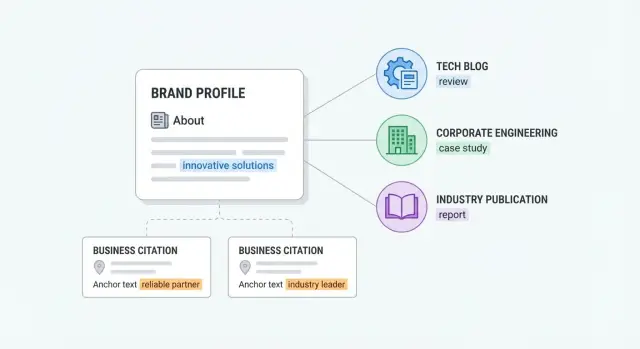
Why brands get mixed signals in search
Search engines do more than rank pages. They try to understand what a brand is, what it’s known for, and how it relates to topics, products, people, and places. When that understanding is fuzzy, your site can show up for the wrong searches, or not show up for the searches you actually want.
An “entity” is a known thing with attributes. For a brand, that often includes your official name, website, location, founders, products, category, and the common ways people describe you. If different parts of the web describe you in conflicting ways, Google can connect your brand to the wrong category, or treat it like multiple separate entities.
Mixed signals usually come from a few repeat offenders:
- Backlinks that use unrelated or inconsistent anchor text and surrounding wording.
- A vague About page that’s missing key facts or contradicts other pages.
- Citations (directory listings, profiles, mentions) that don’t match on name, address, or category.
- High-authority mentions that spotlight a side topic that isn’t your main offer.
The cost is real. You can end up ranking for broad, low-intent terms while missing high-intent queries. You can also lose trust signals that help the right pages win, especially in competitive spaces where many brands look similar.
A simple example: a SaaS brand sells payroll software, but a few strong articles link to it using anchor text like “HR templates” because an old blog post went viral. Over time, the brand can start to look more like a content site than a payroll product company.
Backlinks and entity signals need to work together. The goal is to align three things so they tell one clear story: link context (what other sites say), on-page About information (what you say), and consistent citations (what the wider web repeats). If you use a placement service such as SEOBoosty (seoboosty.com), that clarity should come first so authority links reinforce the right entity instead of amplifying the wrong one.
How backlinks reinforce (or confuse) brand meaning
A backlink does more than pass PageRank. It’s also a public statement about what your brand is, what it does, and what it’s related to. When many sites repeat the same story, Google gains confidence in your brand entity. When the story varies, your brand meaning gets fuzzy.
What a backlink communicates beyond “authority”
A link sends clues through the words and pages around it, not just the clickable text. Even the same referring domain can help in one article and confuse in another if the surrounding context changes.
In practice, backlinks tend to signal:
- Topic and fit (what the page is about, and where you belong in that topic)
- Relationship (partner, tool, founder story, review, comparison, citation)
- Category (agency, SaaS, local business, publisher)
- Scope (one product vs a broader brand)
This is why authoritative sites can amplify both good and bad messaging. If a well-known publication describes you as a “PR tool” when you’re actually an “SEO platform,” that mismatch can echo across other sites that reuse the wording.
If you’re building backlinks to strengthen entity understanding, aim for repeatable language: one clear category, a small set of consistent offers, and a simple “why it matters” framing that shows up across placements.
Homepage link vs specific page link
A homepage link usually supports your overall entity: brand name, category, and trust. A link to a specific service or product page supports a narrower meaning.
For example, a brand that sells both “link building subscriptions” and “SEO audits” can get pulled in two directions. If most authority links go to the audit page, Google may associate the brand more with audits than link building, even if link building is the core business.
Treat the target URL as part of the message. The best placement in the world can still create confusion if it points at the wrong page.
Anchor text and surrounding context: what to aim for
Anchor text is a small detail that can shape the story search engines learn about your brand. If the words in the link and the sentences around it point to different meanings, you end up with mixed intent: are you a brand, a product, a service category, or a person?
A healthy backlink profile usually mixes a few anchor styles, because that’s how people write in real life:
- Branded: your brand name (with or without “Inc.”, “official”, etc.)
- Partial match: brand plus offer (for example, “Acme Analytics dashboard”)
- Descriptive: what the page is (for example, “pricing page” or “case study”)
- Generic: “learn more”, “this website”, “here”
Choosing anchors is less about forcing keywords and more about matching how customers talk about you.
If your real-world name is “SEOBoosty,” don’t build lots of links using only a generic keyword like “premium backlinks.” Mix in branded and brand-plus-offer phrasing so the “who” stays clear while the “what” is still understood.
Just as important is the text around the link. The surrounding sentence should confirm what your brand is and what the linked page is for. A simple pattern works well: brand name + category + proof point.
For example, instead of placing a link in a sentence that only says “best SEO tool,” use something like: “SEOBoosty offers premium backlink placements from authoritative sites, with plans for small businesses and teams.” That context helps the link reinforce an entity (your brand), not just a keyword.
Exact-match anchors can be useful, but they’re easy to overdo. Avoid them when the keyword is ambiguous, when you’re early in brand building and need stronger branded signals, when multiple pages could fit the keyword, or when the source site is unrelated and the match feels forced.
Aim for anchors and surrounding text that sound natural, name the brand, and describe the offer in plain language.
Create a simple brand-topic map (before you build links)
Before you chase more backlinks, decide what you want Google (and people) to understand about your brand in one sentence. Confusion often starts when a brand tries to be known for five different things, and link writers pick whatever wording feels convenient.
Start by choosing 1-2 primary topics. Think of the two phrases a customer would use when recommending you. If you sell many services, pick the ones that matter most for revenue or long-term positioning, not the “nice to have” offers.
Next, write a short set of “allowed descriptors”. These are the consistent words you want to show up in link context, page copy, and citations: your category, main service type, audience, and location (if local). Keep it in customer language. If customers say “IT support” and you keep writing “managed infrastructure solutions,” you’re creating two competing stories.
Then map each descriptor to the best page on your site, so links land where the meaning is clearest:
- Primary topic: homepage or main category page
- Specific service: dedicated service page
- Audience angle (for example, “for startups”): focused landing page
- Proof (case studies, certifications): credibility pages that support the main topic
A quick example: a payroll brand wants to be known for “payroll for small businesses” and “contractor payments.” If authoritative links point to the homepage with anchors about “HR software,” the entity picture gets blurry. A simple map makes it easier to brief anyone placing links so authority reinforces one clear identity instead of drifting.
On-page “About” signals that help confirm the entity
Your About page is where search engines and people go to confirm what your brand is, not what you wish it to be. If your backlinks mention you as “a B2B SEO provider” but your About page reads like a general marketing studio, you create doubt. This page often decides which story wins.
Make the first screen painfully clear. Within the first few lines, state your brand name, what you do, and where you operate (or whether you’re remote or global). Avoid clever taglines that could fit any company. Clarity beats creativity here.
What to state upfront (and keep consistent)
Include the details that other sites tend to cite when they mention you. That gives writers something solid to match.
- Exact brand name (same spelling and spacing used elsewhere)
- Main offering in plain words (one primary category)
- Primary audience or industry focus (1-3 areas)
- Location or service area (city, region, or “global”)
- One proof point (team background, years, notable work types)
After the basics, add supporting detail that reinforces the same meaning your best links are already pushing. If your strongest mentions frame you as “enterprise link building,” your About page should use that language somewhere and explain it simply. If mentions focus on “technical SEO,” don’t bury that behind vague “growth services.”
Match citations, contact info, and branding
Entity understanding depends on consistency. Make sure the About page uses the same logo version, brand name, and contact details that appear in directories and partner pages.
A simple example: if SEOBoosty is repeatedly described across the web as providing premium backlinks from authoritative publications, the About page should say that clearly and use the same core identity details elsewhere. If the page instead leads with “we help brands grow online,” you force search engines to guess, and your strongest links may not connect cleanly to the right entity.
Consistent citations: the quiet signals that add up
A citation is any mention of your brand’s core details online, with or without a backlink. Think: brand name, address, phone number, and category, plus small variations like “Inc.” vs “LLC.” Search engines use these repeated mentions to confirm who you are and whether all signals point to the same real-world entity.
Citations are the background choir. A few high-authority links can help a lot, but if dozens of places disagree about your details, the overall picture gets fuzzy.
Consistency is mostly boring, but it matters. Pick one exact format for your brand name, address, phone, and business category (one primary, a few secondary). Most mismatches come from normal changes: a rebrand, a move, a new call tracking number, or someone creating a fresh profile instead of updating an old one.
To avoid confusion, decide your “source of truth” and document it in one place. For many brands, that’s the website footer and contact section, plus a short internal note that anyone can copy and paste.
A simple rule: before you place new authority links, confirm the target page and the brand details on that page match your source of truth. That way, links and mentions reinforce one clear identity instead of splitting it.
Step-by-step: align links, pages, and citations in one workflow
If you treat backlinks, on-page copy, and citations as separate projects, you often end up telling search engines three different stories. A single workflow keeps everything pointing to the same brand entity.
A practical 5-step workflow
- Write a one-sentence brand definition + primary topic. Example: “Acme is a payroll app for small restaurants.” Keep it short enough that your team can repeat it.
- Update the homepage and About page to mirror that sentence. Use the same wording for what you do, who you serve, and where you operate (if location matters).
- Standardize brand details everywhere. Pick one official name format, one address format, one phone format, and one short description. Put them in a shared note so nobody improvises.
- Choose target pages and anchor styles for each topic. Decide which page “owns” each topic (homepage vs service page). Then choose a safe mix: brand name, brand + topic, and natural phrases that fit your definition.
- Review new backlinks for context fit before scaling. Check the surrounding sentences, page theme, and whether the link reinforces your definition or pulls you into a different category.
A quick alignment test: read your one-sentence definition, then read a backlink paragraph that mentions you. If it sounds like two different companies, fix the page copy, the citation text, or the anchor plan before you build more.
If you use a provider like SEOBoosty for authority placements, this workflow helps you choose destinations and wording so high-trust links add clarity instead of noise.
Example scenario: when authority links point at the wrong story
Imagine an online brand called Northbay Wellness. They started as a CBD skincare store (Service A). A year later, they expanded into telehealth weight-loss coaching (Service B), which is now their main offer.
Their strongest backlinks were earned during the skincare phase. Those articles still describe them as a “CBD skincare brand,” and the anchors and surrounding text mention lotions, creams, and topical products. But the homepage and new landing pages talk almost entirely about coaching and prescriptions. To a search engine, that can look like two different entities or an unfocused brand.
Here’s what they changed to realign signals without rebuilding the site from scratch.
First, they rewrote the About page to tell one clear story: who they are today, what they do, and how the old product line fits in (as a legacy offer, not the core identity). They also added a dedicated page for the skincare line and made it the primary destination for skincare-related mentions.
Next, they adjusted link targeting and language:
- Weight-loss backlinks went to the coaching hub page (not the homepage)
- Skincare backlinks pointed to the skincare page
- New outreach briefs asked for anchors like “Northbay Wellness weight-loss program” instead of “CBD skincare brand”
- Partners updated a few high-value old mentions where possible
Over the next 4 to 8 weeks, the expected outcome is cleaner relevance: weight-loss pages start ranking for weight-loss intent queries, while skincare traffic either stabilizes on the right page or fades without confusing the main brand. When they later add a few authority placements (for example, via a curated inventory like SEOBoosty), those links reinforce the same story instead of pulling the brand back into its old category.
Quick checks before you build more backlinks
Before you buy or earn another link, make sure search engines can describe your brand in one clean sentence. If your pages say one thing and your links say another, even strong authority can pull in different directions.
Start with your About page. In the first screen of text, does it state your main offering in one simple line (who you are, what you do, for whom)? If a reader has to guess, Google may guess too.
Then compare how you describe yourself on-site with how other sites describe you around the link. The anchor matters, but so do the few words before and after it. If those descriptors swing a lot (agency vs software vs blog), treat that as a warning sign.
Here’s a quick checklist you can run in 10 minutes:
- Read your homepage title and main heading. Do they match what your best backlinks call you?
- Open your top backlinks and scan the sentence that contains the link. Are the same 2-3 descriptors used most of the time?
- Check where links point. If the link text mentions a specific service, does it land on the page that is clearly about that service?
- Look at your brand name format (spacing, punctuation, suffix like Inc). Do citations and profiles match it exactly?
- Confirm your About page uses the same core phrasing as your homepage and key service page.
A practical example: if high-authority links say “SEO platform,” but your homepage says “link building service,” either send future links to the page that matches the phrase, or adjust on-page wording so both tell the same story.
Common mistakes that weaken entity clarity
Search engines try to understand your brand as a single, stable “thing” (an entity). Entity clarity drops when your backlinks, page copy, and citations point to different stories about what you are.
Patterns that confuse the signal
Over-optimizing anchors is one of the fastest ways to create problems. If ten sites all use the same exact keyword anchor, it can look manufactured. It also narrows the meaning too hard, so your brand stops sounding like a real company and starts sounding like a target phrase.
Another common issue is mismatch between the anchor and the destination page. For example, links that say “enterprise backlink platform” but land on a generic homepage that never explains the product, who it’s for, or what it does. The link is trying to define you, but the destination page can’t confirm it.
Outdated citations are quieter but just as damaging. Old brand names, previous descriptions, or abandoned profiles can keep competing with your current identity.
Where brands trip up most
These mistakes show up again and again:
- Repeating one anchor too often, especially exact-match keywords across many sites.
- Pointing links to the wrong page type (a blog post when the anchor implies a product, or a product page when the anchor implies a service).
- Mixed positioning on your own site (agency on one page, tool on another, media brand somewhere else).
- High-authority mentions that put you in the wrong category.
- Old citations left live with an outdated name or description.
A concrete example: if SEOBoosty earns a strong mention from a major tech blog but the write-up frames it as an “SEO news site,” that authority can reinforce the wrong category. You reduce the damage by making sure your About copy clearly defines what you are, and by guiding future placements to use wording that matches that definition.
Next steps: reinforce one clear entity with the right authority links
Pick one main idea you want search to remember about your brand over the next 90 days. Keep it simple: who you are, what you do, and who it’s for. If you push three different “main stories” at once, your strongest links can end up supporting different meanings.
Write a short “approved wording” note your team can reuse. It should include a few safe anchor options and a one-sentence description that matches your About page.
A short checklist that tends to move the needle:
- Choose 1 primary topic and 2 supporting topics you want linked mentions to reinforce.
- Create 5 to 8 approved anchor phrases (mix branded, partial-match, and natural anchors).
- Decide which 2 to 3 pages best explain your brand (often the About page, a core service page, and a key proof page).
- Review 20 existing backlinks and flag any that point to the wrong page or focus on the wrong topic.
- Schedule new placements that match your topic map and point to pages that do the explaining.
When you audit, don’t stop at the anchor text. Read the sentence around it. A “good” anchor inside a paragraph about an unrelated topic can still confuse the story.
Example: a brand that sells cybersecurity tools earns a powerful link inside an article about “remote hiring.” Even with a branded anchor, the surrounding context trains search to associate the brand with hiring software. The fix isn’t to chase more links. It’s to secure placements where the surrounding text matches your chosen topic and the link lands on a page that confirms it.
If you want to add authority links without long outreach cycles, SEOBoosty can be useful because it lets you choose placements and point links to the specific pages that define your brand. Just make sure your topic map, About copy, and citation details are already aligned so those links strengthen one clear entity.
FAQ
What does “entity” mean for my brand in SEO?
An entity is how search engines represent a real “thing” like a company, product, person, or place. For a brand, it’s the combined set of facts and descriptions the web repeats about you, such as your name, site, category, offerings, and who you serve.
Why would my brand show up for the wrong searches even with good content?
It usually means different sources describe you in different ways, so search engines can’t settle on one clear category. The result is showing up for the wrong intent, missing the right intent, or splitting your brand into multiple “versions” of itself.
How can backlinks change what Google thinks my brand is about?
Because links carry meaning through the anchor text and the words around the link, not just authority. If strong sites repeatedly mention you with off-topic wording, that narrative can become the dominant story search engines learn about you.
What anchor text mix is safest for brand clarity?
Default to a natural mix that keeps the “who” clear while describing the “what.” Use plenty of branded anchors, add some brand-plus-offer anchors, and keep descriptive or generic anchors where they fit the context so the profile looks like real writing.
When should I link to the homepage vs a specific service page?
A homepage link tends to strengthen your overall brand identity and category, while a deep link strengthens a specific product or service meaning. If the link text is specific, point it to the page that explains that specific thing clearly, so the destination confirms the message.
What should my About page include to support entity clarity?
State your brand name, what you do in plain words, who you do it for, and your location or service area if it matters. Make sure this matches what your best backlinks and mentions already say, so search engines don’t have to guess which description is true.
What are citations, and why do they matter if they don’t include backlinks?
Citations are repeated mentions of your core business details, with or without a link, such as name, address, phone, and category. They matter because consistency across many small sources helps confirm you’re one real entity, and inconsistencies create noise that can weaken relevance.
What’s a simple workflow to align links, on-page text, and citations?
Start with one sentence that defines your brand and primary topic, then align your homepage and About page to that sentence. Standardize your brand details as a source of truth, choose target pages and anchor styles per topic, and review new links to ensure the surrounding context matches your definition.
How do I diagnose “mixed signals” in my existing backlink profile?
Scan your strongest backlinks and read the full sentence around each link, not just the anchor. If the surrounding wording describes a different category than your site does, adjust future placements, update key on-page language (especially About), and consider changing the target URL so each topic points to the right page.
How should I use SEOBoosty placements without confusing my brand entity?
Use it when your positioning and on-page basics are already clear, then brief placements with consistent category wording, sensible anchor options, and the right target pages. With a placement service like SEOBoosty, the key is making sure authority links reinforce your chosen identity instead of amplifying an old or off-topic description.
Share