Backlinks for Featured Snippets: Win and Keep PAA Spots
Learn backlinks for featured snippets: how to choose snippet-ready queries, format answers for extraction, and track ownership so you keep wins.
What makes snippets and PAA hard to win consistently
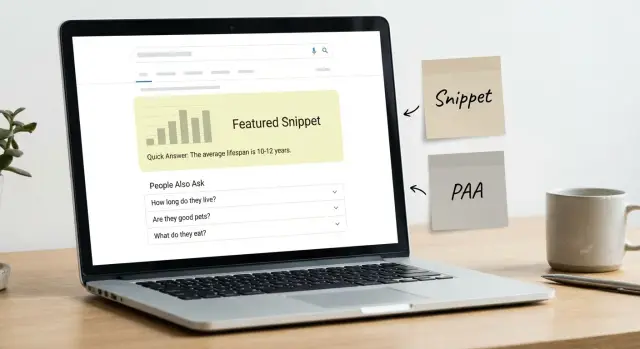
Featured snippets are the short answer boxes at the top of Google results. People Also Ask (PAA) is the set of expandable questions that show quick answers and often link to a page. Both can drive meaningful clicks, but they’re hard to hold because Google can swap the “winner” at any time.
Ranking #1 doesn’t guarantee you get the snippet. Google often picks the page that matches the question format best, not the highest-ranking page. You might rank well with a long guide while a competitor takes the snippet with one clean, direct definition.
Snippets and PAA also change often. Google tests different sources, rewrites how it shows the answer, and sometimes replaces a snippet with a different SERP feature. So a one-time push isn’t enough. You need a repeatable way to win, monitor, and defend.
Ownership usually gets unstable for a few reasons. The query can have mixed intent, so Google rotates sources. Your page might contain the right information, but the answer is buried, wordy, or inconsistent. Competitors may format their answer in a way that’s easier to extract (tight paragraphs, short lists, simple tables). And when several pages look similarly “extractable,” trust signals can tip the scale.
That last point is where backlinks for featured snippets can matter, but only in the right context. Links rarely force a snippet if your answer is poorly structured. They can help when Google is choosing between two well-formatted pages. Think of backlinks as confidence and on-page formatting as readability. You usually need both to win and keep the spot.
Pick snippet-friendly queries that fit your site
Start by checking what Google already shows for the query. If you see a Featured Snippet at the top or a People Also Ask box with repeat questions, it’s a clear sign the topic is “extractable” and worth targeting. If the page is dominated by ads, local packs, or shopping results, it’s usually a tougher fit for snippet goals.
A good snippet-friendly query can be answered clearly in about 40 to 60 words without sounding vague. If you can write a complete answer that includes a simple definition, the key condition, and a quick example, you’re in the right zone. If the answer needs a full guide, research, or lots of exceptions before it makes sense, it’s less likely to win a clean snippet.
Some query types tend to produce more stable snippets. “What is” and “how” questions are often easiest because they invite a short definition or a short process. “Steps” queries frequently trigger numbered snippets. “Vs” queries can win a small comparison snippet if you can state the difference fast. “Best” queries can work, but they often reward lists and freshness, so they’re less predictable.
Before you commit, use a few quick checks. Can you answer it in one tight paragraph without hedging? Is the query specific (a feature, use case, or audience)? Does your site have real experience or proof to back the answer? Are the current top results evergreen rather than breaking news?
For example, “what is a dofollow backlink” is more snippet-ready than “are backlinks still important,” which is broad, debate-heavy, and more likely to shift with trends. Picking the right question first makes backlinks for featured snippets much more likely to pay off later.
Map each query to the right page and intent
Snippets and PAA reward clarity, and that starts before you write. Each query should have one clear “home” page. If two pages try to answer the same question, Google can split signals and you end up with neither page holding the spot.
A simple approach is to keep a small sheet with one row per query, then assign the best page based on what a searcher wants right now. Most snippet wins fall into a few intent patterns: a short definition, a numbered set of steps, a short list, or a quick comparison.
Use these rules to keep things clean:
- If you already have a page that targets the same topic and can answer the query in the first 2-3 paragraphs, improve that page.
- If the query is a different intent (for example, your page is “what is X” but the query is “X vs Y”), create a new page.
- If the query is a narrower sub-question that fits naturally under a broader guide, add it as a dedicated mini-section with its own subheading.
- If two existing pages both “kind of” fit, pick one as the main page and rewrite the other to focus on a different angle.
- If the query is about a specific tool, product, or audience you don’t serve, skip it.
Make the purpose of each page obvious. One page should be the best answer for one intent. For example, “What is a canonical tag?” belongs on a definition page, while “How to set a canonical tag in Shopify” belongs on a how-to page.
This mapping step also makes your backlinks for featured snippets easier to plan later, because you’ll know exactly which page should earn authority for each query.
Structure answers so Google can extract them
If you want a page to win a snippet or a People Also Ask spot, make the answer easy to lift and paste. Put the best answer early, write it in plain language, and place a clear question heading right above it.
Aim for a direct 40 to 60 word answer near the top of the page, ideally right after a short intro. Keep it focused: one idea, no detours, no filler. Then add one sentence on why it matters so the result feels complete even when it’s shown out of context.
A simple extraction-friendly pattern
Use a heading that naturally repeats the question, then answer it immediately.
Example:
Heading: What are snippet-friendly keywords?
Answer (about 50 words): Snippet-friendly keywords are queries where Google can show a short, clear answer, like a definition, steps, or a quick comparison. They usually start with what, how, why, or best way to. Why it matters: these queries give you a chance to earn extra visibility without ranking #1.
Match the format to the query type. If the query asks for steps, use a short numbered list. If it asks for a comparison, a small table can help. Don’t force a list when the query is really a definition.
Before you publish, make sure the top section passes a simple scan: a short H2/H3 question, a 40 to 60 word answer that stands alone, simple copyable wording, and any list or table used only when it fits the intent.
Good structure can win you the snippet, and backlinks for featured snippets can help you keep it when competitors close the gap.
Build depth around the answer without bloating the page
Start with a clean, direct answer near the top. Then add just enough depth to show you understand the topic, without turning the page into a long essay.
Use consistent wording. If you call it a “featured snippet,” don’t switch to “answer box” every other paragraph. Consistency helps readers and reduces confusion for Google.
After the main answer, add a handful of supporting points that expand it: why the answer is true, when it matters, what to do next, what to avoid, and how to measure it. Keep each one short and practical.
Add a few “depth boosters” that also support People Also Ask SEO by answering closely related sub-questions on the same page.
A quick definition: a “snippet-friendly query” is a search that can be answered clearly in 1-2 sentences, often starting with what, how, or why.
If the query is “how many backlinks do you need for a featured snippet,” give a direct range-free answer (it depends), then explain what usually matters more: page match, clarity, and credibility signals.
For medical, legal, or finance topics, a short answer without careful context can be risky. Add one sentence about limits and who the advice applies to.
Where backlinks help for snippets and where they do not
Backlinks aren’t a magic switch for winning a Featured Snippet. Google usually chooses the result that answers the question fastest and clearest. But backlinks can still matter because they raise trust, and trust can be the tie-breaker when several pages have similar on-page answers.
Backlinks tend to help most when credibility matters (health, finance, safety), when your page is new, when your domain is smaller, or when the current snippet owner is a well-known site.
In practice, links work best when they point to the page that contains the extractable answer (your “answer hub” or guide page) and closely related supporting pages. They can also help glossary pages that define terms people ask in PAA. They usually help less when they point to a pricing page or a thin page made only to target a snippet.
A simple example: if you sell accounting software, links to a clear guide like “What is cash basis accounting?” often do more for snippet wins than links to the pricing page. You can still pass value internally by linking from the guide to the product page.
Anchor text is where many snippet campaigns get sloppy. Keep anchors descriptive and human, such as “cash basis accounting definition” or “steps to reconcile a bank statement,” rather than repeating the same exact phrase on every placement.
Avoid patterns that look forced: a sudden burst of links to one page, identical anchors across many sites, lots of links from unrelated topics, sitewide footer or sidebar links, or paid placements that read like ads.
If you use a service like SEOBoosty, focus on placements that match your topic and point them to the page you want to win the snippet, not just the page that makes money. That’s where backlinks for featured snippets tend to support real, lasting ownership.
Step-by-step workflow to win and hold snippet ownership
Snippets and PAA change often, so treat this like a short cycle you repeat. The goal is simple: give Google a clean answer to extract, then earn enough authority that your page stays the safest choice.
- Pick 5-10 snippet-friendly queries and assign each one to a single page. Don’t split the same question across multiple URLs.
- Rewrite the top answer block and headings. Put a direct 35 to 60 word answer right under the main heading, using plain language and the terms people search.
- Add 2-3 PAA-style sub-answers on the same page. Use question headings (H2/H3) and answer each in 2-4 sentences so it can be lifted cleanly.
- Build a small set of relevant, high-authority links pointing to that page. This is where backlinks for featured snippets can help most.
- Re-check the SERP and iterate every 2-4 weeks. Tighten wording, adjust formatting, and expand only where competitors introduced a useful angle.
Keep the page calm and readable. If you add depth, add it under the snippet-ready answer, not inside it.
For links, focus on quality over volume. If you’re using SEOBoosty, the most useful habit is staying disciplined about targeting: pick the exact page you’re trying to move, then keep your placements and tracking focused on that one URL.
How to track whether links are actually moving the needle
If you don’t track SERP features separately, backlinks can feel like guesswork. A page can keep the same average position but still lose the featured snippet to a different URL, or gain PAA visibility without obvious ranking jumps.
Track snippet ownership as its own metric. When you check a query, record who holds the snippet and the exact URL Google is pulling from. Snippets often rotate between pages on the same site, so the winning page matters as much as the domain.
For People Also Ask SEO, treat each question like a mini keyword. Log which questions your site appears for, and whether you show as an expanded answer or only as a plain listing. Over time, you want more questions and more expansions.
Separate link impact from content edits
Keep a change log. When you add backlinks for featured snippets, try to give yourself a clean window where nothing else changes.
Write one line per change with the date and page, and note content edits, technical changes, link changes (new referring domains, anchor notes, target URL), and SERP outcomes (snippet won/lost, PAA questions gained).
What to watch in Search Console
For the page and query, compare two periods (before vs after links) and look at impressions, clicks, and average position. Don’t rely on average position alone. Your real “ownership” metric is whether you hold the snippet or show up in PAA.
A reality check: if impressions rise and snippet ownership stabilizes after new links (with no content edits), the links likely helped. If the snippet flips right after you rewrote the answer, that was probably content, not links. If you use a provider like SEOBoosty, consistent placement timing can make these tests easier to interpret.
Common mistakes that quietly lose snippets
Most snippet losses aren’t dramatic. You keep the same page, keep publishing, and one day the featured snippet or PAA box is gone. Usually it’s a small mismatch between what the SERP wants and what your page shows.
A common trap is chasing too many queries at once. One page tries to answer five different questions, so the main answer gets diluted. Google then picks a cleaner, narrower page that’s easier to extract.
Another quiet killer is burying the direct answer under a long intro, background story, or mission statement. If the first clear answer shows up after several scrolls, you’re making extraction harder than it needs to be.
Over-optimization also backfires. Repeating the exact same phrasing in headings, paragraphs, and anchors can make the page feel unnatural and reduce your odds of being chosen. The same goes for backlinks for featured snippets: if every new link uses identical anchor text, it can look forced.
Here are signs you’re pointing authority at the wrong place:
- The query could match two similar pages on your site.
- Your internal links go to different URLs for the same question.
- New backlinks land on a broader page while the snippet is served from a narrower page.
- You changed the URL or title, and the snippet disappeared soon after.
- The snippet keeps switching between formats (paragraph, list, table).
Freshness is another factor people ignore. Some SERPs reshuffle weekly, especially for tools, pricing, “best” lists, and anything tied to the current year. If your answer is still correct but looks old, you can lose the spot.
A practical fix: update the top answer block first (2-3 sentences), then refresh the supporting section. If you’re building links through a provider like SEOBoosty, make sure they point to the exact page you want to own the snippet, not a nearby “almost the same” page.
Quick checklist before you publish or build links
Before you worry about backlinks for featured snippets, make sure the page is actually extractable. A strong link profile can’t fix a page that hides the answer or spreads it across five paragraphs.
On-page snippet readiness
Check the first screen (what most people see without scrolling). The page should answer the exact question quickly, then explain.
- Is the direct answer near the top?
- Is it about 40 to 60 words and easy to quote?
- Do headings mirror real questions (the kind you see in PAA), not marketing titles?
- Is there one clear best page for this query, with no competing duplicates on your site?
If you fail any of these, fix them before you build links.
Link and tracking sanity checks
Once the page is snippet-ready, decide how you’ll support it.
- Do you have a simple plan to earn a few strong, relevant links pointing to this exact page (not just your homepage)?
- Have you set a weekly or biweekly tracking cadence to check featured snippet and PAA ownership?
If you’re buying placements, treat them like a test: point a small set of high-authority links to the page, then watch ownership and click behavior over the next few weeks.
Example scenario: turning one page into a snippet winner
A local plumbing company wants the featured snippet for the query “how long does water heater installation take?” This is a strong snippet-friendly question because it expects a short answer, and searchers want a time estimate plus what can change it.
The company builds one dedicated page for that exact question (not the service homepage). The first paragraph answers in plain language: “Most standard installs take 2 to 4 hours.” Right after, a one-sentence qualifier covers the common exception: “If upgrades are needed, it can take 6 to 8 hours.”
Then the page is structured so Google can lift the best part without reading the whole thing: a direct answer in the first 40 to 60 words, a simple step-by-step outline (arrival, removal, install, testing), a short FAQ that matches real PAA questions (permits, disposal, same-day scheduling), and a small “edge cases” section (tight spaces, code updates, tankless conversions).
For backlinks, instead of sending authority to the homepage, they point 2 to 3 links to this exact page using natural anchors like “water heater install time” and “installation timeline.” The goal is to strengthen the one URL competing for the snippet. This is where backlinks for featured snippets can help: they raise trust for the page that already answers cleanly.
After 30 days, the page starts appearing in the People Also Ask box, then wins the snippet on some days. If it loses the snippet later, the fix is usually not “more words.” First, tighten the opening answer, add one missing qualifier competitors mention, and refresh the steps to match how people describe the process. If you’re using a provider like SEOBoosty, keep link placement focused on the snippet page and avoid spreading a small budget across unrelated URLs.
Next steps: a practical plan you can run this month
Pick 3-5 queries where you can honestly answer better than the current snippet or PAA result. Good picks are narrow, fact-based, and easy to summarize in 2-3 sentences.
Set up a simple tracking sheet before you change anything. Include the query, target page, current rank, whether you own the snippet or PAA, the snippet format (paragraph, list, table), date checked, and notes on what the current winner is doing.
A simple 4-week loop:
- Week 1: Choose your 3-5 queries and map each one to a single page.
- Week 2: Update each page with a clear answer block near the top (40-60 words), then add 2-3 supporting sections that remove doubt.
- Week 3: Build 1-3 strong links to the pages that matter most, using relevant, natural anchors.
- Week 4: Review what changed, then adjust the answer block to match the winning snippet format.
When you build backlinks for featured snippets, focus on pages that already have a solid answer and clean structure. Links help most when your page is almost there but needs more authority to beat a close competitor.
If you want faster access to high-authority placements without long outreach cycles, SEOBoosty (seoboosty.com) is one option for directing authoritative links to the exact pages you’re trying to push into snippet and PAA spots. Keep it simple: pick your priority page, point the placement to it, and re-check ownership weekly so you can defend the spot once you win it.
Make the monthly review non-negotiable. Snippets change often, and the pages that keep them are the ones that keep refining the answer.
FAQ
Do I need to rank #1 to get a featured snippet?
No. Google often selects the page that answers the question most clearly, not the highest-ranking page. If your answer is buried or overly long, a lower-ranking page with a cleaner 40–60 word definition can take the snippet.
How do I choose snippet-friendly keywords that are actually worth targeting?
Look for queries where Google already shows a Featured Snippet or a People Also Ask box, because that’s proof the topic is “extractable.” Favor questions you can answer in about 40–60 words without heavy caveats, and avoid broad, debate-style queries that need a full guide to make sense.
Should one query map to one page, or can multiple pages compete for the snippet?
Pick one “home” URL per query and make it the best match for that intent. If two pages overlap, Google can split signals and rotate results, which makes snippet ownership unstable. Consolidate by improving the best-fit page and rewriting the other to cover a different angle.
What’s the best way to write the answer block so Google can extract it?
Put the answer near the top under a heading that matches the question, and keep it self-contained and easy to quote. Aim for one clear idea in plain language, then add a short “why it matters” line below it so the snippet still makes sense out of context.
When should I use steps or comparisons for snippets instead of a paragraph?
Match the format to the intent: definitions usually win with a tight paragraph, steps work best when they read like a clear process, and comparisons often benefit from a simple structure. Don’t force a format just because it ranks elsewhere; the best snippet format is the one that mirrors the question.
Do backlinks really help win featured snippets, or is it mostly on-page content?
Backlinks rarely fix a poorly structured page, but they can help when Google is choosing between two similarly clear answers. They’re most useful when credibility is a tie-breaker, your page is newer, or you’re competing with well-known domains. Treat links as trust and on-page formatting as readability—you usually need both.
Which page should I build backlinks to for snippet and PAA gains?
Point links to the page that contains the extractable answer, not just your homepage or a pricing page. If you want the snippet for a specific question, strengthen the exact URL that targets it. You can still guide visitors to money pages with internal links after you’ve earned the click.
What anchor text and link patterns should I avoid in a snippet-focused campaign?
Avoid obvious patterns like a sudden spike of links to one URL, identical anchors across many placements, or links from unrelated topics. Use descriptive, human anchors that vary naturally and match what the page truly covers. If your link building looks forced, it can dilute trust instead of improving it.
How can I tell if backlinks are actually improving snippet ownership?
Track snippet and PAA ownership separately from rankings by logging which URL holds the snippet and which PAA questions you appear for. Keep a change log so you can tell whether improvements came from content edits or new links. In Search Console, watch impressions and clicks for the page and query, but judge success by ownership stability, not average position alone.
Why do I lose a snippet even when my content seems correct?
The most common issues are burying the direct answer under a long intro, trying to target too many queries on one page, and having multiple URLs that “kind of” answer the same question. Over-optimization can also backfire, especially repetitive headings and identical anchor text. Fix the top answer block first, then refine supporting sections and keep links pointed at the one URL you want to win.
Share