Backlinks for personal brand SEO: rank founder bios faster
Learn how backlinks for personal brand SEO help founder bios and long-form interviews rank, build trust during evaluation, and shape what people see first.
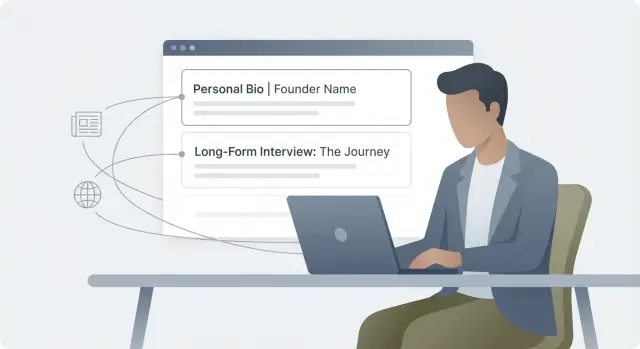
Why founder and personal brand SERPs matter
When someone searches your name, they’re rarely browsing. They’re checking. The results page is a fast background check that shapes whether you get a meeting, a reply, or a serious second look.
Most people scan the top results for a few things: a clear bio that matches your current role, signs you’re real and active (interviews, podcasts, talks, press), consistent details across pages, and trust signals from reputable sites. They also notice anything confusing or risky, even if it’s just outdated info.
Bios and long-form interviews do work that social profiles often can’t. A good bio gives a clean, controlled story. A strong interview shows how you think, how you speak, and what you’ve actually done. During investor diligence, enterprise sales, hiring, or partnerships, those pages can remove doubt quickly. They also support E-E-A-T signals when they live on sites people already trust.
Founder SERPs often have issues you won’t notice until you search your own name in an incognito window. Old roles can outrank your current bio. Thin profiles rank because there’s nothing better. Someone else with the same name can creep onto page one. A random directory or scraped profile can become the default result and tell the wrong story.
One common scenario: a founder is about to announce a funding round. A journalist searches their name. The top results show a dated conference speaker page and a short profile with no context. The best interview is buried on page three. Nothing is “bad,” but the impression is messy.
A strong outcome is a simple, consistent page one where most of the story is yours to shape. That usually means your main bio is near the top and current, one or two strong interviews rank on page one, results reflect the same identity (no mixed people or old titles), third-party mentions come from reputable publications, and thin profiles are pushed down.
That’s where backlinks become practical. When strong sites point to your best bio and interview pages, search engines are more likely to treat those pages as the right answers for your name.
Which pages you should try to rank first
When someone searches your name, they’re usually trying to answer basic questions fast: Who is this? Are they credible? How do I verify what they claim? Your job is to make sure the first results answer those questions without forcing people to dig.
Start with a bio page that deserves to rank. A thin “about” page rarely holds a top spot for long. A strong bio is specific and easy to confirm: your current role, a short timeline, a few proof points (funding, shipped products, awards, notable customers), selected press and speaking, and a clear way to contact you. Use a professional photo and keep the page updated. One great bio beats five half-finished profiles.
Next, prioritize one strong long-form page. Detailed interviews and Q&A pages often rank well for names because they show depth. A 30-60 minute podcast episode page, a written interview, or a guest feature where you share real decisions and lessons tends to build trust because it isn’t purely self-written.
Decide how you want to balance your company leadership page versus a personal site. If your company is well-known, the leadership page can rank quickly and reinforce legitimacy. If your roles change often, you have multiple ventures, or your company brand is smaller, a personal site can stay stable across career moves. In many cases you want both, but don’t split effort across too many URLs.
Third-party profiles can help, but only a few are worth real attention. Prioritize profiles people in your industry expect to see and that already rank for names. Avoid spreading effort across dozens of low-value directories or copycat bio sites that create noise and inconsistent info.
A simple filter for picking your core targets:
- One “home base” bio page you control (personal site or a dedicated founder page)
- One high-quality long-form interview or feature on a respected publication
- One authoritative profile page people expect to see
- Optional: your company leadership page, if it’s strong and current
Example: if an investor is about to review “Jordan Lee,” you’ll usually get more value from pushing Jordan’s bio page, one detailed podcast or interview page, and the company leadership page than trying to boost every profile Jordan has ever created.
How backlinks shape personal brand visibility and trust
A backlink is a public “vote” from one page to another. In plain terms, it tells search engines that a page is worth sending people to. For personal brand pages, that vote matters because search engines want results that feel accurate and safe when someone searches your name.
What a backlink signals (without the jargon)
Links act as clues about quality and reputation. A strong link can suggest the page is referenced by others (not just self-published), the source has its own track record, the topic is connected to a real conversation, and the page is likely to satisfy the searcher (bio, background, proof).
That’s why links often move the needle more than small on-page tweaks. You’re not just polishing words. You’re earning signals from outside your own site.
Why strong sources help you compete with big platforms
Founder bios and interviews often compete with huge platforms that already have years of built-in trust. Even if your bio is better, a big site can outrank it.
Strong backlinks help close that gap. When respected publications or established industry sites point to your bio or interview, your page can earn enough trust to compete. This matters most for evaluative searches, like an investor, journalist, or enterprise buyer doing diligence.
Relevance matters as much as authority
Not every “good” link helps your personal SERP. Who links to you matters. A link from a respected site in your field usually does more than a random high-authority site that has nothing to do with your work.
Aim for a mix: authority for ranking power, and relevance for meaning. If you’re a fintech founder, finance and security publications tend to be more useful signals than generic lifestyle mentions.
Prepare your bio and interview pages before building links
Backlinks work best when they point to pages that already answer the questions people have about you. If your bio is thin, inconsistent, or missing proof, links can bring visitors who leave unsure. That hurts trust and slows momentum.
Start with one “source of truth” bio page on a site you control. Use one consistent name format and keep it the same in the page title, headline, and profiles. Make your role and company wording consistent too, so search results don’t look fragmented.
A strong founder bio usually includes clear credentials (what you do and who you do it for), a few proof points you can stand behind, a short plain-English summary plus a longer version for deeper reading, a professional photo, and a simple way to verify identity through consistent details. If it fits naturally, a “last updated” note helps the page feel current.
Next, publish a simple media or press page that collects your long-form interviews, podcasts, and notable mentions. If everything lives on other sites, you have less control. A media page lets you summarize each appearance, add context, and connect it back to your bio.
Supporting pages also help you look real, not overly polished. If you speak, write, ship products, or contribute to the community, give those areas a place to live.
Keep the structure simple and connected with internal links. Your bio should point to media/press and key projects. Media/press should link back to your bio and (if relevant) your company page. Projects and writing should link back to the bio. Your company “about” page should also link to your founder bio.
Example: before a board-level diligence call, a founder refreshes their bio with consistent naming, adds a media page with three real interviews, and builds small pages for speaking and open-source work. Only then do they start acquiring backlinks, so new visitors land on pages that quickly confirm credibility.
Step by step: build a backlink plan for founder SERPs
Decide what you want to win for. Founder SERPs usually split into a few common searches: your full name, your name plus company, and your name plus role (for example, “Alex Rivera CEO”). Pick the one that matters most during evaluation and treat it as the main target.
Then choose the pages you want Google to show. Keep it tight: one “home base” page (your bio) plus a small set of supporting pages that add depth, like a long-form interview, a podcast page, or a detailed company profile. The goal isn’t to rank everything. It’s to rank the few pages that build confidence.
A simple plan you can actually run
You’ll get better results with a repeatable workflow:
- Define the main query and a few variants you care about.
- Pick 1 primary page (bio) and 1-3 supporting pages (interviews/profiles).
- Assign each planned backlink to a specific page, with a reason.
- Set anchor text rules before you place anything.
- Keep a steady cadence, then review results monthly.
Anchor text is where people get sloppy. You want natural mentions that look like a real editor wrote them. Keep most anchors simple (your name, your brand, or plain references like “site” or “bio”) and let the surrounding context do the work.
Example mapping (so it’s not random)
If someone searches “Jordan Lee Founder,” point the strongest placements at Jordan’s bio page. Then point a smaller number at one or two long interviews that clearly mention the company, role, and story. If the bio moves up and an evaluator clicks deeper, the next results still reinforce trust.
For tracking, don’t obsess daily. Check once a month and note which pages moved, what jumped ahead of you, and whether your bio or interviews are earning richer snippets.
What good backlinks look like for a personal brand
Good backlinks do two jobs at once: they help your pages rank, and they make a human reader trust what they find. That’s why the best links for a personal name usually come from places people already believe.
A strong source is a reputable publication, a well-known industry site, or a respected company page where your work is naturally referenced. Think established tech blogs, recognized trade publications, or company engineering pages that list you as a speaker, contributor, or leader.
Context matters as much as the site. The link should appear where your name belongs: a short bio on a podcast episode page, an interview that shows real expertise, an author page tied to your writing, or a profile mention connected to a product launch or research you led. A random link dropped into an unrelated article can look suspicious, even if it helps rankings.
The healthiest link profile includes variety: different wording, different page formats, and different parts of your story (bio, interviews, key projects). One credible mention can outweigh dozens of weak ones. A good rule is simple: if you’d be proud to show that page to an investor or journalist, it’s probably a strong backlink.
Common mistakes that slow down personal SERP improvements
Most personal brand SEO efforts fail for straightforward reasons: the wrong page gets promoted, the signals look forced, or the content doesn’t deserve to rank.
A common misstep is sending every backlink to the homepage. Your homepage is often too broad. If you want people to find your founder story, credentials, and proof points, links should support the specific page you want to show during evaluation, like a founder bio or a real long-form interview.
Another slowdown is repeating the same anchor text over and over, especially your exact name plus the same title. It looks staged and limits what search engines learn about you. Natural variety helps: your name, your brand, your role, the publication name, and other normal references.
Identity confusion is also bigger than people expect. If multiple people share your name, or your role has changed, your pages need clear signals: full name, current title, notable past roles, and consistent details across your bio and interviews.
Thin content is a quiet killer too. A short Q&A with vague answers rarely earns visibility, even with links. A good interview page shows real experience: specific decisions, outcomes, and a clear timeline.
Example: a founder named “Alex Chen” points new links to their startup homepage, while an old conference speaker page ranks above their current bio. On top of that, every anchor says “Alex Chen CEO.” The result is mixed signals and slow movement. Switching links to a strong bio page, expanding one real interview, and diversifying anchors often improves stability.
Quick checklist before you invest in backlinks
Backlinks can lift the pages you want people to see, but only if those pages are ready to earn trust. Before you pay for placements or start pitching sites, audit what actually shows up when someone searches your name.
Check your top target pages (usually a founder bio and one strong long-form page). They should answer the basics in seconds: who you are, what you do, and why you’re credible. If a reader has to hunt for your role, company, or proof, the page won’t convert interest into confidence.
A simple checklist:
- Make your name, role, and company consistent across your bio, profiles, and press mentions.
- Ensure your bio clearly states what you do today and includes a few concrete proof points.
- Have at least one long-form piece worth ranking (a deep interview, podcast page, or detailed Q&A).
- Decide exactly which page each backlink should point to, and why.
- Track multiple queries, not just your full name (include a few variations and common misspellings).
One quick test: ask a friend to open your bio page and explain, in one sentence, why you’re a safe choice to work with. If they can’t, fix the page before you add links.
Measure progress with a basic weekly or monthly snapshot of the top results for your chosen queries. Personal SERPs can vary by location, so you’re looking for trendlines, not perfect consistency.
Example: improving a founder SERP before a high-stakes evaluation
A founder is preparing for two pressure moments: a fundraising round and a security review with a large enterprise buyer. Both groups will search the founder’s name, click the first few results, and decide fast if they trust what they see.
Right now the results are messy. An old conference speaker profile and a short directory bio rank above the founder’s own bio. There’s also a thin “about” page on the company site that says little beyond a job title. The founder is credible, but the proof is buried.
The plan is to give Google (and humans) three strong pages that tell the same story at different depths: a strong founder bio (clear role, timeline, and a few specific wins), one deep interview that shows decision-making and values, and a media/press page that collects real mentions with short context.
Before building any links, the content gets tightened. The bio and interview use the same name format, the same headshot, and consistent facts. Each page makes identity easy to verify through matching details.
Then backlinks are added with a split strategy. Instead of pointing everything at one page, links support both the bio and the interview so each can compete in the top results. The goal isn’t to rank everything. It’s to make the top of page one feel clean and credible.
Next steps: maintain control of what people see
Personal brand results aren’t a one-time fix. If you want to stay in control, treat your founder SERP like a living asset: check it, update it, and keep earning attention.
Monitor what matters with a simple monthly routine: track rankings for your name and name + role/company, watch clicks and impressions from branded searches in your analytics and Search Console, and log new mentions that start showing up.
Refresh content when the page is good but stale (old photo, outdated role, thin story). Build links when the page already reads like the best answer but still can’t outrank weaker results.
If you don’t have time for outreach, services like SEOBoosty can be a practical option. SEOBoosty focuses on securing backlink placements from authoritative sites and lets you choose where those links point, which is useful when you’re trying to lift a specific bio or interview page.
The goal stays simple: when someone searches your name during evaluation, the top results should match the story you want to be judged on.
FAQ
Why should I care about what shows up when people Google my name?
Start by searching your full name in an incognito window and look at the top 5–10 results like a stranger would. If the results are outdated, inconsistent, or dominated by thin directories, you’re leaving trust to chance during investor, press, hiring, or sales checks.
Which pages should I try to rank on page one for my name?
Prioritize one “home base” bio page you control, plus one strong long-form page such as an interview, podcast episode page, or detailed Q&A. Add one authoritative profile people expect to see, and optionally your company leadership page if it’s current and strong.
What makes a founder bio page strong enough to rank?
A good founder bio clearly states your current role, a short timeline, and a few proof points someone can verify. Keep the name format, title, and company wording consistent, use a professional photo, and update it when your role or focus changes.
Why do long-form interviews and podcasts help personal brand SEO so much?
Long-form interviews show how you think and what you’ve actually done, which builds trust faster than a short self-written profile. They also create a credible page that can rank for your name and support the story your bio claims.
How do backlinks actually improve my personal SERP?
Backlinks act like public votes that tell search engines which pages are the best answers for a query. For name searches, strong links can help your bio or interview outrank weaker results like scraped profiles or outdated event pages, especially when the linking site is reputable and relevant to your field.
Where should my backlinks point: homepage, bio, or interviews?
Send the strongest links to the single page you most want evaluators to land on, usually your bio. Use a smaller number of links to support one or two long-form pages so your top results reinforce each other rather than competing randomly.
What anchor text should I use for personal brand backlinks?
Keep anchors natural and varied, with most using your name, brand, or simple references like “bio” in context. Avoid repeating the exact same “Name + Title” phrase everywhere, because it can look staged and can slow down trust and stability.
How do I stop Google from mixing me up with someone who has the same name?
Identity confusion happens when your results mix with someone else’s name, old roles, or inconsistent details across pages. Fix it by standardizing your name format, using the same current title and company wording everywhere, and making your bio and interview pages clearly match with consistent facts.
What are the biggest mistakes that slow down founder SERP improvements?
The most common mistakes are promoting the wrong page, sending every link to a generic homepage, using repetitive anchor text, and trying to build links to thin content. Improve the actual pages first, then build links to the few pages that best confirm credibility.
When should I invest in backlinks, and when should I fix my content first?
If your bio doesn’t answer who you are, what you do now, and why you’re credible in seconds, fix that before buying or placing links. If you want placements without outreach, SEOBoosty can help by securing authoritative backlinks and letting you choose exactly which bio or interview page those links support.
Share