Backlinks to pricing pages safely: direct vs routed links
Learn when backlinks to pricing pages are worth it, when to point to a plans explainer instead, and how to reduce risk while keeping intent strong.
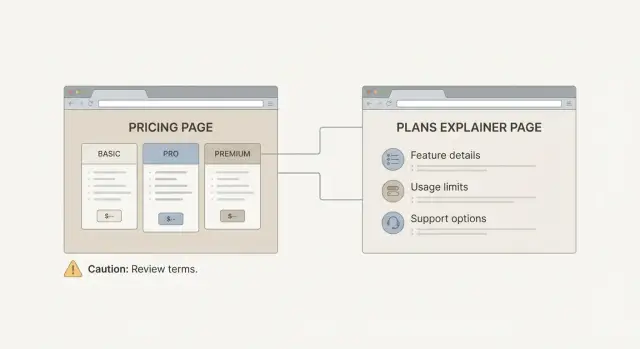
Why pricing page backlinks feel risky
Pricing pages sit at the sharp end of a website. They ask for a decision, not just attention. That’s why teams get nervous about building backlinks to them. A link pointed straight at a sales-first page can feel like you’re waving a flag that says, “I’m trying to rank this money page.”
Pricing pages often attract extra scrutiny for a few simple reasons. Many are thin (plan names plus a table). They can look interchangeable across competitors. And the anchor text people reach for can be too aggressive: “cheap,” “best price,” “discount.” On top of that, pricing pages sometimes pick up links from places that don’t naturally cite pricing, like random directories or low-quality roundups. When revenue targets get tight, it’s also common to see a sudden burst of links to the same pricing URL.
What most people worry about is “penalties.” More often, the outcome is quieter: the links just don’t help much. Search engines can discount links that look unnatural. They can also decide the pricing page isn’t the best match for broader queries if it offers little beyond a price grid. You end up spending money and still watching the pricing page sit on page two while a competitor’s guide or comparison page ranks above it.
The real goal is to support revenue pages without making the link profile look manipulated. That balance comes down to where links point (pricing page vs supporting page), how those links are described (anchors), and whether the destination actually answers the reader’s question. If someone clicks expecting an explanation and lands on a table with no context, the mismatch hurts engagement and wastes the link’s value.
This is why pricing-page link building feels different from linking to blog posts or guides. Informational content naturally earns citations. It can target a wider set of related phrases and gives other sites a reason to reference it. A pricing page rarely offers that “reference value” on its own.
If you’re using a service like SEOBoosty to place high-authority links, the risk usually isn’t the authority. It’s whether the destination and wording look natural for the source. That tension is why many brands route links through a plans explainer first.
What search engines and users expect from pricing pages
A pricing page is high-intent. Users land there when they’re close to a decision, and search engines treat it as a strong signal of commercial intent. Backlinks to pricing pages can work well, but only if the page matches what people expect to see.
Most pricing pages share the same basics: clear tiers, a simple comparison, and a prominent call to action. What they often lack is the “why” behind the numbers. If someone hasn’t met your product before, a bare table can feel abrupt and lead to quick bounces.
A solid pricing page usually adds a little guidance and a few trust cues, such as:
- A short explanation of who each plan is for
- Plain-language feature highlights (not a dense checklist)
- Transparent terms (billing period, renewals, limits)
- A small FAQ that handles common objections
- A clear next step (trial, demo, subscribe, contact)
Supporting pages matter because they add context and reduce hesitation. They answer the questions people ask right before they pay: What problem does this solve? What’s included? What happens if I outgrow the plan?
This becomes even more important when pricing depends on variables that need explanation. For example, with SEOBoosty, the value of a backlink can depend on the source authority you choose. If a visitor lands on pricing without understanding what changes from one option to the next, they hesitate.
Intent changes what “good” looks like:
- Informational intent: learning (needs explanations, examples, comparisons)
- Commercial intent: evaluating (needs plan fit, proof, terms)
- Navigational intent: finding a known brand (needs clarity and easy access)
A pricing page can be the right destination for a link when it stands on its own. If the copy is helpful, the options are easy to understand, and key objections are handled on-page, direct links look less “pushy.”
Example: if someone searches your brand name plus “pricing,” landing straight on a clean pricing page is perfect. But if an article is comparing beginner-friendly solutions, sending readers to a plans explainer first usually matches their mindset better. The pricing page becomes the natural next click.
Direct vs routed links: a simple decision framework
Linking straight to a pricing page can work, but it’s easy to overdo. The safest approach is to decide based on intent and trust: how ready the visitor is, and how normal it looks for your brand to earn that kind of link.
Direct links make sense when the surrounding context is already commercial. Think brand mentions (“Pricing for X”), product comparisons, review roundups, partner pages, and high-intent queries where readers expect to see numbers right away. In those cases, sending people to pricing reduces friction and often improves conversions.
Routing is usually safer when your site is new, your niche is sensitive (finance, health, gambling, adult, etc.), or you have little brand demand yet. If most new backlinks land on “pricing” with money anchors, it can look unnatural. A plans explainer gives you a more editorial destination that still supports commercial intent SEO, while spreading risk across a page that’s easier to reference in articles.
A quick way to choose:
- If the source is clearly commercial (comparison, review, “alternatives,” partner listing), direct is usually fine.
- If the reader likely needs context before numbers, route to an explainer.
- If you have little branded search or brand mentions, route more often.
- If you’re leaning on exact-match anchors (“best pricing,” “cheap plans”), route and vary anchors.
- If the pricing page is thin or hard to understand, route until the page is stronger.
Risk isn’t just about the destination URL. It’s mostly about three things: link source quality, anchor text, and page quality. A high-quality mention with a natural anchor (“see plans”) is low risk even if it points to pricing. A low-quality directory with an exact-match anchor is high risk even if it points to a blog post.
A practical example: if a company is using SEOBoosty to place premium backlinks, it might send the most editorial placements to a plans explainer (safer and easier to cite), while reserving a smaller number of direct pricing links for obvious commercial contexts like comparisons.
How to build a plans explainer page that supports pricing
A plans explainer page is a plain-language guide that helps people understand your options before they hit the pricing table. It keeps commercial intent strong, but it also provides the context a bare pricing page often lacks. That alone can make pricing page link building feel much less risky.
Think of it as a “how to choose” page. It explains the logic behind your plans, who each plan fits, and what changes when you upgrade.
What to include (so it actually helps)
Keep the page focused and easy to scan. A good explainer usually covers:
- Who each plan is for (with real examples like “solo consultant” or “small team”)
- Key limits and thresholds (seats, projects, usage, storage, support level)
- Add-ons and upgrades (what’s extra, when it’s worth it)
- A short FAQ that mirrors what support hears every week
- A comparison summary in words, not only a table
Avoid fluff. Specifics build trust: “If you send under 5,000 emails/month, Basic is enough.”
Linking to the pricing page without forcing it
The goal is to guide, not trap. Give people a few natural paths to pricing:
- One primary button near the top (for visitors who are already decided)
- Context links after each plan description (“See full pricing and billing options”)
- A simple “Ready to choose?” section near the bottom
Keep anchor text plain. Don’t repeat exact-match phrases everywhere. One natural mention is often enough.
Content that reduces friction
Most pricing objections aren’t really about price. They’re about uncertainty. Short, direct answers help, especially around:
- Trials and what happens when they end
- Billing cadence (monthly vs annual) and how upgrades work mid-cycle
- Cancellation rules and how to request changes
- Security basics (only what’s relevant)
- Procurement-friendly details (invoice, tax/VAT, payment methods)
If a SaaS offers a “Team” plan, the explainer should say who it’s for, what seat limits mean, and whether adding a seat changes the bill immediately. Then the pricing page can stay clean and conversion-focused while the explainer handles the questions that slow people down.
Step-by-step: planning pricing-related backlinks safely
A safe plan starts with one idea: you’re not just building links, you’re shaping what a reader (and a search engine) thinks your brand is about. Pricing-related links can be fine, but they need intent, variety, and solid pages behind them.
Step 1-3: decide where the link goes, and how it looks
-
Pick the destination based on intent and page strength. If the visitor is comparison-shopping, a direct pricing page can work. If your pricing is complex (tiers, add-ons, usage limits), route them to a plans explainer first. Also be honest about the page: if the pricing page is thin or rarely earns organic visits, it’s usually a poor first target.
-
Choose a link style that matches the source. In a newsy mention, a brand name or plain URL often reads naturally. In a product roundup, a short descriptive mention (“team plan pricing”) can fit. Save anything close to exact-match wording for rare moments when it truly belongs in the sentence.
-
Map anchors to sources, not to your wish list. Most anchors should be plain, a few can be descriptive, and almost none should be “perfect keyword” phrasing. With backlinks to pricing pages, over-optimized anchors are the fastest way to make your profile look manufactured.
Now zoom out. Even if you point some links at pricing, don’t make pricing the only destination. Mixed destinations look more believable and give people places to find proof.
Step 4-6: diversify, polish the page, and measure outcomes
-
Vary destinations on purpose. Mix in the plans explainer, feature pages, case studies, integration pages, and sometimes the homepage. This supports the pricing page rather than forcing it to carry every commercial signal alone.
-
Fix on-page basics before you publish links. The page should load fast, use clear headings, and explain what’s included without hiding key limits. Add trust details that reduce bounce: contract length, cancellation terms, and a short “who this plan is for” note.
-
Track what matters (not just rankings). Watch pricing page impressions, but also assisted conversions: demo starts, trial signups, contact clicks, and time on page for visitors who arrived via the explainer.
If you use a provider like SEOBoosty for placements on authoritative sites, plan the mix in advance. Reserve your most context-rich placements for explainer or case-study destinations, and use direct pricing links only when the surrounding text makes them feel expected.
Keeping conversions strong when links go to the explainer
Routing backlinks to a plans explainer only works if the path to purchase stays short. People clicking a pricing-related mention are already evaluating. Your job is to answer their questions quickly, then make the next step obvious.
Measure outcomes that show buying intent, not just rankings. A routed link can be a win even if the explainer page never ranks on its own. Common signals include:
- Clicks from the explainer to pricing or checkout
- Trial starts or demo requests within the same session
- Contact form submissions (or sales chat starts)
- Time to next step (how long it takes to reach pricing)
- Drop-off points (where people leave)
To keep routed traffic converting, build one clear path and repeat it in the right places. A good explainer reads like a short guide, not a brochure: what the plans are for, what’s included, and how to pick.
Keep internal links helpful, not pushy. Two to three strong calls to action usually beat a dozen scattered buttons. High-performing placements are often the first screen (for decisive visitors), right after the “how to choose” section (for careful readers), and in a simple comparison section where each column has one action.
If your explainer sends people to pricing, send them to the section that matches what they just read (for example, the Team plan), not the top of a long page.
Handling regions, currencies, and billing terms
Multi-currency and multi-region setups can quietly kill conversions if the explainer and pricing pages disagree. Use consistent language for billing terms (monthly vs annual, per seat vs flat), and show the same default across both pages. If pricing changes by region, make the selector visible early and remember the choice across pages so visitors don’t have to reselect.
Example: a SaaS tool gets a backlink in a “best tools for agencies” post. Instead of landing on a dense pricing grid, visitors land on an explainer that answers “Which plan fits a 5-person agency?” with a short paragraph, a mini comparison, and one button: “See agency pricing.” The explainer doesn’t distract, it guides.
Common mistakes that raise unnecessary risk
The biggest risk with pricing-related backlinks isn’t the pricing page itself. It’s the pattern you create around it. Search engines and people both notice when a site suddenly gets a bunch of very similar links pointing at the most sales-heavy URL.
A common mistake is overusing exact-match anchors like “cheap pricing” or “best pricing.” Even if those phrases describe what you sell, repeating them across sites can look manufactured. Mix in brand anchors, product name, and neutral wording that sounds like how someone would actually reference you.
Another issue is sending a lot of new links to a thin pricing page. If your pricing page is basically a table and a “Start trial” button, it gives very little context. When many links land on that kind of page, it can feel like the links exist only to push buyers, not to help them understand.
Patterns that tend to raise flags or waste link value include:
- Many links arriving in a short period, all pointing to the pricing URL
- Anchors repeating the same money terms again and again
- Links from irrelevant sites (topic mismatch) just because they were easy to get
- One destination for every mention, even when the article is about features, comparisons, or use cases
- Weak brand signals: inconsistent company name, missing about/team information, unclear contact details
A simple fix is matching the destination to the context. If an article is about a specific use case, send the link to a use-case page or a short plans explainer, then let visitors click to pricing when they’re ready.
Example: a SaaS tool gets featured in five “best tools” roundups. If every roundup uses “best pricing” and links straight to the pricing URL, that’s a loud pattern. A safer approach is to split destinations: a couple to a plans explainer, one to a comparison page, and only one direct pricing link with a natural anchor like the brand name.
Finally, avoid low-quality placements for high-intent pages. If you’re paying for placements, prioritize relevance and real editorial standards. SEOBoosty positions itself around backlinks from established, authoritative publications, which can help you avoid spammy signals, but the same rule still applies: match the placement, anchor, and destination to what the reader expects.
Quick checklist before you build links to pricing
Before you point new backlinks to pricing pages, do a fast quality pass. The goal is simple: a real person should understand the offer quickly, and the link profile should look natural.
30-second page sanity check
Open your pricing page in a private window and pretend you know nothing about the product. If you hesitate, fix the page before you build links.
- Is the plan layout easy to scan (who each plan is for, what’s included, what it costs)?
- Are key trust details visible without hunting (billing terms, cancellation, refunds, support, taxes, limits)?
- Is there a clear next step without popups blocking it?
Link plan safety check
A safe strategy is usually about balance and context, not “never link to money pages.” Backlinks to pricing pages can be fine when the page is strong and the links come from places where a pricing reference is normal.
- Are you linking to more than one destination (homepage, use-case pages, guides, plans explainer), not just pricing?
- Do most anchors look natural (brand name, product name, “pricing,” “plans”), with very few exact-match keyword anchors?
- Are the sites relevant and editorial (real articles or resource pages), not random listings that accept anything?
- Does the surrounding text make sense for a pricing reference (comparison, recommendation, “how much does X cost,” buying guide)?
- Can you explain why that site would link to your pricing page in one sentence?
If you’re using a provider like SEOBoosty, apply the same checks: prioritize relevant publications, keep anchors natural, and spread links across multiple pages so your profile doesn’t look like a pure “pricing push.”
Example: a realistic SaaS linking plan for pricing intent
Picture a small SaaS called TaskNest. It has three tiers (Starter, Pro, Business), low brand search, and a brand-new pricing page that hasn’t earned trust yet. The team wants to rank for plan-related queries, but they don’t want to spike risk by pointing every new backlink straight at pricing.
They start by building one “Plans” explainer page that answers the questions people ask before they compare numbers: who each tier is for, what’s included, limits, and common upgrade paths. They also pick one supporting feature page (for example, “Automations”) that ties directly to the Pro tier.
Here’s the first 6-week plan:
- Weeks 1 to 2: Send most new links to the plans explainer. Add a smaller batch to the feature page to build topical relevance.
- Weeks 3 to 4: Add 1 to 2 direct backlinks to the pricing page from brand-friendly mentions (for example, “TaskNest pricing” in a product roundup).
- Weeks 5 to 6: Keep the explainer as the main target, and only add another direct pricing link if the earlier ones look natural and performance is steady.
This approach uses backlinks to pricing pages without making pricing the only destination for commercial anchors. The plans explainer keeps intent strong because it still serves people who are comparing, but it gives search engines and users a softer entry point.
What they watch for: rankings improving for “task management software plans,” “best plan for small teams,” and tier-specific queries; more assisted conversions (visitors landing on the explainer, then clicking through to pricing); and a healthier mix of landing pages in analytics.
After 4 to 8 weeks, they adjust based on data. If the explainer gets impressions but few clicks, they tighten the page title and add clearer tier summaries near the top. If pricing conversions drop, they improve the explainer-to-pricing path (stronger comparison, clearer buttons). If everything is stable, they slowly increase direct pricing links, prioritizing clean, editorial placements.
Next steps: build, measure, and scale without overdoing it
Treat the next month like a small experiment, not a permanent policy. Keep commercial intent strong while you learn what actually earns clicks, rankings, and sign-ups.
Start with a simple destination map. If you’re unsure, send most new links to the explainer first and only a smaller share to the pricing page until the pricing page has proven it can handle attention.
- Weeks 1 to 2: Prioritize the plans explainer (the page that explains who each plan is for).
- Weeks 3 to 4: Add selective links to pricing if the pricing page is clear and stable.
- Keep one primary path: explainer -> pricing -> checkout or contact.
- Use one consistent tracking view so you can compare outcomes over time.
Make your pricing page safer to point at over time. “Safe” mostly means “useful and clear.” Tighten the copy, add plan context, and answer objections on the page. A short FAQ can carry a lot of weight: cancellation, contracts, what’s included, and who should choose each plan.
Set simple rules for anchors and cadence so growth looks natural. Don’t force exact-match anchors like “cheap pricing” repeatedly. Mix branded, partial, and neutral phrases, and keep the pace steady instead of spiky.
If you want to reduce outreach work while still aiming for editorial-grade placements, SEOBoosty is built around a curated inventory of premium backlink opportunities on authoritative sites. The practical upside is control: you can choose relevant domains and point links to your plans explainer or pricing page based on what fits the context.
Review results monthly and rebalance toward what converts best. Look at two buckets: search impact (rankings, impressions, landing page traffic) and business impact (trial starts, demos, purchases). If the explainer brings more qualified visitors who later move to pricing, keep feeding it. If direct pricing links convert better and bounce less, increase their share slowly, and keep quality and context doing the heavy lifting.
FAQ
Why do backlinks to pricing pages feel riskier than links to blog posts?
They’re “money pages,” so a sudden pattern of lots of similar links and aggressive anchors can look unnatural. The bigger practical risk is usually that the links get discounted because the page doesn’t provide enough context to deserve citations.
Will linking to my pricing page get me a Google penalty?
Most of the time, nothing dramatic happens; the links just don’t move rankings much. If the page and link pattern look forced, search engines may ignore the value rather than “punish” the whole site.
When is it actually okay to link directly to a pricing page?
Send direct links when the surrounding content is clearly commercial and a pricing reference is expected, like comparisons, reviews, “alternatives,” partner pages, or brand-name-plus-pricing mentions. In those cases, a pricing destination often matches what the reader wants next.
When should I route backlinks through a plans explainer instead of pricing?
Route links when people likely need an explanation before numbers, or when your site is new and you don’t have many brand mentions yet. A plans explainer is easier to cite editorially while still guiding readers toward pricing.
What anchor text is safest for pricing-page backlinks?
Keep anchors plain and varied, using your brand name, product name, “pricing,” or “plans” most of the time. Use exact-match “money” phrases rarely, and only when they genuinely fit the sentence on the linking page.
How do I make my pricing page strong enough to deserve backlinks?
Add quick context so the page stands on its own: who each plan is for, what changes between tiers, and the key terms people worry about like billing and cancellation. A thin table-only page can still convert, but it often won’t earn or benefit from links as well.
What should a good plans explainer page include?
Explain the logic behind the tiers, give real “who it’s for” examples, and clarify the limits and upgrade paths in plain language. Then make the next step obvious with a clean path to pricing or checkout without turning the page into a hard-sell brochure.
How fast should I build pricing-related backlinks without raising red flags?
Avoid spikes where many new links hit the same pricing URL with similar wording. A steadier pace with mixed destinations across your site tends to look more natural and usually performs better over time.
How do I measure whether routed links are working?
Track outcomes beyond rankings, especially how many visitors move from the explainer to pricing and then to trial, demo, or checkout. If routed traffic clicks through and converts, the strategy is working even if the explainer page itself isn’t your top ranking page.
How should I use SEOBoosty placements for pricing intent without overdoing it?
Start by matching the placement context to the destination and anchor, rather than defaulting every link to the pricing URL. With SEOBoosty, the key choice is still yours: pick relevant authoritative sites, keep anchors natural, and spread placements across an explainer, key feature pages, and selective direct pricing links where they’re clearly expected.
Share