Backlinks for site consolidation in M&A merges: preserve authority
Backlinks for site consolidation: a practical plan to protect rankings during M&A merges, choose redirects, and reinforce the right legacy URLs.
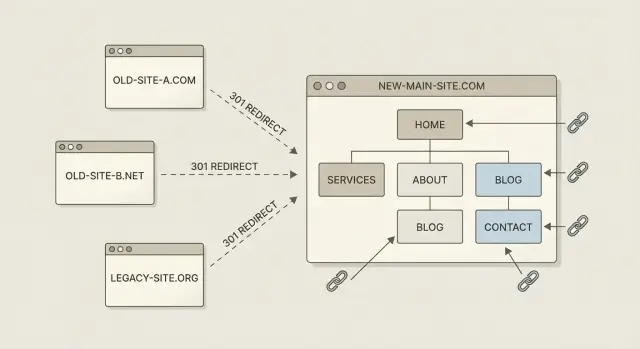
What can go wrong with authority during an M&A merge
Rankings often drop after an M&A site merge even when you set up 301 redirects. A redirect is a strong hint, but it doesn't guarantee every signal from the old pages will carry over cleanly. Search engines still need to recrawl, reprocess, and decide whether the new pages deserve the same trust.
Think of link equity as the value you earn when other sites link to you. If a respected site links to an old URL, that vote can help the new target. But some value can get diluted, and it can get misrouted if the redirect points to a less relevant page, a generic homepage, or a page that no longer matches what the old URL was about.
Preventable authority loss usually comes from a few patterns: many old pages get funneled into one catch-all destination, URLs change at the same time as titles and intent, non-HTML assets (like PDFs and old tools) get missed, duplicates stay live and compete, or internal links break so crawlers have fewer clear pathways to your strongest pages.
The goal is simple: keep the pages that earned trust (and the signals around them), map them to the closest new equivalents, and remove or merge duplicates without creating confusion.
Some short-term volatility is normal. Crawling and index updates take time, and rankings can bounce for a few weeks. Bigger drops usually come from avoidable issues like irrelevant redirect targets, dropped content that used to rank, or losing direct access to high-value legacy pages.
Build a clear inventory of pages, backlinks, and page intent
Before you merge anything, get one shared spreadsheet that lists every URL that matters. In consolidation work, the biggest losses happen when teams rely on memory or partial exports. Your job is to know what exists, what it does, and what authority it carries.
Pull inputs from sources that show different sides of the truth: XML sitemaps, analytics (landing pages, conversions, top traffic pages), Search Console (queries, top pages, indexing issues), backlink exports, and CMS or database exports so older or gated content doesn't get missed.
Next, label each URL by intent, not by folder name. Common buckets are brand pages, product or service pages, blog or resources, support docs, and legal pages. Intent labeling makes it easier to spot what should be merged versus what should stay separate.
Add a few columns that force decisions: organic sessions, conversions (or leads), number of linking domains, and notes for any links you consider critical (trade press, major tech blogs, industry publications). If your project includes backlinks for site consolidation, this is where you separate pages with real outside authority from pages that only look important internally.
Finally, flag overlap across the merging sites. A common pattern is two pages that answer the same question but target different keywords, or a product page and a blog post that both rank for the same term. For example, Site A might have a "Pricing" page that converts, while Site B has a "Plans" page with the strongest backlinks. Mark them as the same intent so you can plan one final target and avoid splitting authority after the merge.
Pick the new site structure before you touch redirects
Redirects work best when they point to a page that clearly matches what the old page promised. So before you map anything, lock the new site structure: what types of pages exist, how they are named, and how they are organized.
Start with simple, consistent rules. Pick one pattern for slugs (for example, lowercase and hyphenated), one approach to folders (by product, by industry, or by resource type), and one rule for when a page gets its own URL versus being grouped into a hub. Consistency reduces redirect chains and makes future content easier to keep tidy.
The hardest decision is whether to consolidate or keep pages separate. The tie-breaker is intent, not wording. Two pages that target the same question should usually become one stronger page. Two pages that serve different goals should stay separate, even if they look similar.
A quick way to decide:
- Would a visitor feel satisfied landing on the same final page from either legacy URL?
- Do the pages rank for different queries with different expectations (pricing vs how-to, overview vs documentation)?
- Do they have different conversion paths (demo request vs download vs contact)?
- Is one page clearly more complete and up to date?
For similar pages you do consolidate, choose the single canonical target early. Pick one destination URL that will carry the topic long term, then point every overlapping legacy URL to it. This is the foundation of a clean legacy URL backlink strategy and keeps signals from being scattered across near-duplicates.
Don't ignore special cases. PDFs often earn strong links and may need their own preserved landing page (or a clear HTML replacement). Subdomains and microsites should be treated like separate properties, with their own intent mapping and a clear decision: fold them in or keep them distinct. International pages need a consistent locale pattern so you don't accidentally redirect a country-specific page to a generic version.
Once the structure is set, redirects become matching, not guesswork.
Step-by-step: a redirect plan that keeps link value
A good redirect plan does one thing well: it sends every important old URL to the most relevant new page. That relevance is what helps search engines carry over ranking signals and keeps users from bouncing.
1) Build the redirect map (one-to-one first)
Start with a spreadsheet that lists every old URL and its best new match. Aim for one-to-one redirects whenever possible, especially for pages that already have backlinks or steady organic traffic. If an old page covered a specific product, service, or guide, redirect it to the closest equivalent page, not a generic category.
When you can't keep one-to-one, be careful with many-to-one. Dumping a whole site into the homepage often weakens relevance and can look like a soft 404. Consolidate only when the pages truly belong together (for example, several thin location pages becoming one strong location hub).
2) Set clean rules for duplicates
Before you publish redirects, decide how the new site will handle common duplicate patterns: trailing slash vs no slash, www vs non-www, HTTP vs HTTPS (force HTTPS), parameter URLs, and uppercase vs lowercase. These rules prevent redirect chains and stop search engines from seeing the same page under multiple URLs.
3) Stage, test, then ship
Test redirects in a prelaunch environment with a real sample of URLs: top linked pages, top traffic pages, and a random batch of long-tail URLs. Check that each old URL returns a single 301 to the right new page (not multiple hops), and that the destination loads fast and matches intent.
4) Launch day: watch for 404s and fix fast
After launch, review crawl reports and server logs daily for the first week. Prioritize fixing 404s that have backlinks or external mentions. Even one broken, well-linked legacy URL can waste valuable link equity. Update the map, add missing redirects, and retest until the error list is quiet.
Which legacy URLs deserve direct link reinforcement post-merge
After a merge, 301 redirects usually carry most of the value. But some legacy URLs are too important to leave on autopilot. These are the pages where even a small dip can cost rankings, leads, or trust. A focused legacy URL backlink strategy helps you decide where to add or refresh backlinks after consolidation.
Look past raw backlink counts. One link from a highly trusted, relevant site can matter more than dozens of weak ones. Review which legacy URLs have the strongest referring domains and the most consistent, relevant anchor text.
The legacy pages worth extra protection
Reinforcement is most useful for:
- Revenue pages (pricing, product, demo, core category pages, top location pages)
- Link magnets (guides, original research, statistics pages, calculators, templates)
- Brand and trust pages (press coverage, awards, partner announcements, well-cited leadership posts)
- Pages with a single point of failure (one or two powerful links doing most of the work)
- URLs that map to a new page that's not a perfect match (different intent, content, or CTA)
If you have backlinks pointing to old assets, treat them as first-class citizens. PDFs, slide decks, images, or discontinued tools often keep earning links for years, and they can break quietly during consolidation.
A quick way to spot silent losers
Keep a short watchlist of legacy assets and verify each one after the merge: PDF brochures and spec sheets, download pages and media files, old tool subdomains or app pages, campaign landing pages used in email or ads, and press release URLs that still get cited.
If a legacy report PDF has strong links from major publications, keep the file accessible (or provide a true equivalent) and consider adding a couple fresh, high-authority backlinks directly to the new canonical target.
How to strengthen the new targets with fresh backlinks
After a merge, redirects only pass value if the new page truly fits the old one. The practical way to protect rankings is to make sure the merged domain has strong destination pages, then add a small set of targeted backlinks to the new URLs that matter most.
Start by deciding what should live on the merged domain. Sometimes the best destination isn't a like-for-like swap, but a better page: a new hub that covers a whole topic, an updated guide that replaces several thin articles, or a cleaner category page that matches how people search today.
Before you build links, rebuild the destination page so the redirect makes sense. Add missing sections, update screenshots or specs, and answer the questions the legacy page used to rank for. If the new page looks like a downgrade, fresh links won't fix the mismatch.
To avoid trying to support everything, keep the target list tight. Choose 10 to 20 post-merge URLs tied to revenue, leads, or top non-branded traffic. Prioritize pages that replaced multiple legacy URLs. Favor clear intent (buy, compare, learn) over vague catch-all pages. Reinforce URLs that lost strong referring domains during the move, and leave low-value legacy pages alone unless they drive qualified traffic.
A balanced set of targets usually includes the homepage (brand trust), a few key category or service pages (commercial intent), and a handful of standout resources (the pages people naturally cite).
Example: if three separate "API security checklist" posts get consolidated into one guide, point redirects to the improved guide, then earn a few fresh mentions to that guide plus the main category page that sits above it.
What to monitor after launch (weekly checks that catch problems early)
The first month after an M&A website merge SEO project is where authority is won or quietly lost. Weekly checks give fast feedback on whether redirects, indexing, and backlinks are doing what you expect.
Before launch, capture a baseline so you can compare week over week: top rankings (especially money keywords), count of indexed pages, branded search traffic, and the list of pages with the strongest backlinks. If you're trying to preserve domain authority after migration, this baseline is what tells you whether link equity is landing on the right new URLs.
The weekly checks that catch issues early
Pick one day each week and review the same signals:
- 404 and soft-404 pages (spikes usually mean missing redirect rules or broken internal links)
- Redirect chains and loops (legacy URL -> old redirect -> new redirect wastes crawl time and can dilute signals)
- Index coverage (sudden drops in indexed pages or a jump in "discovered, not indexed")
- Branded traffic and homepage impressions (a fast dip can hint at tracking issues or crawl/index problems)
- Top linked pages (confirm that key backlinks now resolve to the correct final target)
After you review the numbers, look at the pages that mattered most before the merge. Keep a simple table of your top 20 legacy URLs (by backlink value) and their new targets, plus weekly columns for status code, organic sessions, and ranking notes. It's the fastest way to spot one high-authority page that's underperforming.
Decide what triggers action
Set clear thresholds so small problems don't linger for months. For example, act if a top migrated page drops 20% or more in organic sessions for two straight weeks, if any priority URL returns 404, or if you see more than one hop in the redirect.
If a critical target is still weak after technical fixes, reinforce it with a few fresh, relevant backlinks.
Common mistakes that quietly bleed authority
Most traffic drops after an M&A merge aren't caused by one big error. They come from small, easy-to-miss decisions that weaken signals over a few weeks.
Redirect chains and loops are a classic example. A 301 that points to another 301 (or worse, back to itself) makes crawlers work harder and can slow down how fast equity settles. It also increases the chance that one hop breaks later when someone updates a rule.
Another quiet leak is merging pages with different intent. If a legacy page ranked because it answered a specific question, and you redirect it to a broad "solutions" page, relevance drops even if the new page is well written. This is also where 301 redirects and link equity can disappoint: the link still exists, but it no longer points to the best match.
Internal links get forgotten all the time. Teams fix external redirects, but navigation and in-content links inside the new site still point to retired URLs, creating dead ends and mixed signals.
Before launch, check for:
- Redirect chains longer than one hop (and any loops)
- Many-to-one redirects that collapse unrelated topics into one page
- Internal links that still point to URLs that now 404 or redirect oddly
- Letting old domains expire before rankings and indexing stabilize
- Doing a redesign, copy rewrite, and migration all in the same week
Domain timing is a common trap. Teams sometimes cancel the old domain as soon as "everything redirects." In practice, keep the old domains live long enough for crawlers to reprocess redirects and for external sites to update their links naturally.
A simple scenario: an acquired company has a high-ranking pricing page. During the merge, it gets redirected to the new brand's homepage because "pricing moved." Users bounce, and search engines see weaker relevance. The safer move is to redirect to the closest pricing or plans page, then strengthen that destination so it can stand on its own.
Quick checklist for a safer consolidation cutover
A consolidation launch goes better when you treat it like a release: clear scope, verified mapping, and a quick way to spot breakage. Use this checklist right before cutover, then repeat the last two items within 24 to 72 hours.
Pre-cutover (before redirects go live)
Confirm your redirect map is complete for pages that already carry authority. That usually means every URL with meaningful organic traffic plus every URL with strong referring domains. If a page is being retired, pick the closest equivalent (same intent, same topic), not the nearest category page.
Run a sanity check for redirect quality. Priority URLs should go straight to the final destination with a single 301. Chains waste crawl time and can dilute signals.
Make sure you're not sending mixed signals. Canonical tags on the new site should point to the final URLs, and the old URLs shouldn't declare themselves canonical anywhere.
Update the merged site so it supports the new structure: internal links should point to final URLs, the XML sitemap should list only final URLs, and robots rules shouldn't block important sections.
Cutover checklist (keep it simple)
- Redirect map complete for top-linked URLs and top-traffic URLs
- No redirect chains for priority pages (old URL goes straight to final URL)
- Canonical tags point to final URLs (no mixed signals)
- Internal links, sitemap, and robots rules updated on the merged site
- Post-launch scan completed (404 list triaged and fixed)
After launch, triage 404s by impact: fix anything with backlinks or traffic first, then clean up long-tail misses. If you're doing backlink reinforcement, focus on the new target pages that replace your most-linked legacy URLs. Over time, you want the destination page, not the redirect, to be the obvious authority holder.
A realistic example: merging two sites without losing key rankings
Company A buys Company B. Both sell similar software, and both sites have years of content. The plan is one brand and one domain, but they don't want rankings to drop during the merge.
They choose winners for three page types:
- Product: A's product page converts better and already ranks for the main term, so it becomes the single new product URL. B's product page has good backlinks but weaker content, so it redirects to the winner.
- Guide: B has a guide that earns steady links and featured snippets. They keep it, update the branding, and place it under the new site structure with the same topic focus.
- Support: A's support article is accurate and heavily used by customers, so it stays. B's similar article is retired to avoid two thin pages competing.
Redirect decisions are made page by page, not by folder. Some pages stay as-is, some get merged, some get retired (like outdated promos and old event pages), and some get recreated when a strong-linked page has no good destination (build a new page that fits the old intent, then redirect).
After launch, they add backlinks only to the URLs that matter most: the new product page (revenue impact), the migrated guide (informational rankings and internal linking value), the main pricing or plans page (often a heavily linked money page), and one key integration page (high-intent searchers, easy to lose during a merge).
A simple timeline keeps everyone aligned: 2 weeks prep (inventory, mapping, drafts), launch week (redirects, QA, monitoring), then 4 weeks follow-up (fix stray 404s, adjust redirects, and reinforce a few priority pages with fresh links).
Next steps: a simple plan to protect authority and move forward
Write down what matters most to the business and what already has proven link value. You want two short lists: your top 10 business pages (revenue, leads, signups) and your top 10 link-attracting pages (the ones that already earn links and rankings). These are often different, and seeing that gap helps you plan the merge.
Before any DNS changes or launch work, lock your redirect mapping and your monitoring plan. Last-minute decisions are where link equity gets lost.
Keep the pre-launch plan simple:
- Confirm the final URL for each priority page and choose one primary version (no duplicates).
- Finish a one-to-one redirect map for every important legacy URL, especially those with strong backlinks.
- Set up a tracking sheet: old URL, new URL, expected status code, and the main keyword/topic.
- Decide what you'll check weekly for the first month (rankings for key pages, crawl errors, and top referring pages).
- Pick 3 to 5 must-not-drop pages and treat them as emergency items if traffic slips.
Then plan a small reinforcement batch for your highest-priority targets. This isn't about spraying links everywhere. It's about supporting the pages that now carry the combined value of multiple sites.
If you need faster access to high-authority placements, SEOBoosty (seoboosty.com) offers premium backlinks from authoritative sites through a subscription model, which can be helpful for reinforcing a short list of post-merge URLs once redirects and on-page intent are solid.
Revisit results after 30 to 60 days and adjust based on what you see: update content on pages that dipped (match intent, clarify headings, add missing details), fix redirects that land on the wrong section or thin substitutes, and shift link focus toward pages that are close to page-one rankings but not quite there.
That's the calm, repeatable way to use backlinks for site consolidation and preserve domain authority after migration.
FAQ
Why can rankings drop after an M&A merge even if we use 301 redirects?
301 redirects usually pass a lot of value, but they don’t guarantee a full transfer of ranking signals. Search engines still need to recrawl the old URLs, evaluate the new targets, and decide whether the destination pages match the original intent and quality.
Is it bad to redirect lots of old URLs to the homepage?
Redirecting many pages to one generic destination (like the homepage) often breaks relevance. It can look like a “soft 404” where the old page is effectively gone, so link equity and rankings tied to that specific topic don’t settle on the new page.
How do I choose the right redirect target for an old page?
Map by intent, not by URL folder or page template. The best target is the page a visitor would expect after clicking the old link, with the same topic and purpose, even if the wording and design are updated.
What’s the minimum inventory I should build before merging sites?
Build one shared inventory that combines sitemaps, analytics landing pages, Search Console top pages and queries, backlink exports, and a CMS/database export. This helps you catch “quiet” URLs like older resources, gated pages, or orphaned content that still has links.
When should I consolidate two similar pages versus keep both?
Consolidate when two pages satisfy the same search intent and would make users equally happy landing on one final page. Keep them separate when the goals differ, such as pricing versus how-to content, or demo requests versus documentation.
Do PDFs and old tools really matter for authority after a merge?
They’re easy to miss during migrations, and they often have long-lived backlinks from press, partners, or documentation. If an asset can’t stay as-is, replace it with a true equivalent and redirect the old URL to that equivalent, not to a random category page.
Which legacy URLs deserve extra protection after the merge?
Prioritize revenue pages, link magnets (guides, research, calculators), and trust pages that are cited by strong publications. Also watch any URL where one or two high-quality links do most of the work, because a small technical mistake can cause a disproportionate drop.
How can I reinforce key pages with fresh backlinks without overdoing it?
Fix the destination first so it fully covers what the legacy page used to rank for, then point all relevant redirects to that single canonical target. Add a small number of fresh, relevant backlinks to that destination page to help signals settle faster and reduce reliance on the redirect.
What should I monitor weekly in the first month after launch?
Check 404 and soft-404 errors, redirect chains, index coverage changes, branded impressions, and whether your top-linked legacy URLs resolve to the correct final targets. Keep a simple weekly table for your highest-value migrated pages so you can catch one critical miss quickly.
What are the biggest mistakes that quietly bleed authority during a site consolidation?
The most common issues are redirect chains, intent-mismatched redirects, broken internal links that still point to retired URLs, leaving duplicates live, and shutting down old domains too early. Treat the merge like a release with testing, fast 404 triage, and clear thresholds for action.
Share