Backlinks for Social Proof Pages: Rank Press and Awards
Backlinks for social proof pages help press, awards, and case studies rank while keeping claims verifiable, cautious, and easy for publishers to cite.
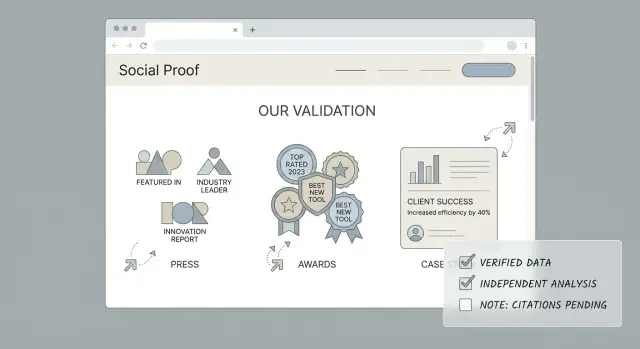
Why social proof pages struggle to rank
Press pages, awards pages, and case study pages look important, but they often pull very little organic traffic. The biggest reason is usually simple: they’re built like a gallery of logos and short quotes. That gives search engines very little text to understand, and it gives readers very little detail to trust.
There’s also a real tension on these pages. You want them to rank, so you’re tempted to make bold claims and pile on “proof.” But you also want them to feel credible, so you keep everything conservative, short, and carefully worded. When that balance is off, you get a page that feels salesy to people and thin to Google.
What counts as “credible” depends on who’s reading. A buyer wants proof that’s real and recent. A journalist wants something they can repeat without getting burned. A partner wants the exact wording and a clear relationship. If your press page blurs details like dates, publication names, or what was actually said, people hesitate to cite it. And when people don’t cite it, the page rarely earns natural backlinks.
Weak claims can hurt SEO and trust at the same time. They read like exaggeration, and they look suspicious when repeated across multiple pages:
- Vague superlatives (“best,” “leading,” “top”) with no source
- “Featured in” with no specific publication name and date
- Logo walls with no context
- Case studies with results but no baseline, timeframe, or method
- Awards listed without the awarding body, category, or year
A quick example: a startup writes “As seen in major tech publications” and shows five logos. If those mentions were tiny listings or sponsored posts, a writer won’t cite the page, and search engines still won’t learn what happened. A specific line like “Mentioned in Publication Name (Month Year) for Topic” is easier to repeat and much easier to rank.
Which pages count as social proof (and how people use them)
Social proof pages answer one quiet question: can I trust you? They work like an evidence folder for prospects, journalists, and partners.
Most companies end up with three main types:
- Press page: coverage, interviews, quotes, and official media assets. Often shows up for searches like “Brand press” or “Brand featured in.”
- Awards page: wins, shortlists, and certifications. Often matches searches like “Brand award” or “best category award winner.”
- Case studies: proof of results with context and constraints. Often matches searches like “Brand case study” or “how Brand helped industry.”
People use these pages during real decisions. Someone might read your homepage, feel interested, then open your press or awards page to see if anyone credible has already looked at you. Procurement might copy a line into an internal doc, but only if it’s easy to verify. Journalists look for publication names, dates, and wording they can safely repeat.
Search intent matters. If you want press page SEO to work, the press page should be about coverage and citations, not testimonials and performance claims. If you want award page SEO, keep it centered on the award body and what the award means. Clear intent also makes it easier for other sites to link to the right thing.
If one “Proof” page is trying to do everything, split it. A simple rule: if a category has more than 10 items, or each item needs even a short explanation to stay honest, separate pages usually work better.
Make claims easy to verify and safe to repeat
Social proof pages fail when the copy is written like an ad but read like evidence. If you want backlinks that stick, every statement should be easy for a careful reader to double-check in seconds.
Replace vague claims with specific ones. “Award-winning” is fuzzy. “Winner of the 2024 X Award (Y category)” is clear. “Featured in top publications” is hard to confirm. “Mentioned in Publication Name on Month Day, Year” is easy to validate.
Context keeps quotes from getting twisted. A short note like “Product update roundup” or “Founder interview” helps readers understand what the mention was and wasn’t. Keep dates visible on press and awards pages so old wins don’t get mistaken for current ones.
Be careful with “As seen in.” It can sound like an endorsement. Safer phrasing describes what happened: “Mentioned by,” “Quoted in,” or “Covered in a roundup,” followed by the date and topic.
If a mention is small, old, or not clearly positive, handle it directly instead of hiding it. Label it honestly (“Brief mention”), move it to an archive section with dates, or leave it out if you can’t verify it.
On-page setup that helps these pages rank
Many social proof pages don’t rank because they look like a collage. Search engines and readers need a clear promise, then easy-to-scan evidence.
Start with a page title and H1 that match the purpose. If the page is media coverage, say that. If it’s awards, say that. Mixing everything under a vague label like “As seen in” makes it harder to match the right intent.
Write a short intro (2 to 4 sentences) that explains what’s included and what the items mean. This sets expectations and reduces the risk that readers assume claims you didn’t make.
Then make each item self-contained. In plain text, include:
- Source name (publication, conference, awarding body, customer)
- Date (month and year is usually enough)
- What it was about (one sentence)
- Your role (winner, finalist, quoted, included in a roundup)
- Any limits (region, category, timeframe)
Keep visuals supportive, not heavy. Logos, badges, and screenshots should back up the text, not replace it. Use short captions and descriptive alt text so the page still makes sense without images.
Step-by-step: prepare a social proof page worth linking to
A social proof page earns links when it’s clear, easy to verify, and safe for other sites to reference. Before thinking about backlinks, get the page into a shape that a journalist, partner, or blogger can cite without extra work.
1) Set one goal per URL
Give each page one job: press, awards, or case studies. When you mix all three, you often end up with a long scroll that ranks for nothing and feels messy to quote.
2) Make every proof item consistent
Use the same mini-format for each entry so people can verify it fast: who, what, and when. Add one sentence of context, not marketing.
3) Add a couple of supporting pages that link back
A few small supporting pages can make internal linking feel natural. Examples include a “Company facts” page, a press kit basics page (logos and boilerplate), or a short methodology page explaining how you measured case study results.
4) Choose realistic search terms
Aim for how people actually search: “{brand} press,” “{brand} awards,” or “{industry} case study.” Don’t aim for broad terms like “best company” unless your proof is strong and widely known.
5) Set claim boundaries
Write down what you won’t claim. No “as seen in” unless it was a real feature. No “award-winning” unless the award is named. No growth numbers unless you can explain the timeframe and source.
A simple test: if a publication asked you to show the source in 30 seconds, could you?
Step-by-step: build backlinks without creating credibility risk
Backlinks can help press, awards, and case study pages rank, but they also raise the stakes. A link doesn’t just affect SEO. It can look like a citation. The goal is to earn links a careful editor would feel comfortable keeping.
Start with sources that already cite things: news recaps, resource lists, conference pages, partner pages, and industry directories with real editorial standards. Match the source to the page. If the page is about an award, an industry publication that covers awards makes sense. A random blog that never covers the topic usually doesn’t.
Keep anchor text neutral. Brand names, the page title, or simple phrases like “press page” and “award details” tend to age well. Avoid anchors that force someone to repeat your marketing line.
A practical process:
- Pick one proof item and collect the original source.
- Link to the most specific page possible (award details to the award page, not the homepage).
- Ask for placements where the link works as a citation, not a cheerleading statement.
- Keep surrounding text factual: who, what, when.
- Track which proof items get referenced most, then focus on those.
If you have a case study with measurable results, the safest angle is usually “details and methodology,” not “we’re the best.” It gives the publisher a reason to link without “agreeing” with your claims.
How to choose link sources for press and awards pages
For press and awards pages, the strongest links come from places people already trust. In plain terms, an authoritative site earns trust over time because real people read it, other reputable sites reference it, and it has clear editorial standards.
Authority does not mean a high SEO score, a site packed with random guest posts, or a page that exists mainly to sell placements.
A few strong links usually beat many weak links, especially for social proof pages. One well-placed mention from a respected publication can help rankings and credibility more than dozens of low-quality directory links no one would cite.
Relevance matters more than you think
Search engines look for signals that the link source and your proof page belong in the same conversation. Relevance can be industry (a fintech award cited by a finance publication), topic (a security certification referenced in a security roundup), audience (SMB media linking to an SMB case study), or format (press pages linked from coverage, not random blogrolls).
Red flags to avoid
These patterns can create ranking risk and credibility risk at the same time:
- Unrelated outbound links everywhere, with heavy “sponsored” labeling
- Awkward placements (a press page link inside a recipe post)
- Wild topic shifts across posts (casino, crypto, health, then your brand)
- No audience signals (no bylines, no clear publisher identity)
Example: making a small set of mentions and awards rank
Picture a startup with three press mentions, one award, and two case studies. They want those proof points to show up for brand searches plus terms like “press” and “award,” without turning the page into hype a journalist wouldn’t repeat.
Give each page one job:
- Press page: a clean index of mentions with consistent fields (publication, date, title, what was said).
- Awards page: award name, year, category, who issued it, and whether you won or were shortlisted.
- Case studies: a list page plus one page per story, focused on the customer problem, the work, and outcomes with context.
If you can only prioritize one first, start with the press page. It often matches existing search intent (“Brand + press”), it builds trust quickly, and it’s the safest page for others to cite.
A simple 30-day plan:
- Days 1-10 (copy + structure): rewrite claims into verifiable statements, add dates, remove vague superlatives.
- Days 11-20 (proof details): add short quotes with attribution, define metrics in case studies (baseline, timeframe, what changed), add short notes about what an award represents.
- Days 21-30 (links): build a small number of high-quality links to the press page first, then add a few to the awards page and your strongest case study.
Common mistakes that hurt rankings and trust
Social proof pages often fail because they try to impress instead of prove. When the page feels like marketing first and evidence second, readers bounce and publishers avoid citing it.
Overstating coverage is a common problem. “Featured in” can quietly turn into “partnered with” or “endorsed by,” even if the original mention was a short quote. If a skeptical visitor could read your wording as an endorsement, you’re taking on credibility risk you can’t control.
Another issue is turning the page into a junk drawer. Press mentions, awards, customer logos, testimonials, and case studies can all help, but mixing everything without structure creates noise. People land with a simple question: are they legit? If they can’t find a clear answer quickly, they leave.
Link patterns can hurt you, too. Repeating the same keyword-heavy anchor text across multiple placements looks unnatural. Variety matters, and brand or neutral anchors are often safer.
Finally, many teams build links to the wrong target. Sending backlinks to a thin, outdated, hard-to-scan page wastes effort. Even if someone mentions you, they’ll hesitate to cite a page that looks neglected.
Quick checklist before you start building links
Before you point backlinks at a press, awards, or case study page, make sure it can survive a fast fact check.
- Every item has a date and a short description that matches the source.
- Wording is cautious and defensible. Describe what happened; don’t imply endorsement.
- Titles and headings match what’s actually on the page.
- The page is fast and easy to scan on mobile.
- If someone asks “where did this come from?”, you can answer in one sentence.
A simple test: ask a teammate to read the page for 30 seconds, then tell you what the strongest proof is and when it happened. If they guess or mix items up, tighten the wording and layout.
Next steps: keep proof current and grow authority steadily
If you publish a press, awards, or case study page and then forget it, it slowly loses power. Editors update pages, awards get retired, and old claims start to look suspicious. Treat social proof pages like living assets.
Review what the page actually does in search, and what proof items people engage with. Then update on a schedule. Keep the layout stable so citations stay consistent. Add new mentions quickly, and remove items that are outdated, unclear, or no longer verifiable.
A lightweight monthly routine:
- Check search clicks and queries for the page
- Add new proof items using the same format
- Rewrite or remove any claim you can’t verify today
- Refresh screenshots, dates, and names
- Note which items drive demos, signups, or replies
If you’re using a curated placement provider, keep the same standard: make sure the page you’re building authority to is specific and easy to cite. For example, SEOBoosty (seoboosty.com) focuses on securing backlink placements from highly authoritative sites, which can only help if the target page is clear enough that readers and editors trust what it says.
Share