Backlinks for landing pages: vertical plans for 4 industries
Learn how to build backlinks for landing pages across SaaS, fintech, healthcare, and ecommerce using clear proof points and matched publications.
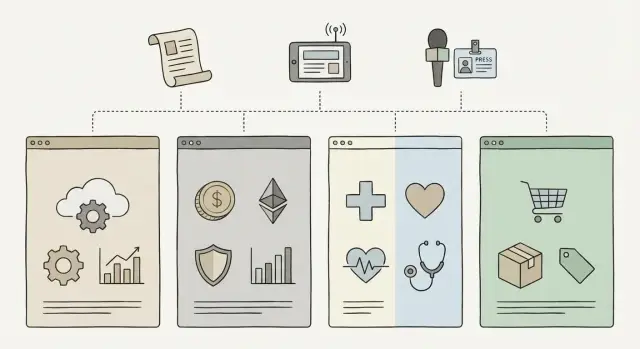
Why vertical landing pages struggle to earn links
Vertical landing pages often turn into orphan URLs. They sit a click or two away from the homepage, live under a campaign folder, and are built for conversions, not browsing. When someone lands there from search, they either convert or leave. They rarely explore the rest of the site, and other sites rarely discover the page on their own.
They’re also hard to cite. Editors and writers link to sources that help their readers: original data, clear definitions, comparisons, or practical how-to guidance. A vertical landing page is usually a pitch: a headline, a few benefits, a form, and maybe a logo strip. That can be great for sales, but it gives outsiders little reason to reference it as evidence.
There’s an intent mismatch, too. People linking are thinking, “What will my audience learn or verify?” People building landing pages are thinking, “What will convince a specific buyer to take the next step?” When those goals don’t meet, the page stays linkless, even if the offer is solid.
Generic links can also underperform for niche offers because they don’t signal the right context. A broad mention on a random blog might pass some authority, but it often won’t match the keywords, audience, or trust signals that matter for a vertical. A healthcare IT page getting links from general marketing sites may not move rankings for health-specific searches, and it won’t reassure cautious buyers the way a relevant industry mention can.
Most “natural” backlink attempts fail for a few predictable reasons. The page has little that’s quotable (data, benchmarks, definitions), the URL feels temporary (campaign naming, dated copy, gated content), the page reads too sales-heavy for editorial citation, and it lacks proof points (compliance scope, outcomes, customer types). On top of that, it’s often disconnected from the site’s informational content, so it never becomes a reference.
The goal isn’t “get any link.” It’s links that support rankings and conversions: placed in publications your buyers actually read, surrounded by relevant context, and pointing to a page that can hold attention once visitors arrive.
What a good backlink looks like for a vertical page
A vertical landing page isn’t trying to rank for everything. It’s trying to win trust for one industry, one audience, and one clear use case. So a good backlink isn’t just “high authority.” It’s a vote from a site that speaks to the same people you want, in a context that makes the link feel earned.
Topical match has three parts:
- Industry: who it serves
- Audience: who decides
- Use case: what problem it solves
A payroll SaaS page aimed at HR teams should earn links from HR, people ops, and B2B software publications, not generic marketing roundups. That’s what makes backlinks help rankings and conversions at the same time.
Proof points editors usually accept
Editors rarely link to pure sales pages unless there’s something verifiable to reference. The fastest way to make a vertical page linkable is to include proof that can be checked.
Good proof usually looks like clear numbers with a source note (even if it’s your own dataset and you explain the method), named customer stories or anonymized case studies with real before/after results, and credentials that matter in the vertical (certifications, licenses, awards, audits). Product evidence helps, too: screenshots, demo clips, pricing transparency, or a simple feature comparison.
In regulated spaces, “boring” trust pages matter more than most teams expect. If you’re in fintech or healthcare, editors look for clear company details and risk-reducing pages: an about page, leadership info, terms, privacy, security notes, and compliance statements where relevant.
Why placement context and anchors matter
Where the link sits changes how it’s interpreted. A link inside a paragraph that explains a problem and cites your data is stronger than a random mention in a tools list.
A few practical rules:
- Put the link near relevant language (industry + use case), so the context matches the page.
- Use natural anchors (brand, product name, or a short descriptive phrase), not exact-match spam.
- Don’t place the link next to unrelated tools or off-topic sections.
- Keep the destination tight: link to the most relevant vertical page, not a generic homepage.
How to pick your verticals and match them to real readers
Start by choosing only a few vertical landing pages to support. Three to five is usually enough. If you spread effort across ten industries, you end up with weak pages and weak link targets.
Pick verticals like you pick products to sell: revenue potential, margin, and search demand. A vertical with high traffic but low close rates can drain time. A smaller vertical with strong deal size can be worth it.
Before you plan backlinks, write a one-sentence promise for each page. Keep it specific enough that a reader can instantly tell, “This is for me.”
A useful format:
We help [who] achieve [outcome] in [timeframe or situation] without [common pain].
If you can’t write that sentence, the page will be hard to pitch to a publication.
Next, name the reader, not just the industry. Most vertical pages attract one of three roles: buyer, evaluator, or researcher. Each one expects different proof. Buyers want outcomes and risk reduction. Evaluators want integration details and requirements. Researchers want clear explanations and comparisons.
To match proof to the reader, rely on signals that are hard to fake, like security and compliance evidence (SOC 2, ISO 27001, PCI, HIPAA, audits), customer proof you’re allowed to share, measurable performance details, and a clear implementation process (timeline, onboarding steps, support model).
Then map where that reader already learns. Trade press and niche industry publications usually carry more weight for a vertical claim than a general tech site, because the audience context matches the page.
Finally, decide which pages get links first. Prioritize pages with the highest intent and the easiest proof to show. A “payments fraud prevention” page that can cite compliance scope and documented processes is often easier to support than an “AI strategy” page built on vague promises.
Industry plan 1: SaaS and B2B software
SaaS landing pages are often built for conversions, not citations. To earn links, treat the page like a reference someone can safely point to. That means clear claims, easy-to-check proof, and a topic that matches what SaaS buyers and builders already read.
Where SaaS links actually come from
For SaaS and B2B software, the most natural sources are developer blogs, SaaS review sites, and product or startup media. These places link when the page helps their reader decide, compare, or implement something.
Before you pursue placements, make sure you can answer basic “risk” questions fast: reliability, integrations, customer proof (only with permission), pricing approach, and security basics (SSO, audit logs, data handling, compliance claims you can support).
Link contexts that fit SaaS readers
The best placements usually happen inside comparison content, “best tools” lists, and technical explainers.
If your vertical page targets “CRM for B2B sales teams,” a review site can cite it as the vendor page that spells out pricing and integrations. A developer blog might cite your integration docs or a short implementation guide. The key is that the mention helps the reader do something.
Anchor text should sound like a human editor wrote it. Mix branded anchors (company name) with feature-level or problem-level phrasing (for example, “Slack integration,” “audit logs,” or “monitor API errors”). Avoid forcing links from unrelated news or lifestyle sites. They might look strong on paper, but they rarely send the right traffic and can make the link profile feel odd for a B2B product.
Industry plan 2: Fintech and financial services
Fintech pages can earn links, but only when they read like a careful, verified resource. Editors in finance are quick to reject anything that sounds like a promise (returns, approval rates, “guaranteed savings”) or an unverified compliance claim.
Start by collecting proof you can show an editor if asked. Don’t publish sensitive documents, but be ready with clear, consistent, verifiable statements.
Proof points to prepare (and keep consistent)
A small “trust pack” for fintech usually includes licensing or registration status (only where you’re actually licensed and only in the regions that apply), a clear security posture (encryption basics, key management approach), verified and current compliance scope (SOC 2 Type II, PCI DSS, ISO 27001, GDPR), and audit and oversight details (independent audits, testing cadence, incident reporting process). It also helps to state product boundaries plainly, like “we are not a bank,” if that’s true.
Adjust copy to be capabilities-first. Prefer “helps teams monitor,” “supports,” and “reduces manual work” over outcomes you can’t guarantee.
Where links fit best in finance publishing
Finance links land most reliably in educational contexts, not hype pieces. Look for placements where your page supports understanding:
- regulatory explainers written for operators (KYC, AML, PCI, data retention)
- risk-management checklists for compliance and security teams
- vendor category overviews that compare options in plain language
- implementation notes for payments, fraud, or reconciliation workflows
Before you pitch or place anything, read the outlet’s ad and editorial policies. Many finance sites require clear labeling of sponsored content, ban “investment advice,” and demand citations for compliance statements.
Example: a payments company has a “chargeback monitoring” landing page. Instead of chasing generic tech blogs, it earns better links from payments and banking-tech outlets by contributing a simple guide on chargeback reason codes, then referencing the landing page only as a practical tool description.
Industry plan 3: Healthcare and health IT
Healthcare and health IT pages can earn strong links, but only if the page feels safe to reference. Editors and compliance teams are careful. They avoid vendors that make big promises without evidence, or that blur the line between marketing and medical advice.
Start by mapping where your buyers actually read. For providers and health systems, that’s often healthcare trade journals and provider news sites. For IT teams, it’s health IT outlets covering EHRs, interoperability, and security. For product-led categories, medical device and digital health publications can work, but they usually expect tighter sourcing.
Proof points you should have ready
In healthcare, proof is part of the content. Before you pursue placements, make sure your landing page (and your “about this product” facts) are easy to verify.
The proof that gets cited (and questioned) most:
- privacy and security posture: HIPAA readiness, BAAs, encryption basics, incident response approach
- audit and compliance signals: SOC 2 / ISO 27001 if you have them, with clear dates and scope
- clinical or operational evidence: outcomes, study design, or measurable case results with context
- implementation reality: integrations, onboarding time, support model, and who owns data
- clear disclaimers: what you do not claim (especially around diagnosis or treatment)
If you can’t document something, don’t hint at it. “HIPAA compliant” as a blanket statement can backfire unless you explain what you actually do and how customers use you.
Best link contexts for health audiences
The safest wins come from practical content: workflow guides, compliance checklists, and interoperability explainers. These topics naturally cite vendors as examples without sounding like ads.
Good angles include a step-by-step guide to preparing for a HIPAA risk analysis (pointing to your security or compliance section), an interoperability piece (FHIR, HL7, EHR integration) that points to your integrations page, or a vendor evaluation checklist that cites your documentation and policies.
Many healthcare outlets also expect reviewer credentials and visible citations. If the publication uses expert review, match that standard on your own page, too.
Example: a small telehealth platform launches a landing page for “secure patient messaging.” Instead of chasing general tech blogs, it targets a health IT outlet running a “secure communications” buyer guide. The backlink points to a section that lists supported standards, data handling, and BAA availability, not a sales promise.
Industry plan 4: Ecommerce and retail
Ecommerce and retail pages can earn strong backlinks when they read like real store help, not a pitch. The best placements tend to come from places store owners already trust: ecommerce platform ecosystems (themes, apps, partner directories), retail trade media, and practical operations blogs that publish playbooks.
Proof points to gather before you pitch
Editors in this space want specifics. If you have measured results, use them, but don’t stretch one case into a promise.
A simple proof pack usually includes performance benchmarks you can defend (conversion lift, return-rate reduction, page speed improvements), integration details (platforms, connectors, setup time), your support model, one short customer story with clear context (store size, category, what changed), and tidy screenshots or quotes that match the claim.
Where the link should live (and what it should say)
For ecommerce, the most natural backlink contexts are educational pages that already discuss tools and workflows: platform comparisons, “how to choose an app” roundups, cart recovery and checkout conversion guides, and store operations topics like inventory accuracy or returns.
Anchors work best when they match the reader’s task and stay modest. Instead of “best ecommerce solution,” use phrasing like “reduce checkout friction” or “inventory sync guide.”
One thing to avoid is coupon-style placements (discount pages, deal directories, promo code hubs). They often look transactional, attract low-intent clicks, and send weak quality signals.
Step-by-step: building and placing vertical-matched links
1) Get the page ready to be linkable
Before you pursue placements, make sure the vertical landing page can survive a quick editor check. Add proof people can verify: short case results, screenshots, pricing ranges, certifications, compliance notes, or a clear “how it works” section. A tight FAQ helps because it answers the objections that stop someone from clicking.
A simple test: if someone found this page from an industry publication, would they trust it in 20 seconds?
2) Build a shortlist of publications by vertical
Create a small list for each industry. Eight to fifteen targets per vertical is enough to start. Match the publication to the reader you want, not just the domain strength.
3) Qualify targets using visible signals
You don’t need secret metrics to spot good targets. Look for visible signs of quality:
- real authors and bylines, corrections, dated updates
- obvious topical fit (they cover your vertical, not “everything”)
- a real audience (comments, newsletter, events, consistent posting)
- natural outbound links (they cite sources without stuffing keywords)
- reputation inside the niche
4) Choose the smallest link format that still feels editorial
Not every site will publish a guest post, and not every vertical page deserves a full story. Choose the smallest format that fits:
- a relevant editorial mention
- a resource list or tools page
- a partner page (best for integrations)
- an interview or expert Q&A
5) Plan anchors and destinations per vertical
Avoid repeating the same anchor everywhere. Keep anchors descriptive and varied, and send links to the most relevant vertical URL, not always the homepage. A fintech page might earn language like “payments risk monitoring,” while a SaaS page might earn “SOC 2-ready onboarding.”
6) Track outcomes that matter
Rankings matter, but track what your business feels: qualified visits, demo or signup rate, and assisted conversions (people who returned later). Tag placements by vertical so you can see which industry pages move revenue, not just traffic.
Common mistakes that waste budget and time
Most failed link plans aren’t about “not enough links.” They fail because the links don’t match the page, the audience, or what an editor can safely publish.
A common budget-waster is treating every vertical page the same. If you reuse identical anchor text across SaaS, fintech, healthcare, and ecommerce pages, the pattern looks unnatural and sends the wrong context signals. A fintech page should earn language that fits finance readers (like “fraud monitoring” or “payment risk”), not the same phrasing you used for a SaaS landing page.
Another trap is sending almost all backlinks to the homepage and hoping vertical pages rise on their own. Homepages often rank for brand terms, but they rarely answer the specific query your vertical page targets. If your goal is rankings and leads from a vertical page, that page needs direct support.
Relevance also gets ignored when people chase pure authority. A high-authority tech blog can help, but if the readers are developers and your vertical page is “fintech compliance for regional banks,” the mismatch shows. Editors and readers notice when a reference feels bolted on.
Proof and page readiness issues
Links also fail when the landing page makes claims nobody can verify. Editors avoid citing numbers, “top rated” statements, or customer logos without sources. If your page says “cuts onboarding time by 60%,” be ready with a short case study, a named method, or a clear explanation of how you measured it.
Before you pay for placements, make sure the page is ready to receive them. Thin copy, vague headlines, and an unclear offer turn good links into wasted traffic.
A practical readiness check:
- one clear vertical promise (who it’s for and what it does)
- at least one proof element (case snippet, testimonial, certification, demo workflow)
- features tied to the vertical, not generic product talk
- fast load, clean layout, clear next step
- basic trust signals (company details, support, security notes where relevant)
Placements that get removed later
Another expensive mistake is buying placements that look like ads. If the content reads like a sponsored blurb, it’s more likely to be edited, nofollowed, or removed when the site cleans up old posts.
A safer approach is placements that fit naturally into real editorial content, with a clear reason for the mention. A healthcare IT page can be cited in an article about audit preparation if the page includes a checklist and a short, concrete compliance explanation.
Checklist, example plan, and practical next steps
Before you buy or build links, make sure each vertical landing page can hold up when a real editor or reader clicks through. If the page feels thin, vague, or over-promising, even a great placement won’t help much.
Quick checklist (use it per vertical page)
- Proof on the page: one or two concrete proof points (a metric with context, a named integration, a short case snippet, or a simple “how it works” flow).
- Clear audience: the first screen says who it’s for and what problem it solves, in plain words.
- Careful claims: avoid absolute promises and handle regulated or medical statements with discipline.
- FAQ that answers objections: pricing approach, timelines, security and compliance basics, and “who it is not for.”
- Publication match: a shortlist of 10 to 20 aligned publications, plus a simple plan for anchors and destinations.
Keep anchors and destinations simple: most links should be branded or natural (company name, product name, “learn more”), and only a small share should be exact-match. If you can, spread links across the vertical page and one supporting asset (case study, benchmark, compliance explainer) so the pattern doesn’t look forced.
Example plan: one company, four vertical pages
Say a workflow automation company has four vertical pages: SaaS, fintech, healthcare, and ecommerce. Don’t start with all four.
Start with the vertical that already has the strongest proof and the shortest sales cycle. If SaaS has two recognizable customer stories and a clear product demo, it’s often the best first bet. Next, pick the vertical with the clearest compliance story. For fintech and healthcare, even a small “security and controls” section plus a straightforward FAQ can reduce bounce and help link traffic convert.
Then map each vertical to the publications its buyers already read. SaaS links should sit near product, engineering, or growth content. Fintech should match payments, risk, and compliance readership. Healthcare should match health IT, operations, and privacy topics. Ecommerce should match merchandising, ops, and retention content.
Practical next steps
Set a steady cadence so results can compound. A realistic pace is a small number of placements per month, weighted toward the verticals that are already ready (clear promise, proof, and tight positioning).
Review performance every 4 to 6 weeks using a few simple signals: ranking movement for the vertical page, organic clicks, conversions or demo requests, and whether visitors from each placement stay on the page.
If you want a more predictable way to secure publication-matched placements, SEOBoosty is one option teams use for premium backlinks on authoritative domains. The key is still the same: pick verticals first, make the landing page worth citing, then choose publications whose readers actually match the page you’re trying to grow.
FAQ
Why do vertical landing pages usually get so few backlinks?
Vertical landing pages are built to convert, not to teach. Most of them don’t offer quotable material like original data, clear definitions, benchmarks, or neutral comparisons, so editors have little reason to cite them as a source.
What’s the fastest way to make a vertical landing page more linkable?
Start by making the page safe to reference. Add one or two verifiable proof elements like a short case result with context, a clear “how it works” explanation, and trust details that match the vertical (for example, security and compliance scope in regulated categories).
What makes a backlink “good” for a vertical landing page?
A good backlink matches your page on three levels: the industry, the decision-maker audience, and the specific use case. If the publication speaks to the same readers you want, the link is more likely to improve both rankings and conversion quality.
What proof points do editors actually trust enough to link to?
Editors tend to accept links to sales pages when there’s something they can verify. Realistic examples include clearly explained metrics, defensible case studies, and credentials you can back up without stretching the truth.
Does link placement context really matter, or is any mention fine?
Put the link where the surrounding text explains the problem your page solves and why you’re being referenced. A contextual mention usually performs better than a random tools list because it signals relevance and makes the click feel earned.
What anchor text should I use for backlinks to a vertical page?
Use anchors that sound like an editor wrote them, usually your brand name, product name, or a short descriptive phrase. Repeating the same keyword-heavy anchor across many sites can look forced and often doesn’t help the way people expect.
How many vertical landing pages should I try to build links to at once?
Keep it narrow: three to five vertical pages is a practical starting point. Spreading effort across too many industries usually produces thin pages and weak link targets, which makes both outreach and results harder.
Which vertical should I build backlinks to first?
Prioritize the page with the highest intent and the clearest proof you can show today. If one vertical has compliance details, integration specifics, and a credible case snippet, it’s often a better first target than a page built on broad, hard-to-verify claims.
Why don’t generic high-authority backlinks move my niche vertical rankings?
Don’t rely on generic authority alone. When the audience and topic don’t match your vertical, you may get little ranking movement for the queries you care about, and the traffic that does arrive is less likely to trust the offer.
How can SEOBoosty help with backlinks for vertical landing pages?
If you want predictable placements on highly authoritative sites without negotiating, some teams use SEOBoosty by selecting domains from its curated inventory, subscribing, and pointing the backlink to the target page. It still works best when the landing page is worth citing and the publication matches the vertical’s audience.
Share