Backlink target URLs: pick pages beyond the homepage
Use a simple framework to choose backlink target URLs beyond the homepage, prioritize product, category, and guide pages, and keep authority focused.
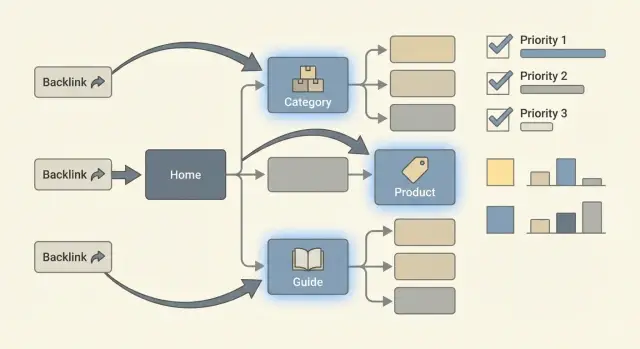
Why the homepage should not get every backlink
The homepage feels like the safest place to point a backlink. It is the main URL, it often has the most internal links, and it can lift overall authority. But if every new link goes there, you miss chances to rank the pages that actually bring signups, sales, and leads.
A backlink is not just "more authority for the domain." It is also a signal about what page should rank for what searches. If someone searches for a specific product, a category, or a how-to question, the homepage is usually the wrong answer. You can end up with a homepage that ranks for broad terms while the pages that should convert stay stuck on page two.
In plain terms, the right target URL is the page that matches search intent and has a clear business payoff. Before you point a link at a page, ask yourself:
- Does this page clearly answer the query you want to win?
- If a visitor lands here, is there a clear next step (buy, book, request, subscribe, sign up)?
- Will this URL still make sense a year from now?
- Can you support it with internal links from related pages?
The opposite problem is spreading links across too many pages. If you point one link to 20 different URLs, none of them may get enough strength to move rankings. It also becomes harder to manage because every target needs its own on-page cleanup, internal links, and tracking.
A practical goal is focus: choose a small set of money pages (product or category pages that generate revenue) and one or two evergreen guides that attract steady demand. Then build enough links to those targets to create real movement.
Know your page types and what each is good for
Different pages are built to answer different questions. Strong backlink targets are the ones where the page purpose matches what people searched for.
The homepage is for brand and navigation. It can work for broad terms (your company name, your main offering) and for people who are still figuring out what you do. For a specific need, the homepage often feels like a detour.
Category pages are for "I'm shopping, show me options." They fit searches like "best [type]," "affordable [type]," or "[type] for [use case]." Because they group many items, category page backlinks often help you rank for wider, high-volume themes.
Product pages are for "I picked one, convince me." These pages fit searches with a model name, a specific feature, pricing intent, or comparisons. Linking to product pages can be the right move when the product must rank on its own and the page answers the query clearly with details, proof, FAQs, and a clean next step.
Evergreen guides are for "teach me" searches: "how to," "what is," "vs," and best practices. Evergreen content backlinks can be powerful because guides are easy to cite naturally, and they can feed authority into your money pages through internal linking for SEO.
A simple way to avoid spreading authority thin: reserve your strongest links for the pages that must rank to hit your goal. If you need revenue now, that usually means a category or product page. If you need demand generation, it often starts with a guide that can later route readers to the right category or product.
Example: if people search "project management software for nonprofits," a homepage link is rarely the best match. A dedicated landing page for nonprofits or a guide like "How nonprofits choose project management software" is usually a better target because it matches the intent without making the visitor hunt.
Start with goals, not URLs
Picking backlink target URLs gets easier when you decide what you want the link to achieve. A backlink is not just a vote for the site. It pushes people (and search engines) toward a specific page. If that page does not help your business, the win is mostly theoretical.
Start by choosing 1 to 3 outcomes that matter this quarter. Keep them measurable: more demo requests, more trials, or more sales of a specific product line.
Then map each outcome to the pages that directly make it happen. "Directly" means the page has a clear next step and does not rely on a visitor clicking around to find it.
To keep your plan from turning into a long wish list:
- Limit yourself to up to 3 primary outcomes.
- For each outcome, choose 2 to 4 pages that can convert a visitor today.
- Treat everything else as support pages that earn authority through internal links.
This is where most teams get stuck. A new feature page, a press mention, or a trendy blog post can feel exciting, but that does not make it a good backlink destination. If it cannot convert (or quickly route to a page that converts), it is usually not a priority target.
A realistic example: say you sell a project management tool. Your outcomes might be (1) increase trials and (2) increase paid upgrades. Your must-rank pages could be pricing, the core product page, and a high-intent use-case page like "Project management for agencies." An evergreen guide like "How to run a weekly client meeting" can still matter, but it is a support asset unless it consistently drives sign-ups.
Once you have a must-rank set, build around it. Add authority to those few pages first, then use internal links to spread that strength to related product, category, and guide pages without thinning it out.
A simple scoring system to prioritize targets
If you pick backlink target URLs based on gut feel, you usually end up with too many "good ideas" and not enough results. A basic scorecard forces you to choose a few pages that can actually carry the weight.
Score each page from 1 to 5 on the same five factors (1 = weak, 5 = strong), add the total, and only back the top 3 to 5 pages at a time:
- Traffic potential: Is there real search demand for this topic?
- Conversion value: If this page ranks, what is a visit worth?
- Ranking readiness: Is the page clear, complete, and easy to understand?
- Stability: Will the URL and the offer stay consistent over time?
- Internal link support: Can other pages on your site naturally link to it?
As a rule of thumb, anything under 15/25 is usually not ready for new backlinks. Fix the page first or choose a different target.
Quick example for a small ecommerce site: a "running shoes" category page might score 4 (traffic), 4 (conversion), 3 (readiness), 5 (stability), 4 (internal support) = 20. A single product page for "Model X Blue" might score 2, 3, 3, 2, 2 = 12 because it may go out of stock and has fewer natural internal links.
Step-by-step: choosing targets beyond the homepage
Treating backlink target URLs like a shopping list leads to overbuying. The goal is focus: a small set of pages that deserve authority now, plus a smaller set that supports them.
1) Build a short candidate list
Collect 5 to 15 URLs max, pulled from three buckets: top products, main categories, and 1 to 3 evergreen guides that answer common questions. If you end up with 30 candidates, you are not being thorough, you are avoiding a decision.
2) Score each page the same way
Use a simple spreadsheet and keep your criteria consistent so you can repeat it later. Your scoring can match the five-factor system above, or use your own version, but keep it stable across every URL.
3) Split winners into money vs supporting
Money pages are the pages you want to rank for buyer-intent terms (often products and categories). Supporting pages are usually evergreen guides that attract clicks, build trust, and pass internal links to money pages.
Keep the money set small (2 to 5 pages). Keep the supporting set smaller than you think you need (3 to 8 pages).
4) Decide allocations before you place anything
Avoid improvising link targets week to week. Pick a simple plan in advance, like "most new links go to money pages" and "supporting pages get a smaller share." The exact split matters less than sticking to it long enough to see results.
5) Document the plan so you can repeat it
Write down your candidates, scores, final targets, and allocation. Next month, you can update scores instead of starting from scratch.
How to choose between product, category, and guide pages
This choice is mostly about intent.
Choose category pages when the search is broad and people are comparing options. They are also safer targets when products rotate often, because the category page stays stable.
Choose product pages when the query is specific and the page has clear profit value. Favor products that are likely to stay in stock and stay relevant. A good gut check: if you would happily send paid traffic to that product page all year, it is often a good backlink target.
Choose evergreen guides when people are trying to learn, not buy yet. Guides attract natural citations over time, and they can route readers to your best categories and products with internal links.
Be cautious with seasonal pages and short campaigns. If the page will be removed or heavily changed, the backlink can lose value. A safer pattern is to point links to an evergreen hub page you refresh each season.
If you have similar pages competing with each other (two categories targeting the same keyword, or multiple near-identical products), pick one primary target and make the others support it. Consolidate where you can, and use internal links so the chosen page is clearly the main one.
Mistakes that dilute authority (and how to avoid them)
Most issues are not about getting the link. They are about pointing it at the wrong place, or failing to support it after the link goes live.
1) Pointing links at weak or unstable pages
A backlink amplifies what is already there. If the target page is thin, outdated, or confusing, the link does little. Unstable URLs are risky too: renames, merges, discontinued products, temporary promo URLs, and faceted navigation can all weaken the long-term payoff.
2) Spreading links evenly "to be fair"
Giving every product or post its turn usually means nothing gets enough authority to stand out. A smaller set of durable targets tends to outperform a perfectly even spread.
3) Ignoring internal linking after the backlink
A backlink should not be a dead end. When a link lands, make sure authority and visitors can flow deeper:
- Add a few relevant internal links from the target page to key product or category pages.
- Link to the target page from places you control (navigation, hub pages, related guides).
- Use clear anchor text that matches what the page is about.
4) Creating keyword cannibalization
If two or three pages chase the same keyword, search engines may rotate them or pick the wrong one. Choose one main page per primary keyword, and let the other pages support it with different angles and internal links.
Quick checklist before you point a backlink
Before you choose backlink target URLs, do a quick quality pass:
- Intent match: the page should feel like the obvious answer to the query.
- Indexable and clean: no noindex issues, no login walls, no messy duplicates.
- Clear first screen: headline and opening should confirm the topic fast.
- Internal support: the page should be easy to reach from related pages.
- Measurable outcome: define success (rankings for a small term set, organic visits, and one business metric).
A simple reality check helps: if the page is not good enough to send a real person to, it is not a great backlink target.
Example: a realistic targeting plan for a small site
Picture a small SaaS company with one core product and three use cases: agencies, in-house marketing teams, and consultants. They want backlink target URLs that help them rank for specific searches and bring in trial signups.
They pick four targets for the next 30 to 60 days:
- One hub page that summarizes the three use cases and links into each page
- Two use-case pages (the two that convert best)
- One evergreen guide that answers beginner questions and routes readers to the hub and use-case pages
This small set still covers a lot of queries. The hub can pick up broader terms, the use-case pages can win more specific searches, and the guide captures early-stage demand while feeding authority and visitors into the pages that convert.
They then decide which pages get the strongest links. The simplest rule is also the most useful: point your highest-authority placements at the pages that must rank to drive revenue.
After 30 to 60 days, they adjust based on results. They keep the targets that are moving up and converting, and swap out the ones that are flat. They track a short list of signals: keyword movement, qualified organic visits, conversions (trials, demos, sales), and whether internal links are sending people to the right next step.
Next steps: keep focus and scale without spreading thin
Once you have a short list of backlink target URLs, the real win is staying consistent. Most sites stall because they keep adding new targets every week, so none of the pages get enough support to move.
A simple routine helps: keep 3 to 5 active target pages for the quarter, maintain a small backlog of next-best pages, review performance monthly, and only change targets quarterly.
If you are using a provider like SEOBoosty (seoboosty.com), this focus matters even more because high-authority placements are hard to replace. Use those links on stable pages that are ready to rank and convert, then rely on internal linking for SEO to spread the gains to the rest of the site.
FAQ
Should I point most of my backlinks to the homepage?
Not by default. The homepage is great for brand queries and broad positioning, but it’s usually a poor match for specific searches. If you want rankings and conversions, point many links to the page that best answers the exact query and has a clear next step.
How do I decide between a category page, product page, or an evergreen guide?
Category pages fit “show me options” searches and can rank for broader, higher-volume terms. Product pages fit “I chose one” searches where the user wants details, pricing, and proof. Evergreen guides fit “teach me” searches and often earn links naturally while passing authority to money pages through internal links.
What’s the simplest way to pick backlink target URLs that actually drive revenue?
Start with business outcomes, not URLs. Pick 1 to 3 measurable goals for the quarter, then choose the few pages that directly produce those outcomes, like pricing, a top category, or a high-intent use-case page. Treat other pages as support that benefits from internal linking.
How many pages should I actively build links to at once?
A good default is 3 to 5 active targets at a time. That’s usually enough focus to move rankings without spreading authority too thin. If you’re tempted to target dozens of URLs, you’ll often end up with no page getting enough strength to break through.
What’s a quick scoring system to prioritize backlink targets?
Use a simple 1-to-5 score across traffic potential, conversion value, ranking readiness, stability, and internal link support. Add the scores and back the pages that rise to the top. If a page is weak on readiness or stability, fix it before you send expensive links to it.
How do I avoid wasting backlinks on pages that won’t last?
Aim for durable, evergreen URLs and avoid targets that will change soon. Pages that frequently get renamed, removed, or heavily reworked can waste link value over time. If the offer or URL won’t still make sense in a year, it’s usually not a great primary target.
What should I do on my site after a backlink goes live?
Make the target page a strong hub, not a dead end. Ensure it links clearly to your key product, category, or conversion pages, and make sure other relevant pages on your site also link back to the target. This helps both visitors and search engines understand what the page is about and where to go next.
How do I handle keyword cannibalization when choosing link targets?
Pick one primary page per main keyword theme and support it with related pages that target different angles. If multiple pages chase the same query, search engines can rank the wrong page or rotate them unpredictably. Consolidating, clarifying intent, and tightening internal links usually solves it.
How should I split links between money pages and supporting content?
A practical default is to send the strongest links to money pages and a smaller share to evergreen guides that feed those money pages. The exact split matters less than staying consistent long enough to see movement. Change targets too often and you reset momentum.
If I use a backlink provider like SEOBoosty, what should I do differently?
Premium placements are hardest to replace, so use them on stable pages that are already ready to rank and convert. Keep your target set small, document it, and track outcomes like qualified organic visits and signups, not just “more authority.” If you’re using a provider like SEOBoosty, that focus helps you get more impact from each placement.
Share