Cluster-based backlink sourcing for cleaner topical SEO
Cluster-based backlink sourcing helps you match referring domains to content clusters, so backlinks reinforce clear topical themes and rankings.
Why your backlink profile can feel scattered
If you have plenty of backlinks but your rankings still feel random, your site may be sending mixed signals.
Search engines try to understand what your site is really about. When the sites linking to you cover too many unrelated topics, it gets harder to see a clear theme. That can leave your best pages without consistent, relevant support.
A messy link profile is not only about “bad links.” It often looks like this: a fitness blog links to your pricing page, a finance site links to a beginner recipe post, and a local directory links to a technical guide. None of those links are automatically harmful, but together they create noise. Your site looks busy, yet it’s unclear what you should be trusted for.
This tends to happen when you have multiple categories, a broad blog, or content aimed at different audiences (like product updates, hiring, and customer education all on one domain). It’s also common after years of one-off guest posts, PR mentions, or “take whatever link you can get” campaigns.
The fix is not making every link identical. The goal is building a few clear themes that match your most important content areas, so authority grows where you want to win.
What cluster-based backlink sourcing means
Cluster-based backlink sourcing is a way to plan backlinks so they strengthen topics, not just individual pages.
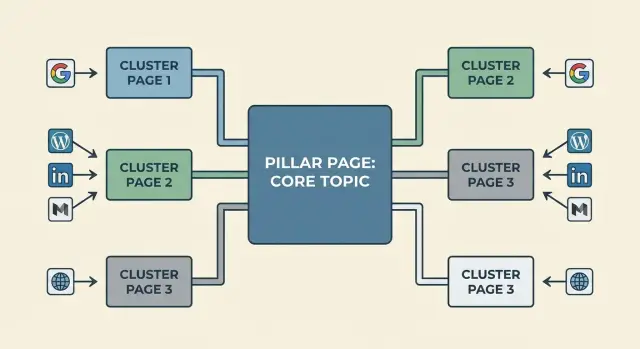
You start with your content clusters (a main theme page plus supporting articles). Then you choose referring domains that naturally reinforce one of those clusters, and you point links to the most fitting page inside it.
Instead of a random mix of links to unrelated pages, you build small, consistent signals around a few themes. Over time, search engines see the same topics repeated around your site, from the kinds of sites that normally talk about those topics. That consistency makes it easier for your content to be understood and trusted.
The planning question changes:
- Not “Which page needs a boost today?”
- But “Which topic are we strengthening this month, and which sites make sense for it?”
Set expectations: this is structure, not a shortcut. It won’t fix weak content, sloppy internal links, or a confusing site overnight. But it prevents a common problem: a link profile that looks active while failing to communicate a clear message.
A simple example: if you have a “healthy meal prep” cluster and a “strength training for beginners” cluster, a nutrition blog and a gym equipment site are not interchangeable. Map each domain to the cluster it supports, then choose a target page in that cluster that fits the context.
A quick refresher on content clusters
A content cluster is a practical way to organize pages around one theme.
You usually have one pillar page that covers a topic broadly, plus a set of supporting pages that answer specific questions. The pillar sets the direction. Supporting pages do the detailed work. They should link back to the pillar (and sometimes to each other) so the set feels like one topic, not a pile of random posts.
Example: a pillar page might be “Email deliverability,” while supporting pages cover “SPF vs DKIM,” “warming up a new domain,” and “how to fix spam complaints.”
Clusters help visitors because they can move from an overview to the exact detail they need without starting over. They help search engines for a similar reason: clear internal connections and consistent focus make it easier to understand your theme and which pages matter most.
Common ways to define clusters include grouping content by use case, audience, product line, or industry. If your site is small and tightly focused, you may not need a formal setup yet. But even a lightweight cluster structure makes backlink planning far easier.
Define your clusters before you source any links
Cluster-based backlink sourcing works best when you decide your themes first, then treat each new referring domain as support for one clear topic.
Start by listing your main topics and keep it small. For a growing site, 2 to 6 clusters is usually enough. Give each cluster a plain name you’d recognize in a spreadsheet (like “Email deliverability” or “HR compliance”), not a clever marketing label.
For each cluster:
- Pick one pillar URL that should become the strongest “home” for that topic.
- Choose supporting URLs that expand the pillar with specific subtopics (often 5 to 15 pages).
- Note the primary intent: informational (learn), commercial (compare), or navigational (find a brand or tool).
Overlaps will happen. A page can mention two topics, but it should belong to one cluster. A simple rule: assign it to the cluster it answers most directly, then note the overlap.
A basic spreadsheet is enough. Track the cluster name, the pillar URL, the supporting URLs, intent, and any notes. This upfront clarity prevents you from guessing later when you’re deciding where a link should go.
Step-by-step workflow to map domains to clusters
A clean map is simple: every referring domain you pursue should clearly support one content theme.
Create one spreadsheet with three columns: referring domain, best-fit cluster, and the page you want to strengthen. Then follow this routine:
-
Tag what you already have. Export your current referring domains and label each one as a strong fit, weak fit, or unrelated for a specific cluster. If you can’t explain the fit in one sentence, mark it weak.
-
Pick 1 to 2 focus clusters for the next 30 to 90 days. Choose clusters where you already have solid content and a clear business goal. Keeping scope tight is what makes new links send a consistent signal.
-
Choose a few recipient pages inside each focus cluster. Start with the pillar page and 2 to 3 supporting pages. This keeps links from drifting toward random posts.
-
Set a cadence you can keep. Weekly is great if you have capacity; monthly is fine if you’re selective. Consistency matters more than volume.
-
Track placements and review monthly. Log each new link with its cluster tag, target URL, and a short note on why it fits. Then check which cluster is gaining impressions and rankings.
How to judge whether a referring domain fits a cluster
A referring domain fits a cluster when it would make sense for that site to mention your page even if SEO didn’t exist.
Start with relevance. Skim the site’s recent posts and categories. If your cluster is “email deliverability,” a site that mainly publishes crypto news might have one token marketing post, but it’s not a natural home for that theme.
Then consider authority, but in context. A large general site can help, but a smaller industry publication that lives and breathes your topic often sends clearer topical signals.
Context matters as much as the domain. The best placements sit inside an article where the surrounding paragraph is actually about your cluster topic, and your linked page is a natural next step.
If you want a quick fit test, look for most of these signs:
- The site regularly publishes articles aligned with your cluster’s topic and intent.
- The content has real structure and substance, not a few thin paragraphs.
- Outbound links look selective, not like a directory.
Red flags that usually break topical signals
Off-topic categories, thin pages, obvious “write for us” footprints, and pages packed with outbound links are common warning signs. If the site feels like it exists mainly to host links, it rarely strengthens your cluster.
Picking target pages and anchors without overthinking it
The easiest way to stay consistent is deciding where links should land before you start placing them.
Think of links as votes for a specific theme, not just your site in general. Pillar pages usually deserve your highest-trust links because they’re meant to rank for the big topic. Supporting pages are better when the referring domain fits a narrower angle, or when you want the cluster to grow naturally instead of pushing one URL over and over.
A practical rule:
- Use pillar pages for broad, high-intent searches and category-level topics.
- Use supporting pages for specific questions, comparisons, and how-to content.
- Link to the homepage only when it truly matches the context (brand mentions, company story, press).
- When you link to a supporting page, make sure it links back to the pillar.
Anchor text is where people tend to overcomplicate things. Keep it readable, on-topic, and varied. You don’t need to repeat the exact keyword every time. If a sentence naturally says “guide to onboarding emails,” that’s usually better than forcing a clunky phrase.
Common mistakes that weaken topical signals
The fastest way to lose topical clarity is building links before your clusters are real. If a “cluster” is only a few loosely related posts with no clear hub page, new links don’t reinforce a theme. They just add noise.
Another common trap is chasing authority without fit. A powerful site isn’t automatically a good match if its audience and topics sit far from your cluster.
Most problems come from a few patterns:
- Sending links to pages that don’t connect to a hub or support a single theme.
- Prioritizing big-name domains even when the content context is off-topic.
- Repeating the same keyword-heavy anchors until it looks unnatural.
- Leaving older links pointing to outdated or mismatched pages after a reorg.
- Trying to push links for too many clusters at once, so none gains momentum.
A simple example: you rebuild a “technical SEO” cluster, but most historical links still point to your homepage or a broad services page. Your topical signals stay blurry until you improve internal paths and start sending new links into the hub and key supporting pages.
Quick checklist before you place the next link
Before you commit to a placement, confirm the basics:
- Keep clusters limited (2 to 6 is a good target for many sites).
- Tie each cluster to one pillar URL, plus a short set of supporting pages.
- For every referring domain, write one sentence on why it fits the cluster. If you struggle, skip it.
- Spread links across the pillar and key supporting pages, not only the homepage or a single “money” page.
- Track every link by cluster so you can compare results and adjust.
A useful test: can you explain the choice in 10 seconds? “This domain writes for finance teams, so it supports our invoicing pillar and the ‘late payments’ guide.” If you can’t say something like that, the match is weak.
A realistic example of cluster-aligned link planning
Picture a B2B SaaS that sells a workflow tool. Their content is organized into three clusters: Use cases (what the product helps you do), Integrations (how it connects to other tools), and Pricing (plans, costs, and buying questions).
Before, they earned or bought links wherever they could, often pointing to random posts. The result was lots of backlinks, but weak topical clarity.
Now they plan 10 new referring domains and split them so the link profile tells a clear story: 4 domains for Use cases, 3 for Integrations, and 3 for Pricing. They choose target pages that can “carry” each cluster first (the hub page and the top supporting pages that already perform). They keep anchor text natural: mostly brand and descriptive phrases, with occasional partial matches when they read like something a writer would actually use.
The biggest change is what they stop doing: no more planned links to unrelated posts just because the post is new.
How to measure results by cluster (not just overall)
Sitewide SEO numbers can hide what’s actually working. A cluster view shows which theme is gaining trust and which one still feels weak.
Give each cluster a simple scorecard. Keep it light, with 2 to 3 metrics you can check weekly:
- Search impressions for pages in the cluster
- Average ranking (or a short list of 5 to 10 important keywords)
- New referring domains pointing into the cluster
Log every new backlink under the cluster it supports. Then watch for uneven growth. If one cluster climbs while another stays flat, the lagging cluster usually needs better internal linking, stronger pages, or more aligned referring domains.
Switch focus when a cluster shows consistent movement for 3 to 4 weeks and the next links feel optional instead of necessary. Then move to the next cluster with the biggest gap between importance and performance.
Next steps: build one strong theme at a time
Narrow your focus. Pick one cluster and give it 30 days. That time box keeps decisions simple and makes it obvious whether your link profile is starting to form a clear topical shape.
Write down your rules before you place anything: what counts as a fit, and what doesn’t. Then keep the process boring on purpose. Pick the domain, confirm the cluster match, and point it to the single best page in that cluster. If a placement can’t be cleanly mapped, skip it.
If you’re using a curated placement catalog, the same discipline applies. For example, SEOBoosty (seoboosty.com) offers premium backlink placements on authoritative sites, so you can choose domains with your cluster in mind and then point each backlink to the right URL.
Revisit your cluster map every quarter. As you publish more, some supporting pages will deserve to become mini-pillars, and some clusters will split into two. Updating the map is how you keep growth from turning into a scattered link profile again.
FAQ
Why do I have many backlinks but my rankings still feel random?
A scattered backlink profile happens when lots of different kinds of sites link to lots of different kinds of pages, so the overall topic signal gets blurry. You can have “good” links and still struggle if they don’t consistently support the same few themes you want to rank for.
How do I define my content clusters before building links?
Start by choosing 2 to 6 themes that match your business goals and your strongest content. For each theme, pick one pillar page as the hub and group the supporting articles that answer specific subtopics under it.
How many clusters should I try to strengthen at once?
Most sites do better focusing on 1 to 2 clusters at a time for 30 to 90 days. Spreading effort across too many clusters usually creates weak, inconsistent signals and makes it harder to see what’s working.
How can I tell if a referring domain is a good fit for a cluster?
A referring domain fits when it would naturally mention your page even if SEO didn’t exist. Check whether the site regularly covers the same topic and whether your target page feels like a logical resource in that exact article context.
Should backlinks go to the pillar page or supporting pages?
Default to linking your strongest, most relevant placements to the pillar page, because it’s meant to represent the whole theme. Use supporting pages when the placement is narrow and specific, and make sure that supporting page links back to the pillar so the topic stays connected.
How do I choose anchor text without over-optimizing?
Keep anchors readable and on-topic, and let them vary naturally. A mix of brand, descriptive phrases, and partial matches is usually safer than repeating the same exact keyword every time.
What should I do if my existing backlinks are off-topic or noisy?
Don’t panic, and don’t try to “make every link perfect” overnight. Start by stopping new mismatched placements, then concentrate new links into one cluster while improving internal linking so older authority can flow toward your hubs and key pages.
How do I measure SEO results by cluster instead of overall?
Track results per cluster, not just sitewide, so you can see which theme is gaining traction. Watch impressions and rankings for pages in the cluster, and compare that against the number of new referring domains pointing into that cluster.
Can I use cluster-based backlink sourcing if my site covers multiple topics?
If the clusters are truly different audiences or intents, keep them separate and strengthen each with its own relevant domains and target pages. If the overlap is heavy, pick the single best “home” cluster for the page and connect the overlap through internal links rather than mixed backlink targeting.
How does SEOBoosty fit into a cluster-based backlink plan?
Yes, as long as you still map each placement to one cluster and point it at the best matching URL. Services like SEOBoosty can help by offering a curated inventory of authoritative sites, so you can choose domains that align with your cluster instead of taking whatever opportunity appears.
Share