Community and forum SERPs dominate: a decision checklist
Community and forum SERPs dominate for many queries. Use this checklist to decide when authority links help your page compete vs when to publish a community-style asset.
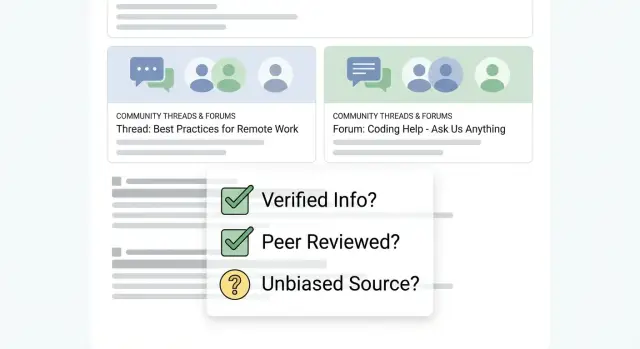
Why forum results take the top spots
When community and forum pages dominate the results, Google is usually signaling something simple: people don’t want a single polished answer. They want real experiences, edge cases, follow-up questions, and updates over time.
Threads often outrank brand pages because they’re built around messy reality. They collect lots of mini-answers, quick clarifications, and corrections. That’s a strong match for searches where the “right” answer depends on context (device, budget, location, version, skill level).
Discussions also tend to feel more believable because they show breadth. A good thread might share five different fixes, warn about common mistakes, and confirm what actually worked. Even if the writing isn’t pretty, it can satisfy more people in one visit.
You’ll see this pattern most in:
- Product research ("best X for Y")
- How-to topics with multiple valid methods
- Troubleshooting ("X not working")
- Comparisons ("X vs Y")
Once you notice this, you’re at a fork in the road. Either (1) make your existing page a better, more trustworthy match for the query, then add authority if needed, or (2) publish a community-style asset that mirrors what the winning threads do, but in a clean structure.
A simple way to think about it: if the SERP rewards “many perspectives,” you need either stronger authority plus better coverage, or a page designed to hold multiple answers on purpose.
First decide the intent: one answer vs many answers
Forum-heavy SERPs usually mean Google thinks the searcher wants people, not just a page. Your first job is to decide whether the query needs one clean answer or a set of real-world perspectives.
A “one answer” query has a finish line. The searcher expects a clear definition, a step-by-step process, a price range, a policy, or a yes-no outcome. If you can satisfy the question with a tight structure, a focused page can win.
A “many answers” query is open-ended. The searcher wants lived experience: what worked, what failed, weird edge cases, and opinions from different situations.
Signals the searcher wants lived experience
Certain phrases invite stories, tradeoffs, and personal context:
- “best” (best X for Y, best under $100)
- “is it worth it” / “should I”
- “reddit” / “forum” / “community” added to the query
- “pros and cons” / “alternatives”
- “what do you use”
When you see that language, a single “perfect” answer often feels incomplete.
Signals the searcher wants an official source
Other phrases point to a single correct response: “definition,” “requirements,” “specs,” “documentation,” “pricing,” “policy,” “deadline,” “supported,” “how to reset,” “error code meaning.” In these cases, people want clarity, not debate.
Small wording changes can flip the best format. “Best project management tool” often rewards community-style content, while “Asana free plan limits” is better served by a structured, official answer.
A quick SERP scan you can do in 5 minutes
You can usually tell what’s happening from a single screen.
Open an incognito window, search the exact phrase, and look at the first page like it’s a set of clues.
First, count the mix in the top 10. If 6 to 8 results are threads (forums, Q&A, Reddit-style pages), that’s a strong sign users want many viewpoints, not one “final” answer.
Next, check whether those threads win because they’re fresh or because they stay useful. Look for visible dates in titles or snippets. If most top threads are recent, the query may be changing fast (pricing, new models, new rules). If older threads still rank, the value is usually evergreen (common problems, how-to, comparisons).
Then scan the wording in the titles. Repeating themes usually reveal the real shape of the question:
- “best” or “top” usually means options and tradeoffs
- “worth it” usually means experiences and pros/cons
- “problems” usually means troubleshooting and edge cases
- “alternatives” usually means comparisons and switching advice
- “review” usually means credibility and details, not slogans
Also notice what else appears besides blue links. If Google shows discussions, short videos, or product grids next to threads, your page may need more than text (a quick summary, a simple table, or clear specs).
Finally, write one sentence: “To deserve a click, my page must add ___.” That blank might be verified answers, screenshots, a comparison table, or a tight summary of 20 opinions. If you can’t name a specific add, you’re fighting the wrong battle.
When authority links can help your existing page compete
A forum-heavy SERP doesn’t automatically mean you need to build a “community” page. Sometimes your page already gives the right type of answer, but it isn’t trusted yet.
Authority backlinks help most when the page clearly matches what searchers want and the SERP isn’t locked up by a few untouchable brands. If you see smaller sites ranking alongside threads, there’s usually room to move.
Signs it’s worth improving the current page and supporting it with stronger links:
- The page answers the question cleanly, but sits on page 2-3 with low impressions.
- The top results include smaller publishers, not only massive brands.
- The top threads are thin (repeated opinions, vague answers, lots of “it depends” with no steps).
- You can show real expertise (examples, data, screenshots, clear criteria).
- You can improve structure without changing the topic (tighter intro, clearer headings, a short comparison table, a direct “best answer” section).
A quick sanity check: open the top 3 to 5 threads and ask, “If I wrote one strong page that summarizes the best points and adds proof, would it be better than this?” If the honest answer is yes, on-page improvements plus authority links can be a good bet.
Example: you publish “best noise-canceling headphones for flights.” The ranking threads are mostly personal takes with no testing, no clear picks, and lots of old models. If your page adds a simple scoring method and updated recommendations, stronger links can help it look more credible and compete.
If you do build links, point them at the page that actually fits the intent, not a random homepage. Links work best when the page itself deserves to rank.
When a community-style asset is the better move
Sometimes you aren’t losing because your page is weak. You’re losing because the query wants many voices, not one polished answer.
A community-style asset is the better move when the top results read like a conversation: people sharing what worked, what failed, and how outcomes changed by budget, location, or experience level. In that environment, a single “best” answer can feel dishonest because the truth depends on the situation.
Threads also win because they bundle many small questions together. One page can satisfy “what should I buy,” “what should I avoid,” “is it worth it,” “what about beginners,” and “what about my constraint” without forcing the reader to click five different articles.
Strong signals you should publish a community-style page instead of trying to force your current page to rank:
- The top results are mostly discussions, personal stories, and side-by-side comparisons.
- People want multiple options, not one “correct” choice.
- The query has lots of edge cases (different goals, budgets, regions, tools, skill levels).
- You can’t answer credibly without showing tradeoffs.
- Your current page is a product or landing page, and it feels too narrow for the question.
If your landing page sells one solution but the query is “best options for X,” users expect a menu of paths and real experiences. In that situation, even strong links rarely fix the mismatch.
Instead, build a hub page that reads like a curated thread: short contributions, mini case notes, and a clear “who this is for” section. If you have permission to share real customer quotes, even better.
Step-by-step: choose improve vs publish
When forums dominate, guessing gets expensive. Use a simple routine to decide whether to improve an existing page or publish something new.
1) Map the current results
Pick one target query. Search it in an incognito window and capture the top 10 results (titles and domains is enough). You’re not judging quality yet. You’re looking for patterns.
Label each result by type: forum thread, community Q&A, guide, product page, review, tool. If 6 to 8 out of 10 are forums, the query usually wants many angles.
Keep it simple:
- Write down the top 10 results.
- Label each by type.
- Decide what you’re missing: content, authority, or both.
2) Make the decision (and define success)
If your page already matches the dominant format (for example, you have a strong guide and guides are ranking), choose “improve.” Upgrade usefulness, structure, and credibility, then support it with authority if needed.
If your page doesn’t match the dominant format (for example, you have a product page but the SERP is mostly discussions), choose “publish.” Create a community-style asset like a curated Q&A page, a “best answers” roundup, or a hub that compares viewpoints.
Define success before you start (top 5, +30% organic visits, 10 qualified leads/month). Set a 4 to 8 week review date and track rankings, clicks, and conversions.
Example: if the top results are threads like “X vs Y for beginners,” a single sales page will struggle. A new page that collects scenarios, pros/cons, and short answers can match the intent. Then you can decide whether authority links are needed to push it into the same tier as the big communities.
How to write a community-style page without running a forum
You can match the “thread vibe” with one well-structured page, without needing users to post.
Start with a hub layout. Open with a clear summary that answers the main question in plain language. Then break the page into sub-answers that match what people debate: price, setup, safety, alternatives, best for beginners, best for power users.
Keep the structure familiar. Most strong community-style pages include:
- honest pros and cons (real tradeoffs, not marketing)
- gotchas (what surprises people after week 1)
- who it’s for and who should avoid
- options by scenario (best if you have X constraint)
- a practical “what to do next” recommendation
To create the “many voices” feel, add short viewpoint notes. You don’t need to name people. For example: “Some users prefer A because it fails less often. Others pick B because it’s easier to repair.” Keep each viewpoint to 1 to 2 lines so the page stays skimmable.
Finish with a “common questions” block pulled from patterns you see in ranking threads: repeated objections, confusion about terms, and the same follow-up questions. Answer each in 2 to 4 sentences, and say “it depends” when it really does.
The tone matters. Don’t force one pitch. Show options, explain tradeoffs, and make it feel like the best parts of 20 threads, minus the noise.
How to pair authority links with the right on-page work
Links work best when your page already looks like the right result. If your content is vague, thin, or off-intent, links might lift it a little, but they won’t fix the core problem. Make the page earn the click first.
Start by matching query language. Use the words people search in your title, main heading, and early sentences. If searchers type “best X for Y,” don’t lead with “Our X platform” and hope authority will do the rest.
Then add proof that makes readers stay: a clear definition, a quick comparison table, a short example, screenshots, or a “who this is for” section. When threads win, it’s often because they include real experiences. You can borrow that strength by adding concrete use cases and answers to the most common follow-ups.
A focused pairing process:
- Give the page one clear job: answer fast, then support with details.
- Rewrite the title and H2s to mirror real searches.
- Add 2 to 4 proof points (examples, comparisons, screenshots, definitions).
- Pick a small support set: the main page plus 1 to 2 related pages.
- Build authority backlinks to that small set so signals concentrate.
Example: if you have a “best time tracking app for contractors” page, add a short “contractor workflow” example and a comparison of 3 options. Once the page reads like the best answer, authority links are more likely to push it into the top results.
Decision checklist you can reuse for any query
Use this when you see threads taking over. It helps you decide whether to push your current page harder (often with better structure plus authority) or publish a community-style asset.
Start with a simple test: can your page answer the main question in the first screen? If someone has to scroll just to understand your point, forum snippets will often beat you.
Next, check findability. Can a reader land on the page and find the exact section they need in 10 seconds? Clear headings, a short table of contents, and direct sub-answers matter because people scan.
Then “steal the thread outline.” Open 2 to 3 ranking discussions and note the top 3 to 5 sub-questions people ask (ignore side chats). If your page doesn’t cover those sub-questions, links alone rarely fix it.
Now look at the SERP mix. If 7+ of the top 10 results are forums, that usually signals “many answers” intent. If it’s mixed (forums plus guides, tools, and brand pages), you have more room to compete with a well-structured page.
Finally, sanity-check page type. A product page rarely outranks threads for “best settings” or “what should I do when…”. A guide, checklist, comparison, or FAQ hub is usually the right format.
If your page passes these checks and the SERP is mixed, authority backlinks can be the push that gets you into the conversation. If it fails two or more checks and the SERP is forum-heavy, publish a community-style asset first, then promote it.
Common mistakes that waste time
The fastest way to lose weeks is to fix the wrong problem. Most misses come from mixing up intent, copying the wrong format, or chasing a metric that doesn’t reflect business value.
One common trap is assuming more authority backlinks will rescue any page. If the top results are threads full of options, opinions, and edge cases, a single “best answer” page often won’t satisfy what searchers want. Links can help a page compete, but they can’t change the job the query is asking the page to do.
Community-style content can fail too. A huge list of tips with no sections, no summaries, and no clear next step reads like a dump of notes. People bounce, and the page doesn’t earn trust.
Time-wasters to watch for:
- Building links to a page that doesn’t match intent (one answer vs many answers).
- Publishing a community-style page with no structure (no categories, no quick summary, no “what to choose” guidance).
- Targeting a broad keyword when the SERP is clearly niche (by tool, price, region, skill level).
- Launching a new asset but not connecting it to key pages (so it can’t guide people to an action).
- Tracking only rankings while ignoring outcomes (engagement, signups, leads, sales).
A practical example: you publish a “Best X” hub, it starts ranking, but it never sends readers to your product or pricing pages because there’s no clear path. That’s traffic without results.
If you invest in authority backlinks from any source, pair them with the basics first: match intent, improve structure, and define what a “win” means beyond position in search.
Example: choosing between a product page and a community hub
You search your main keyword and the first page is packed with forum threads. Your product page sits on page 2 while five discussions take the top spots. Those threads all follow the same pattern: short answers, screenshots, and people comparing options in the comments.
Here’s the realistic fork.
Option A: make the product page win the “official” intent
If the query sounds like “pricing,” “download,” “is X safe,” “official docs,” or “does X work with Y,” people usually want a clear, trusted answer.
In that case, keep the product page and make it the best place to decide. Tighten the headline to match the exact question, add a short quick-answer box near the top, and expand the sections that provide proof (limitations, setup steps, common objections). If competitors on page 1 have stronger sites, a small set of authority backlinks can help signal trust.
Option B: publish a community-style hub that mirrors the threads
If the query is messy (“best way to fix,” “why is this happening,” “alternatives,” “anyone else”), the threads are winning because they cover many angles.
Instead of forcing a single product page to do everything, publish a hub page that collects the recurring themes you see in those discussions: comparisons, troubleshooting paths, and small real examples.
Think of it like a curated Q&A page you control: questions as subheadings, direct answers, and a few “if this, try that” paths. You’re not running a forum. You’re packaging the useful parts of one.
After 4 weeks, measure results side by side:
- impressions and clicks in Search Console
- time on page and scroll depth
- conversion actions (trial starts, demo requests, email signups)
- lead quality (are people asking the right questions?)
Then decide what to double down on. If Option A gains clicks but not leads, you may match the query but not the real need. If Option B gains engagement and assisted conversions, expand the hub and consider promoting that hub with authority links.
Next steps: a simple plan for the next 30 days
You don’t need to rebuild your whole site. You need one clear test, measured over enough time to learn.
Pick a single query cluster (5 to 15 closely related searches) where you already have some relevance, or where you can realistically publish a strong page.
Days 1-5: pick a target and run one clean test
Do a quick SERP scan for the main query and note what wins: threads, Q&A pages, tools, guides, category pages. Then pick one page to focus on, not five.
Commit to one move:
- Refresh one existing page (tighten headline, add missing sections, answer top follow-up questions).
- Publish one new page designed to match the format you saw (often a “many answers” hub when forums are ranking).
Days 6-20: improve the page, then wait long enough to learn
Make your edits, publish, and hold steady. Give it time to be crawled and re-ranked. During this window, only fix obvious issues (broken headings, missing meta title, thin sections). Don’t rewrite the whole page every few days.
Days 21-30: decide if authority links are the missing piece
If the page matches intent and is genuinely helpful but still sits on page 2 or lower, that’s when authority backlinks can make the difference. Start with a small number of high-quality placements and watch for movement.
If you’re already at the stage where the page is solid and you simply need harder-to-get authority placements, services like SEOBoosty (seoboosty.com) are designed for that use case: securing premium backlinks and letting you point them at the specific page you’re trying to rank.
Repeat the process on the next cluster. Keep variables controlled: one cluster, one page, one clear change. That’s how you build wins you can trust.
FAQ
Why do forum and community pages sometimes outrank official brand pages?
Google often rewards forum threads when a query benefits from multiple perspectives. Threads collect real experiences, edge cases, follow-up questions, and corrections over time, which can satisfy more searchers than one polished page.
How can I tell if a query needs one answer or many answers?
Do a quick intent check: if the search expects a clear definition, policy, spec, or step-by-step fix, it’s usually a “one answer” query. If the wording invites opinions and tradeoffs like “best,” “worth it,” or “what do you use,” it’s usually a “many answers” query.
What’s the fastest way to confirm what Google wants for a keyword?
Search the exact query in an incognito window and look at the top 10 results. If most are discussion threads, Google is leaning toward “many viewpoints” intent; if guides and official pages dominate, a structured page can win with clarity and trust.
When do authority backlinks actually help against forum-heavy SERPs?
Authority links help when your page already matches the intent and format that’s ranking, but it’s not trusted enough to compete. If smaller sites can rank on page one for the topic, that’s a sign there’s room for your page to move with stronger credibility signals.
When should I avoid building links and create a new page instead?
If the top results are winning because they offer lots of scenarios, opinions, and updates, links won’t fix an intent mismatch. In that case, a sales page or single-answer article can still feel incomplete, even with more authority.
How do I write a community-style page without running an actual forum?
Build a page that feels like a curated thread: start with a quick plain-language summary, then cover the main sub-questions people argue about. Add short viewpoint-style notes that show tradeoffs and real constraints, while keeping the structure clean and easy to scan.
What on-page improvements matter most before I try to earn or buy links?
Give the page one clear job: answer quickly, then support it with proof like examples, comparisons, or clear criteria. A page that keeps readers engaged tends to benefit more from authority links because it already “deserves the click.”
How should I measure whether my “improve vs publish” decision worked?
Pick a simple target like reaching the top five, increasing qualified organic clicks, or improving conversions from that page. Then set a review window of about 4–8 weeks and compare Search Console performance with on-page engagement and the actions you care about.
What’s a realistic 30-day plan when forums dominate my target keywords?
Start with one query cluster and one page so you can learn what changed the outcome. Spend the first week mapping the SERP and planning, the next two weeks improving or publishing, then use the final week to decide whether the missing piece is authority links.
Where does SEOBoosty fit into this process?
If your page is already solid and you mainly need harder-to-get authority placements, a service like SEOBoosty can be used to point premium backlinks at the exact page you’re trying to rank. It works best when the content already matches intent and has strong coverage, so the links amplify a page that’s genuinely useful.
Share