Compliance-Friendly Link Risk Scoring: A Simple Legal Rubric
Use a compliance-friendly link risk scoring rubric legal teams can approve. Score disclosure, topic fit, and editorial control before placing backlinks.
Why you need a link risk score (plain terms)
Backlinks sit in an awkward spot. SEO teams see them as a practical way to earn visibility. Legal and compliance teams see them as a public signal that can create disclosure obligations and brand risk.
The conflict usually is not about goals. It is about uncertainty. SEO asks, "Can we place this link?" Legal asks, "What will a regulator, journalist, or customer think this implies?" Without a shared way to judge risk, reviews become long threads, different answers from different reviewers, and last-minute reversals.
What can go wrong is concrete:
- A link that looks like an ad but is not disclosed can trigger complaints or enforcement.
- A placement in an unrelated article can look misleading, even if the anchor text is accurate.
- A page with weak editorial standards can be edited later in ways you would never approve.
A simple scoring rubric will not eliminate risk, but it fixes the process. It gives everyone the same language and the same thresholds, so decisions are faster and more consistent.
What a link risk score should mean to compliance and SEO
A link risk score is a shared language between marketing and compliance. It does not predict rankings or guarantee legal safety. It answers one question:
"If we place this backlink, what is the chance it creates regulatory, reputational, or contractual trouble?"
For compliance, the score should map to real obligations: advertising and endorsement rules, internal policies, partner contracts, and industry guidelines. For SEO, it should map to practical search risk: links that look unnatural or out of place are often the ones that become a problem later.
A workable model ends in a clear outcome:
- Approve
- Approve with controls
- Reject or escalate
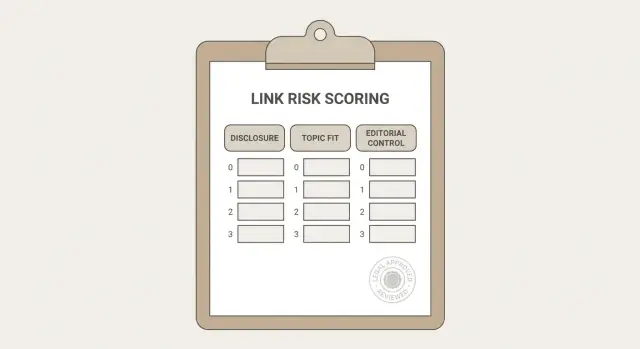
Keep the scoring simple. One option is three categories, scored 0 to 3 each (total 0 to 9):
- 0-2: Low risk (standard process)
- 3-5: Medium risk (needs controls or sign-off)
- 6-9: High risk (do not place, or escalate as an exception)
Ownership matters as much as the math. Marketing should capture the facts (site, page, draft context, disclosure plan). Legal or compliance should confirm the rating and required controls.
Category 1: Disclosure expectations (how transparent is it?)
Start with a simple test: if a reader knew exactly how the link got there, would anything feel hidden?
Proper disclosure is not just a checkbox. The label needs to match reality. If money, free products, reciprocal value, or a placement fee influenced the link, the reader should see clear language like "Sponsored," "Advertisement," "Paid placement," or "Affiliate" (when commissions are involved). Exact wording varies, but the intent should be obvious.
Placement matters as much as wording. Disclosure should be near the content it applies to, ideally at the top of the article or next to the relevant section. If it is buried in a footer, hidden behind expandable menus, or only explained on a separate policy page, treat that as higher risk.
Red flags that should push the score up:
- Vague labels like "Partner" with no explanation
- Tiny or low-contrast text
- Claims of "pure editorial" when you requested or paid for placement
- Disclosure only on an author profile or sitewide page
- Language implying the publisher reviewed or endorsed claims they did not verify
To keep reviews fast and consistent, save evidence that matches what you approved:
- A screenshot showing the disclosure and the link
- The disclosure wording and where it appears
- The date and who reviewed it
- Any publisher statement about sponsored or affiliate policies
- A saved copy of the draft or placement terms
Category 2: Topic adjacency (does the placement make sense?)
Topic adjacency is simple: if a normal reader lands on the page, would they expect to see your brand mentioned there, and would the link help them learn something relevant?
A high-adjacency placement reads like a natural citation. A low-adjacency placement feels like an ad dropped into the wrong room.
Adjacency matters for compliance because it often tracks intent. When the fit is strong, the mention looks like a legitimate reference. When the fit is weak, it looks promotional, which increases the chance of disclosure questions, complaints, or rework.
Common warning signs of low fit:
- The site mixes unrelated categories (casino, crypto, health, "business") on one domain.
- The article reads generic, repetitive, or oddly broad (content created mainly to host links).
- The page has clusters of unrelated outbound links.
- The mention forces brand keywords where a neutral term would do.
- The surrounding paragraph does not match the page's main topic.
A practical tie-breaker: write a one-sentence rationale you could defend internally, such as "This page covers payroll compliance, and the link supports the section on reporting tools." If you cannot write that sentence without stretching, score it as low adjacency.
Category 3: Editorial controls (who decides what goes live?)
Editorial control means: who can edit the page, who checks it before it publishes, and who has the final say.
This matters because weak editorial control increases the chance of unexpected changes later, including misleading claims placed near your brand. Strong editorial control usually means standards, accountability, and a reason to protect reputation.
Signals of stronger editorial control
You do not need a deep investigation. Look for a few quick signals that a real person or team is responsible:
- Visible author bylines and named editors or an editorial team
- Consistent writing standards across posts (tone, formatting, sourcing style)
- Corrections or updates that look real (dates, revisions)
- Clear submission guidelines that suggest review (not automatic publishing)
- A stable publishing history (not hundreds of thin pages posted in a week)
Red flags that push risk up
Be cautious when the site feels like a self-serve upload tool:
- Pay-to-publish offers with no mention of review
- User-generated pages that exist mainly to host links
- Networks of near-identical sites publishing the same template content
A fast way to verify control is to check three things: a byline, an editorial team or contact page, and recent posts that look genuinely reviewed.
Step-by-step: How to score a link before you place it
Collect the same facts every time. You want enough detail for legal to review quickly without turning the request into a long email thread:
- Publisher and domain
- Page type (news article, guest post, directory, partner page)
- Draft copy around the link (or the section where it will appear)
- Your disclosure plan (wording and placement)
Use the same 0 to 3 meaning for each category (disclosure, adjacency, editorial control):
- 0: Clear, standard, low risk
- 1: Minor questions, easy to fix
- 2: Noticeable risk, needs conditions and sign-off
- 3: High risk, usually a no
Then follow a repeatable flow:
-
Record inputs in one place (ticket, spreadsheet, or template). Add screenshots if anything is unclear.
-
Score the three categories and write one sentence for each. Example: "Disclosure = 2 because wording is vague and placed below the fold."
-
Add controls based on the highest score. Typical controls: specific disclosure wording, rules for where the link can sit on the page, and confirmation of editorial review.
-
Decide based on the score:
- Approve (all categories 0-1)
- Approve with conditions (any 2, and fixable)
- Reject or escalate (any 3, or multiple 2s you cannot control)
- Save the decision record for audits and renewals. Re-check when the page topic changes, surrounding text is rewritten, disclosure is removed or moved, or the site changes its editorial policy.
Turning scores into decisions and guardrails
A score only helps if it leads to the same decision every time. The goal is predictability, not approving more links or blocking more links.
One simple threshold model:
- 0-3 (Low risk): Proceed with standard checks and documentation.
- 4-6 (Medium risk): Proceed only with added safeguards.
- 7-9 (High risk): Do not place unless the plan changes enough to re-score lower, or it is approved as an exception.
Medium risk is where teams lose time because it feels "probably fine." Treat it as "fine if tightened." Standard safeguards might include clearer disclosure, stronger topic fit, and proof of who controls edits after publication.
Written confirmation does not need to be complex. Even an email stating the disclosure expectations, who approves copy, and what happens if the page changes can prevent weeks of rework later.
Common mistakes that create legal risk (and rework)
Most link programs run into trouble when compliance is treated as a label added at the end instead of a decision made before anything goes live.
A common misconception is that adding a "nofollow" or "sponsored" attribute automatically makes a placement safe. Those markers can support transparency, but they do not fix a confusing page context, a misleading endorsement, or a paid placement presented as pure editorial.
Another frequent mistake is scoring only the domain and ignoring the exact page, paragraph, and surrounding claims. Even reputable sites can host pages that read like advertorials or sit far outside the topic.
Patterns that tend to cause rework:
- Negotiating disclosure after publication instead of agreeing on it before launch
- Approving a site but not reviewing where the link will actually appear
- Leaving no paper trail (who approved what, and why)
- Building a rubric so complex that teams skip it and ask legal to approve at the last minute
A 5-minute screen your team can run
Open the draft placement (or the exact page where the link will live), plus the destination page on your site. Then check five things:
- Disclosure is clear: If sponsored or paid, the label is obvious and near the content.
- Topic fit is obvious: The surrounding paragraph matches the page topic and the linked page.
- Editorial rules exist: You can tell who reviews or approves what gets published.
- No link-selling footprints: The page does not look like a dump of unrelated outbound links.
- Decision is recorded: Save a screenshot or PDF, plus a short note on why it passed.
If all five are green, most teams can approve quickly. If one is yellow, ask for a change. If two or more are red, treat it as a no unless legal approves an exception.
Example: A realistic link review from request to approval
Marketing is two weeks from a product launch and wants a backlink pointing to the new product page.
They submit a short request: target publisher, where the link would appear, draft anchor text, landing page, and any payment or placement details.
Legal and compliance score it using the same 0 to 3 model:
- Disclosure expectations: 2/3. The placement is paid, and the publisher's labeling is not clear by default.
- Topic adjacency: 1/3. The article topic closely matches the product category.
- Editorial controls: 2/3. The publisher allows changes after payment and review standards are not clearly documented.
Total: 5/9, so it is "approve with conditions." The conditions are specific:
- Add a clear disclosure label (for example, "Sponsored" or "Advertisement") near the content.
- Get written confirmation the disclosure will remain visible for the agreed term.
- Use neutral anchor text (brand or product name), not keyword-heavy phrases.
- Keep the link in a paragraph that actually discusses the same topic.
Once marketing confirms those conditions, legal signs off. The team saves the final page snapshot, disclosure language, approval date, approver name, scoring notes, and the publisher confirmation.
Next steps: Make it part of the process (without slowing work)
Keep the rubric short enough that people will actually use it. Three categories, fixed definitions, and a place to paste the placement details are usually enough.
A lightweight rollout:
- Pilot the rubric on 10 planned placements and track where reviewers disagree.
- Adjust definitions until two reviewers usually land close to the same score.
- Assign clear ownership: SEO gathers facts; legal or compliance confirms risk and controls.
- Set a simple stoplight action: green = proceed, yellow = revise, red = do not place.
If you are using a provider that offers pre-arranged placements, ask for the same inputs up front: the exact page type, the surrounding context, what disclosure will appear, and who controls edits after publication. For teams sourcing links through curated inventory and subscriptions, SEOBoosty is one example of a service where having page-level details documented makes this rubric easier to apply consistently.
Share