Content refresh vs new links: a decision tree for SEO
Use a content refresh vs new links decision tree to choose between updating a page, improving internal links, or adding backlinks based on SERP drift.
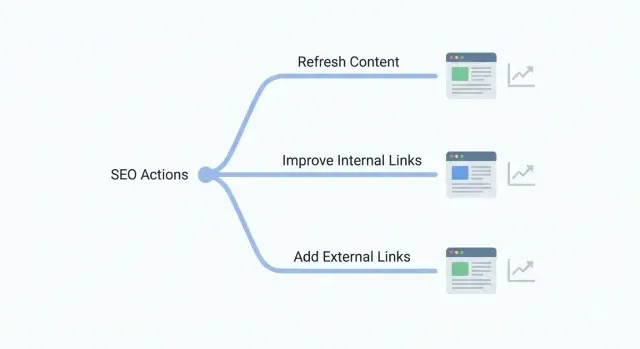
What this decision tree solves
A page can do everything right for months, then quietly slide. Rankings dip, clicks fall, and a competitor you never noticed jumps ahead. The hard part isn’t spotting the drop. It’s deciding what to fix first without wasting weeks.
Most slipping pages need one of three things:
- The content is out of date, too thin, or missing the angles searchers now expect.
- The page is fine, but your site isn’t sending it enough internal signals, so search engines treat it like a side note.
- The page is strong, but it’s losing to competitors with higher authority, where external links matter.
This decision tree helps you pick the first move based on what you can observe: changes in the search results (SERP drift), obvious content gaps, and whether the page has enough internal and external support.
Success isn’t vague. Within a reasonable window, you should see at least one of these:
- Positions recover for the main query and close variants
- Clicks rise (not just impressions) because the page matches what searchers want today
- Topic coverage improves so the page competes with what the SERP is rewarding now
The goal is speed and clarity. Make the smallest change that can realistically reverse the slide, then measure. If that first move doesn’t work, the tree tells you what to try next.
Three options, in plain language
When a page starts slipping, you usually have three realistic moves. The trick is choosing the one that matches the problem, not the one that feels easiest.
A content refresh improves the page without changing what it’s about. That might mean updating old numbers, fixing confusing sections, adding a missing mini-section people now expect (like pricing, pros and cons, or a quick FAQ), replacing outdated screenshots, or tightening the first few paragraphs so the main answer is obvious.
Internal links are links from your own pages to the page you want to lift. They help in two ways: they clarify what the target page is about, and they pass authority from pages on your site that already have it. The best internal links are contextual, relevant, and use natural anchor text.
External links are backlinks from other websites. They’re often the missing ingredient when your content is genuinely competitive but still can’t outrank pages with stronger authority.
Picking the wrong fix wastes time. If competitors improved their answers, backlinks won’t rescue a weak page. But if your page covers the topic well and still drops, repeated rewriting can turn into busywork when what you actually need is stronger signals (internal, external, or both).
How to spot SERP drift (and what it usually means)
SERP drift is when a page that used to perform well slowly loses ground because Google starts rewarding something slightly different. It usually looks like a steady slide over weeks, not a single bad day.
Look for patterns across multiple signals, not just rankings. Common signs include a gradual position drop, fewer clicks while impressions stay roughly steady, and different competitors rotating into the top spots. Sometimes the results page changes too: more videos, product blocks, “People also ask,” or local packs can steal clicks and push classic results lower.
Signs that often point to real drift (not noise):
- Rankings fall across multiple related queries, not just one keyword
- CTR drops while average position stays similar
- Top results shift intent (how-to vs buying, beginner vs advanced)
- New SERP features appear and take attention
- Competitors’ titles and snippets emphasize angles you don’t cover
Before you choose a fix, rule out short-term noise. A holiday bump, a news spike, or a temporary indexing hiccup can distort the picture. Compare similar time ranges (month over month, or year over year when possible). Also check whether the page was recently recrawled.
Then look at what changed in your traffic mix. Performance often shifts by device (mobile moves faster) and by location (rankings can vary by country, and sometimes by city). Finally, scan the queries driving impressions now versus a few months ago. If you’re showing up for new terms, the page might not be the best match anymore.
If a new searcher lands on the page today, is it still the right answer for what the SERP is asking? If not, links won’t fix the mismatch.
Find content gaps the SERP rewards now
When a page slips, it’s often not because the topic is wrong. It’s because the top results changed what “a good answer” looks like.
Open the current top results for your main query and scan for patterns. Are they newer, with current screenshots or updated product names? Do they cover one subtopic more deeply? Do they lead with a different angle?
A practical approach: compare your page against 3 to 5 pages that are winning, and write down what they include that you don’t. Keep it about usefulness, not word count.
Look for missing intent segments. Many SERPs serve “mini audiences,” such as:
- People who want steps they can follow today
- People who want pricing or cost expectations
- People who need comparisons (A vs B, alternatives, best options)
- People who are troubleshooting errors and edge cases
Also check for freshness gaps. Old tools, outdated UI, and stale stats can make a page feel untrustworthy fast. Small updates help more than you’d think: current-year references where relevant, refreshed examples, and removing products that no longer exist.
Finally, watch for format gaps without padding the page. If top results use a table to compare options, a short FAQ to clear objections, or a simple framework to make actions obvious, that’s a signal. Use these formats only when they make the answer faster to understand.
Example: if a “best project management tools” page is dropping and every top result now includes a pricing table and a section like “best for remote teams,” you’ve found a clear gap. Fix that first.
When internal linking is the fastest win
Internal linking is often the quickest fix when a page is “good enough” but not getting the signals it needs. If your page slipped a few positions and the SERP hasn’t radically changed, you might not need a rewrite or a backlink push yet.
Start by checking whether the page sits inside a clear topic cluster. Ideally, it has supporting pages (subtopics, FAQs, comparisons) and a clear “parent” page that represents the main topic. Without that structure, search engines can struggle to understand which page you want to rank.
The fastest win usually comes from a handful of intentional links from pages that already earn traffic and have a related audience. A contextual link from a relevant, high-traffic article is worth far more than random sitewide links in a footer.
A simple internal linking pass:
- Add 2 to 5 contextual links to the target page from closely related pages that already perform well.
- Use anchor text that describes what the destination page is about (skip “click here”).
- Fix orphan pages by linking them to the parent topic and one or two close siblings.
- If two pages compete for the same query, merge or refocus so one is clearly the main answer.
Example: a “pricing” guide drops from position 3 to 7. Before rewriting it, add links to it from your highest-traffic “features” page and a relevant comparison post, using anchors like “pricing breakdown” or “plan costs.” If you have older posts answering the same pricing questions, combine them so you stop splitting relevance.
If internal linking lifts impressions and clicks, you have your answer. If nothing changes after a couple of weeks, it’s time to look harder at content gaps or authority.
When new external links make sense
External links are worth considering when the page is already good, but it still can’t break into the spots that get most clicks. This is the classic moment where you’re choosing between more on-page work and building authority.
Signs you’re hitting an authority wall
Backlinks are often the missing piece when several of these show up together:
- The page matches intent, reads well, and covers the topic, but rankings stay stuck around positions 8 to 20.
- The sites above you are mostly bigger, well-known domains.
- You improved content and internal linking, impressions rose, but position barely moved.
- The top results rarely change, and the SERP is packed with pages that have many referring domains.
- Your page gets clicks when it appears, but it doesn’t appear often enough.
Some SERPs have a competitive threshold. Once your content is “good enough,” movement depends more on trust signals, and links are one of the biggest.
Quality beats quantity
A few relevant, editorial placements can matter more than dozens of weak links. Prioritize links that fit the topic, sit inside real content, and point to the page that actually needs to rank.
Before building links, make sure the page deserves them. If it misses intent, is thin, or is outdated, links tend to produce a short lift at best.
If you want a curated way to secure high-authority placements without traditional outreach, SEOBoosty (seoboosty.com) focuses on premium backlinks from highly authoritative sites, and you can point the link to the exact URL you’re trying to move.
The decision tree (step by step)
Use this as a quick path from symptom to first fix. Pick the smallest change that can realistically move rankings, then measure.
-
Confirm the page matches the main search intent. Open the current top results. Are they mostly guides, product pages, comparisons, or templates? If the SERP has shifted from “how to” to “best tools,” a well-written page can still lose.
-
If content gaps exist, refresh content first. Look for what competitors cover that you don’t: new subtopics, updated steps, clearer definitions, recent examples, or missing FAQs. Tighten the first 100 words so the page answers the query faster.
-
If content is strong, improve internal links and on-page clarity. Ask: can search engines and readers quickly understand this page is important? Add a few relevant internal links from pages that already get traffic, and make sure your title and headings make the topic obvious.
-
If you still look capped by competitors, add external links. When your page is on par with the top results but lacks authority signals, quality links can provide the push.
-
Re-check and iterate. If rankings rise but stall, repeat the tree: intent, gaps, internal links, then external links. Keep a simple change log so you know what actually helped.
Example: choosing the right fix for one slipping page
A SaaS company has a guide called “How to reduce churn.” Two months ago it sat at position 3. Now it hovers around position 9. Traffic is down, but the page still gets impressions.
A quick look at the current top results shows three changes: competitors are using fresher dates and tighter intros, the SERP now favors subtopics like onboarding checklists and health score models, and the winning pages are easier to scan (short sections, a simple framework, concrete examples).
The cheapest, most direct path looks like this:
First, refresh the content. Add the missing subtopics, update stats, and rewrite the opening so it matches intent (tactical steps, not theory). Improve the structure with clearer headings, a short template, and one real scenario.
Second, add internal links. If the site already has a strong post on onboarding emails and another on customer success playbooks, add contextual links from those into the churn guide. Then link out from the churn guide to a couple of supporting pages so the cluster is clear.
Third, consider selective external links only if you still can’t regain ground.
Measurement plan for the next 4 to 6 weeks:
- Track weekly average position for the main query and a set of related queries.
- Watch clicks and CTR in Search Console (title and intro changes often move CTR quickly).
- Confirm internal link clicks and crawl activity.
- Set a trigger: if position stays below 6 after 4 to 6 weeks, test 1 to 2 new backlinks.
Common mistakes that slow you down
The biggest time-waster is treating every ranking drop like the same problem. When you guess wrong, you can spend days “fixing” a page that was fine, while the SERP changed under you.
A common miss is updating copy without checking what Google is rewarding now. If the top results shifted from a how-to guide to templates, product pages, or comparisons, adding more paragraphs to the old format rarely brings you back. Match the intent first, then improve the content.
Internal links can also backfire when they come from unrelated pages. Forced anchors dilute relevance and confuse readers.
External links are another trap. If the page is thin, off-intent, or missing key sections, piling on links is like pouring water into a leaky bucket. Links work best when the page already deserves to rank.
Mistakes that commonly slow down decisions:
- Changing the headline, intro, and structure at the same time, then not knowing what helped.
- Refreshing facts but ignoring new SERP features that hint at new subtopics.
- Adding internal links with vague anchors that don’t match the destination.
- Pointing links to one URL while your internal structure still favors a different page.
- Chasing cheap, low-quality backlinks that don’t fit the niche or look natural.
Quick checklist before you spend time or money
Before you choose a fix, pause and run this check. It keeps you from polishing a page that no longer matches intent, or building links when the page itself is the problem.
Five questions to answer in 10 minutes
- Does the page match today’s intent? Are the top results teaching, comparing, listing options, or selling?
- Can you name three concrete content gaps? Missing subtopics, missing sections, missing examples, missing objections.
- Is internal linking doing its job? Does the page have a few contextual links from related pages with specific anchors?
- Are stronger domains beating you with similar content? If yes, you might be dealing with authority, not information.
- What’s the single primary change, and when will you review? Pick one main move and set a review date.
Next steps: build a repeatable plan
If you only fix pages when traffic drops, you’ll always feel behind. A simple routine makes these decisions faster and prevents small issues from turning into big losses.
Pick a cadence that matches your site size. Many sites do fine with a monthly SERP drift check for priority pages, a quarterly refresh pass, and a weekly habit of adding a few internal links from new or high-traffic posts.
Keep it lightweight: one spreadsheet or board with page URL, target query, last update date, and the next action (refresh, internal links, or external links).
Before you invest in backlinks, sort pages into two buckets:
- Refresh-needed: clear content gaps, outdated details, weak examples, or the SERP now favors a different format.
- Link-ready: strong content that matches intent, decent on-page basics, and sits just outside the top results.
Define what “better” means and when you’ll reassess. Track rankings for the main query, clicks from search, and the conversion that matters (signup, demo request, purchase). If none of them improve after your chosen fix, run the tree again and pull the next lever.
FAQ
My page is slipping in rankings—what should I fix first?
Start by checking whether the search results for your main query changed. If the top results now answer a different intent or include sections you don’t have, refresh content first.
If the SERP looks basically the same and your page is still a good match, try internal links next. If your page is clearly competitive but can’t break past bigger domains, consider external links.
What is “SERP drift,” and how do I know it’s happening?
SERP drift is a slow slide where Google starts favoring a slightly different kind of answer. You’ll often see rankings drop across related queries, or clicks fall even when impressions stay similar.
Confirm it by comparing today’s top results to what was ranking before. If competitors are emphasizing new angles, formats, or freshness, you’re likely seeing drift, not a one-day fluctuation.
When is a content refresh the right move?
Refresh content when the page is outdated, missing sections searchers now expect, or the SERP intent has shifted. Updating a few key parts can be enough, especially the opening and any stale examples.
Don’t rewrite for the sake of it. Aim for the smallest update that makes your page the clearest, most current answer for the query.
When are internal links the best fix?
Internal links are often the fastest win when the page is already solid but isn’t getting enough signals from your own site. They help search engines understand the page’s topic and importance.
Prioritize contextual links from relevant pages that already get traffic. If you add internal links and see improved crawling, impressions, or clicks, you’ve likely found the lever.
How do I know if I need external links (backlinks)?
Use external links when your content matches intent, reads well, and still can’t reach the top spots because competing pages come from stronger, more established domains. That’s the “authority wall” scenario.
Make sure the page deserves the links first. If the page is thin or off-intent, backlinks may give only a short-lived lift.
What’s the quickest way to find content gaps competitors are winning with?
Start with the top 3–5 ranking pages for your main query and note what they include that you don’t. Focus on usefulness, not word count, and look for missing subtopics, examples, or objections they handle.
If multiple winners share the same elements, that’s a strong clue the SERP is rewarding that coverage or format right now.
How can I tell the difference between normal ranking noise and a real problem?
Look for patterns beyond one keyword. If several related queries drop together and clicks decline over weeks, it’s more likely a real issue than normal volatility.
Also compare similar time windows and check for seasonality. A temporary dip can look scary, but it often reverses without major changes.
Why shouldn’t I change headline, intro, and structure all at once?
Test one primary change at a time so you can attribute results. If you change the title, intro, structure, and links in one go, you won’t know what actually helped.
A simple log of what you changed and when makes the decision tree repeatable and saves you from chasing the wrong fix.
Which URL should I point links to if I have multiple similar pages?
Usually, you should link to the page you want to rank for the query, assuming it’s the best match for today’s intent. If two pages compete for the same query, you may be splitting relevance and weakening both.
In that case, consolidate or refocus so one page is clearly the “main” answer, then point internal and external signals to it.
When does it make sense to use SEOBoosty for backlinks?
Use a service like SEOBoosty when your page is already strong and you need high-authority placements without spending weeks on outreach and negotiation. It’s most effective for “link-ready” pages sitting just outside top positions.
Still do the basics first: confirm intent match, fill obvious gaps, and add internal links. Then backlinks can provide the extra push instead of masking on-page problems.
Share