Editorial placement brief template: what publishers need
Use this editorial placement brief template to share angle, sources, claims, and constraints so publishers can place your link with minimal edits.
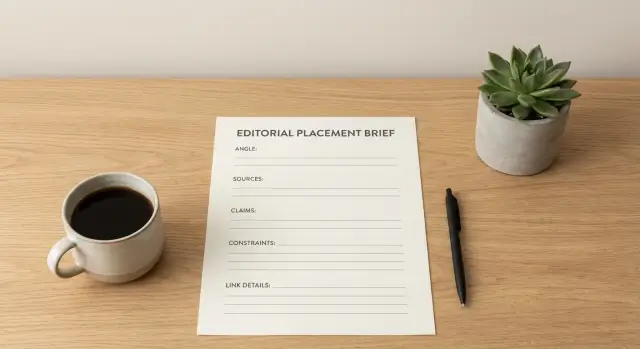
What an editorial placement brief is (and what it is not)
An editorial placement brief is a short set of inputs that helps a publisher include your link in a way that fits their article and their readers. Think of it as a clear note to the editor: what page you want referenced, why it belongs in the piece, and what boundaries they need to respect.
A good brief cuts down back-and-forth because it answers the questions editors ask when details are missing. If your message is vague, the publisher has to guess. What is the point of the link? Is this a requirement or a suggestion? Can they change the wording? Are there claims they should avoid? Each unknown turns into another email.
Brief vs. full draft
A brief is not a finished article, and it is not a script. You are not asking the publisher to copy-paste your paragraph. You are giving them the ingredients so they can write it in their own voice and match the tone of their site.
A solid brief typically includes the one page to reference (and what it helps the reader do), a suggested angle for how the link can appear naturally, a few credible proof points, clear constraints (what can be said and what must not be said), and simple link details (anchor style and any internal-link requests).
Who controls the final wording
Publishers control the final wording, placement, and whether the mention makes sense for the article. Your job is to make it easy for them to say yes without risking accuracy, policy issues, or awkward phrasing.
If you are placing a backlink to a product page, don’t push a sales line like “the best solution.” Give a neutral reason an editor can use, such as: “This page lists pricing tiers and what’s included,” or “This guide explains the steps with screenshots.”
That framing also matters if you order editorial placements through a service. For example, SEOBoosty (seoboosty.com) offers subscription-based access to premium backlink placements on authoritative sites, where customers select domains from an inventory and point the backlink to a chosen page. Even with a pre-arranged opportunity, editors still need clear, verifiable context to write a natural mention.
When you treat the brief as editorial support (not an ad request), publishers can place your link with fewer questions and better results.
Start with the goal and the one page you want referenced
A publisher can move fast when you make one thing clear up front: why the link exists, and where it should go. If your brief feels like “here are five pages that might work,” the editor has to guess, and you end up in a long thread.
Start with one sentence that states the primary goal. Keep it specific and editorial-friendly, not salesy. Common goals include a brand mention, a feature mention, or a resource citation that supports a point in the article.
Next, pick one primary destination page. This is the page you want referenced even if other pages could fit. Multiple competing targets create decision fatigue and raise the chance the editor chooses a different page, or asks you to decide.
At the top of your brief, provide:
- Primary goal (one sentence)
- One destination page (title plus a short description of what the reader will find)
- Reader intent match (who the reader is and what problem they’re trying to solve)
- One desired action after the click (download, compare, learn, sign up, request a demo)
The “reader intent” line matters more than most people think. Editors care about fit. Tell them what moment in the story your link supports. For example: “This is for a reader who is comparing backlink providers and wants to understand what makes premium placements different from standard outreach.”
Be equally clear about the action you want. If you want sign-ups, say so. If you want readers to learn and come back later, say that instead. Ambiguous goals lead to mismatched placement, like a link dropped into a definition paragraph when you wanted it in a “how to choose” section.
Example (simple):
Goal: resource citation.
Destination: a pricing overview page that explains what’s included at each tier.
Intent: readers who are evaluating options and want to sanity-check costs.
Action: start a subscription.
If you’re placing a link on a high-authority publication, clarity is even more important. You want the editor to place the reference where it feels natural, so the click comes from genuine interest, not curiosity or confusion.
Angle and context: help the editor fit your link naturally
The fastest way to get a clean placement is to make the editor’s job easy. Give a few story angles and show where your reference fits.
Offer 2-3 angle options so the publisher can pick what matches their audience and current draft. Keep each angle to one sentence and make it editorial, not promotional.
For example, if your page explains a process or tool, your angles might look like:
- A practical definition: what the concept means in plain language and why it matters
- A decision moment: how to choose between two common options without regret
- A proof point: one data-backed insight that changes how people think about the topic
After the angles, add context on where the link belongs inside a typical article. Don’t say “place it anywhere.” Suggest a natural slot: near a definition, inside a short example, or next to a stat that needs a citation.
Then include one ready-to-use sentence that introduces the mention. Keep it neutral so it reads like the editor wrote it. Example:
“If you want to compare options step by step, this short explanation can help you choose the right approach: [page title].”
(Replace the bracketed part with your page title or brand mention, depending on what the publisher allows.)
Finally, add a short “avoid” note for brand safety and positioning. This prevents rewrites later. Mention topics to steer clear of (competitor callouts, medical or financial promises, political framing), and any wording you do not want (like “#1,” “guaranteed results,” or aggressive sales language).
Sources: make it easy to verify and cite
Editors move faster when they can trust your facts. If you give them a short set of credible sources, they can confirm details, quote accurately, and place your link without another thread.
Aim for 3 to 5 sources that directly support your key point. Don’t dump a research folder. Pick the references an editor will recognize and feel safe citing.
Separate evidence from your own facts
Keep third-party evidence (studies, official docs, reputable reporting) separate from your product facts (pricing, features, your process). Evidence shows the topic is real and worth covering. Your facts keep the placement accurate.
A simple rule: if a claim is about the world (market size, behavior, policy, technical standards), back it with a third-party source. If it’s about your business, label it as “provided by us” so the editor knows it is not independent.
What to include for each source
Add the title and publisher name, the date (or “last updated”), and one sentence on why it matters. If a number is an estimate, say so.
Example sources for a brief about editorial links and why quality matters:
- Google Search Central: “Link spam policies” (Google, last updated 2024) - Explains what kinds of links can cause ranking issues.
- Google Search Central: “How Search Works” (Google, last updated 2024) - Gives safe, high-level context for how ranking signals are evaluated.
- “The State of Link Spam” (Search Engine Journal, 2023) - Provides industry reporting and definitions editors can quote.
- “Webspam Report” (Google, 2022) - Useful for credible stats, with clear dates.
- “PageRank” (Stanford University, 1998) - Background only, helps frame why links became a signal (historical).
Then add your own facts in a separate block, for example: “Subscription pricing starts from $10/year (provided by us)” or “Inventory includes placements on authoritative tech and industry publications (provided by us).” This keeps verification simple and expectations clear.
Claims and constraints: what can be said (and what cannot)
Publishers move faster when they don’t have to guess what you’re comfortable stating. Keep this section tight: a short set of approved claims, a short set of off-limits claims, and any required disclaimers.
Allowed claims (approved wording)
Write 3 to 5 sentences that are specific, easy to fact-check, and not hype. If a claim needs a source, note it right next to the claim.
- "[Brand] helps [audience] do [job-to-be-done] by [simple mechanism]."
- "Customers can choose from a curated set of publisher domains and point a backlink to a chosen page." (Only if true for your offer.)
- "Pricing starts at $X" or "Plans start at $X" (Only if publicly accurate and you will honor it.)
- "Typical setup takes about [time range]" (Only if you can support it.)
- "Results vary and depend on factors like competition and current site quality." (A safe, honest line.)
Add one sentence on tone constraints too, for example: “Neutral and factual, no sales language.” That line prevents a lot of rewrites.
Disallowed claims (do not state)
These phrases create risk: guarantees, absolutes, and anything that could be read as advice.
- "Guaranteed rankings" or "#1 on Google" (no ranking promises)
- "Instant results" or "immediate traffic increase" (avoid time-based certainty)
- "Best" or "#1 provider" unless you have a credible, current award you can cite
- "Approved by" or "partnered with" a publisher or brand unless it is contractually true
- "This is financial/legal/medical advice" or anything that sounds like it
Disclaimers and sensitive categories
If your topic touches health, finance, legal, gambling, adult content, or any kind of guarantee, add a short disclaimer the publisher can paste as-is. Examples: “Availability may vary by region,” “Pricing may change,” “No guarantee of specific outcomes,” “Not financial advice.”
If you’re in SEO services (for example, offering premium backlinks), be extra clear that outcomes depend on many factors and that you are not promising rankings. This protects you and helps the publisher keep the piece compliant.
Link details: anchor text, destination, and internal links
Most back-and-forth happens here, because editors are trying to avoid anything that looks forced. Give clear link details, but leave enough flexibility for the sentence to read naturally.
Anchor text guidance (give options, not one demand)
Provide 2 to 4 anchor options plus one safe fallback. Keep them short and readable.
- Preferred anchors: “monthly reporting dashboard”, “marketing KPI dashboard”, “dashboard for KPI tracking”
- Safe fallback (if none fit): your brand name
- Avoid list: exact-match money keywords, unnatural long phrases, or anything that reads like an ad
Also state your restriction rules in one line so the editor doesn’t guess. For example: “No exact-match anchors. Do not place our link in a sentence that mentions competitors.”
Destination page: define it in one sentence
Editors often juggle multiple pages. Add one sentence describing the destination page so they pick the right one.
Example: “Destination page explains how to set up a KPI dashboard, includes a simple template, and is meant for beginners.”
If you have more than one acceptable page, label them by intent (beginner guide vs pricing vs product overview) and tell the editor which is the first choice.
Placement preferences (where the link should live)
Be explicit about placement, but allow alternatives. A quick line like “Prefer an in-body mention; a resource list is fine if it matches the article style” prevents misunderstandings.
- Best: in-body mention inside a relevant paragraph
- OK: resources or further reading section
- Not allowed: sidebar, author bio, footer, or anything labeled “sponsored” (if that is your policy)
Internal links (only if you truly need them)
If you request internal links on the publisher’s site, specify the exact target pages and suggested anchors. Don’t say “add a few internal links” and leave it open-ended.
Concrete example: “If you include internal links, please point to (1) their ‘SEO basics’ page with anchor ‘SEO basics’, and (2) their ‘keyword research’ page with anchor ‘keyword research tips’.”
Step-by-step: build the brief in 20 minutes
If you want a publisher to place your link with minimal back-and-forth, write your brief like a ready-to-use insert, not a brainstorm. This 20-minute workflow produces a template you can reuse.
20-minute workflow
- Minute 0-4: Collect the basics (one paragraph). Write a plain-language product summary and who it is for. Example: “SEOBoosty helps teams get premium backlinks from highly authoritative sites through a subscription, without outreach.” Add 1-2 sentences on the reader benefit.
- Minute 4-8: Draft 2-3 angles, then pick one. Keep them specific (problem, why now, what changed, what readers can do). Choose the angle that matches the publisher’s usual topics and tone.
- Minute 8-12: Add sources and allowed claims, then cut anything fuzzy. For every claim, ask: can an editor verify this quickly? If not, remove it or reword it as an opinion or goal.
- Minute 12-16: Put all link details in one block. Include destination page, anchor guidance, and any internal links that must or must not be included. Add constraints like “no competitors mentioned” or “avoid pricing.”
- Minute 16-20: Add a mini FAQ. This reduces small follow-up questions that slow publishing.
Keep your tone firm but simple. Editors like clear boundaries, but they also need room to make the link feel natural.
Mini FAQ (copy/paste)
- Brand name (exact spelling and capitalization):
- How to describe the product in one sentence:
- Pronunciation (if needed):
- Terms to avoid (for legal or positioning reasons):
- Who can approve final wording (name or role):
Example: a real placement brief (simple and realistic)
Scenario: a marketing manager wants a single reference included in an article about SEO results (what improves rankings, what does not, and why some sites move faster than others). The goal is to give the publisher everything needed to place the link without a long email thread.
Here is a filled brief you can copy and adjust. Keep it to one page when possible.
EDITORIAL PLACEMENT BRIEF (FILLED EXAMPLE)

1) One-sentence goal
Place a citation that supports the point: “authority signals, especially trusted links, can speed up SEO results when content and technical basics are already solid.”

2) Page to reference (single destination)
Destination: https://example.com/seo-results-study
What the reader gets: a short study-style summary of what changed (links + content refresh) and what improved (rankings + organic clicks).

3) Suggested angle (to fit the publisher’s article)
Angle: “Why SEO timelines vary: the same work can produce different results depending on site authority and competition.”
Context line you can use: “Even with strong content, higher-authority sites often earn trust faster, which can shorten the time to see ranking gains.”

4) Key points (pick any 1-2)
- Links from trusted sites are a strong authority signal.
- Link quality matters more than link count.
- Results are usually faster when the site already has solid technical SEO.

5) Sources you can cite (choose one)
- Google Search Central documentation on links and ranking signals (general guidance).
- An industry study (Ahrefs/Semrush-style) that discusses correlation between backlinks and rankings.
Note: If you prefer, we can provide exact source titles/quotes on request.

6) Allowed claims (safe wording)
- “High-quality backlinks are associated with better rankings.”
- “Authority can influence how quickly SEO efforts show results.”

7) Not allowed (constraints)
- No guarantees (avoid “will rank #1” or “results in 7 days”).
- No competitor call-outs.
- No medical/financial claims.

8) Link details (editor chooses what reads best)
Preferred anchor options (use ONE):
A) “SEO results timeline”
B) “how long SEO takes”
C) “SEO results study”

Acceptable placement spots (any ONE is fine)
- In a paragraph explaining why some sites improve faster than others.
- Near a section about authority/backlinks as a ranking factor.
- As a supporting citation under a “what to expect” timeline.

9) Internal links (optional, only if it truly helps the piece)
If you include one additional internal link, please use ONE of these:
- “technical SEO checklist” -> https://example.com/technical-seo
- “content update guide” -> https://example.com/content-refresh
If it doesn’t fit naturally, skip internal links.

10) Contact for quick approval (one person)
Name, email, and a “reply with draft line + anchor used” note.
Notice how the internal links are handled: two options max, clearly labeled optional, and easy to ignore. Editors usually push back when they see a long list of pages and anchors.
This same brief format also works if you’re getting placements through a service. It tells the publisher what you want referenced, what language is safe, and where the link can sit without forcing an awkward mention.
Common mistakes that create back-and-forth
Most delays happen for one simple reason: the editor has to guess what you meant. A good brief removes guesswork by being specific early, and flexible where it matters.
1) Too many targets, too many anchors (and then changing them)
Editors lose time when they draft around one URL and anchor, then you swap it. Pick one primary destination page and one preferred anchor style. If you want options, keep them limited and ranked.
A common pattern that triggers emails: you give three pages, five anchor ideas, and later decide you only want the homepage. The editor then has to rewrite the surrounding paragraph to make it make sense.
2) Big claims with no sources (or no timeframe)
If you include claims like “improves rankings” or “increases traffic,” you need a source and a timeframe. Otherwise the editor either removes it, asks you to prove it, or rewrites it into something so vague it stops helping.
If you can’t cite it, downgrade it to a safe statement that’s still true, like “can help increase visibility in search,” and avoid numbers.
3) Constraints revealed after the draft
If there are topics you can’t mention, words you can’t use, or compliance rules, put them in the brief up front. Hiding constraints until the editor has already written the section creates rework and frustration.
Examples: no competitor comparisons, no medical claims, no mention of pricing, no mention of customers.
4) Writing like an ad instead of matching the publisher tone
Publishers protect their voice. If your copy reads like marketing, the editor will either rewrite it heavily or push back. Give neutral, helpful context that fits the article.
Instead of “best-in-class solution,” describe what the reader gets in plain terms.
5) Demanding exact wording that conflicts with editorial independence
Requesting specific phrases and exact sentences is one of the fastest ways to create back-and-forth. Editors need freedom to edit for flow, accuracy, and house style.
Use guidance, not mandates:
- Provide 1-2 acceptable anchor approaches (exact or partial match)
- Give 1-2 key points the link should support
- Allow the editor to adjust wording as long as meaning stays accurate
A simple example: you ask for the exact phrase “premium backlinks” as the anchor, but the draft reads better with “authoritative references.” If you allow a close alternative, the editor can keep the paragraph natural and move on.
Quick checklist and next steps
Before you hit send, run your brief through a fast check. A tight brief saves time for you and the publisher, and it keeps your link from being “almost right” but not usable.
Checklist:
- Goal and target page: what page should be referenced, and what should the reader learn from it?
- Angle and context: 2 to 3 sentences on how the link fits naturally in the article.
- Sources: 1 to 3 credible references the editor can cite (with the key stat highlighted).
- Allowed claims and constraints: what you can say, what you can’t say, and any compliance notes.
- Link details: preferred anchor options, final destination, and any internal link preferences.
Don’t skip the approval workflow. Tell the editor who can approve changes, what needs approval (anchor text, claims, screenshots, pricing), and how fast you’ll respond. If you can commit to a same-day reply, say it. If you need 48 hours, say that too. Clarity beats optimism.
To prevent lost edits, version your brief like a small release: add a date and a version number at the top (for example, v1.2, 2026-02-02). If anything changes after you send it, update the version and summarize what changed in one line.
Keep next steps low-friction:
- Send the brief and one contact person for questions.
- Answer questions once, in a single message, and update the brief version if needed.
- Then let the editor write. Avoid rewriting their outline unless something is truly incorrect.
If you’re buying placements (including via SEOBoosty), a clear brief often means fewer revision loops, because the publisher can publish with confidence on the first pass.
FAQ
What is an editorial placement brief in plain English?
An editorial placement brief is a short set of inputs that helps an editor include your link naturally and accurately. It’s not a full draft or a script, and it shouldn’t ask the publisher to copy-paste your marketing copy.
When should I send a placement brief instead of a simple link request?
Send a brief when you want a publisher to mention or cite your page without a long email thread. If your link needs context, constraints, or proof points to be used safely, a brief prevents guesswork and rewrites.
How do I choose the one destination page to include?
Pick one primary page and describe what the reader will get from it in one sentence. If you include backups, label them as secondary and explain when they should be used so the editor doesn’t have to choose for you.
What’s the best way to state the goal without sounding salesy?
Write one clear sentence describing the goal in editorial terms, such as supporting a definition, adding a citation, or explaining a decision point. Avoid sales goals in the goal line; you can still state the desired post-click action separately.
How do I help the editor fit my link into their article naturally?
Give two or three one-sentence angles that fit the publisher’s audience, then suggest where in a typical article the link could sit. The angles should describe how the reference helps the reader, not why your brand is great.
What sources should I include, and how many is too many?
Provide a small set of third-party references for “about the world” claims, and separate them from facts that are “provided by us” like pricing or product details. This makes it obvious what can be independently verified and what should be phrased carefully.
How do I write “allowed” and “not allowed” claims without overcomplicating it?
Include a short block of allowed claims written in neutral, easy-to-check language, and a short block of disallowed claims that create risk. If you have any required disclaimer language, include it exactly as you want it to appear.
How do I give anchor text guidance without being pushy?
Offer two to four anchor text options plus a safe fallback, usually your brand name. Keep anchors short and natural, and tell the editor what to avoid so they don’t accidentally use wording that feels forced or policy-sensitive.
Where should I ask the editor to place the link?
State your preference first, such as an in-body mention, and then name acceptable alternatives if needed. If certain placements are off-limits for you, say that up front so the editor doesn’t draft something you’ll reject later.
Do I still need a brief if I’m using a placement service like SEOBoosty?
Yes, as long as you provide clear, verifiable context and keep claims conservative. With services like SEOBoosty, you still get better results when you supply a brief that explains the exact page to reference, the safest way to describe it, and any wording constraints.
Share