Engineering blog vs newsroom backlinks: what changes and why
Learn how engineering blog vs newsroom backlinks differ in topical fit, update cadence, and long-term link stability on large sites, plus how to choose wisely.
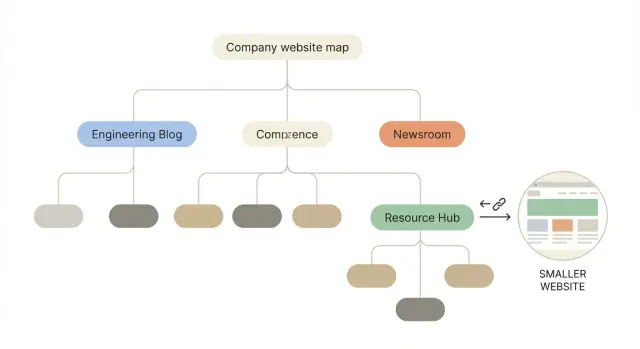
Why the site section matters more than the domain
A backlink from a famous domain can feel like a single win. But large websites are really multiple mini-sites under one roof. A link from the engineering blog, a newsroom post, and a resource hub page can perform very differently, even when the domain is the same.
That difference isn’t a minor detail. The section tells you what the page is for, who reads it, and how the site team maintains it. Those factors shape the SEO value you actually keep.
Three ideas matter most:
Topical fit means the link looks like it belongs on that page. If the article is about API performance, a link to a benchmark report fits. A link to a generic “best tools” page can look forced, which makes it more likely to be edited out.
Edit frequency is how often pages in that section get updated after publishing. Some sections are constantly cleaned up: headline tweaks, compliance edits, product naming changes, and link pruning. Others are closer to “publish once, leave it.”
Link longevity is how long your backlink stays live and unchanged. Longevity often matters more than a short-term bump, because a link that disappears in two months can’t keep supporting rankings.
A simple way to think about section choice:
- If you want strong topical relevance for a technical page, an engineering blog is often the cleanest match.
- If you want brand trust but can tolerate more edits, newsroom links can work.
- If you want stable, evergreen placements, resource hub backlinks often last longer.
Quick definitions: engineering blog, newsroom, resource hub
On large websites, the domain name gets the credit, but the section tells the real story. An editor and a reader can usually tell what a page is for in seconds from the layout, the tone, and the surrounding articles. That context is why engineering blog vs newsroom backlinks behave differently over time.
Engineering blog
An engineering blog is where a company’s builders explain how things work. Posts often cover technical decisions, reliability lessons, security fixes, and problem-solving write-ups. The tone is practical and specific.
A placement here tends to work best when your link supports the technical point: a standard, benchmark, how-to, case study, or a developer-focused product page that clearly solves the problem being discussed.
Newsroom
A newsroom is built for announcements: product launches, funding updates, executive changes, major partnerships, event recaps, and official statements.
Because the goal is “what happened” and “what’s new,” outbound links are often limited to the company’s own pages, partners, or essential references. If your link is included, it usually needs to be directly tied to the announcement.
Resource hub
A resource hub is the evergreen library. It might be a learning center, glossary, templates page, annual report archive, or a set of long guides that stay useful for months or years.
This is where resource hub backlinks can feel most natural because these pages are designed to help readers learn and often cite sources. A good fit is a definition, research report, checklist, or comparison that supports the guide.
If you’re unsure which section you’re looking at, check the surrounding content. Newsrooms usually emphasize dates and press framing. Engineering blogs often show author bios, technical tags, and detailed examples. Resource hubs typically group content by topic and link between related lessons.
Topical fit: what looks natural to editors and readers
A link can look wrong even on a famous domain. The mismatch usually happens because the page is written for a specific audience, and your topic doesn’t belong in their day-to-day work. A security team doesn’t expect a random marketing tool inside an engineering deep dive, and a product launch post rarely needs a detailed how-to guide.
Editors and readers judge fit quickly. They look for shared language and a shared problem. If your page answers the same kind of questions their readers already have, the link feels normal. If it forces a new topic into the story, it reads like an ad.
Signs the fit is strong
You don’t need complicated rules. The fit is usually strong when:
- The article and your page use the same terms (tools, standards, roles, metrics).
- They solve the same problem space (debugging, scaling, compliance, reporting).
- Your link supports a point already being made instead of starting a new topic.
“Close enough” can work when the overlap is obvious. For example, a post about performance testing can naturally reference an analytics product page. But if the only connection is a vague word like “optimization,” it will look out of place.
Match your target page to the section
The destination page matters as much as the placement. A practical match looks like this:
- Engineering blog: technical guides, benchmarks, case studies, developer-focused product pages.
- Newsroom: announcements, partnerships, high-level brand pages.
- Resource hub: evergreen explainers, templates, glossaries, learning content.
If you’re promoting a product homepage, a newsroom mention often feels forced unless the story is actually about your company. That same homepage can fit better in an engineering blog if the article is discussing a problem your product clearly solves.
How each section affects link placement quality
Link placement quality isn’t just about domain strength. The section changes how naturally your link fits, how strict editors are, and how likely the page is to keep its references.
Engineering blog: context-rich, citation-friendly
Engineering posts exist to explain how something works, so references and citations feel normal. A good link supports a specific point: a definition, benchmark, standard, or deeper guide.
Because the article has room for detail, the anchor text can be precise and the surrounding paragraph can justify why the reader should click. A backlink to a focused resource can feel like part of the author’s research, not a promotional insert.
Newsroom: high scrutiny, low tolerance for extras
Newsrooms are usually closer to brand communications. The format is tighter, and outbound links tend to be limited to sources that are essential for the story.
That often means editors question links more, and anything that looks promotional is more likely to be removed during updates. Even if a placement goes live, it may change later when the release is corrected, republished, syndicated, or updated to match current messaging.
Resource hub: evergreen pages with “helpful link” intent
Resource hubs live under sections like “Resources” or “Learn.” Pages are built to answer questions, define terms, and guide readers to next steps. That makes outbound links feel natural when they expand the reader’s understanding.
Placement quality often improves when your link matches the page’s promise, such as a definition page citing a credible source, a guide listing tools or templates, or a pillar page pointing to deeper reading.
Edit frequency: which section gets edited most often
Edit frequency is how often a page gets touched after it goes live. That can be a simple copy refresh, a template change, or a larger cleanup like merging several old pages into one.
More edits aren’t automatically bad. Regular updates can keep a page fresh and ranking. But every edit is also a chance for a link to be moved, rewritten, or removed during a “tidy up.”
Engineering blog
Engineering blogs often change in small, ongoing ways. Teams fix typos, update screenshots, add “Updated on” notes, or swap examples when an API changes. Links inside the body usually stay if they still support the point, but posts are also more likely to be migrated to a new CMS or URL structure.
Common triggers include product changes, team naming updates, CMS migrations, and site-wide style or accessibility updates.
Newsroom
Newsroom pages can be edited heavily in bursts, then left alone. During a press cycle, titles, quotes, and numbers get corrected quickly. Later, legal or compliance teams may prune outbound links, remove partner mentions, or standardize boilerplate across many releases.
This is a key engineering blog vs newsroom backlinks difference: newsroom edits often happen for risk control, not to improve the reader experience. That makes non-essential links more likely to disappear.
Resource hub
Resource hubs sit in the middle. Individual guides may get updated yearly or when a new version ships. But hubs also get reorganized: categories renamed, pages moved, older resources retired, and “start here” pages rewritten.
Reorgs are where links get lost most often, not because anyone dislikes them, but because content gets merged and editors keep only a few references.
Link longevity: what keeps a backlink alive
A backlink can be “high quality” on day one and still disappear a month later. On large sites, link loss is often about maintenance, not intent. Pages get merged, templates change, and teams prune older content when priorities shift.
Common causes are predictable: content merges, CMS migrations that change URLs, legal or brand cleanups that remove outbound links, and periodic pruning where older pages are shortened or deleted.
Stable usually means evergreen content with a clear job and a clear owner. Think of a guide that supports a long-term topic. Those pages get updated, but their purpose stays the same, so links that fit the context often survive.
How longevity differs by section
Volatility is the biggest difference when people compare engineering blog vs newsroom backlinks.
Engineering posts often stay online for years, but may be edited when examples, tools, or strategy changes. Newsrooms are typically the most fragile: announcements get consolidated, older releases get archived, and dated pages can be removed during brand refreshes. Resource hubs often have the longest life when treated as reference content, but they’re actively maintained, so off-topic links can be quietly removed.
A simple example: a newsroom post about a funding round might later be rewritten into a short timeline that drops most external links. A resource hub guide about “API security basics” might keep external references, but only if they remain directly useful.
What to check before you commit
Before you pay for or request a placement, try to confirm a few basics:
- Is the page evergreen, or tied to a date, launch, or campaign?
- Does it have a stable URL pattern and consistent formatting?
- Who owns it: engineering, PR, legal, or a content team?
- Are there signs of frequent cleanup, like heavy rewrites or removed sections?
- Would the link still make sense if someone shortened the page by 30 percent?
If the link only works when the page stays exactly as it is today, its life is usually short.
How to choose the right section (step by step)
Choosing between an engineering blog, a newsroom, or a resource hub changes how natural the link looks, how often the page gets revised, and how long the placement tends to survive.
Start with one decision: what do you want most from the placement right now? A link meant to build trust is different from a link meant to rank a specific page for a specific topic.
A simple 5-step method
- Name the primary outcome. Pick one first: credibility, rankings for a topic, steady referral traffic, or a mix.
- Match the outcome to a target page on your site. Engineering placements fit technical explanations. Resource hubs fit evergreen learning content. Newsrooms fit brand mentions and announcements.
- Shortlist by section before you compare domains. This is the fastest way to improve topical relevance for backlinks.
- Check recent edit behavior on similar pages. Look at posts in that section from the last 6 to 12 months. If headlines and outbound links change often, your link is at higher risk.
- Build a small mix with different risk levels. A varied set usually holds up better when teams reorganize content.
As a rough guide, evergreen resource hubs tend to be lower churn, engineering blogs are often medium churn, and newsrooms are usually higher churn.
Common mistakes that shorten link life
A backlink can disappear for boring reasons: a page gets refreshed, a template changes, or an editor removes anything that feels off-topic. Most lost links trace back to avoidable choices at the start.
One common trap is chasing the biggest name and ignoring the section. With engineering blog vs newsroom backlinks, the domain might be equally strong, but the expectations aren’t. An engineering blog post often tolerates practical references and tools. A newsroom post is more likely to be tightened later to remove anything that looks like promotion or “extra.”
Another link killer is sending every placement to the homepage. Editors prefer a destination that clearly matches the sentence. If the paragraph is about a specific problem, a focused article or product page usually reads more naturally than a generic front page.
Anchor text matters too. Overly commercial anchors can look odd inside editorial writing, especially on large sites with strict style rules. Plain, descriptive anchors tend to survive edits because they read like normal citations.
Quick checklist before buying or requesting a placement
Before you pay for a placement or pitch an editor, do a quick reality check. On big sites, the section often decides whether the link looks natural, gets edited, or disappears later.
Ask yourself:
- Does the headline and first screen of content match your target page topic without stretching?
- Is this section built to stay useful for months (guides, docs, resource hubs), or tied to a date and announcement (newsrooms)?
- Do similar pages show frequent rewrites, “updated on” notes, or signs of cleanup?
- Would the link genuinely help a reader complete a task or understand a concept?
- If this link is removed next quarter, do you still have other placements supporting the same goal?
If you’re comparing engineering blog vs newsroom backlinks, treat “how often this section changes” as a core quality signal, not a minor detail.
Example: choosing sections for two realistic campaigns
A useful way to choose between sections is to start with the goal: do you need attention around a specific event, or steady authority around a topic you want to own?
Campaign 1: SaaS launch with a time-sensitive feature
A B2B SaaS company ships a new security feature and wants credibility and referral traffic during launch week. The newsroom (or press section) is often the best fit because readers expect announcements there.
To reduce removal risk, they point the backlink to a stable page that will still make sense in six months, and they keep the link text plain and factual so it matches the tone of a news post.
Campaign 2: long-term topical authority for a growing niche
A company wants to become known for a topic, like API reliability or warehouse forecasting. Here, an engineering blog post or a resource hub page is often a better fit than news.
They choose a page meant to be referenced (a guide, glossary, benchmark report, or template) and make sure the link supports a point already being made. Neutral anchors and evergreen destinations tend to last longer.
Next steps: build a small, stable backlink mix
The core idea is simple: you’re not just buying a domain, you’re betting on a page that will stay relevant and intact long enough to pay you back.
Start small, then scale with proof. One or two placements is enough to learn how a site behaves. Give it 60 to 90 days and watch what happens to the page, the anchor, and the surrounding text.
Keep tracking lightweight: note the placement URL, the section type (engineering, newsroom, resource hub), the live date, the target page, and the last time you checked it.
If you’re sourcing placements through a curated inventory, it still helps to choose by section first. For example, SEOBoosty (seoboosty.com) focuses on access to rare placements on authoritative sites, but the same rule applies: the section determines whether the link feels native and whether it’s likely to survive edits.
FAQ
Why does the site section matter more than just the domain name?
Because big sites act like several different sites under one domain. The section tells you the audience, the editorial rules, and how the content is maintained, which affects whether the link looks natural, gets edited, or stays live long enough to matter.
How can I tell if a page is an engineering blog, a newsroom post, or a resource hub page?
Look at the page’s intent and layout. Engineering posts usually explain how something works with technical detail, a newsroom reads like an official announcement with dates and press framing, and a resource hub is organized to teach or reference topics over time.
What kind of page should I point to from an engineering blog backlink?
Send an engineering-blog placement to something that directly supports a technical point, like a benchmark, standard, how-to, or a developer-focused page. If the destination doesn’t answer the same kind of question the post is discussing, it will feel inserted and is easier to remove later.
Why do newsroom backlinks get removed more often?
Most newsroom posts are written to communicate a specific update, so editors often limit outbound links to essentials like the company’s own pages, partners, or primary references. If your link isn’t clearly necessary to the announcement, it’s more likely to be questioned or pruned during later cleanups.
Are resource hub backlinks usually more stable, and why?
Resource hubs are designed to help readers learn, so citing useful sources is normal and often expected. Longevity improves when your link genuinely expands the guide, matches the topic, and would still make sense even if the page gets shortened or reorganized later.
What does “edit frequency” mean, and why does it affect my backlink?
It’s how often a page is changed after publishing, from small copy tweaks to major rewrites, migrations, or consolidation. Each edit is a chance for an editor to remove anything that looks off-topic or non-essential, even if the link was acceptable on day one.
What anchor text is safest if I want the link to last?
Use plain, descriptive anchor text that fits the sentence, like a normal citation. Overly promotional anchors can stand out in editorial writing and are more likely to get rewritten or deleted when someone tightens the copy.
Should I avoid sending most backlinks to my homepage?
Usually not, because it often doesn’t match the specific point being made in the paragraph. A focused destination that clearly answers the relevant question tends to read more naturally and survive later edits better than a generic front page.
Is it better to build links across multiple sections instead of choosing only one?
A balanced mix reduces risk because different sections change for different reasons. If one section gets reorganized or pruned, you still have other placements supporting the same goal, and you also learn which section types stay most stable for your niche.
How does SEOBoosty fit into choosing the right backlink section?
SEOBoosty gives access to premium backlinks on highly authoritative sites through a curated inventory and subscription model, but section choice still matters once you have options. The practical move is to pick placements by section fit first, then point the link to the most context-matching page so it looks native and is more likely to remain live.
Share