Estimate backlink impact before you buy: a simple checklist
Use this pre-purchase checklist to estimate backlink impact with your current rankings, expected CTR lift, and realistic movement ranges before spending money.
What you are trying to predict (and why it is hard)
Buying a backlink can feel like guessing because you’re paying for a signal, not a guaranteed result. The link is one input among many, and Google can react differently based on your page, your competitors, and the query.
When people ask about “impact,” they usually mean some mix of:
- higher rankings for specific keywords
- more clicks and organic traffic
- more leads or sales from that traffic
- stronger overall authority that helps future content
Those outcomes are connected, but they’re not the same. A ranking lift on a low-impression keyword can look great in a tracker and still drive almost no traffic. Meanwhile, moving from position 6 to 4 on a high-impression query can produce a real click gain, even if it doesn’t feel dramatic.
Starting point matters. Two sites can get the same link and see very different outcomes. A page with solid content, good internal links, and a clean technical setup often responds faster. A thin page, a page that misses search intent, or a page up against much stronger competitors may barely move. Even premium placements from highly authoritative sites (including the types SEOBoosty focuses on) won’t do much if the target page isn’t already credible and useful.
Ranking movement also isn’t linear. A small authority increase can bump you a few spots when results are tightly clustered, or do nothing when one competitor is far ahead. Google updates and competitor changes can also shift the goalposts while you’re measuring.
The practical approach is to forecast a range, not a promise. Think “conservative, expected, optimistic.”
Example: if your page sits around position 9 for a keyword with steady impressions, your range might be “no change,” “up a couple spots,” or “into the top 5.” Each scenario implies a different click expectation. Before you buy, connect those scenarios to traffic and business value so the price still makes sense in the conservative case.
What you can and cannot estimate before purchase
Separate hard numbers from educated guesses. Mixing them makes forecasts look precise but fail in practice.
What you can measure (before you spend)
Pull a clean baseline from Search Console and your analytics. These are facts, not opinions, and they anchor everything.
At minimum, record:
- current average position (for the page and for the key queries)
- impressions and clicks over a consistent window (often 28 to 90 days)
- your actual CTR at your current positions (not a generic chart)
- conversions and conversion rate for the page (or a consistent proxy)
- value per conversion (or a simple proxy like average order value)
These numbers tell you whether the page has enough exposure for a ranking change to matter, and whether extra clicks are likely to turn into revenue.
What you can only approximate
A backlink isn’t a fixed “+X positions” input. Before purchase, you can only estimate:
- how much authority passes through the link (depends on the source page and placement)
- relevance (how well the linking page and site match your topic)
- competition (how strong the current top results are, and whether they’re also improving)
Even with curated placements from a provider like SEOBoosty, you’re still estimating a range, not a single outcome.
Timing: when movement tends to show up
Ranking changes rarely happen the same day a link goes live. Indexing and re-evaluation take time, and competitors can shift around you. Plan to judge results over a window, not a single snapshot.
A simple rule: if you need results next week, a backlink is the wrong lever.
Backlinks also tend to do little when a page is already ranking #1-2, when the link points to the wrong URL (home page instead of the ranking page), or when the query intent doesn’t match the page.
Collect your baseline: positions, impressions, CTR, value
If you don’t lock in a clear “before” snapshot, your forecast turns into vibes, and later you won’t know what actually changed.
Pick one target page. The goal is to predict what happens to that page’s existing search demand, not to guess new demand that might never appear.
1) Capture what the page already ranks for
Open your search performance data, filter to the exact page, and export the queries that already generate impressions.
Don’t obsess over one “main keyword.” Most pages earn traffic from a cluster of related terms. Group queries into 3 to 5 themes (for example: pricing, templates, comparison, how-to). Forecasts based on groups are usually more stable.
For each query group, record:
- average position (rounded or as a range)
- impressions per month (or last 28 days, but stay consistent)
- clicks and current CTR
- the URL shown in results (confirm it’s the same page)
One caution: average position can hide spread. A group “average 9” might include terms at 4 and others at 15. Note the high and low ends even if you don’t model them perfectly.
2) Tie clicks to business value
Traffic only matters if it leads to something you care about. Decide what “value” means for this page (leads, trials, signups, demos, purchases, email captures), then write down the current baseline.
If you have conversion tracking, pull the organic conversion rate for that page. If you don’t, use a consistent proxy (like contact form submits from this page).
Example baseline: 20,000 impressions/month across a few query groups, 600 clicks (3% CTR), and 12 signups (2% conversion rate). Now you can model outcomes in clicks and signups, not just rankings.
Once you have that baseline, you can estimate what moving from positions 8 to 12 into 4 to 7 might do. This is also the moment to sanity-check budget, whether you buy a placement directly (including inventory-style services like SEOBoosty) or use another approach.
Choose the keywords that actually move the needle
A clean forecast beats a complicated spreadsheet built on the wrong queries.
Start by splitting branded vs non-branded. Branded searches often rank well because people already want you, so new links may not change much there. Non-branded queries are usually where improved authority can change visibility.
Next, separate informational vs transactional intent. Informational terms can bring lots of impressions, but clicks get split across features like snippets and “People also ask.” Transactional terms often have fewer impressions, but higher value per click.
Impressions keep you honest. A keyword with 40 impressions a month is hard to model and rarely moves revenue. A keyword with 4,000 impressions a month gives you enough data to estimate click changes with less guesswork.
A quick filter that works for most sites:
- mostly non-branded
- clear intent (you can explain what the searcher wants)
- consistent impressions over time
- close enough to improve (often positions 4 to 15)
- maps to a page you actually want to grow
Finally, remove obvious outliers before you calculate anything. One-time spikes, news-driven surges, and seasonal weeks can make a keyword look far more promising than it is.
If you’re considering premium placements like the ones SEOBoosty provides, this step matters even more. The best ROI usually comes from strengthening pages with steady demand that are within striking distance, not from chasing noisy spikes.
Translate ranking movement into expected CTR and clicks
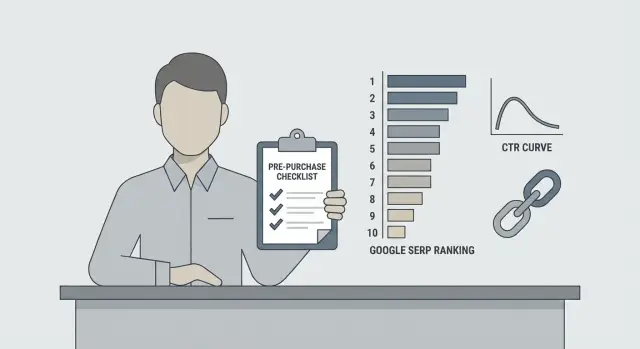
Search results have a CTR curve: the higher you rank, the more people click. But the curve isn’t universal. Titles, snippets, brand strength, and SERP features all change CTR.
Use a simple CTR-by-position table for rough math, then swap in your own Search Console numbers whenever possible:
Position:  1   2   3   4   5   6   7   8   9   10
CTR (%):  28  16  11   8   6   5   4   3  2.5   2
Anchor to reality: if Search Console shows you rank #6 and get 3.5% CTR (not 5%), use 3.5%.
Keep the model simple:
- current clicks = impressions x current CTR
- expected clicks = impressions x new CTR
- click lift = expected clicks - current clicks
The biggest gotcha is that “one or two positions” can be tiny or huge depending on where you start. Going from #9 to #7 might add a little. Going from #4 to #2 can be a jump.
Model three scenarios to stay honest:
- conservative: small move, small CTR change
- expected: mid move, mid CTR change
- optimistic: big move, best-case CTR change
Example (one keyword): 10,000 monthly impressions. You’re #6 with 3.5% CTR (350 clicks). If you reach #4 with 6% CTR, that’s 600 clicks (lift of 250). If you only reach #5 with 4.5% CTR, that’s 450 clicks (lift of 100).
Then convert clicks into outcomes using your conversion rate. If your conversion rate is 2% and lift is 250 clicks, expect about 5 extra conversions (250 x 0.02). Multiply by value per conversion to estimate business impact.
Set realistic movement ranges (so your forecast is honest)
The fastest way to overestimate results is assuming every backlink pushes you from “pretty good” to “#1.” Movement gets harder as you get closer to the top.
Use movement bands based on where you start. Treat these as ranges, not promises:
| Starting position | More likely movement (band) | Less likely stretch |
|---|---|---|
| 31-50 | +5 to +15 spots | +20+ spots |
| 21-30 | +3 to +10 spots | into top 10 |
| 11-20 | +2 to +8 spots | top 3 |
| 6-10 | +1 to +3 spots | #1-#2 |
| 1-5 | 0 to +1 spot | staying #1 long-term |
These bands steer you away from “#6 to #1” fantasies and toward forecasts like “#20 to #12,” which are usually more realistic.
Don’t ignore SERP features that cap your CTR
Even if rankings improve, clicks might not. Ads, map packs, shopping blocks, “People also ask,” and featured snippets can steal attention. When SERP features are heavy, assume a smaller CTR gain than the ranking chart suggests.
Check whether the race is getting faster
Shrink your movement range if competitors are actively investing.
Reality checks that matter:
- Are the top pages clearly updated and maintained?
- Are new competitor pages entering the top 10?
- Do the top results belong to very strong domains that rarely drop?
- Has the SERP layout changed recently (more ads, new blocks)?
Example: if you’re #12 and competitors above you publish new supporting pages every month, your “+2 to +8” band might become “+1 to +4” unless your page improves too.
Set a time window before judging results. For many sites, 4 to 8 weeks shows early signs, and 8 to 12 weeks gives a clearer read. Decide upfront what “success” looks like inside that window so you don’t panic after 10 days or celebrate a one-week spike.
Step-by-step pre-purchase checklist
The goal isn’t a perfect forecast. It’s a decision you can defend.
The 10-minute checklist
Start with the page. If the page can’t rank, no forecast will save it.
Confirm the basics: the page is indexable (noindex, robots blocks, bad redirects), loads cleanly, and has a clear primary topic.
Then do a fast intent check: read the current top results for your main query. If searchers want a how-to guide and your page is a product pitch, links often won’t move it much.
Next, look for proof of life:
- the page already ranks in the top 30 for relevant queries (even positions 15 to 30 count)
- the last 28 to 90 days show consistent impressions, clicks, and CTR
Now turn the baseline into a range forecast. Write the position changes you’re assuming (for example, 12 to 9), not vague phrases like “big lift.” Convert the range into clicks using CTR assumptions, then convert clicks into outcomes using your page’s conversion rate and value per conversion.
Finally, set two numbers that keep you disciplined:
-
Maximum price: what you’ll pay for the expected value over a clear window (often 3 to 6 months).
-
Stop rule: what must be true by a certain date to keep investing. Example: “If impressions are flat and there’s no sustained position improvement for priority queries within 8 to 12 weeks, pause link buying and fix intent match and internal linking first.”
If you use a provider where you can choose specific domains from a curated inventory (as with SEOBoosty), this gets easier because cost and placement inputs are clearer. The range can still be wrong, but it’s usually wrong in a more controlled way.
Example: estimating impact for a page stuck on page one
Imagine a product page sitting around positions 8 to 15 for a handful of valuable queries. Impressions are steady, but traffic feels capped.
Starting point (baseline numbers)
Assume one target query (or small cluster):
- Current average position: 12
- Monthly impressions: 10,000
- Current CTR at position 12: 1.2%
- Current clicks: 10,000 x 1.2% = 120 clicks/month
- Conversion rate from visit to lead/sale: 2%
- Value per conversion: $120
Baseline value per month: 120 clicks x 2% x $120 = $288.
Movement scenarios (conservative, expected, optimistic)
Run three outcomes and keep them grounded:
- Conservative: 12 to 10 (CTR 1.8%)
- Expected: 12 to 8 (CTR 2.5%)
- Optimistic: 12 to 5 (CTR 5.0%)
New clicks and lift:
- Conservative: 10,000 x 1.8% = 180 clicks (lift +60)
- Expected: 10,000 x 2.5% = 250 clicks (lift +130)
- Optimistic: 10,000 x 5.0% = 500 clicks (lift +380)
Convert lift into monthly value:
- Conservative: 60 x 2% x $120 = $144/month
- Expected: 130 x 2% x $120 = $312/month
- Optimistic: 380 x 2% x $120 = $912/month
Adjust CTR if SERP features are stealing clicks
Those CTR assumptions can be too generous when the results page is crowded.
Common click-stealers:
- multiple ads above the fold
- featured snippet that answers the query
- local pack (map results)
- shopping results
- “People also ask” pushed high
A simple adjustment is to reduce your CTR estimates by 20% when the SERP is busy. In the expected case, $312/month becomes about $250/month.
Break-even price (what you can pay and still win)
Pick a timeframe for payback, like 6 months.
Break-even (expected) = $250/month x 6 = $1,500.
If the backlink costs less than $1,500 over that window, the expected case breaks even (before other costs). If you’re comparing a subscription-style backlink, compare the subscription cost over your chosen timeframe to this break-even number, not just the annual price.
Common mistakes that make forecasts wrong
Most backlink forecasts fail for simple reasons. They rely on one number, one curve, or one guess.
Mistake patterns to watch for
-
Betting everything on one vanity keyword. Head terms can look impressive, but they’re often unstable and hard to move. A better forecast uses a small set of related queries so one spike doesn’t fool you.
-
Using a generic CTR curve that doesn’t match your SERP. CTR isn’t universal. Ads, maps, shopping, AI answers, video blocks, and strong brands can all reduce organic clicks.
-
Ignoring intent mismatch. A backlink can help authority, but it can’t fix a page that doesn’t satisfy the query.
-
Expecting instant movement and refreshing rankings daily. Rankings move in steps. Daily checking turns normal noise into emotional decisions.
-
Overpaying without a ceiling tied to outcomes. Decide what a click and a conversion are worth, set a max price, and stick to it.
Even with high-authority links, the forecast is only as good as your baseline, your intent check, and your price discipline.
Quick checks and next steps after you decide to buy
Before you spend, make sure the page is ready. A backlink can help, but it won’t fix a page that’s hard to crawl, hard to trust, or unclear about the topic.
A fast pre-launch check:
- Page quality: does it satisfy the intent better than the pages above it?
- Internal links: is it easy to reach, with a few relevant pages linking to it?
- Technical blockers: noindex tags, wrong canonicals, slow load, crawl issues.
- Freshness: if competitors updated recently, add missing sections or clearer examples.
- Conversion path: if you get more clicks, is the next step obvious?
Use one decision rule to stay sane: only buy if the conservative case still makes sense.
After you buy, track results in a way that avoids panic.
How to track without overreacting
Use the same query set you used in your forecast.
- Take weekly snapshots (not daily) of position, clicks, and impressions.
- Keep the query set fixed for 4 to 8 weeks.
- Note site changes (title edits, content updates, internal links).
- Look for trend direction, not one-week spikes.
If a page moves from position 9 to 7 and impressions also rise, your click gain may come from both position and broader visibility. That’s still a win, just label it correctly.
Next step if you want more predictable placements
If you want more predictable access to high-authority placements, using a curated inventory can be easier to plan around. With SEOBoosty (seoboosty.com), customers select specific domains, subscribe, and point the backlink to the exact page they want. The planning rule stays the same: only proceed when your conservative forecast and your page readiness checks both say yes.
FAQ
Can I really predict what a backlink will do before I buy it?
Start with a range, not a promise. A backlink is one input among many, so your best pre-buy forecast is a conservative, expected, and optimistic scenario tied to your current rankings, impressions, CTR, and conversions.
Why do two sites get the same backlink but see totally different results?
Expect different results because the starting point is different. A page with solid content, clean technical setup, and good internal links usually responds faster than a thin page or a page that doesn’t match search intent.
What numbers should I record before buying a backlink?
Pull your baseline from Search Console and analytics: average position for the page and key queries, impressions, clicks, your actual CTR at those positions, conversions for the page, and value per conversion (or a simple proxy). These numbers anchor every forecast.
How do I know if a ranking increase will actually bring traffic?
Don’t estimate ranking changes first. Check whether the page already has steady impressions; without demand, a ranking lift won’t create meaningful clicks. Then model clicks and conversions, not just “positions.”
Should I use a generic CTR curve or my own Search Console CTR?
Use your own CTR data when possible. If you don’t have enough history, use a simple CTR-by-position table for rough math, then replace it with Search Console CTR once you have real numbers for the same query and page.
What can I estimate ahead of time, and what is basically guesswork?
A backlink doesn’t act like “+X positions.” Authority passed depends on the source page and placement, relevance depends on topical match, and competition depends on how strong (and active) the top results are. Treat these as uncertainty drivers and keep your movement range modest.
How long does it usually take to see movement after a link goes live?
Plan to judge results over weeks, not days. Early signs often show in 4 to 8 weeks, with a clearer read in 8 to 12 weeks, because indexing and re-evaluation take time and competitors can shift during your test window.
Which keywords should I model for backlink ROI?
Target non-branded queries with consistent impressions, clear intent, and rankings that are close enough to improve (often positions 4 to 15). Skip one-off spikes and ultra-low-impression terms because they make ROI math unreliable.
How do I decide what a backlink is worth before I pay?
Set a maximum price based on the expected value over a fixed window (like 3 to 6 months), and only proceed if the conservative case still makes sense. Also set a stop rule, such as pausing link buying if there’s no sustained improvement for priority queries after 8 to 12 weeks.
How should I track results after buying so I don’t overreact?
Daily checks turn normal noise into bad decisions. Track the same fixed query set weekly, compare against your baseline, and note any site changes you made (titles, content updates, internal links) so you don’t attribute everything to the backlink.
Share