Link portfolio rotation strategy: keep, replace, or diversify
Use a link portfolio rotation strategy to decide when to keep, replace, or diversify backlink sources based on topical fit, returns, and risk.
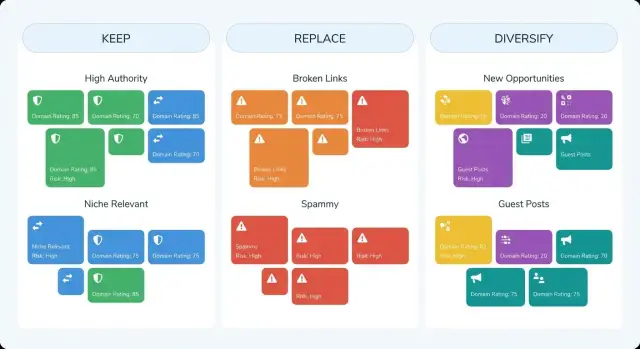
What link rotation means and why it matters
Link rotation is the habit of reviewing where your backlinks come from and making small, regular adjustments. You keep sources that still help, replace sources that no longer earn their spot, and add new sources so you are not relying on the same few places.
A good link can become less useful over time for normal reasons. Your site may outgrow the topic of the source. The linking page may lose visibility. Or you may already have enough links sending the same type of signal. Sometimes nothing is “wrong” with the link. It just stops being the best use of your time and budget.
Most decisions fall into three buckets:
- Keep: the source still fits your topic and continues to support rankings or traffic.
- Replace: the source is no longer a strong fit, or you are seeing diminishing returns from adding more of the same.
- Diversify: you are too dependent on one type of site, one network, or one topic cluster, which creates concentration risk.
If you work with a provider like SEOBoosty, rotation is often simpler because you can choose from a curated inventory of authoritative domains and adjust your mix over time instead of waiting on unpredictable outreach.
The three signals: topical fit, returns, and concentration risk
A rotation routine is basically a repeatable check-in: what deserves more budget, what should be swapped out, and where you need new sources.
1) Topical fit (does this source make sense for you?)
Start with relevance. A link from a site that regularly covers your core topics usually helps more and looks more natural than a random mention on an unrelated publication.
A quick gut-check: if a real reader landed on that page, would they understand why your site is referenced? If the answer is “not really,” the fit is weak.
2) Returns (are more of the same still helping?)
Even good sources can hit diminishing returns. You add another similar link from a similar type of site, and rankings barely move. That can happen when you have already built enough authority in that lane, or when the extra links do not add anything new (a new audience, a new topic cluster, or support for a different page).
Look for patterns over time. If your last few links from the same category stopped improving impressions, rankings, or qualified traffic, rotate budget to a different source type.
3) Concentration risk (are you overexposed?)
If too many links come from one niche, one format, or one network of sites, your profile becomes fragile. A redesign, editorial shift, or policy change could wipe out a lot of value at once.
Time matters here. Pages get updated, posts age out, and search intent shifts. A link that was perfect last year may now sit on a stale page, a redirected URL, or a page that no longer matches the query.
A few simple signals to review each quarter:
- Relevance drift: the linking site or page changes topics, tone, or audience.
- Performance plateau: new links from the same bucket stop moving key pages.
- Overweight sources: one category of site makes up an uncomfortable share of your links.
- Decay events: noindex tags, redirects, heavy edits, or shrinking visibility on the linking page.
Example: if a SaaS company has 60% of its strongest links from generic tech news sites, it might keep the best performers, replace those that lost topical alignment, and add more industry-specific publications to reduce concentration risk.
How to inventory your current backlink portfolio
A useful inventory is not a dump of every URL. It is a simple view that helps you decide what to keep, what to rotate out, and where you have gaps.
Start by grouping links by topic cluster, not just by domain. For example, a SaaS CRM might have clusters like “sales pipeline,” “email outreach,” and “customer support.” A link from a general tech blog belongs in the cluster it supports, not in a bucket called “tech sites.” This makes relevance easier to judge later.
Then capture a few consistent details for each link. A spreadsheet is enough as long as it stays simple.
- Topic cluster the link supports
- Link type (editorial mention, resource page, partner page, directory/profile)
- Basic quality signals (is the page indexed, does the site look active, does it seem to get real traffic)
- Anchor style (brand, URL, generic like “here,” partial match)
- Status notes (live, removed, nofollow, redirected)
Keep the “quality” part practical. You do not need perfect metrics. If a page is not indexed, looks abandoned, or is surrounded by spammy content, that is a clear warning sign even without tools.
Next, define what “healthy” means for your site. For example: no single topic cluster should hold more than half of your strongest links. Branded or URL anchors should be the majority, with only a small share of keyword-heavy anchors.
If you use a provider like SEOBoosty, tag those links too. Not to treat them differently, but to see how much of your portfolio depends on a single source type and where you still need variety.
When to keep a link source (and keep investing)
Keeping a link source is usually the right move when it keeps doing one job: it sends steady trust signals without forcing anything. Good sources become part of your foundation, so do not swap them out just to “stay active.”
A source is worth keeping when the topic match still feels obvious. If you sell accounting software, an ongoing mention from a finance or business operations publication makes sense to readers now, not just to search engines. The same link on an unrelated page (or wedged into a strange paragraph) tends to age poorly.
Also pay attention to how the placement reads. If the link is part of a real explanation, a case study, or a resources section someone would use, it is a keeper. If it looks squeezed in, it is more likely to become fragile over time.
Anchor patterns matter too. A safer profile is mostly brand and natural phrasing, with exact-match anchors as the exception.
Signs a source is “keep and build”:
- The site continues publishing quality content in your category, and your link still fits the page.
- Rankings and organic traffic stay stable or improve after placements (not necessarily instantly, but without odd drops).
- The source can support more than one relevant page over time without repeating the same anchor.
- Your portfolio is not becoming lopsided because of that source.
- The page looks stable and stays indexed.
Keeping is also the safer choice during sensitive periods like a migration, a redesign, or a major repositioning. That is when stability beats experimentation.
When to replace links: spotting decline and diminishing returns
Replacing links is not about chasing shiny new sites. It is about noticing when a source has stopped helping, or when it starts adding risk.
Signals a link source is fading
Diminishing returns often show up quietly. You add another placement from the same type of site and rankings barely move (or move briefly, then settle back).
Common warning signs:
- Repeated placements bring smaller gains, even when your content improves.
- The context becomes less relevant over time (different audience, broader and more generic pages).
- The site quality slips (thin posts, excessive ads, visible topic drift, heavy sponsored content).
- The content changes around your link (your mention removed, pushed into a footer, or surrounded by unrelated links).
- Anchors start to look forced or repetitive across placements.
One signal once is not a crisis. Several signals on the same source usually means it is time to rotate out.
Over-concentration is another reason to replace. Even good links can become a liability if too many wins come from one niche or one network. It limits upside and raises the impact of a single negative change.
What to replace first
Start with the highest-risk, lowest-upside items:
- Links from sources that lost topical fit.
- Links tied to repeated anchor patterns.
- Clusters where one source type dominates your recent growth.
- Placements that used to correlate with movement but now align with flat results.
Example: if a SaaS brand has 30% of new links coming from the same “startup tools” blog group, it is often safer to shift the next buys to different, still-relevant publications.
How to diversify sources without losing topical focus
Diversifying your link sources does not mean going random. The goal is a clear theme without putting all your trust in one type of site, one authority level, or one page on your website.
Start with topic adjacency. If your core topic is payroll software, nearby topics like HR compliance, finance operations, or small business accounting usually make sense. The link still belongs in the conversation, even if it is not a perfect keyword match.
Then vary where links come from. A natural profile includes a mix of articles, resource pages, partner mentions, and (when relevant) company engineering or product pages. If every link looks like the same kind of blog post, the pattern can feel manufactured.
Also mix authority levels. An “all top tier” footprint can look unusual if your brand is not widely known yet. Pairing strong sites with mid-tier niche publications often looks more believable and spreads risk.
Finally, spread links across destination pages. If everything points to the homepage, you miss the chance to build trust for the pages that actually rank, like feature pages, category pages, and key guides.
A simple mix many teams can maintain:
- 60% core-topic sources and 40% adjacent-topic sources
- a mix of niche publications, broader industry sites, and company or community pages
- a blend of top-authority, mid-authority, and smaller but highly relevant sites
- a healthy share of links to deep pages, not just the homepage
A step-by-step rotation process you can repeat
A repeatable routine keeps your link profile fresh without random changes. The goal stays the same each cycle: keep what works, replace what is fading, and diversify before one source type becomes a liability.
Pick a schedule you can actually stick to. Quarterly works for most sites because link impact and indexing take time. Monthly can make sense if you publish often or add placements regularly.
A simple five-step process:
-
Set the review window and goal. Choose what you want to improve this cycle (a topic cluster, branded visibility, recovery after a dip). Use the same window each time, like the last 60 to 90 days.
-
Score each source on three factors. Give a quick 1 to 5 score for topical fit, performance, and concentration risk.
-
Choose one action per source. Keep sources that score well on fit and performance. Replace sources that are off-topic, unstable, or no longer correlate with movement. Diversify when risk is rising, even if results are still good. Pause when you cannot measure impact or when budgets are tight.
-
Plan new placements to fix gaps. If your portfolio is heavy in one niche, add a few placements from adjacent, relevant categories. With a service like SEOBoosty, this is where you intentionally pick domains that widen the mix while staying on-topic.
-
Track outcomes and leave one note for next time. Watch a small set of signals: target keyword positions, organic landings to the pages you supported, and how quickly new placements get indexed. Keep a short log like: “Kept 6, replaced 2, diversified with 3 new topics. Best lift came from X.”
A practical example: if a SaaS site has five strong links from the same type of tech blog, keep two or three, replace one that stopped driving movement, and add a couple of placements from closely related business or industry publications to reduce concentration risk.
Common mistakes that make rotation backfire
Link rotation can protect growth, but it can also erase progress if you treat links like disposable ads. Most issues come from moving too fast, chasing the wrong metrics, or swapping sources without improving what the links point to.
Rotating too quickly is a common mistake. Good links often compound over time as pages get crawled and recrawled. If you replace a solid source after a few weeks because you do not see instant movement, you can cut off delayed lift.
Another trap is chasing authority while ignoring topical fit. A high-authority page in an unrelated topic can dilute relevance. A B2B SaaS that collects links mainly from gadget reviews might gain raw authority, but it also starts sending mixed signals about what it should rank for.
Anchor over-optimization is also easy to trigger during replacement cycles. When performance is flat, it is tempting to reuse the same keyword anchor again and again. Keep anchors varied and natural, especially on new placements.
Rotation also fails when you replace links but do not upgrade the target pages. If a page is thin, outdated, or mismatched to search intent, new links can only do so much. Make sure the linked pages deserve the boost.
Warning signs worth stopping for:
- too many new links landing on one page in a short window
- anchors repeating the same exact phrase
- new sources drifting into unrelated categories
- replacing “okay” links without a clear reason or goal
If you use a service like SEOBoosty to add placements, treat it like a portfolio: keep winners long enough to pay off, and diversify without losing topical clarity.
Quick checklist for a healthy backlink portfolio
A quick audit once a month can catch issues early, before rankings wobble.
- Concentration check: Review your top sources by volume and group them by type (niche blogs, partner sites, directories, PR mentions, resource pages). If one category dominates, you are exposed.
- Destination page check: Look at your most important pages. Do the pages that drive revenue have enough relevant links, or are most links pointing to easy-to-link blog content?
- Anchor check: Scan for repeated phrases. If you see the same wording too often, widen it with branded, partial-match, and natural anchors.
- Topic coverage check: Map links to your core offers. If a key product or service page has very few links, you likely have a gap holding it back.
- Quality drift check: Revisit a few newer placements and a few older ones. If a source now looks thinner than before (more ads, weaker editorial, irrelevant content), mark it for replacement.
If one or two items fail, you do not need a full reset. Make one change next cycle: add links to under-supported pages, replace a drifting source, or spread new placements across more categories.
Example scenario: rotating links for a growing SaaS site
A growing SaaS company sells one main feature: automated invoice reconciliation. It also has three supporting use cases: helping finance teams close the month faster, reducing payment errors for ops, and giving founders simple cash flow reporting.
At the start, their backlink profile is lopsided. Most new links come from the same type of small accounting niche blog. It worked early on, but rankings have stalled. The team also worries about concentration risk: if that niche loses visibility or gets hit by a quality update, a big chunk of their link equity is exposed.
They run one rotation cycle for a quarter.
First, they keep the few sources that still match the product closely and consistently send qualified traffic (for example, a respected bookkeeping newsletter and two high-quality accounting resources). Next, they replace links that are “close enough” but not actually about invoice workflows, because those links do not support the right pages or queries.
Then they diversify, but only into adjacent topics that still make sense: fintech and payments publications, SaaS operator content, and trusted tech blogs or engineering pages that cover integrations and data reliability. They also add established industry publications that finance leaders already read.
They rotate where links point, too. Broad sources go to the homepage for brand trust. Links about reconciliation go to the feature page. Links about closing the books, reducing errors, and cash flow reporting go to the three use case pages so each page earns relevance signals that match its intent.
Success after one cycle looks like this: referral traffic spreads across multiple sources, the use case pages start ranking for more long-tail terms, and new links are not all in one basket. Even if total link volume stays similar, growth becomes more stable because topical fit is tighter and the portfolio is less concentrated.
Next steps: build a simple plan and stick to it
Rotation works best when it is boring and repeatable. Start with one small cycle, not a full overhaul. Pick one area where rankings matter most, make a few careful changes, then watch what happens before you touch everything else.
Choose one or two topic clusters to strengthen first. These should match how people search for you, not how your org chart is structured. Then pick two or three priority pages in those clusters that deserve the strongest support.
Keep tracking simple. A basic sheet is enough if you update it monthly and keep the same fields each time:
- each link source, the page it points to, and the topic it supports
- date added, a practical quality note, and anchor type
- outcomes (ranking movement for the target page and organic clicks)
- risks (topic mismatch or too many links from one source type)
- next action (keep, pause, replace, or add a new source)
If you want more predictable placements, a curated inventory service can help you pick authoritative domains and point links to the pages you choose. SEOBoosty focuses on securing rare link placements on highly authoritative sites, which can be useful when you want to rotate toward higher quality without spending months on outreach.
Set a review date now. When it arrives, keep what is clearly helping, replace what is fading, and diversify only where you see concentration risk. The goal is not constant change. It is small, measured moves you can repeat, using what you learned in the last cycle.
FAQ
What does “link rotation” actually mean?
Link rotation is a regular review of your backlink sources where you keep what still helps, replace what’s fading, and add new types of sources so you’re not dependent on the same few places.
Why should I rotate backlinks instead of just building more?
Rotation matters because links and the pages hosting them change over time. A source can drift off-topic, lose visibility, or stop adding anything new, so small adjustments help you keep momentum without taking big risks.
How do I know if a backlink source has good topical fit?
Topical fit is about whether the link makes sense to a real reader in context. If someone lands on the linking page and your site feels like a natural reference for that topic, the fit is usually strong.
How can I tell if I’m hitting diminishing returns from the same link sources?
Diminishing returns show up when new links from the same category stop correlating with better impressions, rankings, or qualified traffic. The fix is usually to shift budget to a different source type, topic-adjacent category, or a different target page.
What is concentration risk in a backlink profile?
Concentration risk is when too much of your backlink value depends on one niche, one format, or one network of sites. If that area changes policy, loses traffic, or gets deindexed, your performance can drop faster than it should.
What’s the easiest way to inventory my current backlinks?
Start simple: group links by topic cluster, then note the destination page, link type, anchor style, and basic status (live, nofollow, redirected, removed). You don’t need perfect metrics; you mainly need a view that helps you decide keep, replace, or diversify.
When should I keep a link source and keep investing in it?
Keep a source when the topic match is still obvious, the page stays indexed and stable, and the placement reads naturally (like part of a real explanation or resource). It’s also smart to keep stable sources during migrations or major site changes to avoid unnecessary volatility.
When is it time to replace a link source?
Replace first when the source loses relevance, the site quality slips, your link context gets weakened (moved, edited, buried), or anchors start to look repetitive and forced. Replacing is also a good move when one category has become too dominant, even if it still performs.
How do I diversify link sources without going off-topic?
Diversify by expanding into topic-adjacent publications that still make sense for your audience, mixing different source types, and spreading links across key deep pages instead of only your homepage. The goal is variety without losing a clear theme.
How often should I run a link rotation review?
Quarterly is a solid default because link impact and indexing take time to settle. Monthly can work if you publish and acquire links frequently, but avoid swapping things too quickly or you may cut off delayed gains.
Share