Maintain Page One Rankings: A Simple SEO Maintenance Plan
Maintain page one rankings with a simple plan: refresh key pages, add selective new links, monitor changes, and respond fast to competitors.
Why page-one rankings are hard to keep
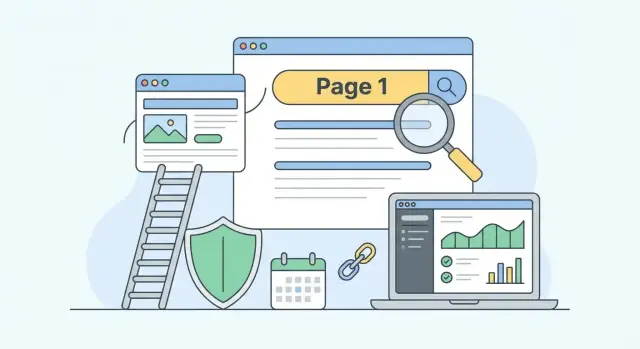
Reaching page one feels like the finish line. It’s really more like getting a booth in a busy market where everyone can see you, including competitors who want your spot.
Search results move even when your site doesn’t. Search intent shifts. New questions show up. A page that used to match what people wanted can slowly drift out of sync. Meanwhile, competitors publish fresher content, add clearer proof, and earn new mentions across the web. If your page stays untouched for months, it can start to look older and less complete, even when the core info is still mostly right.
Once competitors notice you ranking, they rarely ignore it. A common pattern: they make the page more practical (new screenshots, FAQs, pricing notes, clearer steps), then add a few relevant links to push it past you. Some also create supporting articles that target related searches and internally link back to the main page, strengthening the whole topic.
You can’t control what others do. You can control three levers that help protect your spot:
- Content: keep the page accurate, current, and more helpful than alternatives.
- Links: add new, high-quality references when it makes sense.
- Monitoring: spot dips early so small problems don’t turn into big ones.
Think in months, not days. A one-week wobble is often noise. A slow decline over 6 to 8 weeks usually signals that the page is aging, competitors improved, or something technical changed. Treat page-one rankings like a garden: small, regular care beats occasional emergency fixes.
Choose what you’re actually trying to protect
Page one is not one “thing.” You usually have a mix of rankings that behave differently. If you try to defend everything, you’ll end up reacting to noise.
Start by choosing the exact pages and queries that matter most to the business. For most sites, that’s a small set: pages that reliably drive sales, sign-ups, or qualified calls.
Brand terms and non-brand terms need different expectations. Brand terms (your company name, product name, branded reviews) are often easier to hold unless something breaks or your reputation changes. Non-brand terms (like “best accounting software” or “emergency plumber near me”) are where competitors keep pushing, so they need the most attention if your goal is to maintain page one rankings.
Intent matters too:
- Informational pages can stay strong with light refreshes when facts, examples, or dates change.
- Commercial pages need upkeep that matches buyer questions: pricing clarity, trust signals, comparisons, and proof the offer is current.
Define what you’re defending with a simple scope:
- One target page and 3 to 10 primary queries it should rank for
- A split between brand vs non-brand targets
- A label for intent: informational or commercial
- A success metric: position range, clicks, or conversions
- An alert point that defines “slipping” (for example, falling from positions 3 to 5 down to 8 to 12)
Example: if your pricing page ranks #4 for a non-brand query and drives demos, success might be “stay top 5 and keep demo requests steady.” For a blog guide, success could be “stay top 10 and hold steady organic clicks.” That clarity makes every later refresh, link, and monitoring check feel purposeful.
Set a baseline before you change anything
Don’t start by “fixing” things. Start by writing down what “good” looks like today. Without a baseline, you can’t tell whether a change helped, hurt, or did nothing.
Make a simple inventory of what you’re protecting. For each page-one URL, write down the main query it’s meant to rank for (plus 1 to 2 close variations). Then capture the numbers that matter to your business, not just positions.
For each priority page, record:
- Current rank for the target query
- Clicks from organic search (last 28 to 30 days)
- Conversions tied to that page (leads, trials, sales, sign-ups)
- The top 3 competing pages that also rank for that query
- What the results page looks like today (ads, map pack, featured snippet, “People also ask,” video results)
Competitors matter because rankings often drop when someone else improves, not because you broke something. Skim the top competing pages and note what they do better: fresher examples, clearer answers, stronger visuals, better internal linking, or a stronger backlink profile.
Also capture the current search results layout. If a featured snippet appears, you may need to defend your visibility differently than if results are buried under ads and rich elements.
Example: if your pricing page ranks #3 and drives most sign-ups, it’s higher priority than a blog post ranking #1 with low conversions. When you later refresh content or add a few selective links, you’ll be able to measure impact against a clean baseline instead of guessing.
Content refreshes that keep you relevant
Freshness isn’t about changing a few words each month. It’s about making sure the page still deserves its spot on page one today.
You can often spot a page that needs attention by looking for simple signals: the “last updated” date is old, examples mention tools or rules that changed, impressions stay stable but clicks fall, or the query starts sending different kinds of questions (you’ll see this in competitor headings and sections).
Refresh without rewriting the whole page
Treat your content like a house. You rarely rebuild it. You fix the rooms people use most.
Start with what readers see first, then work down:
- Update outdated stats, prices, rules, and dates.
- Add a short FAQ based on real questions now showing up in search results.
- Replace old screenshots and steps that no longer match the interface.
- Expand one thin section competitors cover better (often “cost,” “how long it takes,” or “common mistakes”).
- Remove or shorten parts that don’t help the main question.
Match the intent, not just the keyword
If the page targets a “how to” query, people expect steps, time estimates, and a clear outcome. If it targets a “best” query, they expect comparisons and quick pros and cons. Small changes that better match intent often do more than adding extra paragraphs.
Be careful with titles and meta descriptions. Keep the core promise, then test small tweaks like a clearer benefit or a current year. Big changes can hurt click-through rate, which makes it harder to maintain page one rankings.
Example: if your “SEO maintenance plan” post starts losing clicks, keep the main headline, update the first 100 words, add a few new FAQs, and replace outdated tactics with what works now. That’s often enough to recover momentum without starting over.
A refresh schedule you can actually follow
If you try to update everything, you’ll update nothing. Start with a small set of pages that truly matter: pages that bring in leads, sales, bookings, or help people decide (pricing, comparisons, key product pages).
Protect your money pages first, then the pages that support them. A blog post might not convert on its own, but it can feed steady traffic into a service page.
A cadence most teams can keep:
- Monthly (30 to 45 minutes): quick checks on top pages and their main keywords
- Quarterly (half-day): a focused refresh on the top 5 to 10 pages that drive revenue or assist conversions
- Twice a year (1 day): review your top set and swap in pages that have become important
Monthly checks are about catching small issues early, not rewriting. Quarterly refreshes are where most gains happen: new examples, clearer wording, and better alignment with what people search for now.
Use the same mini-checklist each time:
- Facts and numbers are current (dates, pricing, tools, screenshots)
- Examples are current (add one good new scenario, remove outdated ones)
- Headings and claims match what the page actually delivers
- The page still matches the intent behind the query
- Leave working sections alone (if a section drives clicks or conversions, don’t “improve” it without a reason)
Avoid changing URLs, page titles, or the first paragraph unless you have a clear reason. Small, steady edits create less risk than big rewrites.
Selective new links: when and how to add them
Links help most when your content is already strong but needs extra trust to stay ahead. Think of links as planned reinforcements, not a panic button.
When to add links
Add links when there’s a clear reason. Common signals:
- A competitor jumps above you with similar content
- You slide from positions 1 to 3 down to 4 to 10 (or keep bouncing)
- The query gets more competitive (new brands, new results features)
- You refreshed the page and want it to be re-evaluated faster
- Your page is strong, but your domain looks weaker than the sites outranking you
How to be selective (and keep things steady)
Quality and relevance matter more than volume. One strong placement from an authoritative, relevant site can beat a pile of random mentions. Pace matters too. Steady, small additions tend to look more natural and keep performance more stable than sudden bursts.
To keep it practical, spread link targets across what drives results:
- Your homepage (brand authority and overall trust)
- A key service or category page (the money page)
- Your best supporting content (guides that feed internal links)
- A newer page that’s close to page one and needs a nudge
Set a limit you can stick to, then watch how rankings respond before adding more. For many sites, 1 to 3 new quality links per month across the whole site is a reasonable starting point.
Example: you run a local IT service site and your “managed IT services” page slips from #3 to #7 after two competitors publish updated pages. Refresh your page first. If the content now matches intent and competitors still outrank you on authority, add one relevant high-authority link to that service page and one to your strongest guide that internally links to it.
Monitoring that catches problems early
The fastest way to lose a win is to stop watching it. You don’t need constant dashboards, but you do need a light routine that catches real drops early.
What to check weekly vs monthly
Weekly checks focus on early signals:
- Rankings for priority keywords (especially page-one terms)
- Clicks and impressions for those pages
- CTR changes (snippet changes can hurt fast)
- Conversions or leads from those pages (even if rankings look fine)
Monthly checks can be broader. Compare month-over-month trends, review which pages gained or lost impressions, and confirm the pages still match what searchers want.
Watch competitors and results page changes
Sometimes the issue isn’t your site. A competitor may publish a fresher guide, add a comparison table, or gain links. The results page itself can also change: featured snippets, “People also ask,” map packs, videos, and ads can push your listing down even if your position number looks similar.
When a key page drops, open the top results and note what changed in the top 5. Are titles more specific? Are there more “best” lists? Did competitors add new sections, tables, or fresher dates?
Set alert thresholds and keep a change log
Alerts keep you from checking rankings all day. Choose thresholds that matter to you:
- A priority keyword drops 3+ positions for 7 days
- Organic clicks to a top page drop 20% week over week
- CTR drops 15% after a title or meta change
- Conversions drop 10% while traffic stays flat
Keep a simple change log (a spreadsheet is fine): date, page, what changed, and why. It’s the fastest way to connect cause and effect later.
Step-by-step: what to do when rankings start slipping
Rank drops feel urgent, but rushing often makes things worse. Treat it like troubleshooting: measure the drop, find the likely cause, make one clear change, then wait long enough to judge the result.
A simple triage flow
- Step 1: Pinpoint the loss. Identify the exact page and query (or close group) that slipped, and how far. Position 3 to 9 is a different problem than 3 to 30. Check traffic and conversions too, not just rank.
- Step 2: Diagnose the most likely cause. Compare your page to what’s now ranking. Look for intent shifts, competitor updates, results page feature changes, or a clear link gap.
- Step 3: Choose one action. Pick the smallest move that matches the cause: a focused content refresh, a snippet improvement (title and opening), better internal links, or selective new links if authority is the gap.
- Step 4: Re-check in 2 to 4 weeks and document the outcome. Track the original keyword plus a few close variations. Write down what you changed and the before-and-after positions.
Example: a pricing page drops from #4 to #11 after competitors add pricing tables and FAQs. The best first move is usually a refresh that adds clear packages, answers objections, and updates details, not a site-wide rewrite or a burst of links.
Common mistakes that quietly cause ranking drops
The easiest way to lose a page-one spot is to “improve” a page without protecting what already works. Big rewrites can remove terms people were searching for, change structure, or delete the sections that answered the question best.
Another quiet problem is reacting to every tiny movement. Rankings bounce day to day. Without a baseline (your normal range for position, traffic, and conversions), it’s easy to make changes that fix nothing and create new issues.
Mistakes that show up often:
- Large refreshes across many pages at once, so you can’t tell what helped or hurt.
- Tweaking based on small rank changes instead of waiting for a clear trend and checking clicks and traffic.
- Pointing new links to the wrong page (for example, the homepage instead of the page that ranks).
- Ignoring CTR. If the title and snippet stop earning clicks, rankings can slide even if the content is fine.
- Not watching competitors. A few smart updates and a couple of strong links can edge you out before you notice.
A quick example: a software company updates a high-ranking guide by removing a comparison table and softening the title to sound “brand safe.” The page still ranks for a week, but clicks drop because the snippet is less clear. At the same time, a competitor adds a fresh 2026 section and earns a couple of relevant links to that exact page. The drop isn’t a mystery. It’s a click problem plus fresher competition.
Quick checklist for ongoing SEO maintenance
A simple routine beats constant tweaking. The goal is to keep your best pages accurate, trusted, and problem-free while competitors keep publishing.
Run these checks monthly, then do a deeper pass quarterly:
- Refresh top pages every 90 to 180 days (update key facts, add one useful section, confirm intent still matches).
- Check “trust” sections for staleness (pricing, screenshots, step-by-step instructions, dates, product names).
- Watch stability for priority queries (clicks and impressions matter as much as position).
- Keep a small, steady link plan for your most competitive pages (only where the page is already strong but fighting tough rivals).
- Keep alerts on and maintain a change log (title edits, section changes, internal linking, technical fixes).
Example: if your “best product” page hasn’t been updated in six months and clicks dipped last week, start by updating comparisons and screenshots. Then confirm it’s indexed and technically healthy. Only then consider adding a new link if competitors are gaining authority.
Example maintenance plan and next steps
Imagine a local service business (an HVAC company) that reaches page one for three money keywords: “AC repair [city],” “furnace installation [city],” and “emergency HVAC [city].” The goal is to maintain page one rankings without turning SEO into a full-time job.
They set a light routine: monthly monitoring and quarterly refreshes. Each month, they check rankings, clicks, and which pages are pulling leads. Each quarter, they update the three landing pages so they stay accurate and competitive (pricing ranges, service areas, FAQs based on real calls, clearer before-and-after examples).
A link push isn’t automatic. It’s triggered by signals that usually show up before a drop hurts revenue:
- A new competitor appears on page one and stays there for 2 to 3 weeks
- You lose featured snippet or “People also ask” visibility you used to have
- CTR slides even though rankings look similar
- A key page stops earning impressions (search engines test other pages instead)
When a trigger hits, they add a small, selective batch of new links pointing to the exact page that’s slipping.
If you want predictable access to high-authority placements without extended outreach cycles, a service like SEOBoosty (seoboosty.com) is designed around curated backlink inventory and subscription-based link building. Used selectively for high-value pages, it can fit neatly into link building maintenance alongside regular content refreshes.
Here’s a simple 30-day plan to lock in the habit:
- Week 1: Write down your three keywords, their target pages, and current rankings and CTR.
- Week 2: Refresh one page (update sections, tighten the headline, add a few FAQs).
- Week 3: Refresh the second page, and test a small title/meta update for the first.
- Week 4: Review changes in Search Console and decide: no action, small on-page tweaks, or a targeted link push for one page.
FAQ
Why do I lose page-one rankings even when I didn’t change anything?
Page-one rankings are a moving target because search intent shifts, the results page layout changes, and competitors keep improving. Even if your site stays the same, Google may test newer pages, prioritize fresher details, or reward pages with stronger proof and recent mentions.
How do I decide which rankings are worth protecting?
Start by picking a small set of pages and queries that directly impact revenue or qualified leads. Write down the target page, 3–10 main queries, whether they’re brand or non-brand, the intent (informational or commercial), and what “slipping” means for you in positions, clicks, or conversions.
What should I track before I start updating a page?
Capture a baseline first so you can measure change without guessing. Record current rankings, organic clicks from the last 28–30 days, conversions tied to the page, the top competing pages, and what the search results page looks like right now (ads, snippets, “People also ask,” maps).
What’s the fastest content refresh that actually helps maintain rankings?
Refresh the parts people rely on most: the opening, key steps, pricing or dates, screenshots, and any thin sections competitors cover better. Keep the main promise of the page the same, and aim to match what searchers want today rather than adding extra text everywhere.
How often should I refresh pages to keep rankings stable?
A practical rhythm is light monthly checks, focused quarterly refreshes on your top pages, and a broader review twice a year to update your priorities. Consistency matters more than big overhauls, because small updates reduce the risk of breaking what already works.
What does it mean if my impressions are steady but my clicks drop?
If impressions stay similar but clicks fall, your snippet may be less appealing or the results page may have changed. Start by reviewing the titles and meta descriptions ranking above you and then make a small, clear improvement to your title and opening lines without changing the page’s core topic.
When should I add new backlinks to defend a page-one spot?
Add links when the page is already strong but is getting edged out on authority, such as when a competitor with similar content jumps above you or you drift from top 3 into positions 4–12. One or two highly relevant, high-quality placements can be more effective than many weak mentions.
How do I add links without causing volatility?
Build a small, steady plan and point links to the exact page you’re trying to rank, not just your homepage. Spread effort across your money pages and the supporting content that internally links to them, and avoid sudden bursts that make it hard to tell what actually helped.
What alert thresholds should I set for ranking drops?
Use simple thresholds so you react to trends, not daily noise. A good starting point is a sustained position drop for about a week, a meaningful click decline week over week, a CTR drop after a snippet change, or conversions falling while traffic stays flat.
Should I refresh content first or build links first when rankings slip?
Start by refreshing the page so it better matches intent and answers buyer questions, then add selective links only if authority is the clear gap. If you want predictable access to high-authority placements without outreach, a service like SEOBoosty can be used selectively for your highest-value pages as part of maintenance.
Share