Niche sites vs authority sites: how to choose confidently
Niche sites vs authority sites: use a simple decision matrix to choose based on topical fit, trust signals, and the keyword you want to rank.
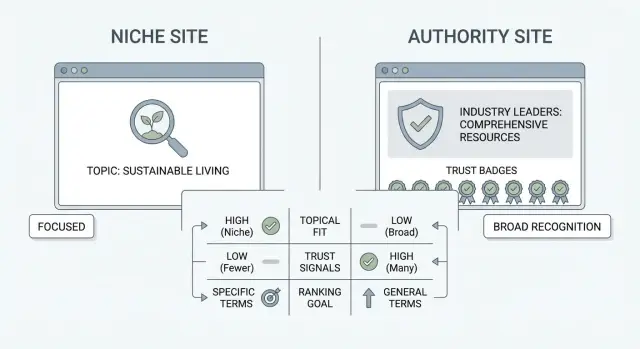
What you are really choosing between
The real question behind niche sites vs authority sites is simple: should your backlink come from a site that lives and breathes your exact topic, or from a widely known site that covers a lot of topics?
A niche site stays focused. It might publish only about email marketing, home workouts, or SaaS finance. The audience is narrower, and the content tends to cluster around one theme.
A general authority site is broader. Think large publications, big company blogs, or established industry outlets that publish across many categories. One article might sit next to content on completely different subjects.
Both can help, but they usually help in different ways:
- Niche sites often win on topical fit. A link feels natural because the surrounding content and audience match.
- Authority sites often win on trust. They tend to have stronger reputations, stricter editorial standards, and more people citing them.
There isn’t a single best choice for every keyword. The right pick depends on what you’re trying to rank, what kind of page it is, and what your site already has. A newer site often needs trust first. A more established site may benefit more from tighter topical reinforcement.
Start with what you are trying to rank
Before comparing site types, get clear on the page you want to move. Links work best when they match the purpose of the target page and the kind of query you’re going after.
Most target pages fall into a few buckets: homepages and category pages, product or service pages, blog posts, and local pages.
Then ask one practical question: how competitive is the keyword?
- Competitive, broad terms (category-level phrases, popular products) usually need stronger trust signals and more link equity over time.
- Specific, narrow terms (long-tail queries, niche questions, local intent) can often move with fewer links if the page already matches search intent.
Speed vs compounding matters too. If you need movement quickly for a new page or time-sensitive offer, you usually want links from sources search engines already treat as highly credible. If you’re building a long-term theme, topical relevance compounds: a steady pattern of closely related links can make it easier to rank multiple pages in the same cluster later.
Example: if you’re trying to rank a new product page for “CRM for dentists,” a handful of relevant links from dental and practice-management sites can make the page look like it belongs in that niche. But if you’re also aiming for something broad like “CRM software,” you’ll likely need more widely trusted sites in the mix.
A simple rule of thumb:
- For broad category and homepage terms, lean more toward trust.
- For narrow product pages and specialized queries, lean more toward topical fit.
- For blog posts, match the exact question being answered.
- For local pages, combine local relevance with credible, established sites.
Topical fit: how close is close enough?
Topical fit is how naturally a linking site matches what your page is about. Not just the same broad industry, but the same subtopic and the same kind of reader.
A quick way to judge fit is to check three layers:
- Same industry (marketing, finance, health, SaaS, travel)
- Same subtopic (email deliverability vs general marketing, retirement taxes vs general finance)
- Same audience intent (beginners learning basics vs pros comparing tools)
Strong alignment looks like a cybersecurity blog referencing a guide on password managers, or a running publication citing a marathon training plan. Weak alignment looks like a pet care blog linking to “best CRM software” with a thin excuse. Even if the site looks “good,” that kind of mismatch can feel like a paid placement.
Topical fit matters most when you’re targeting specialized queries, operating in money/health/safety/legal-adjacent topics, or trying to establish credibility quickly.
Watch out for forced relevance. A simple test: if you removed the link, would the paragraph still feel complete and useful? If yes, the link probably wasn’t doing much for the reader.
Trust signals: what makes a site feel credible
Trust signals are the cues that tell Google (and humans) a website is real, careful, and worth listening to. For some searches, trust matters more than perfect relevance.
You can often sense trust without any tools. The writing is consistent, pages look maintained, and the site has a clear point of view. You also see “grown over time” signals: older articles, a stable brand, and references from other respected sources.
Common trust signals include recognizable brands, clear editorial standards, consistent authorship, a real publishing history, and citations that make sense for the topic.
Trust can outweigh relevance on higher-stakes queries: medical advice, financial guidance, security topics, and a lot of “best” and “reviews” searches. In those cases, search engines often prefer sources that feel safe and established, even if they’re slightly broader than your exact niche.
One warning: “looks big” isn’t the same as real authority. Some sites fake it with flashy design and endless guest posts. Real authority tends to show restraint: fewer better pages, consistent quality, and a reputation that existed before SEO.
Link strength: thinking beyond “DA”
Domain metrics are shortcuts. They can hint at how trusted a site might be, but they don’t tell you how much ranking power a specific placement will pass.
Think of link equity as the amount of “push” a link can give your page. That push depends on where the link sits, how discoverable the page is, and how clearly the context relates to what you’re trying to rank.
One strong placement can beat a pile of weak ones. An in-body link in a real article that gets steady attention, appears near the top, and reads naturally often outperforms many low-quality placements.
What actually makes a link strong
Look past the domain name and evaluate the placement:
- Page quality: the page looks maintained and genuinely useful.
- Placement: in-body links usually matter more than footers or author bios.
- Context: the surrounding text clearly matches your topic.
- Indexing and reach: the page is discoverable, not buried.
- Outbound clutter: fewer, more relevant outbound links is usually a better sign.
More links aren’t always better. You can hit diminishing returns if you keep buying the same type of placement, or if you point too many similar links at one URL too quickly. Over-concentration can also look unnatural, especially if anchor text repeats.
A simple decision matrix you can actually use
When you’re stuck, score each option on two things only: topical fit and trust.
Topical fit asks: “Will real readers and search engines see this as a natural reference for the page I want to rank?”
Trust asks: “Does this site look real, consistent, and respected?”
| High trust | Low trust | |
|---|---|---|
| High topical fit | Best-case: a primary link that reinforces relevance and looks credible. | Proceed carefully: only consider it if the site clearly has real standards and history. |
| Low topical fit | Support role: can build broader authority, but won’t usually move a tightly focused keyword by itself. | Skip: it adds risk without a clear upside. |
If two options land in the same quadrant, use one tie-breaker: pick the site most likely to send a qualified reader to your page (the “would someone actually click this?” test).
Keep your checks lightweight. You don’t need 20 metrics, but you do want a few clear signs before you pay for a placement:
- The site covers the topic regularly, not as a one-off.
- Authors and branding look consistent across multiple posts.
- Recent content exists and fits the site’s theme.
- Outbound links look selective, not like a directory.
Step-by-step: choose the right sites for one keyword
Most bad link buys happen when people shop for “strong sites” without deciding what the link is supposed to prove. Make the decision around one page and one keyword.
-
Write down the exact page and the exact keyword. Add one line about intent: “This page should rank for X, and the searcher wants Y.”
-
Look at a few pages already ranking. Open 3 to 5 competitors and note the types of sites that mention them. Are the citations mostly niche sources, broad publications, or a mix?
-
Score your options (1 to 5 each). Rate topical fit and trust. Fit is “Would a reader expect this site to mention my page?” Trust is “Does this look careful and real?”
-
Match the anchor and context to the page. A guide can support anchors like “how to” or “checklist.” A product page often does better with brand or partial-match phrasing. The sentence around the link matters as much as the clickable words.
-
Plan a small mix instead of an all-in bet. A common starting point is 2 to 4 links split across one or two strong niche placements and one higher-trust placement.
Example: for a “B2B onboarding checklist” page, one link from an HR operations blog (high fit) plus one from a well-known business publication (high trust) is often stronger than buying four random “high metric” links.
Common traps that waste money and time
Most wasted budget comes from two habits: choosing by reputation alone, or rushing and hoping the numbers work out.
Five mistakes that quietly ruin results
- Buying “famous” placements that don’t match your topic. Big sites can help overall trust, but off-topic mentions often don’t move the page you care about.
- Going too narrow and ignoring trust. Some niche blogs have weak standards or thin content. If a site looks like it exists only to place links, the value can be discounted.
- Sending your strongest links to the wrong page. If the goal is a product page or a guide, it usually needs direct support. Don’t default everything to the homepage.
- Repeating the same anchor style. Exact-match repetition can look unnatural. Mix brand, partial-match, and natural phrasing.
- Ignoring placement context. The page and paragraph matter as much as the domain. A link buried in a messy list of unrelated tools often underperforms.
A reality check: if you’re trying to rank “accounting software for freelancers,” a link from a general tech site can help, but it works best inside a clearly relevant article, not “top apps of the year.”
Example scenario: picking links for a real page
A SaaS company sells an analytics tool for Shopify stores. They want to rank a feature page for the mid-competition keyword “Shopify cohort analysis.” They have budget for one strong placement now, and possibly a second next month.
They’re choosing between a niche ecommerce analytics blog and a major tech publication.
Two link options
Option A: Niche industry blog A well-known ecommerce analytics blog that regularly publishes Shopify reporting tutorials and tool comparisons.
Option B: Major tech publication A big, widely trusted tech site that covers SaaS and product news, but not Shopify analytics every week.
Score both (1 to 5):
| Factor | Option A (Niche) | Option B (Authority) |
|---|---|---|
| Topical fit with the exact page | 5 | 3 |
| Trust signals (brand, editorial standards) | 3 | 5 |
| Likely link impact (real strength, not just metrics) | 3 | 5 |
| Audience match (readers who might click and try it) | 5 | 2 |
If you can only buy one link, Option B often wins on raw trust, especially if your site is newer. If you can do two over 4 to 6 weeks, the mix is usually better: take the authority placement for trust, then the niche placement to reinforce relevance and attract the right readers.
Where the link should point (and what success looks like)
Point the link to the specific feature page targeting “Shopify cohort analysis,” not the homepage. Make sure the page explains the feature clearly, includes examples, and connects to one supporting guide with internal links.
Success rarely looks like a next-day jump. A good outcome after a few weeks is: impressions rise in Search Console, average position improves by a few spots, and the page starts ranking for close variants like “cohort analysis Shopify app.”
If nothing moves after a few weeks, check three things: confirm the linking page is indexed, improve the feature page with clearer examples and comparisons, and add one more supporting link (either another niche placement or a second authority-style placement).
Quick checklist and practical next steps
If you’re stuck choosing between niche and authority links, do a quick scan of each site you’re considering. You’re not just buying a link. You’re borrowing context, trust, and attention.
Quick checks before you pick a site
- Topical match: would a real reader care, or is it a stretch?
- Consistency: do they publish related topics often?
- Editorial quality: does the writing feel specific and maintained?
- Placement context: can your mention sit naturally inside a useful paragraph?
- Patterns: watch for repeated layouts, boilerplate bios, or obvious networks.
A simple trick: open five recent posts. If you can’t describe who the site is for and what it consistently covers, search engines will struggle to place it too.
Practical next steps
Build a small plan tied to your goal:
- Pick one target page and one main query.
- Add a couple of niche-relevant placements that clearly support the page’s topic.
- Add one or two higher-trust placements to strengthen credibility.
- Vary the wording and context so each mention looks like it belongs.
- Recheck after 3 to 4 weeks: did the main query move, and did related queries lift too?
If you want to avoid outreach and still get access to hard-to-land placements, SEOBoosty (seoboosty.com) offers a curated inventory of authoritative sites where you can subscribe to a domain and point a backlink to your page. The decision matrix above still applies: choose placements for fit and trust, not a single score.
FAQ
Should I choose a niche site or an authority site for my next backlink?
Start by naming the exact page and keyword you want to move. If the keyword is broad and competitive (homepages, category terms), prioritize trust from widely recognized, carefully maintained sites. If the keyword is narrow and specialized (long-tail, niche product terms), prioritize topical fit so the link looks like a natural citation for that exact topic.
What’s better for a brand-new website: niche links or authority links?
Lean toward higher-trust authority placements first. Newer sites often need credibility signals before relevance can fully compound, especially on competitive queries. After you’ve secured a baseline of trust, add niche links to reinforce a tight topic cluster around the pages you care about most.
What type of link helps a product or service page rank faster?
Most product and feature pages respond well to niche-relevant links because the context can match the buyer’s intent and the exact use case. The best outcome is a niche site that regularly covers your subtopic and can mention your page without stretching the story. If you can afford only one placement and the market is highly competitive, a trusted authority site can still help, but relevance in the surrounding article becomes critical.
For blog posts, should I aim for niche sites or big publications?
Match the linking page to the exact question your post answers. A niche site is often ideal because the audience and content are already in the same lane, which makes the reference feel natural. An authority site can work well when the post targets a broader “best,” “reviews,” or high-stakes query where search engines expect more established sources.
How do I judge topical fit quickly without overthinking it?
Check three layers: same industry, same subtopic, and same audience intent. A site that only matches the broad industry can be “close,” but the strongest links usually match the subtopic and the reader’s level (beginner vs advanced). If the mention would still read fine with the link removed, the fit is probably weak.
What are the simplest trust signals to look for on a site?
Look for signs the site is real and maintained: consistent writing quality, a clear editorial voice, stable authorship, and a publishing history that looks like it grew over time. Trust is also about restraint; sites that publish endless thin posts with random outbound links can look less credible even if they appear “big.” When the topic affects money, health, safety, or security, trust usually matters more.
What actually makes one backlink stronger than another?
Don’t stop at domain metrics. A strong link is usually an in-body mention within a useful article that’s easy to discover, clearly relevant to your page, and not surrounded by a cluttered list of unrelated outbound links. One well-placed link in a solid context can outperform multiple weak placements.
How should I choose anchor text for niche vs authority links?
Use anchors that match the page type and read naturally in the sentence. For product pages, brand or partial-match phrasing is usually safer and often more effective than repeating exact-match keywords. For guides, descriptive anchors that match the question can work well, but keep variety across placements so your backlink profile doesn’t look repetitive.
Is it smarter to buy one big authority link or a mix of links?
A simple default is a small mix: one placement chosen mainly for trust and one chosen mainly for topical fit, spaced out over a few weeks. This approach reduces the risk of betting everything on one signal and helps both credibility and relevance. Keep the plan tied to one page and one keyword so you can measure what worked.
How do I know if the link worked, and what should I do if nothing changes?
Give it a few weeks, then look for practical signals: more impressions for the target query, improved average position, and new rankings for close variants. If nothing moves, first confirm the linking page is indexed, then strengthen the target page with clearer examples and intent match, and only then consider adding another supporting link. Avoid “panic buying” multiple similar placements too quickly.
Share