PR mention vs editorial backlink: speed, control, risk
PR mention vs editorial backlink explained with a clear comparison of speed, control, and risk, plus when a vetted paid editorial placement is smarter.
The real problem: mentions are not the same as links
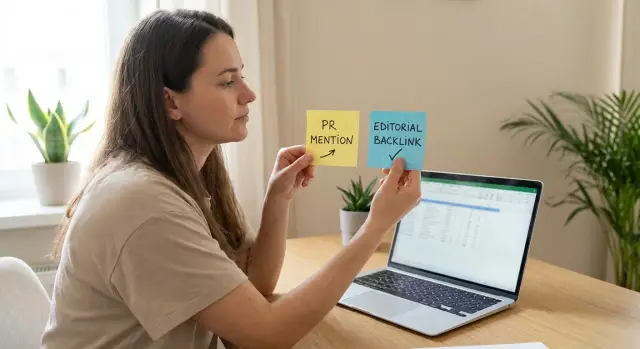
Most people want the same outcome: credibility that also helps SEO. A brand mention can signal you matter. An editorial backlink is a signal search engines can count.
The confusion usually starts after a PR win. You see your name in an article and expect rankings to move, then you notice there’s no clickable link. Or the link points to the wrong page. Or it’s marked “nofollow.” The coverage is real, but the SEO impact is smaller than you expected.
A mention is simply your name being referenced. It can build trust with readers and sometimes drive direct traffic if people search for you afterward. A backlink is different: a publisher links to a specific page on your site inside the editorial content. That’s why the difference isn’t word choice. It changes what you can realistically expect.
Three things decide whether your effort pays off: speed (how long it takes to go live), control (what you can influence), and risk (what can backfire).
Quick definitions (no jargon)
A PR mention is when your brand, product, or founder gets named in press coverage. It might be a quote, a line in a roundup, or a “Company X announced…” paragraph. The key detail: the writer is talking about you, but they might not link to you.
An editorial backlink is a clickable link to your site placed inside a real article where it makes sense for the reader. It usually points to a page the author believes supports a claim, adds context, or provides a source.
Backlinks are often described in two basic types:
- Dofollow: the link can pass SEO value and help pages rank.
- Nofollow: the link typically doesn’t pass the same SEO value (it can still send real people to your site).
PR coverage sometimes includes a link, but it’s not guaranteed. Many outlets avoid linking, link only to a homepage, or use nofollow by default. PR is strong for credibility and awareness, but unreliable if your main goal is consistent SEO lift.
Speed: how long each approach usually takes
PR is usually slower because it runs on someone else’s schedule. A journalist has to like the story, fit it into their calendar, and get it through edits. Even when they respond quickly, your pitch competes with breaking news and internal priorities.
A realistic expectation: you might hear back in days, but publication is often weeks away. Sometimes it becomes months. Sometimes it never happens. That isn’t always a reflection on your story. PR is unpredictable by nature.
Editorial backlink placements can be faster when there’s a clear process and an available slot. You’re not waiting to be discovered at the perfect moment; you’re working within a queue.
A practical range to plan around:
- PR pitching: a few weeks to a few months, with a real chance of no placement.
- Editorial placement: a few days to a few weeks, depending on the publisher’s schedule and your turnaround time.
Example: a SaaS company launches a feature in three weeks. PR might land a great write-up, but timing is risky. If the editor delays, the launch window passes. If you need something live on a deadline, predictability matters as much as exposure.
Control: what you can and cannot influence
The most noticeable day-to-day difference is control. Not in a shady way, just in basic predictability: what gets published, where it appears, and what it points to.
With PR, you can pitch an angle, offer quotes, and provide useful material. After that, the story belongs to the journalist. They decide the framing, who else gets included, and whether your brand gets a link at all. Even if you get a link, it may go to your homepage instead of the page you care about.
With editorial backlink placements, you typically have more control over the mechanics that matter for SEO: the target site, the destination URL, and the general topic. You still shouldn’t expect to control every word, but you can avoid the common outcome of “great coverage, zero link value.”
What you can influence (and what you cannot)
- PR mention: you can influence the pitch, the facts you provide, and the timing of your outreach. You can’t control the headline, final edits, whether a link is included, or which page they choose to link to.
- Editorial placement: you can often choose the target domain and the destination URL. You may be able to request a natural anchor, but total wording control is unrealistic.
Anchor text is just the clickable words. The goal is simple: keep it natural and relevant to the page you’re linking to. Overly salesy or overly exact anchors can look forced and increase risk.
The control tradeoff: standards need to be higher
More control is useful, but it also raises the bar. If you can choose the site and link details, you need to be picky: real editorial pages, real audiences, and context that fits your brand.
If you’re launching a product page next week, an editorial placement lets you point the link directly to that page with sensible context. With PR, you might get a mention quickly, but it could be brand-only, no link, or the wrong destination.
Risk: what can go wrong (SEO and brand)
A common risk with PR is simple: you can do everything right and still get no SEO value. PR is built for stories, not for passing ranking signals.
Typical PR outcomes include a mention without a link, a nofollow link, or a link to an unhelpful destination (homepage, social profile, generic about page). You can also get coverage that’s only loosely related to what you sell. That can be great for awareness, but weak for search intent.
Paid editorial placements change the risk profile. You often get more predictability, but quality matters more than ever. If a site is low-quality, stuffed with sponsor-heavy content, or unrelated to your topic, the link can look unnatural. At best, you waste money. At worst, you create SEO risk if your link pattern looks manipulative.
The reputational risk people miss
There’s also brand risk. A quote inside real reporting looks earned. A paid placement can feel like an ad if it appears on a page that reads like a brochure, sits inside a “best tools” list with no substance, or screams sponsor cues.
The goal isn’t to hide anything. It’s to avoid placements that feel fake or out of place.
A simple rule that reduces both risks
If you pay for an editorial placement, treat it like borrowing the publisher’s trust. Only do it when the site and the page are a clear match for your topic and audience.
A quick filter before you commit:
- Relevance: would this site plausibly cover your industry even without payment?
- Editorial fit: does the page look like a real article, not a thin directory?
- Reputation: would you feel comfortable showing the placement to a customer or investor?
How to choose: a simple decision path
The fastest way to decide is to start with what you need most right now: trust, rankings, clicks, or a mix.
-
Name the primary goal. If you want credibility and broad awareness, PR is usually the better tool. If you need measurable SEO lift for a specific page, an editorial link is more direct.
-
Set your timeline. If you have a launch next month or a quarterly traffic target, ask if you can afford “maybe.” PR can take weeks or months and still end in silence. Editorial placements are often chosen when you need a predictable outcome.
-
Decide how much control you need. With PR, you don’t control the angle, the link, or the destination page. With editorial placements, you can often point a link at the page that matters (product page, comparison page, guide).
-
Set your quality bar. The biggest risk isn’t “paid vs unpaid.” It’s ending up on the wrong site or in the wrong context.
-
Mix them when it fits. PR can build trust and brand signals that are hard to buy. Editorial links can support specific pages when you need consistent SEO progress.
Example: a B2B startup needs leads for a demo page before an event in six weeks. PR might land after the event, and even then it might mention the founder without linking. In that case, one or two high-quality editorial placements to the demo page can make sense, while PR runs in parallel as a longer-term credibility play.
Effort and cost: what you’re really paying for
Cost is rarely just the invoice. You also pay with time, attention, and what you postpone while you wait.
The real cost of PR (even when it’s “free”)
PR can be excellent for credibility, relationships, and brand search. The hidden cost shows up in the work and the waiting: tailoring angles for different outlets, back-and-forth edits and fact checks, and long lead times that don’t match product launches or quarterly goals. Even if you hire help, your team still has to provide data, quotes, and fast approvals.
The real cost of editorial backlink placement
With editorial placements, you usually pay more upfront, but you’re buying clarity: what site, what page, and what happens next. The money only makes sense when the placement is truly vetted and the context reads like normal editorial content.
Opportunity cost: what you give up while you wait
Chasing press can quietly delay other work: improving core pages, shipping product updates, or running conversion tests that could lift revenue sooner.
A practical approach for many teams is to keep a steady PR baseline for brand and credibility, then add a small number of high-impact editorial links when you need to support specific pages on a deadline.
Example scenario: choosing under a real deadline
A small SaaS launches a new feature in six weeks. The team wants search traffic for a handful of high-intent queries within 60 to 90 days. Competitors already have strong pages and strong links.
What PR might look like in that window: they pitch a story to reporters, maybe with original data or a customer trend. They may get a reply, they may not. If a story runs, it might include the brand and a quote, but no clickable link. Even when a link is included, it might point to the homepage, not the feature page that needs to rank.
What an editorial placement might look like: they secure a placement on a relevant site, point the link to the feature page, and use a natural anchor. The tradeoff is straightforward: you’re paying for certainty and control, so quality standards have to be strict.
A balanced plan under a deadline often looks like this:
- Run one PR angle for trust and brand awareness.
- Add a small set of vetted editorial backlinks to the feature page and one supporting guide.
- Keep messaging consistent so mentions and links reinforce the same topic.
Common mistakes that waste time or create risk
A lot of frustration comes from one assumption: that a press hit automatically helps SEO. Many mentions never include a clickable link, and even when they do, it may be nofollow or pointed somewhere that doesn’t support your goal.
Mistake 1: Treating any mention as “link building”
A journalist may mention your brand without linking, or link to a social profile, an app store page, or a third-party review. That can still be useful for trust, but it’s not the same as earning an SEO-relevant backlink.
If the goal is rankings, set expectations early: PR is a brand win first. A link is a bonus, not a guarantee.
Mistake 2: Paying for placements without checking quality
Buying an “editorial placement” without looking closely at where it will live is the fastest way to waste money and invite long-term problems.
Before you pay, confirm the basics: the site actually covers your topic area, the page reads like a normal article (not a thin sponsored directory), the context is brand-safe, and you understand whether the link will be dofollow or nofollow.
Also match the target page to intent. A link to a clear product or feature page often beats a homepage link when you’re trying to rank something specific. And avoid forcing exact-match anchor text. Natural wording usually holds up better.
A quick checklist and next steps
If you’re stuck choosing between PR and editorial links, get specific about speed, control, and risk. If you need results on a deadline, “nice coverage” isn’t the same as a link you can count on.
Quick checklist
- Speed: do you need a placement this week or this month?
- Control: do you need to choose the target page and topic?
- Quality: is the publication reputable and clearly editorial?
- Fit: would your ideal customer read it?
- Success: are you measuring rankings, referral traffic, qualified leads, or all three?
Next steps
Pick what you’ll do in the next 7 days:
- Choose one primary goal for the next month (rank a page, generate leads, or build trust).
- Pick one target page and make it worth linking to (clear offer, helpful content, easy to understand).
- Write down a simple measurement plan: starting rankings, referral visits, and leads tied to that page.
If predictable placements matter for your plan, a curated service can remove a lot of uncertainty. For example, SEOBoosty (seoboosty.com) focuses on securing premium backlinks from highly authoritative websites through a curated inventory, so you can select domains and point the backlink to the exact page you want without drawn-out negotiations.
Treat PR like relationship and reputation building. Treat editorial placements like an execution plan where the inputs and outcomes are clearer. "}
FAQ
What’s the simplest difference between a PR mention and an editorial backlink?
A mention is just your brand name appearing in an article. A backlink is a clickable link to a specific page on your site inside the editorial content, which is the part search engines can count as a stronger ranking signal.
Will a PR mention improve my SEO if there’s no link?
Usually not much, because many mentions don’t include a clickable link. Mentions can still help by building trust and making people search for you, but they’re not a reliable way to move rankings for a specific page.
Does “nofollow” mean the link is worthless?
A dofollow link can pass SEO value and help pages rank, while a nofollow link typically passes less or none of that value. Nofollow can still be useful for real clicks and brand exposure, but it’s weaker if your main goal is ranking gains.
Which is faster: PR pitching or getting an editorial backlink placed?
If you need something live by a specific date, editorial placements are usually more predictable because there’s a defined process and an available slot. PR can be slower and uncertain since it depends on a journalist’s calendar and priorities.
How do I decide whether I should focus on PR or backlinks right now?
Start with the primary goal and deadline. For broad credibility and awareness, PR is often the better tool; for measurable SEO lift to a specific page, an editorial link is more direct, especially when timing matters.
Does it matter which page the backlink points to (homepage vs a specific page)?
Yes, it matters a lot if you’re trying to rank a specific query or drive conversions. A homepage link is often too generic, while a link to a relevant product, feature, comparison, or guide page usually supports SEO intent better.
What’s the safest approach to anchor text for editorial backlinks?
Keep it natural and relevant to the page being linked. Overly exact, salesy, or repetitive anchor text can look forced and increase risk, while simple descriptive wording tends to hold up better over time.
What can go wrong when you pay for editorial link placements?
The main risk is buying low-quality or irrelevant placements that look unnatural and waste money, or create a suspicious link pattern. The best protection is strict vetting: real editorial pages, real audience fit, and context that makes sense even without payment.
Can I ask a journalist to add a link or change where it points?
Ask for a link to the most relevant page and provide a clean, helpful URL and short context, but accept that the writer controls the final edit. If they won’t add a link or they add a nofollow link, treat it as a brand win, not an SEO deliverable.
What’s a practical way to combine PR and editorial backlinks without wasting effort?
Run PR to build trust and brand signals over time, and add a small number of high-quality editorial backlinks to support the pages that must perform on a deadline. Services like SEOBoosty are designed for that second piece by letting you choose vetted domains and point links to the exact page you want without long back-and-forth.
Share