Prioritize Links by Revenue per Visit to Grow Pipeline
Learn to prioritize links by revenue per visit by mapping keywords to lead quality and LTV, so your link budget boosts pipeline, not vanity traffic.
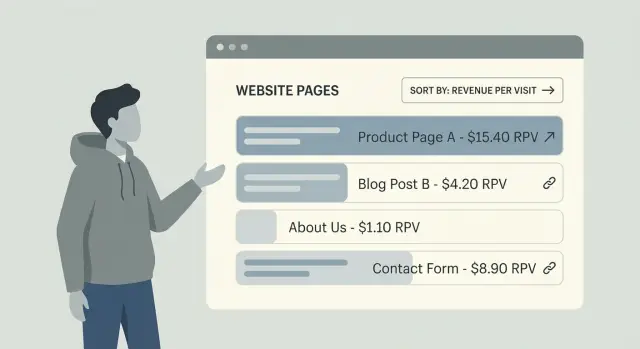
Why more traffic can be the wrong goal
Traffic feels like progress because it’s easy to measure. Rankings go up, sessions rise, and the report looks healthier. But if those visits don’t turn into qualified leads, trials, demos, or sales, you’re paying for attention that doesn’t help the business.
Vanity traffic is when a page attracts lots of clicks but almost no value. A common example is a SaaS company ranking for a broad keyword like “free invoice template.” It gets 20,000 visits a month, but most people just want a download and leave. The sales team sees no lift, and the pipeline stays flat. Meanwhile, a lower-traffic page like “invoice software for construction companies” might bring fewer visits but far more demos and higher close rates.
That’s why link building works better when you prioritize pages by revenue per visit, not by search volume or “traffic potential.” The goal is to strengthen the pages and keywords most likely to create real pipeline, even if they’ll never be your biggest traffic drivers.
You don’t need perfect attribution to do this well. You just need a reasonable value signal and the discipline to apply it consistently. Even imperfect data is better than guessing.
A few questions are usually enough to get started:
- Which pages start or assist conversions most often?
- Which leads from those pages tend to be higher quality or higher LTV?
- Which topics attract buyers vs casual browsers?
Once you can answer those, link building becomes a business decision, not a popularity contest.
Revenue per visit: the simple metric that changes priorities
Revenue per visit (RPV) is exactly what it sounds like: on average, how much money each visit to a page is worth. It turns link building from a traffic contest into a business decision because it highlights which pages actually pay you back when they move up the rankings.
Here’s the basic formula:
Revenue per visit (RPV) = Revenue from a page (or keyword) / Visits to that page (or keyword)
To keep it usable, define the inputs clearly:
- Revenue: money tied to those visits (online sales, booked calls that close later, renewals, upgrades).
- Visits: sessions or users landing on that page, ideally from organic search.
- Time window: use the same period for both, like the last 30 or 90 days.
RPV is often more useful than conversions per visit because not all conversions are equal. A page that converts at 1% can beat a page that converts at 5% if it attracts higher-value buyers, sells a higher-priced plan, or leads to common upsells. If you sell multiple tiers, annual plans, or add-ons, RPV captures that reality.
Example: Page A brings 1,000 visits and 10 trials that usually convert into a $2,000 average deal. Page B brings 3,000 visits and 30 trials that usually convert into a $300 average deal. Conversion rate makes them look similar. RPV makes it obvious which page is worth pushing.
If you don’t have direct revenue tracking, use proxy values and keep them consistent. Assign a value per qualified lead based on close rate and average deal size, or use a lead quality score tied to past outcomes. A rough model is enough to avoid spending on pages that only generate vanity traffic.
Choose the value signal: revenue, lead quality, or LTV
Before you prioritize links by revenue per visit, decide what “value” means for your business. The right signal depends on how you sell and how long the buying cycle is.
If you sell online and revenue tracking is clean, direct revenue is the simplest option.
If you’re sales-led, revenue often shows up weeks later. In that case, use a pipeline proxy like qualified leads, booked calls, demos, or trials, and separate lead volume from lead quality. Ten low-fit leads can look great in a dashboard and still do nothing for pipeline. One lead that matches your ideal customer profile and converts is worth more than fifty “maybe someday” sign-ups.
If customers renew, expand, or buy repeatedly, use LTV (or first-year value) instead of a one-time payment. It keeps you from over-investing in pages that attract bargain hunters and under-investing in pages that bring long-term accounts.
A practical rule:
- Ecommerce or self-serve checkout: use revenue (or gross margin) per visit.
- Sales-led B2B: use qualified leads or booked meetings, then back into expected revenue.
- Subscription or strong upsell: use LTV or 12-month value, not just the first payment.
If data is limited, don’t wait for perfection. Start with average deal value (or average first-year value) and a simple qualification rule. For example, if a “Contact Sales” form converts to a closed deal 5% of the time and your average deal is $8,000, each qualified submission is worth about $400 in expected revenue. That’s enough to rank pages and decide where links can actually move pipeline.
Map keywords to intent and likely lead quality
To prioritize links by revenue per visit, sort keywords by intent first. Intent is the fastest clue for how close someone is to buying, and how sales-ready that traffic will be.
A simple grouping that works for most sites:
- Problem-aware: “how to fix…”, “what is…”, “best way to…” (early research)
- Comparison: “X vs Y”, “alternatives to…”, “best tools for…” (shortlisting)
- Product-ready: “pricing”, “demo”, “buy”, “implementation”, “agency near me” (ready to act)
Informational keywords usually have lower revenue per visit because many people just want an answer and leave. They can still matter if they assist conversions later, build trust, or feed high-intent pages through strong internal links. They just shouldn’t dominate your link budget unless you have proof they help revenue.
If you want a quick way to compare pages, score lead quality by intent group:
- High: product-ready terms tied to a clear buyer signal (role, budget, compliance)
- Medium: comparison terms that suggest evaluation
- Low: broad problem-aware terms with lots of DIY searchers
Watch for edge cases that skew your data. Support queries (“reset password”, “error code”) often bring existing customers, not new pipeline. Brand queries can convert well but may not need links to rank. Job seeker queries (“careers”, “salary”, “internship”) can inflate traffic and lower lead quality if they land on the wrong pages.
Step by step: build a revenue per visit model for your pages
To prioritize links by revenue per visit, you need a simple model that turns page traffic into a dollar number. Start with what you already track, then add a few assumptions you can defend.
1) Gather the minimum data
For each page you might build links to, pull:
- Sessions (or organic sessions) by page
- Conversions you trust (demo request, signup, “contact sales”, trial start)
- A value signal (average deal size, pipeline created, or lead score)
- Lead-to-customer close rate (rough is fine)
Use at least 60 to 90 days if you can. Shorter windows swing wildly when volume is low.
2) Put a dollar value on a lead
If you don’t have clean revenue attribution per page, use a lead value assumption:
Lead value = (Average deal value) x (Close rate)
Example: your average deal is $12,000 and 15% of qualified leads close. One qualified lead is worth $1,800 in expected revenue. If a page generates 10 qualified leads a month, that page is producing about $18,000 in expected revenue.
If you only have lead scores, translate them into tiers (A/B/C) and assign each tier an estimated close rate. It won’t be perfect, but it will be consistent.
3) Calculate RPV by page (and by keyword group)
For each page:
RPV = (Conversions x Lead value) / Sessions
Then group pages by the keyword theme they target (for example: “pricing,” “alternatives,” “how-to,” “templates”) and look at average RPV across the group. Patterns show up fast, like “comparison pages convert 3x better than guides.”
If the sample is small (for example, under 300 sessions), treat the number as directional. Use a longer window, combine similar pages, or set a minimum threshold before you trust the RPV.
4) Bucket the results
Once you have RPV, sort pages into three buckets:
- Scale: high RPV and enough volume. These deserve links now.
- Test: high RPV but low volume (or low confidence). Add a few links and re-check.
- Deprioritize: low RPV. Don’t spend link budget here yet.
Turn RPV into a link target shortlist
If you want to prioritize links by revenue per visit, accept a simple rule: links are too expensive (in time, money, and opportunity) to spend on pages that can’t turn extra clicks into pipeline.
High-performing targets usually fall into two groups. Some already have strong RPV and just need more visibility. Others have strong intent and a good offer but don’t get enough qualified visits yet. They’re the “potential RPV” pages.
A simple scoring matrix
Score each page on three factors, from 1 to 5, then multiply:
- RPV (or proxy): revenue per visit, lead quality score, or LTV estimate.
- Ranking position: how close you are to meaningful gains (moving from #9 to #4 is often easier than #40 to #15).
- Conversion readiness: how well the page turns visits into next steps (clear offer, proof, fast load, strong internal links).
| Factor | 1 (low) | 5 (high) |
|---|---|---|
| RPV | weak or unknown value | proven high value |
| Position | far from page 1 | already near the top of page 1 |
| Readiness | thin or unclear CTA | strong copy and proof |
Then filter for pages that are actually “linkable,” meaning they match search intent, have enough substance, and aren’t held back by obvious technical problems.
A balanced shortlist usually mixes a few conversion pages (product, service, demo, pricing) with a few supporting pages that rank for high-intent questions and feed those conversions through internal links.
Pick targets and anchors without over-optimizing
“Strengthen” should mean one thing: improve rankings for the specific queries that bring high-value visits. It doesn’t mean “raise a metric” or “get more links.” If a page ranks for the right terms but doesn’t convert, links are rarely the fix.
Pick one primary target per topic: the page you most want ranking higher for your money keywords. Then choose one to three supporting pages that help it win, like a comparison page, a use-case page, or a deep guide that answers common objections.
If two pages could rank for the same query, choose one as the primary and adjust the other to support it. Otherwise you split signals and confuse both search engines and readers.
Anchor text: keep it natural and varied
Anchor text should read like a real citation, not a repeated keyword.
Good mixes include your brand name, partial matches that describe the topic, and plain phrases like “pricing guide” or “how it works.” Use exact matches sparingly, and only when they read naturally in context.
When not to point links at a page
Avoid sending links to pages that are thin, outdated, or mismatched to the offer. Links amplify weaknesses.
If your pricing page shows old plan names, update it first. If a “best tools” post is short and generic, expand it before you build links to it. Make sure the page has a clear next step and a clean internal path to conversion.
Budgeting links: proven winners vs smart experiments
Ten links isn’t “ten links.” The same number of placements can drive very different results depending on where they point. A link to a page that already converts high-value visits can lift revenue quickly. A link to a top-of-funnel article may bring more sessions, but little movement in qualified leads.
A simple budget split:
- Proven winners (60-80%): pages with known RPV or strong lead-to-close rates.
- Smart experiments (20-40%): high-intent pages that should perform well but don’t yet have enough data to prove RPV.
Keep experiments small and measurable. Choose one page, build a few links, and define success before you start. You’re looking for ranking movement and business impact together, not one without the other.
A practical test: pick one keyword set, point 3 to 5 new links to the page over 2 to 4 weeks, then watch for (1) a step up in average position and (2) an RPV lift, such as more demo requests per 100 visits or higher-quality leads in your CRM.
Revisit priorities on a cadence you can maintain. Monthly works if you have enough volume to see change. Quarterly is safer for lower-traffic sites.
Common mistakes that waste link spend
The fastest way to waste money on links is to treat “more sessions” as the goal. Top-of-funnel pages often look like winners in analytics, so they get attention first. But if they bring low-intent visitors, strengthening them can inflate traffic while pipeline stays flat.
Another common issue is counting every lead the same. A form fill from a student, competitor, or tiny budget can “count” just like a real buyer unless you check quality. If you can’t tie leads to sales-accepted stages, deal size, or retention, you’ll keep feeding the wrong pages.
Analytics can also mislead when you rely on last-click attribution only. Many pages assist conversions by introducing the problem, building trust, and pushing people to a demo or pricing page later. Ignoring assist value can make you under-invest in pages that quietly drive real revenue.
Mistakes worth fixing before you prioritize links by revenue per visit:
- Funding the highest-traffic pages instead of the highest-value pages
- Optimizing for lead volume without a quality signal (SQL rate, close rate, LTV)
- Judging pages by last click only and missing assisted conversions
- Changing content, offers, and links all at once so results are hard to explain
- Pointing links to pages with no clear next step (no CTA, weak internal path)
A quick gut check: if a page can’t clearly move a visitor to “request a quote,” “book a call,” or a strong comparison step, links won’t fix it.
Quick checklist before you prioritize link targets
Before you spend a dollar or an hour on links, make sure the page can actually capture value. A “priority” page with no clear next step turns even great rankings into a dead end.
- One clear action: Can a visitor do one obvious thing (request a demo, start a trial, book a call, get pricing) without hunting for it?
- Numbers you can defend: Do you have basic assumptions written down (lead-to-close rate, average deal size, and if relevant, LTV)?
- Clean page mapping: Are keyword groups pointing to the right page, with no two pages fighting for the same query?
- Striking distance rankings: Are your targets close enough that links can realistically move them (often mid page 1 to page 2)?
- One-sentence reason: For each page, can you explain who it converts and what kind of revenue it drives?
A simple example: if your pricing page brings fewer visits than a blog post but produces higher-quality leads, it usually deserves links first.
Example: turning keyword value into a pipeline-focused link plan
A B2B SaaS team has steady blog traffic, but pipeline isn’t moving. Their top posts rank for broad how-to terms. Sales says most inbound leads are small companies that churn fast.
They decide to prioritize links by revenue per visit by mapping keyword groups to likely lead quality, then choosing pages that deserve authority first.
Simple keyword value map
They bucket keywords into three groups and assign a rough value score based on past conversions and deal size.
| Keyword type | Example query | Intent | Typical lead quality |
|---|---|---|---|
| Problem/education | “how to reduce onboarding time” | Learning | Low to medium |
| Comparison | “Tool A vs Tool B” | Shortlist | Medium to high |
| Vendor/buying | “Tool A pricing”, “Tool A demo” | Ready to act | High |
Next, they pick three pages to strengthen with backlinks:
- A “Tool A vs Tool B” comparison page (already converts, stuck at position 8)
- A “Tool A pricing” page (high demo rate, low traffic)
- A customer stories hub (good assisted conversions, needs more reach)
They also tighten internal linking from a couple of supporting pages so more visitors flow into comparison and pricing.
Over the next 6 to 8 weeks, they track ranking movement for the target terms, demo rate from each page, and RPV lift. They also check lead quality in the CRM: company size, sales stage reached, and time-to-close.
A realistic outcome looks like this: total organic visits drop 12%, but demos rise 18%. Pipeline influenced by organic grows 25% because more visits land on comparison and pricing pages.
Next steps: make link building accountable to revenue
Keep the workflow simple and repeatable. You’re not aiming for a perfect model. You’re building a decision system that points your link budget at pages that actually move pipeline.
Run this monthly:
- Pick one value signal (closed-won revenue, lead quality score, or LTV).
- Map your most important keywords to that signal.
- Estimate RPV for the pages that target those keywords.
- Turn the top pages into a short link target list.
Do one small action this week: score 10 pages. Choose five pages you already care about and five that get traffic but feel weak for sales. For each page, write down the keyword theme, the intent, the likely lead quality, and a rough RPV. You’ll usually spot a few pages that deserve links immediately and a few that shouldn’t get another dollar.
As you execute, keep the plan honest by updating assumptions with real deals. When sales closes (or loses) opportunities, look back at the pages and queries that started those journeys. If your “high value” pages are creating low-fit leads, lower their score. If a boring page quietly produces high-LTV customers, move it up.
If you’re using a premium placement provider, treat each placement like a budgeted bet with a named page and an expected outcome. For example, SEOBoosty (seoboosty.com) focuses on securing backlinks from authoritative sites, which makes it especially important to aim those links at pages with proven or high-confidence RPV.
Decision rule: if a page can’t clearly justify value (now, or with a realistic path to value), don’t buy links for it.
FAQ
Why is “more traffic” sometimes a bad SEO goal?
Start with pages that already create demos, trials, or sales, even if they don’t have the most sessions. If you can’t tie a page to any meaningful next step, sending more traffic there usually just increases bounce and support noise.
What is vanity traffic, in plain terms?
Vanity traffic is traffic that looks good in reports but doesn’t create qualified leads or revenue. It often comes from broad, low-intent keywords where visitors want a quick answer or free asset and leave without taking action.
What does “revenue per visit” (RPV) mean?
Revenue per visit (RPV) is the average value of a single visit to a page. You calculate it as revenue (or expected revenue) from that page divided by the number of visits in the same time window.
How do I calculate RPV if I can’t track revenue per page?
Use a proxy value for a conversion you trust, like a qualified lead, booked call, or demo request. Estimate lead value with a simple model such as average deal value multiplied by close rate, then divide by page visits to get a workable RPV.
What time window should I use for RPV so it’s not misleading?
Use a consistent time window, like 60–90 days, and only compare pages using the same inputs. If a page has very low traffic, treat its RPV as directional and combine it with similar pages or wait for more data before making big link decisions.
How do I tell which keywords bring buyers vs casual readers?
Group keywords by intent: problem-aware, comparison, and product-ready. Product-ready and comparison terms usually bring higher-quality leads, while broad informational terms often need stronger proof before they deserve a large link budget.
How do I choose link targets and anchor text without over-optimizing?
Start with one primary page per topic that you want to rank for the money keyword, then add one to three supporting pages that answer objections or comparisons. Keep anchor text natural and varied so it reads like a real reference, not repeated keywords.
When should I NOT build links to a page?
Don’t point links at thin, outdated pages or pages with no clear next step. Links amplify what’s already there, so fix the offer, content clarity, and internal path to conversion before spending on authority.
How should I split link budget between “winners” and experiments?
Put most of your effort into proven winners with known value signals, then reserve a smaller portion for high-intent pages that should perform well but need data. Run small tests, watch rankings and lead quality together, and adjust based on real outcomes.
How should I use a premium backlink service like SEOBoosty with an RPV plan?
If you’re using a provider like SEOBoosty, treat each placement as a deliberate bet tied to a specific page and expected business outcome. The safest approach is to aim premium links at pages with proven or high-confidence RPV, not pages chosen only for search volume.
Share