Publish-first vs link-first: timing links for new pages
Publish-first vs link-first can decide whether a new page indexes fast and gains authority. Use this sequencing playbook to time links for maximum lift.
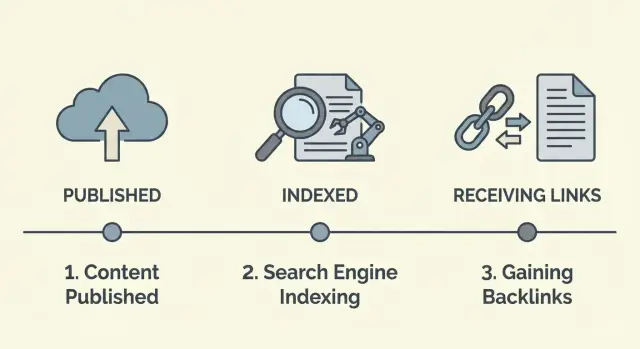
The sequencing problem in plain English
You publish a new page, it looks good, and then nothing happens. It doesn’t show up in Google for days, or it shows up but sits around page 5 where nobody clicks. That’s frustrating because you did the work, hit publish, and expected at least some movement.
Most of the time, the problem isn’t the topic or the writing. It’s timing.
Search engines have to discover the page, crawl it, and index it before links can help in a predictable way. If those early steps are slow, links you add right away can land before the page is really “ready” to benefit.
People usually describe this as publish-first vs link-first:
- Publish-first: Put the page live, get it discovered and indexed, then add links to push it up.
- Link-first: Line up links (usually internal links, sometimes external) so the page has strong signals as soon as it goes live.
The goal is simple: get indexed quickly, then add the strongest signals at the moment they’ll count.
Sequencing matters most when you have less margin for error:
- A newer site that Google doesn’t crawl often yet
- A site with low authority and few existing backlinks
- A page targeting a competitive query where small advantages matter
- A page buried deep in the site (not linked from menus, hubs, or popular pages)
A simple example: you publish a new service page and only mention it in one blog post that also has no traffic. Google may take a while to find it, and even longer to trust it. If you connect it from a strong, already indexed page on your site, the new page usually gets discovered faster. Then any later external backlinks tend to “stick” better because the page is already part of your site’s structure.
What a new page needs before links can help
Links only work well when search engines can actually find and understand the page you’re trying to boost.
A new URL usually moves through four stages: discovery, crawl, index, then rank. If you add strong links while the page is still stuck at discovery or crawl, the impact is often delayed or watered down.
The minimum signals that make a page “link-ready”
First, the page has to be discoverable. There should be at least one clear path to it from places Google already visits. After that it needs to be crawled, indexed, and only then can it compete to rank.
What helps discovery right away:
- An internal link from a page that already gets crawled often (homepage, a popular blog post, a category page)
- Inclusion in your XML sitemap
- A visible navigation path (menu, hub page, related articles)
- A clean, final URL you don’t plan to change next week
- A small burst of freshness signals (publish the page and update a couple of related pages to reference it)
If you do nothing except publish, the page can still get found, but the timing becomes unpredictable.
Indexing is not the same as ranking
Seeing “Indexed” in Search Console doesn’t mean the page will jump in results. Indexing only means Google stored the page. Ranking is the harder step: Google decides whether your page is a better answer than competing pages.
Brand new URLs get treated cautiously. There’s little history, few engagement signals, and limited context. Updated URLs are different. If you refresh an existing page that already has crawl history and links, Google can re-evaluate it faster.
When publish-first is the better move
Publish-first means you get the page live, make sure it can be crawled and understood, then add stronger links.
This is usually the safer choice when your site already gets crawled regularly and new pages are discovered quickly. If your internal linking is reasonably consistent (navigation, category pages, sitemap, contextual links), search engines will often find the new URL without you needing external backlinks on day one.
Publish-first also gives you room to confirm the page is worth promoting. Early performance data is practical: even a small number of impressions can tell you whether the title matches intent, what queries you’re showing for, and whether the intro is doing its job.
Publish-first is a smart move when:
- Your site gets indexed reliably and new pages show up in search without much effort
- The page is complete enough to stand on its own
- You expect to tweak the angle after seeing early impressions and queries
- There’s a real chance the URL, headline, or structure could change
- You might remove the page if it doesn’t fit your content plan
Example: you publish a new pricing comparison page. After a week, you notice it ranks for slightly different terms than planned, and visitors keep looking for “what’s included.” You add a clear table and rewrite the intro. Only after that do you point higher value links at the improved version.
When link-first makes sense
Link-first means you line up a few meaningful links before (or the same day) you publish, so discovery and trust start faster. It’s not about blasting links at a draft. It’s about giving a finished, stable URL a head start.
This approach is most useful when your site has a discovery problem. If new URLs sit unvisited for days, even great content can spend its first weeks invisible. A small set of internal links from pages Google already crawls can speed up that first crawl.
Link-first also fits competitive topics and deadlines. If the page supports a product launch, campaign, or PR push, waiting two weeks to add links can waste your highest attention window.
Link-first is a good call when:
- New pages are slow to get discovered and crawled
- You’re targeting a competitive keyword where early trust helps
- The page supports a time-sensitive launch
- The URL and draft are truly final
- You have existing pages that can naturally point to it
To do link-first safely:
- Publish (or schedule) the final page before placing external links
- Add internal links from pages that already get crawled often
- Use natural anchor text that matches what the page is actually about
- If you add external backlinks early, start with a small number of high quality placements
The key condition is stability. If you expect to change the slug, rewrite the core angle, or split the page into two, link-first can create redirects, diluted signals, and confusion.
A simple sequencing playbook
If you’re stuck between publish-first vs link-first, use this order. It makes sure links show up when the page can use them, not while it’s still half-finished or hard for Google to see.
- Decide what the page is supposed to win. Pick one main query and one clear job: inform, compare, or convert. If it’s meant to convert, decide the single action you want.
- Finish the on-page basics. Title that matches intent, clean headings, enough detail to answer the query. Add an FAQ only if it genuinely helps.
- Publish, then add internal links right away. Use a few relevant pages that already get crawled often.
- Confirm discovery and indexing. Can you find it with a brand + topic search? Do you see it indexed in Search Console?
- After the page is stable, add external links. Aim them at pages you want to become anchors in your site: core guides, comparisons, or key commercial pages.
Then wait long enough to learn something. A common trap is changing content and adding links every day, so you never know what actually worked.
What to do next
Use a simple rule:
- If the page is indexed but not moving, improve the content first (intent match, examples, missing subtopics).
- If it’s moving but stuck behind competitors, that’s when more authority often helps.
Timing windows: week 1, week 2, and month 1
Timing matters because search engines and people both respond better to a stable page. If you change the page too much too soon, you can slow down indexing and blur what the page is about.
Week 1: discovery first, stability second
In the first 24 to 72 hours, focus on helping the page get found, then mostly leave it alone. Make sure it’s reachable from your site, loads fast, and doesn’t return errors. Fix obvious issues, but avoid big rewrites.
Over days 3 to 10, watch for signs of life: indexing, crawling, and early queries (even if impressions are tiny). Small edits are fine, but keep the main topic, title, and headings consistent.
If the page still isn’t indexed after about a week, don’t jump straight to buying a pile of backlinks. Check basics first: it’s not blocked by robots.txt, it’s not tagged noindex, it’s in your sitemap if you use one, and it has at least one clear internal link from a crawlable page.
Week 2 to month 1: add force after the page is “set”
Weeks 2 to 4 are usually a better window for stronger link pushes, once the URL is indexed and the content has stopped shifting.
A practical order that works for most sites:
- Add a few relevant internal links from pages that already get traffic
- Improve snippet basics (title, meta description, first paragraph) based on early queries
- Add external links only after the page is stable and aligned with the keyword intent
For pages that keep changing (pricing, inventory, living docs), aim for stable anchors. Keep the URL, main heading, and core structure consistent, and batch updates so crawlers see a clear “main version” of the page.
Which links to add first (internal vs external)
A simple rule: internal links first for discovery, external links second for authority.
Internal links are the fastest way to help a new page get found and understood. They also pass relevance from pages that already have trust and traffic. Add a few as soon as the page is live, then watch whether it gets crawled and indexed.
When deciding which pages should link to the new page, prioritize quality over quantity. The best sources are usually topically close pages, pages that already rank for related terms, and pages Google visits often (popular guides, category hubs, homepage).
Once the page is being crawled reliably, external backlinks can have the most impact. They work best when the target is stable: final URL, final title, and solid content.
Anchor text is where many sites overdo it. Keep it natural and specific, like how a person would describe the page in a sentence. Mix it up, avoid repeating the same keyword-rich phrase everywhere, and make sure the anchor matches what the page delivers.
Example scenario: launching one new page the smart way
You’re launching a new page targeting a mid-competition keyword, like “invoice automation for freelancers.” You have a decent site already, but this topic is new for you. The goal is to get the page indexed quickly, confirm it matches search intent, then add stronger links when they can actually push rankings.
A simple timeline
- Day 1 (publish): Publish with a clear title, one strong H1, and sections that answer the obvious questions (price, steps, tools, mistakes).
- Day 2 (internal links): Add 3 to 5 internal links from relevant pages using natural anchor text.
- Day 3 to 7 (index check): Watch for indexing and early impressions. If it’s not indexed after a week, improve clarity and make sure it’s reachable from a crawlable page.
- Week 2 (content tune-up): If impressions show up but clicks are low, rewrite the title and intro to match what people are searching for.
- Week 2 to 3 (external links): Once the page is indexed and showing impressions, add 1 to 3 high-quality external backlinks.
What to watch
In Search Console (or your analytics tools), pay attention to:
- Index status
- Impressions (proof Google is testing the page)
- Clicks (a sign the snippet and intent match)
- Average position (direction matters more than the exact number early on)
- Query themes (if you rank for the wrong terms, the page may be unclear)
A realistic expectation: small movement can show within 2 to 4 weeks, but meaningful gains often take longer. The win isn’t speed. It’s using your best links only after the page proves it can compete.
Common mistakes that waste link value
Link value is easiest to waste when you treat links like a switch you can flip at any time.
The most common failure is simple: the page can’t be indexed. If the URL is set to noindex, blocked in robots.txt, or canonicalized to a different URL, links may push power into a dead end. Check this before any placement.
Another silent killer is changing the URL after links go live. Even with redirects, you usually lose some value and add delays. Lock the final slug early.
Intent mismatch wastes links too. If your page targets pricing queries but reads like a generic overview, more backlinks won’t fix the disappointment.
Mistakes to avoid:
- Sending links to a page that is noindex, blocked, or canonicalized elsewhere
- Editing the URL structure after links are placed
- Pointing links to content that doesn’t match what searchers want
- Repeating the same keyword-rich anchor text again and again
- Skipping internal links and hoping external links will do all the work
Quick checklist and next steps
Links work best when the page is stable, crawlable, and clearly worth ranking.
Quick checklist (before you add serious links)
- The URL is final, loads fast, returns a 200 status, and isn’t blocked by robots.txt
- The page is indexable (no noindex) and uses a self-referencing canonical
- It has at least 3 relevant internal links pointing to it from crawlable pages
- It’s indexed before you spend on strong external links (unless you’re intentionally doing link-first)
- You can name one clear next move: add links, improve the content, or build a supporting page that feeds it
If you’re unsure about indexing, search the exact page title in Google after a reasonable wait. If nothing shows up, fix the basics (indexability, canonical, internal links) before spending money on powerful backlinks.
Next steps
- If the page isn’t indexed yet, focus on discovery: internal links, sitemap inclusion, and removing technical blocks.
- If it’s indexed but not moving, improve the page before adding more links.
- If it’s indexed and solid but stuck mid-pack, that’s often the moment external links have the cleanest impact.
If you want predictable access to authoritative placements without traditional outreach, SEOBoosty (seoboosty.com) is one option for timing premium backlinks after a page is indexed and stable, so you’re not paying to amplify a moving target.
A practical habit: set calendar reminders for 7 and 21 days after publish. At day 7, check indexing and internal links. At day 21, decide whether the next move is content upgrades, stronger internal linking, or carefully chosen external links.
FAQ
Should I publish a new page before building links or build links first?
Use publish-first when your site gets crawled regularly and you might still adjust the angle, title, or structure after seeing early impressions. Get the page live, make it easy to discover with internal links and your sitemap, confirm it’s indexed, then add stronger links once the page is stable.
When does link-first make more sense than publish-first?
Choose link-first when discovery is your bottleneck: new URLs on your site take days to get crawled, the page is buried deep, or you’re working against a deadline like a launch. The safe version is to publish the final URL first (or at least lock it), add a few strong internal links immediately, and only then add a small number of high-quality external backlinks.
How long should I wait before adding external backlinks to a new page?
A practical window is after the page is indexed and stable, often around weeks 2 to 4. If you add strong external links before Google has reliably crawled and indexed the page, you may just delay the impact because the page isn’t “ready” to benefit.
What should I do if my new page isn’t indexed after a week?
Check the basics first: the page isn’t blocked by robots.txt, it isn’t set to noindex, and it isn’t canonicalized to a different URL. Then make sure there’s at least one clear internal link from a crawlable, frequently visited page and that the URL appears in your XML sitemap if you use one. If those are solid and it still isn’t indexed after about a week, focus on making the page clearer and more internally connected before spending on external links.
Why is my page indexed but still stuck on page 5?
Indexing means Google stored the page and can show it in results, but it doesn’t mean Google thinks it deserves a top spot. Ranking depends on how well your page matches the query intent, how strong competing pages are, and how much authority and context your site has. Treat “Indexed” as permission to compete, not proof that you’ll win.
How many internal links does a new page need to get discovered faster?
Start with internal links because they help with discovery and understanding. A good rule is to add a few contextual links from relevant pages that already get crawled often, then watch for crawling, indexing, and early impressions. Quantity matters less than placing links from pages that are topically close and already trusted by search engines.
What anchor text should I use for internal and external links to a new page?
Avoid repeating the exact same keyword-heavy anchor everywhere. Use natural phrasing that matches what the page actually is, like how you’d describe it inside a sentence. A small mix of anchors is usually safer and clearer than forcing one “perfect” keyword each time.
What happens if I change the URL after I’ve built links?
Changing the URL after links go live usually costs you time and some signal, even if you use redirects. If you expect the slug or structure to change, prioritize publish-first, gather early data, and lock the final URL before you point high-value links at it. Stability is the condition that makes link-building pay off cleanly.
What technical issues can completely waste link value?
Make sure the page returns a normal 200 status and can be crawled, then confirm it’s indexable with no noindex tag and no conflicting canonical pointing elsewhere. If links are pointing at a page Google can’t index, you’re effectively paying to push authority into a dead end. Fix indexability first, then worry about link volume.
How many external backlinks should I add to a new page in the beginning?
Keep it small and selective at first, especially for a brand-new URL. A few authoritative placements after the page is indexed often beat a bigger batch placed too early or aimed at a page that’s still changing. If you want a predictable way to place premium backlinks without outreach, services like SEOBoosty are best used after the page is indexed and finalized, so you’re amplifying a stable target.
Share