Questions to ask before paying for a backlink: a short script
Use this short script of questions to ask before paying for a backlink to confirm link attributes, exact placement, edit policy, and replacement terms.
Why you need a script before you pay
Paid links fail more often than people expect, and it’s rarely because the seller is “bad.” It usually comes down to missing details: the link gets removed during a site update, the page is rewritten and your anchor disappears, or the placement ends up somewhere visitors barely see (like a thin author bio, a sidebar, or a rotating block).
A short script prevents that. It turns a vague promise like “we’ll add your link” into clear yes/no answers you can screenshot and save. If you care about results, the questions that matter most are the ones that define what you’re actually buying.
Small details can completely change the value. A dofollow link inside the main body of an article isn’t the same as a nofollow or sponsored link in a footer. A link on an indexed, stable page isn’t the same as one on a page that gets overwritten every month. Even if both cost the same, they don’t deliver the same outcome.
When someone says “permanent,” assume it means “it stays up unless something changes.” Sites get redesigned, editors update posts, and policies shift. A placement can also be removed because of a legal request, a new ad partner, or a cleanup of old content. “Permanent” is just a marketing word unless you confirm the edit policy and replacement terms.
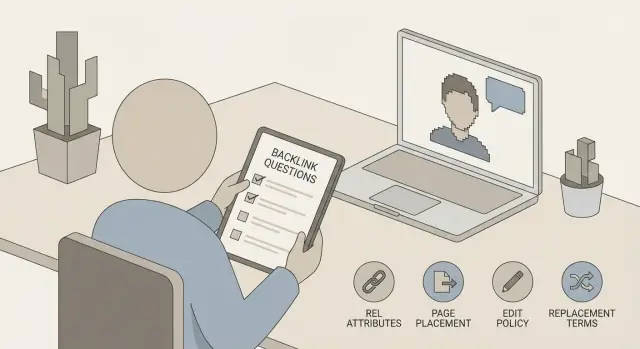
Before money changes hands, lock down four things:
- Link attributes (dofollow vs nofollow, and whether it’ll be marked sponsored or UGC)
- Exact placement location (main content vs author bio, sidebar, footer, or resources page)
- Edit policy (what can change later, and whether you’ll be notified)
- Replacement terms (what happens if the link is removed, changed, or the page is deleted)
Step-by-step: a short script you can copy and use
Use this as a simple message you can send to a site owner, editor, or reseller before you pay. Keep it calm and specific. You’re not negotiating yet - you’re removing uncertainty.
Hi [Name] - quick check before we proceed.

I want to promote this page: [your URL]. The goal is [1 short reason, e.g., “to rank for our brand + product term” / “to support our product page with a relevant mention”].

1) Link attributes
Can you confirm the link will be: [dofollow] and not marked as nofollow, sponsored, or UGC?

2) Exact placement location
Where exactly will the link be placed on the page (top/middle/bottom), and in what section or paragraph?
Will it be in the main content (not the sidebar, footer, author bio, or a resources box)?

3) Edit policy
After the link goes live, what can be changed without my approval (anchor text, surrounding text, URL, page title, or the page itself)?
If you need to edit anything related to the link, will you confirm with me first?

4) Replacement terms
If the link is removed or the page is deleted later, what happens?
Do you replace it with an equal or better placement, and what is the time window for replacement?

Also, can you share 1 sample URL where you placed a similar link (same style and location)?

If all of the above is confirmed, please reply in writing here (email/message) with the agreed terms, and I’ll send payment.

Recap (so we’re aligned): [attribute], [location], [edit rules], [replacement terms].
Thanks!
Before you hit send, fill in the blanks and decide what you will and won’t accept. Simple rule: if they can’t answer these points clearly, you’re buying a guess.
To stay consistent, keep the same structure every time: one page, one goal, the same four sections (attributes, location, edits, replacement), written confirmation before payment, one real sample URL, and a one-line recap of the deal.
Link attributes: what to ask and what the answers mean
When you buy a link, you’re not just buying clickable text. You’re buying technical choices that affect how search engines treat it.
1) Confirm the link attribute (rel)
Start with the simplest check: what will be in the link tag. Ask the seller to paste the exact HTML they plan to publish.
- “Will the link be dofollow (no rel), or will it have rel=nofollow, rel=sponsored, or rel=ugc?”
- “Can you confirm the exact HTML snippet you will add?”
A plain link without nofollow/sponsored/ugc is usually the strongest for SEO. rel="sponsored" labels it as paid. rel="ugc" is for user-generated content like comments. rel="nofollow" asks crawlers not to pass ranking credit (some engines may still treat it as a hint, but don’t count on it).
2) Make sure crawlers can actually see it
A link that humans can click isn’t always a link that search bots can count.
Ask directly:
- “Is the link in the raw HTML when the page loads, or is it injected by JavaScript?”
- “Is the page blocked by robots.txt or a noindex tag?”
- “Is the link hidden behind a script, accordion, or click-to-reveal element?”
If they can’t answer clearly, ask for a screenshot of the page source or a simple written confirmation that the page is indexable and the link is present in the HTML.
3) Check for redirects, tracking, and canonicals
Some sellers add a detour that reduces value.
Ask: “Will the link go directly to my page, or through a redirect/tracking URL first?” A direct link is usually cleaner.
Also ask: “Does the page use a canonical tag that points to a different URL?” If the canonical points elsewhere, search engines may treat another page as the main version, and your link may carry less weight than you expect.
4) How crowded is the page?
Two pages can sit on the same domain but have very different link quality.
Ask: “About how many outgoing links will be on that page, and will my link be one of many paid links?” One relevant link on a focused article tends to look more natural than a page that links out to dozens of unrelated sites.
Exact placement location: get specific before paying
The fastest way to end up with a weak backlink is to be vague about where it will appear. “It will be on our site” can mean anything.
Start with the exact page URL. If the page already exists, ask for the live URL. If it doesn’t exist yet, ask for the planned URL format (or at least the page title and category) and confirm you’ll receive the final URL once it’s published.
Then confirm placement type and position. An in-content link isn’t the same as a link in an author bio, sidebar, footer, or a generic resources page.
Use a short check like this:
- “What is the exact URL where my link will be placed?”
- “Will it be in the main content, author bio, sidebar, footer, or a resources page?”
- “Roughly where will it appear: top, middle, bottom, or under a specific heading?”
- “Is the page fully public (no login, paywall, or geo blocking)?”
- “How often is this page updated or refreshed?”
That last question matters. News-style pages and frequently refreshed posts are more likely to move your link down the page or remove it during edits.
Example: you pay for a link “in a blog post,” but it lands in a rotating “Featured partners” block near the footer. It technically exists, but most readers never see it. If you had asked for “in the second paragraph under the section called Pricing,” you would have avoided the mismatch.
Anchor text and surrounding text: keep it realistic
Anchor text is a signal, but it’s also writing. If it looks forced, repeated, or unrelated to the sentence around it, it can do more harm than good.
Ask what the anchor text will be and whether you can approve it before publishing. Approval matters because small wording choices change how natural the link feels. A brand name, product name, or a simple “learn more” style phrase often blends in better than a hard sales keyword.
Also confirm the link will point to the final destination URL you want. Be clear about whether you expect a clean URL, a tracked URL, or a specific landing page. If the seller plans to use a redirect or shortener, ask them not to do it unless you explicitly agree.
The surrounding text matters just as much. Ask for 1 to 2 sentences that will appear around the link so you can judge tone and relevance. If they can’t share the exact sentence in advance, ask what level of control you have: can you provide a suggested line, or can you only give general guidance?
A quick script you can use:
- “What anchor text are you planning to use, and can I approve it before publishing?”
- “Can you confirm the exact URL the link will point to, with no redirects unless we agree?”
- “Can you share the 1 to 2 sentences around the link so it reads naturally?”
Avoid repeating the same exact-match keyword across many sites. If you push “best payroll software” everywhere, it can look manufactured. Vary naturally: a brand name on one site, a partial phrase on another, and a plain URL occasionally.
Example scenario: you’re buying a mention in an article about hiring. Instead of forcing an exact-match anchor, you approve a sentence like: “We used AcmeHR to centralize onboarding documents, which saved us a lot of back-and-forth.” The anchor is “AcmeHR,” and the link points directly to the onboarding page you want. That reads like a real recommendation.
Edit policy: what can change after the link goes live
A backlink isn’t a one-time purchase if the page can be edited later. Posts get refreshed, moved, rewritten, or “cleaned up” by someone who wasn’t part of your deal.
First, find out who can change the page. Some sites let the author edit freely, others require an editor, and some route everything through a third-party content manager. The more people who can touch the page, the higher the chance your link changes without anyone telling you.
Questions worth asking:
- Who controls edits after it’s published (author, editor, or another team)?
- Can my anchor text or destination URL be changed later without my approval?
- If the article is updated and my link is removed, what’s your process to restore it?
- Can I request small fixes later (typo near the link, updated URL, brand name change)?
- Do you add disclosure labels later that could change the link attributes (for example, adding sponsored and changing rel)?
Push for how it works in practice, not “we usually don’t.” A clear answer sounds like: “Only the editor can change links, and we notify you before changing anchor or URL.” A vague answer sounds like: “It should be fine.”
Also clarify what you’re allowed to change later. Businesses rebrand, URLs change, and tracking parameters get removed. If they refuse any future edits, even small ones, treat it as a risk you’re accepting.
Replacement terms: what happens if the link is removed
A backlink is only worth what it looks like months later. Before you pay, decide what happens if the page is deleted, the site is redesigned, or your link disappears.
Define “replacement” in writing. “We’ll replace it” can mean anything unless you agree on specifics: same domain or not, similar page type, and the same kind of placement (in-body text vs sidebar or author bio). If the original deal was a contextual link in an existing article, a replacement that ends up on a thin new page isn’t the same outcome.
Ask for a replacement window. A usable policy answers two things: how long they stand behind the placement, and how long you have to report a problem.
Also clarify how replacements work day to day:
- Are replacements automatic, or do you have to report the issue?
- What proof do they accept (screenshot, crawl report, date the link vanished)?
- Can you choose the replacement target URL so it points to the right page on your site?
- If the new placement differs, do you get a redo?
Agree in advance on what counts as “delivered” (domain, page type, placement location, and link attributes). That’s what stops arguments later.
Common mistakes and red flags to watch for
The easiest way to waste money is paying for a promise instead of a specific placement.
One common trap is buying something described only as “DA 70” or “high authority,” with no clear page, no paragraph, and no screenshot-level detail. Authority metrics can be useful, but they don’t tell you where your link will sit, how long it will last, or whether the page will even be indexed.
Another red flag is “nofollow for safety” as a default answer. Nofollow, sponsored, and UGC attributes aren’t automatically bad, but they change the value and the reason you’re paying. If the seller won’t say which attribute will be used (and why), assume you won’t like the outcome.
Be careful when the seller insists they can place the link “somewhere on the site” or wants full control over location. That often means low-value areas like author bios, footer blocks, tag pages, or a generic resources page that gets little traffic.
Quick red-flag checklist
Watch for these before you send payment:
- No exact placement details (page URL, section, and a sample of surrounding text)
- Vague location terms like “in-content” without saying where
- Seller can change your anchor text or URL later “to keep it natural”
- Link goes through a redirect, tracking script, or shortener instead of a clean direct link
- Page is blocked (noindex), script-injected, or not accessible without login
Future edits are a bigger issue than most people think. A link can go live today and quietly change next month: anchor swapped, URL replaced, or the link moved into a widget. If you can’t get a clear edit policy in writing, treat it as temporary.
Example Q&A: what a good conversation looks like
You’re buying one link to a product or service page. Here’s a realistic exchange you can copy.
Buyer:
Hi! Before I pay, can you confirm four things?
1) Link attributes: will the link be dofollow, and will it be marked rel="sponsored" or "nofollow"?
2) Placement location: which page, and where on the page will the link appear (top/middle/bottom, in-body vs sidebar)?
3) Edit policy: can you change the article, anchor text, or remove the link later? If yes, under what reasons?
4) Replacement terms: if the link is removed or the page is deleted, do you replace it, and for how long?

Seller (good):
1) Dofollow. We do not add sponsored or nofollow.
2) It will be in the main body, second section, on an existing article about [topic].
3) We only edit for typos or legal issues. We won’t change or remove your link without asking.
4) If it’s removed for any reason, we replace it with a similar placement for 12 months.

Seller (bad):
1) We can’t guarantee, it depends.
2) We’ll add it “somewhere” on a relevant page.
3) We update posts often, links may change.
4) No replacements.
If you get the good answers, ask for one more detail: the exact URL (or page title) and the sentence where the link will sit. “Second section” helps, but “the link will be in this paragraph under this heading” is clearer.
If you get the bad answers, don’t argue. Ask once for specifics, then walk away if they won’t commit.
Quick checklist and next steps
If you keep one thing from this post, keep a short checklist you can paste into a chat or email. It helps you stay consistent and compare offers.
Checklist:
- Link attributes: dofollow vs nofollow, and whether it will be marked sponsored or UGC
- Exact page URL and placement type (in-content vs author bio/resources list)
- Anchor text and whether you can approve it before publishing
- Edit policy (can they change content, anchors, or move the link later?)
- Replacement terms if the link is removed or the page is deleted (timeline and like-for-like replacement)
After publication, verify while it’s still easy to fix:
- Open the live page URL and find the link where you agreed it would be.
- Click the link and confirm it resolves to the right page (no unexpected redirects).
- View page source and confirm the rel attribute matches what you paid for.
Then set a reminder to check again later. Link rot happens, pages get updated, and “temporary” changes become permanent if you don’t notice. A 30-day check and a 90-day check are usually enough.
If you want fewer back-and-forth messages, a curated inventory model can help because the source and terms are defined upfront. For example, SEOBoosty (seoboosty.com) offers premium backlink placements from a curated set of authoritative websites through subscriptions, which can make it easier to know what you’re buying before you commit.
FAQ
What should I confirm before I pay for a backlink?
Ask for four written confirmations before paying: the link’s rel attribute, the exact on-page placement, what can be edited later, and what replacement you get if it disappears. If they can’t give clear yes/no answers, treat the offer as uncertain and skip it.
How do I ask for these details without sounding pushy?
Send a short message that states the exact URL you want to promote and your goal, then ask your four questions in order: attributes, placement, edit policy, and replacement terms. End by asking them to reply in writing with the agreed terms, so you can save it.
What does “dofollow” actually mean, and how do I verify it?
“Dofollow” usually means the link does not include rel="nofollow", rel="sponsored", or rel="ugc". The safest way to avoid misunderstanding is to ask them to paste the exact HTML snippet they will publish, so you can see the rel value yourself.
How do I make sure search engines can actually see the link?
You want the link to be present in the raw HTML when the page loads and the page to be indexable. Ask whether the link is injected by JavaScript, whether the page has noindex, and whether it’s blocked by robots rules; get a written confirmation if they won’t share technical proof.
Should I accept a backlink that goes through a redirect or tracking link?
A redirect or tracking hop can dilute value and can also be changed later without you noticing. Ask for a direct link to your final destination URL and request confirmation there will be no intermediate tracking URL unless you explicitly approve it.
What’s the best way to lock down the exact placement location?
“In-content” can still mean a weak spot unless you pin it down. Ask for the exact page URL (or the planned title/category if it doesn’t exist yet) and where the link will appear on the page, such as top/middle/bottom and the specific section or paragraph.
What anchor text should I use for a paid link?
Start with a realistic default: brand name, product name, or a natural phrase that fits the sentence. Ask to approve the anchor text and request the exact sentence or two around the link, because awkward wording is a common reason paid placements get edited later.
What edit policy terms should I get in writing?
Assume the page can be updated, rewritten, or cleaned up, even if the seller says “permanent.” Ask who controls edits after publishing and whether they can change the anchor, URL, or link attributes without your approval; get a clear “we’ll confirm with you first” in writing.
What counts as a fair replacement policy if the link is removed?
A useful replacement promise is “like-for-like,” meaning same domain (or clearly agreed alternative), similar page type, and the same placement style and link attribute. Also confirm the time window they will stand behind the placement and how quickly they will replace it once you report an issue.
What should I check after the link goes live?
Verify immediately while it’s easy to fix: open the live page, click the link to confirm it resolves correctly, and check the page source to confirm the rel attribute matches what you paid for. Then recheck later on a schedule, because many problems show up after updates rather than on day one.
Share