How many referring domains do you need for a keyword? SERP method
Learn how many referring domains do you need for a keyword using a repeatable SERP competitor average method, plus authority gaps and a quick checklist.
What you’re estimating (and what you’re not)
When people ask, “how many referring domains do you need for a keyword,” they’re usually asking one specific thing: how many unique websites need to link to the page you want to rank for that keyword.
That detail matters because Google ranks pages, not whole sites. Your homepage can be strong, but if the page you’re trying to rank has weak authority, you can still struggle.
There’s no universal number that works for every keyword. Some topics rank with a handful of strong referring domains because competition is light or the intent is narrow. Other keywords need dozens (or more) because the top results are backed by years of links, brand trust, and deeper content.
This method isn’t about predicting an exact number. It’s about estimating a realistic range you can plan around, based on what’s already ranking.
You’re drawing a clear line:
- You’re estimating a workable link target for one page, for one keyword (or a tight keyword group).
- You’re not estimating how many links your whole domain needs to “be strong.”
- You’re estimating a range (minimum, likely, stretch), not a magic number.
- You’re not getting a guarantee. Rankings still depend on intent match, content quality, internal links, and the strength of competing brands.
Treat it like budget planning. You’re turning “we need backlinks” into a target you can test, measure, and adjust.
Referring domains in plain language
A referring domain is a unique website that links to you. If one site links to you 20 times, that’s still 1 referring domain (but 20 backlinks).
That’s why people focus on referring domains instead of raw backlink totals. Links from many different sites usually signal broader trust than lots of links from the same place.
Think of it like recommendations: ten different people vouching for you is often stronger than one person repeating the same praise ten times.
Referring domains vs. total backlinks
Backlinks are the individual links. Referring domains are the unique sources of those links. Both matter, but unique domains often move the needle more because they look like independent approval.
A quick sanity check:
- 5 links from nytimes.com = 1 referring domain, 5 backlinks
- 1 link each from 10 different blogs = 10 referring domains, 10 backlinks
- A sitewide footer link on one domain = still 1 referring domain
Page strength vs. domain strength
Another common mix-up is page-level vs. domain-level strength. A link can point to your homepage (helping the domain overall) or to the exact page you want to rank (helping that URL compete right now). For competitive keywords, links to the ranking URL often matter more than links to unrelated pages.
Also watch the “root domain” confusion. You might earn links to your main domain, but the URL ranking in Google could be a blog post or product page. If competitors have many links pointing directly to that ranking page, looking only at root domain totals can make you undercount what you actually need.
Why the number changes by keyword
Keywords don’t compete on equal ground. Some SERPs are stacked with brands that have earned trust for years. Others are full of smaller sites where a strong page can climb with far fewer links.
Search intent is a major driver. Buyer intent queries like “best X” often pull in big publishers and heavy SEO investment. Pure informational queries like “what is X” can be easier, especially if current results are thin or outdated.
Niche matters too. Finance, insurance, and software usually have a higher baseline because more companies actively build links. A narrow B2B subtopic or local hobby can be lower simply because fewer sites compete.
Page age plays a role as well. Older pages have had time to collect links, mentions, and user signals. A new page may need extra referring domains just to catch up on trust.
Links aren’t the only lever. Better relevance can reduce the link requirement. A page that answers the query more directly can win with fewer links than a generic page.
Common reasons the “needed” number swings:
- The top results are major brands vs. smaller sites
- The SERP favors a specific format (product pages, reviews, deep guides)
- Competitors have older pages with steady links over time
- Your page matches intent tightly (or misses it)
- The topic expects expert proof (data, credentials, clear sourcing)
Example: two keywords both get 1,000 searches. “Best project management software” usually needs far more referring domains than “how to write a project status update,” because the first is a buyer SERP with strong incumbents, while the second rewards clarity and usefulness.
Define the target before you count
Start by locking the target down. Small changes (country, language, device, even wording) can change the SERP and the backlink profiles you’re comparing.
Pick one exact keyword and one search context. For example: English in the US vs. English in the UK, or “accounting software for freelancers” vs. “freelancer accounting software.” Treat each as its own project.
Next, decide what “success” means. Top 3 isn’t the same as top 10, and “first page” is a big range. Many keywords have a steep jump between positions 8-10 and positions 1-3.
Also choose the exact URL you want to rank. Estimating links for an existing page vs. a brand-new page (starting from zero) leads to very different plans, so don’t mix the two.
Before you pull competitor data, decide what you’ll compare:
- Referring domains to the ranking page (page-level)
- Overall domain strength (domain-level)
- Page type (homepage, category, product page, blog post)
- Your current numbers for the same two metrics
If you’re trying to rank a product page but the SERP is full of long guides, your estimate will be misleading. In that case, change the page format or change the keyword.
Collect competitor data from the SERP
Start with the live search results for your exact keyword. Pull the top 10 organic results in an incognito window (or while logged out).
Before you record numbers, label each result as either a “true competitor” or a “platform.” A true competitor is a site that publishes content like yours and could realistically be replaced by your page. Platforms are things like giant marketplaces, government pages, encyclopedias, or massive brand homepages. They often rank for reasons you can’t copy quickly with links alone.
Capture the same data points for every result (using one SEO tool consistently so the numbers line up):
- Ranking URL (the exact page)
- Referring domains pointing to that URL
- One domain strength proxy (pick one metric and stick to it)
- Page type
- Notes on why it ranks (brand, freshness, depth, tools, etc.)
Now clean the set. Outliers can wreck your estimate. Remove obvious ones (a Fortune 500 homepage, a government site, a major encyclopedia entry) and note why you excluded them. Also flag extreme link outliers (for example, a page with 10x the referring domains of the rest), even if you keep it for context.
A simple check: if 6 to 8 of the remaining results look like pages you could publish, you have a usable sample.
Turn competitor counts into a usable range
When you pull referring domain counts for top results, you’ll almost always see outliers. One page has 2,000 referring domains because it’s a giant brand, while the rest are in the low hundreds. A simple average gets dragged upward and can push your target way too high.
Use the median (not the average)
A better starting point is the median. Sort the competitor counts from low to high, then take the middle value (or the average of the two middle values if you have an even number). The median represents a “typical” ranking page even when one or two results are extreme.
To understand the spread, add an interquartile range (IQR). That’s the middle 50% of results: the 25th percentile (Q1) to the 75th percentile (Q3). It gives you a realistic band many ranking pages sit inside.
A repeatable workflow:
- Collect referring domain counts for positions 1-10
- Sort them and note the median
- Find Q1 and Q3 to form your IQR band
- Split into two groups: positions 1-3 and positions 4-10
- Compare the medians to see the “top 3 jump”
That split matters because the top 3 often requires a step up. If positions 4-10 cluster around 40-80 referring domains, but the top 3 cluster around 120-200, your target depends on how aggressive you want to be.
Write a target you can act on
Put the result into a range, not a single number. Example: “To compete for this query, we likely need 70-120 referring domains to enter the top 10, and 150-220 to push into the top 3.”
That range is what you plan against, test, and refine.
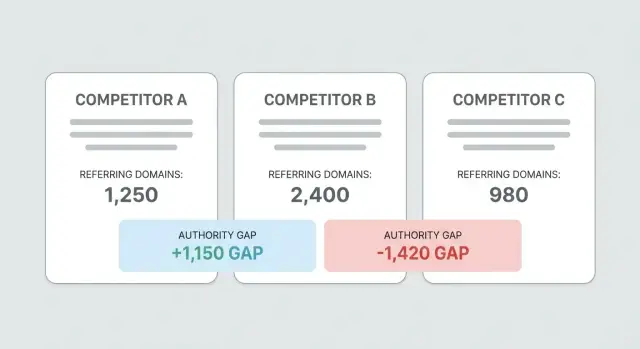
Adjust for authority gaps
An authority gap is the difference between how much search engines trust your site and how much they trust the sites already ranking. If most of page 1 is dominated by well-known brands, they can often rank with fewer new links because their whole domain carries weight.
That’s why the same referring domain number can be enough for one site and not enough for another. The real question becomes: how many do you need given your current strength compared to the winners?
A simple adjustment after you’ve calculated a page-1 baseline:
- If your site is clearly weaker than most page-1 domains, increase the target by about 25%-100% (small gaps need small bumps, big gaps need big bumps).
- If your site is similar to the pack, keep the range as-is.
- If your site is stronger, or you already cover the topic deeply across multiple related pages, reduce the target by about 10%-30%.
Example: page 1 suggests 40 referring domains to the ranking page. If your site is newer and competitors are trusted brands, aiming for 50-70 is usually more realistic than aiming for 40 and hoping content alone bridges the gap.
One more important split: page-level links vs. site-level strength. Links to the specific page help it compete now. But if your overall domain is far behind, you’ll also want a longer-term plan that builds authority across the site so future keywords become easier.
Build a link target you can actually execute
Once you have a competitor-based range, turn it into a plan you can sustain long enough to learn what the keyword really needs.
Choose a timeframe. For many sites, 8-12 weeks is long enough to see movement without locking yourself into a long commitment. Then convert the range into a monthly pace. If your estimate says you need 30-60 new referring domains, you don’t have to chase 60 immediately. Pick something you can keep up with (for example, 10-15 per month) and reassess after the first cycle.
Quality matters more than hitting a raw count. A few relevant, editorial links inside real articles can do more than dozens of weak mentions.
A simple shape for the plan:
- Set a monthly pace
- Prioritize relevance (same industry, real audience, natural context)
- Vary anchors and target pages (don’t force the same keyword every time)
- Track outcomes weekly (rankings, impressions, clicks, not just link counts)
Mix quick wins with longer plays. Quick wins can come from partners, associations, vendor pages, and resource pages. Longer plays come from PR-style mentions and content that attracts links over time.
Decide a stop rule upfront. Example: “After 10 weeks or 25 new referring domains, we pause and re-check the SERP.” If the page is climbing but slow, keep going. If nothing moves, adjust the page, the keyword choice, or link quality before adding volume.
A simple example
Say you want to rank for a friendly, non-technical keyword like “online invoice template.” The question isn’t “how many links exist on the internet.” It’s: how many unique websites point to the pages already ranking, and how far behind you are.
Imagine you check the current top results and record referring domains to the exact ranking page:
| SERP position | Page type | Referring domains to the page |
|---|---|---|
| #1 | Template gallery page | 58 |
| #2 | Single template landing page | 41 |
| #3 | Blog post with templates | 36 |
| #4 | Template gallery page | 33 |
| #5 | Tool page with templates | 19 |
Sort the counts (19, 33, 36, 41, 58). The median is 36. A practical starting range might be 30-45 referring domains.
How the target changes if your domain is newer
If your site is much newer than the top results (or has fewer strong pages overall), you usually need a cushion. In this example, instead of 30-45, you might plan for 45-65 referring domains, or choose a longer-tail variation first.
A rule that keeps you honest: if you’re clearly behind on overall authority, add roughly 25% to 50% to the median-based target, then reassess once you see movement.
Common traps that make estimates wrong
Most bad estimates come from measuring the right idea in the wrong way.
Where people usually go wrong:
- Counting total backlinks instead of unique referring domains.
- Comparing competitors’ whole domains when the SERP is powered by specific pages.
- Ignoring intent. If the top results are how-to articles and you try to rank a product page, links alone often won’t fix it.
- Copying competitor numbers without adjusting for trust and topical strength.
- Building links too fast and skipping basic checks (indexing, internal linking, content upgrades).
A common scenario: you see competitors with 60, 75, and 90 referring domains to their ranking pages, so you aim for 80. But two of those sites are household brands and their pages match intent perfectly. Your page is thin and mismatched. Even if you hit 80, you may still not crack the top 10.
Before you commit budget, sanity-check:
- Are you counting unique referring domains to the exact ranking URL?
- Does your page format match what the SERP rewards?
- Are new links getting indexed, and are rankings moving week to week?
Quick checklist before you spend money
Small mismatches (wrong intent, wrong page type, wrong URL data) can double your effort for no gain.
Five checks that prevent expensive mistakes:
- Match intent and format: scan the top results and note what wins.
- Count referring domains to the ranking URL, not the whole site.
- Use the median plus a range so one outlier doesn’t set your target.
- Adjust for your authority gap (newer/weaker sites usually need more).
- Set a measurement window (rank position, impressions, clicks) and stick to it.
After that, write down one clear target: “X referring domains to this specific page over Y weeks.” That’s a plan you can execute.
Recalculate if the SERP shifts (new competitors, new formats) or after meaningful link growth.
Next steps: test, measure, then scale
Your estimate is a starting point, not a promise. Treat the number you calculated as a range. Build toward the low end first, pause, then read the results. If the page starts moving after a handful of new referring domains, you may only need incremental gains. If nothing changes, revisit the basics: intent match, content quality, internal linking, and the authority gap.
A simple way to run this:
- Pick one target page and one primary keyword
- Build to the low end of your range
- Hold steady briefly and watch the trend
- Add another small batch only if the page is still stuck
- Stop if conversions don’t improve, even if rankings do
Rankings are useful, but they’re noisy. Also track organic clicks, visit quality, and whether the page leads to signups or sales.
If your plan depends on acquiring a few high-authority referring domains faster, SEOBoosty (seoboosty.com) is one option. It focuses on securing placements on authoritative sites, which can be helpful when you’re trying to close a clear authority gap without relying only on outreach.
FAQ
What am I actually estimating when I ask “how many referring domains do I need?”
You’re estimating how many unique websites need to link to the specific page you want to rank for that keyword. It’s a planning range based on what’s already ranking, not a guarantee or a site-wide “strength score.”
What’s a referring domain in plain terms?
A referring domain is one unique website that links to you. If the same site links to you 20 times, that’s still 1 referring domain, even though it’s 20 backlinks.
Why focus on referring domains instead of total backlinks?
Referring domains are often a better proxy for broad trust because they represent independent sources. Total backlinks can be inflated by repeated links from the same site, sitewide links, or duplicated placements that don’t add much new “approval.”
Do links need to point to the exact ranking page, or is linking to the homepage enough?
Page-level links help the exact URL compete right now, which matters a lot for competitive SERPs. Domain strength helps overall, but a strong homepage doesn’t automatically make a weak article or product page rank for a tough keyword.
Why does the “needed” number change so much from keyword to keyword?
Because each SERP has different competitors, intent, and content formats. A narrow informational query might rank with a small number of strong referring domains, while a buyer-intent keyword can require far more because established brands and older pages dominate.
What should I define before I start counting competitor referring domains?
Lock down one keyword, one location/language context, and one target URL, then pull the top organic results for that exact query. If you change wording, country, or page type, you may be comparing a different SERP and your estimate can become misleading.
How do I handle big brands or weird outliers in the top 10 results?
Remove obvious “unfair” comparisons like government pages, giant encyclopedias, or major brand homepages that you can’t realistically replace. Also watch for extreme link outliers that can distort the picture, even if you keep them noted for context.
Why use the median instead of the average for competitor link counts?
Use the median because it represents a typical ranking page even when one or two results have extreme link counts. Then turn it into a range by looking at how spread out the middle of the results are, and by comparing positions 1–3 versus 4–10.
How do I adjust the target if my site is newer or weaker than competitors?
If your site is clearly less trusted than most page-one domains, you usually need more referring domains than the baseline suggests. A practical approach is to increase the target range by roughly 25% to 100% depending on how big the gap is, then reassess after you see movement.
How fast should I build referring domains, and when should I stop or reassess?
Set a timeframe you can stick to, build toward the low end first, and measure rankings plus impressions and clicks before adding more. If you need a small number of high-authority placements quickly to close a clear gap, a service like SEOBoosty can help by providing access to curated, authoritative referring domains without long outreach cycles.
Share