SEO experiment with backlinks: control pages, timing, metrics
Run a clean SEO experiment with backlinks using matched control pages, clear timelines, and simple success metrics so you can trust the results.
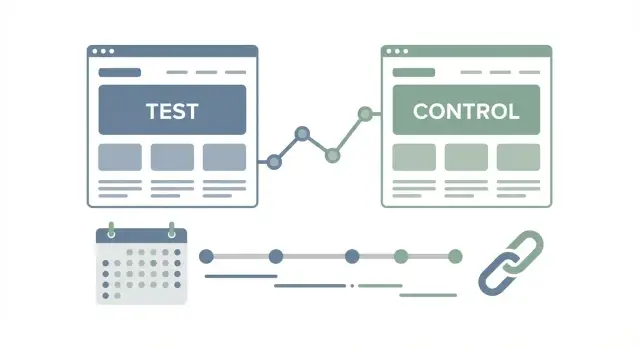
Why backlink experiments get messy
Backlink results often look random because search is noisy. Rankings move for reasons you didn’t touch, and links rarely land in a vacuum. Even if you build one new link, other shifts in the same week can blur the picture.
The biggest issue is hidden variables. A small content tweak, a new internal link from your homepage, or a title rewrite can create a bigger lift than the backlink itself. Seasonality can do the same: a page about taxes or gifts will rise and fall on its own schedule. Competitors keep publishing and earning links too, so a simple “before vs after” view gets contaminated.
A few common sources of noise:
- Content edits (headings, intros, new sections, dates)
- Internal linking changes (menus, related posts, hub pages)
- SERP changes (new features, local packs, more ads)
- Demand swings (news cycles, holidays, launches)
- Indexing and crawl timing (Google noticing changes on different days)
A clean backlink experiment can usually prove one narrow thing: whether adding a specific type and quantity of links to a page tends to improve visibility compared to similar pages that didn’t get links, during the same window. It won’t prove long-term revenue impact, and it can’t perfectly separate links from every other factor.
Skip this type of test when the site is mid-redesign, pages are being heavily refreshed, or you can’t keep internal linking steady. Also avoid it if you have too few comparable pages, or if the topic is extremely seasonal.
Define your question and hypothesis
Start with one clear question. If you try to answer three things at once (rankings, traffic, conversions), you’ll usually end up with a result you can’t trust.
Make the question specific to one page type and one outcome. “Do new backlinks improve Google rankings for our product comparison pages?” is much more testable than “Do backlinks help SEO?” because it names what you’re testing and where.
Turn the question into a hypothesis you can disprove. Keep it plain and measurable:
- “If we add X new referring domains to page type Y, its average position for 5 target keywords will improve within Z weeks.”
- “If we build links to page A, it will gain more impressions than similar pages with no new links.”
- “If backlinks matter here, the linked page should move first, before other site pages change.”
Decide what “success” means before you start. Pick one primary metric and one secondary metric. Primary metrics are usually ranking position or Search Console impressions (they react sooner than sales). Secondary metrics might be clicks or organic sessions, but only if the pages already have steady traffic.
Keep the test small enough to manage. You want enough pages to see a pattern, but not so many you stop checking details.
A simple starting setup:
- 4 to 10 pages total
- 3 to 8 tracked queries per page
- One target movement (example: +3 average positions)
- A fixed link input you can repeat (same type, similar authority)
Choose test pages and control pages
Page selection matters more than the number of backlinks. The goal is to give test pages and control pages the same starting conditions, then change only the links.
Choose pages that target the same kind of intent and sit in the same “difficulty neighborhood.” Two pages can both be blog posts and still be a bad match if one targets a broad keyword and the other targets a very specific question.
Good matches usually share the same intent (informational vs commercial), a similar current rank range (for example, positions 8 to 20), similar content depth and format, similar internal-link support, and similar freshness.
Your control group should be boringly comparable. If the control pages have stronger internal links, better snippets, or a more trusted brand presence, you’ll end up measuring those differences instead of link impact.
Pairs vs groups
Use pairs when you only have a handful of candidates and can match them tightly. Use groups when you can test enough pages that one weird outlier won’t dominate the outcome.
A practical rule:
- Use pairs when you have 2 to 6 strong matches
- Use groups when you can find 10+ comparable pages
If you go with pairs, keep the match strict. For example, pick two very similar “how to” posts that already get impressions, then add links to only one.
Lock down other changes so links are the main variable
Most backlink tests fail for one reason: too many things change at once. If you want the experiment to tell you anything useful, treat your site like a lab. During the test window, freeze anything that can move rankings besides the new links.
Start with on-page edits. Even small tweaks like rewriting a title, adding an FAQ block, changing headers, updating schema, or expanding copy can shift impressions and clicks. If a page must be edited (legal or accuracy reasons), note the date and what changed, and consider removing that page from the final analysis.
Internal links are the next hidden variable. A new navigation module, a fresh “popular posts” block, or a new hub page can send more internal authority to your test URL and make the backlink look stronger than it is. Keep menus, sidebars, footer blocks, and contextual links to test and control pages stable until the observation window ends.
Also avoid creating new competitors by accident. Publishing a new page that targets the same query (or a close match) can split rankings and traffic.
What to freeze (and what to log)
Aim for “no changes” wherever possible, and log anything you can’t avoid:
- On-page: titles, H1s, key sections, schema, above-the-fold layout
- Internal linking: menus, category pages, sitewide blocks, contextual links
- Content calendar: no new pages targeting the same main queries
- Site events: outages, migrations, redesigns, CMS changes, major pricing changes
- Marketing spikes: email blasts or paid pushes that could distort click data
If you place a backlink and then also rewrite the intro and add internal links from your homepage a few days later, you won’t know what moved the needle. A clean test is boring by design: add the links, then leave everything else alone.
Set your timeline: baseline, launch, and observation window
Timing is where most backlink tests fall apart. If you don’t separate the before and after cleanly, you end up measuring noise instead of link impact.
Start with a baseline period long enough to see normal week-to-week swings. For most sites, 2 to 4 weeks is a practical minimum. During baseline, record starting levels for each test and control page: impressions, clicks, average position, and current referring domains. Note anything unusual (a holiday, a newsletter send) so you don’t misread the chart later.
Define one clear intervention date: the day the backlinks go live. If you can, track two extra timestamps: when the linking page gets indexed and when your target page is recrawled. That gap explains a lot of “nothing happened yet” moments.
A timeline that works for many teams:
- Baseline: 2 to 4 weeks with no SEO changes
- Launch: place links on a single day (or as close as possible)
- Observation: watch results for 6 to 12+ weeks after the last link is live
Expect lag. Some pages react in a couple of weeks, others need longer, especially in competitive niches or if the pages weren’t ranking at all.
To avoid overreacting to spikes, compare averages (for example, the last 14 days of baseline vs the last 14 days of observation), not single-day peaks.
Pick success metrics that reflect the link effect
The right metrics answer one question: did the new links change how Google treats these specific pages? If your metrics are too broad, you’ll end up with a general performance report.
Start with metrics closest to the expected link effect. Rankings are useful, but only if you track a fixed keyword set chosen before the test starts. Pair that with Search Console impressions and clicks for the test pages, because they show visibility and demand without guessing.
A simple page scorecard (updated on a set schedule, like twice per week):
- Average position for pre-selected keywords (same locations and device type each time)
- Search Console impressions for the page
- Search Console clicks for the page
- CTR for the page
- Notes on major SERP changes (new competitors, new features)
Secondary metrics (conversions, demo requests, lead quality) are useful context, but they’re noisier. Don’t make them your only pass/fail signal.
Link verification is part of the measurement. If a placement isn’t live, isn’t indexable, or the linking page isn’t indexed, you may be testing “almost a backlink.” Keep a simple log: placement status, target URL used, and whether the linking page appears indexed.
Avoid vanity metrics that don’t test the hypothesis. Domain-wide traffic, total keyword counts, and third-party authority scores can move for reasons unrelated to your links. Keep the dashboard page-level and keyword-level.
Step-by-step: run the experiment from setup to readout
A clean backlink experiment is mostly discipline. You’re changing one input (links) and watching what happens.
Use a simple tracking sheet (a spreadsheet is fine) and keep it updated the whole time.
1) Setup and baseline
Use a repeatable sequence so you don’t lose track of what changed and when:
- List every page in the test, label each as test or control, and note its main target query.
- Record a baseline snapshot for each page: average position, impressions, clicks, and organic sessions.
- Write down the start date, plus any known seasonality (sale periods, launches, holidays).
- Freeze on-page edits and internal-link pushes.
- Set a weekly check-in day to update the sheet.
Give baseline data enough time to be believable (often 2 to 4 weeks), especially if pages have low traffic.
2) Launch, tracking, and readout
Launch backlinks to test pages only. During the observation window, don’t add extra links through other channels to those same pages. Otherwise, you won’t know what you’re measuring.
Each week, log anything that could bias results: template changes, new internal links, PR or social spikes, indexing issues, downtime, and obvious competitor shifts.
At the end, compare test vs control using percent change, not raw numbers. For example, moving from position 18 to 12 is a clearer signal than “traffic went up,” which can be seasonal.
Quick checklist before you start
A clean test is mostly planning. If you set the rules now, you won’t be tempted to “fix” things mid-way and ruin the readout.
Pre-flight checklist
- Confirm your page map (test vs control). Write down which URLs are in each group and the inclusion rule (same intent, similar age, similar baseline performance). If a page doesn’t match, drop it.
- Record a baseline snapshot. Capture current rankings for your main queries and the last 28 days of impressions and clicks for each URL. Save the date and don’t overwrite it later.
- Freeze other changes. No planned edits to titles, headings, content, internal links, navigation, templates, redirects, or sitewide cleanup during the experiment window.
- Verify links are live and track indexation. Confirm the link points to the correct URL and uses the intended anchor. Track whether the linking page (and your target page) gets indexed.
- Set one readout date in advance. Decide the day you’ll judge results and what “success” means.
After you run the checklist, write a one-sentence hypothesis and keep it visible. Example: “If we add one high-authority backlink to each test page, their average impressions will rise more than the control pages by the readout date.”
Common mistakes that break the results
Most failed backlink tests fail for simple reasons: too many moving parts, mismatched pages, or rushed decisions.
Common mistakes:
- Changing multiple things at once (content updates, internal links, titles, and backlinks in the same week)
- Using weak control pages (different intent, different competition, different internal-link strength)
- Calling it too early (links need time to be crawled and reflected)
- Moving the goalposts (switching keywords or metrics mid-test)
- Ignoring outside events (algorithm updates, PR spikes, paid campaigns, seasonality)
A quick reality check: if both test and control pages jump on the same date, your links probably aren’t the cause. Look for differences in direction and magnitude, not just movement.
When something feels off, pause and write down what changed in the last 14 days. That short log usually exposes why the test stopped being clean.
Example: a simple test with matched blog pages
A B2B SaaS team wanted to test backlink impact without guessing what caused the lift. They picked 20 product-led blog posts with stable rankings and a clear “next step” (demo, trial, or a feature page).
They split them into 10 test pages and 10 controls by matching pairs first. Each pair covered a similar topic (for example, “audit checklist” vs “audit template”), had similar last-28-day organic sessions, and targeted keywords with similar difficulty. They also confirmed both pages had similar intent and weren’t already picking up new links naturally.
After a 4-week baseline, they pointed new backlinks only to the 10 test pages and left the controls untouched.
Each week, they tracked a small set of signals and annotated anything weird:
- Search Console clicks and impressions for each page
- Average position for the main query group
- Conversions that started on the page (trial or demo starts)
- Site-wide events (launches, tracking changes, seasonal shifts)
Two weeks were messy: one week a product launch drove brand search, and another week a tracking tag broke. They didn’t delete data. They annotated those weeks and compared results using a rolling average, plus test-vs-control differences.
The outcome wasn’t “everything jumped.” Four test pages improved clearly (for example, +18% clicks vs controls), three moved a little, and three did nothing. Controls stayed mostly flat. That mixed result still helped: they scaled only where the paired control stayed stable and impressions rose before clicks (a common pattern when rankings improve).
Next steps: repeat, scale, and keep inputs consistent
Once you have a readout, turn it into a playbook you can reuse. The first test should answer one practical question: which types of pages benefit most, and under what conditions.
Write down what worked in plain terms: the page pattern, the link pattern, and the timeline. You might learn that mid-ranking posts (positions 8 to 20) react more than pages already in the top 3, or that pages with stronger internal links show clearer movement.
When you scale, do it in batches. Small batches make it easier to catch problems early, like a tracking change or an unexpected content update.
Keep one shared log with dates for link placement, site edits, internal linking changes, and notes about seasonality or campaigns.
If you want more controlled inputs, a consistent link source helps. For example, SEOBoosty (seoboosty.com) offers a curated inventory of placements on authoritative sites, which can make it easier to keep the “link input” similar from one batch to the next.
Finally, rerun the test on a new set of matched pages. If you see the same direction twice, you can scale with a lot more confidence.
FAQ
What can a “clean” backlink experiment actually prove?
A clean backlink experiment tests one narrow thing: whether adding a defined set of backlinks to specific pages changes their visibility compared to similar pages that get no new links during the same period. It won’t prove long-term revenue impact, and it can’t remove every outside influence, but it can give a credible directional answer.
How long should the baseline period be before adding links?
Baseline data shows you the normal ups and downs before you change anything. For most sites, 2 to 4 weeks is a practical minimum so you can see typical weekly swings and avoid mistaking a random spike for a link effect.
How do I choose good test pages and control pages?
Pick pages with the same intent and similar starting conditions, especially a similar rank range (for example, both sitting around positions 8–20) and similar internal-link support. If the pages aren’t comparable, you’ll measure those differences instead of link impact.
What site changes should I freeze during the test window?
Freeze anything that can move rankings besides the new links, especially titles, headings, major copy edits, schema changes, and internal linking changes. If something must change, log the date and what changed, and consider excluding that page from the final readout.
Which metrics best reflect a backlink effect?
Ranks are useful if you lock a fixed keyword set before the test starts, but Search Console impressions per page are often the cleanest early signal that visibility changed. Treat clicks and CTR as supporting metrics, since they’re more sensitive to SERP features and demand shifts.
How long should I wait after links go live before judging results?
Plan for lag and use an observation window of 6 to 12+ weeks after the last link goes live. Some pages move quickly, but others won’t show a clear signal until Google crawls and reevaluates the linking page and your target page.
How do I know if Google has even counted the backlinks yet?
Indexing is a common reason tests look like “nothing happened.” Confirm the backlink is live, points to the correct URL, and the linking page is indexable, then check whether that linking page appears indexed. If the linking page isn’t indexed, you may be testing “almost a backlink.”
How do I tell link impact apart from general SEO “noise”?
If both test and control pages move in the same direction at the same time, it’s usually not your links. Look for a difference in direction or magnitude between groups, and compare averages (like last 14 days vs last 14 days) instead of reacting to single-day spikes.
When should I avoid running a backlink experiment?
Don’t run it during redesigns, migrations, major template changes, or heavy content refresh cycles, because too many variables move at once. Also skip it if you have too few comparable pages or the topic is extremely seasonal, since demand swings can drown out the signal.
How can I keep the “link input” consistent across multiple tests?
Consistency matters more than volume because it keeps the input repeatable across batches. Using a consistent source of placements, such as SEOBoosty’s curated inventory of authoritative sites, can make it easier to keep link type and quality similar so your test is about “links vs no links,” not “random link mix.”
Share