SEO for startups: backlinks that support fundraising proof points
SEO for startups that are fundraising: learn how to aim backlinks at proof pages that show category leadership, real use cases, and market demand.
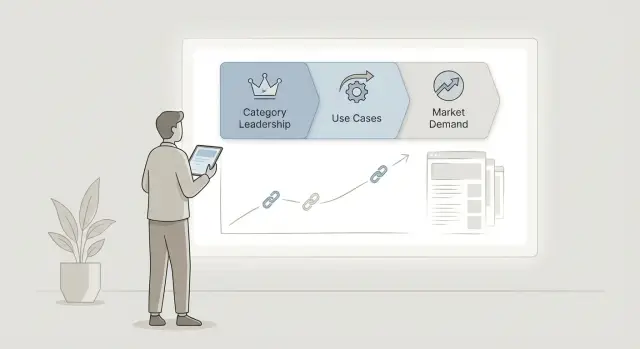
Why fundraising narratives break when SEO pages do not match
Investors are paid to doubt. A pitch can sound great in a meeting, but the next step is quiet verification: a quick search, a scan of your site, and a look for evidence that your claims are real.
When SEO for startups turns into a pile of unrelated posts, the outside view of the company gets blurry. The deck says one thing, but the site suggests something else (or nothing at all).
The narrative usually breaks in a few predictable ways:
- The "category leader" claim leads to a homepage that never defines the category or explains why you win.
- Use cases come up in sales calls, but there’s no clear page that matches how customers actually use the product.
- Market pull is implied, but there’s no page that shows the problem is urgent and widespread.
- Multiple pages compete for the same idea, so searchers (and investors) bounce instead of getting convinced.
Backlinks matter here because they’re more than rankings fuel. A relevant link from an established publication works like a public reference. It signals that someone else, with a reputation to protect, thought your page was worth citing.
That signal is strongest when the link lands on a page that supports one proof point, not a generic catch-all. A backlink to a vague homepage rarely answers the real question: "What exactly are you known for, and can I verify it?"
A simple example: imagine a startup pitching itself as the clear leader in "privacy-first analytics." If backlinks point to a general product page while the only detailed explanation lives in a buried blog post, the outside proof looks thin. If the links instead point to a focused category page that defines privacy-first analytics, shows clear differentiation, and points to real adoption signals, an investor’s quick scan can turn into confidence.
This is why link placement and link targets are part of the fundraising narrative. Services like SEOBoosty can help you secure placements on highly authoritative sites, but the lift shows up only when those links point to pages that make your key claims easy to find and easy to trust.
Turn your pitch proof points into a simple page map
Fundraising stories fall apart when the web doesn’t back them up. The fix isn’t "more content." It’s a clear page map where each proof point in your pitch has one obvious place to land, read, and believe.
Start by writing down 3 to 5 proof points. Keep them specific enough that a reader can verify them:
- Traction: growth, retention, pipeline, signed customers
- Outcomes: time saved, revenue lift, risk reduced, ROI
- Category leadership: what you define, why you win, what you believe
- Market demand: urgency, trends, regulatory pressure, cost pressure
- Credibility: partnerships, compliance, security, press, awards
Now match each proof point to one best page. One page per proof point is the rule. If "results" are split across three case studies and a blog post, you’re making the reader do work. Most people won’t.
Give each page one main action. Investors and buyers take different actions, so be explicit. A category page might push "Understand our point of view." A use case page might push "See how this works for your team." A demand page might push "Get the data and benchmark yourself."
To avoid mixing audiences, label pages internally as either investor-facing (narrative, category, credibility, traction summary) or buyer-facing (use cases, integrations, pricing, security, docs, demos). The pages can still be public, but the intent should be clear.
A concrete example: if your pitch claims "We own the category for X," choose one category leadership page that explains the space, shows your angle, and references proof (customers, data, third-party mentions). Then make backlinks point there, not to your homepage. This is where SEO for startups becomes a fundraising asset: links stop being generic authority and start acting like receipts.
Link targets for category leadership: what to point at
A category leadership page is where your story says, in plain terms: "Here’s the problem space, here’s the modern way to solve it, and here’s why we’re credible." It’s also a clean backlink target because it sits above features and pricing and matches investor language.
Keep the page simple and specific. It should feel like a helpful overview, not a manifesto. A strong version usually includes:
- A clear category definition (one short paragraph, minimal jargon)
- What changed in the last 12 to 24 months
- Your point of view (how the modern approach works)
- Proof points (a few numbers, outcomes, or recognizable signals)
- A "who it’s for" section that names real roles and teams
Not every claim needs a citation. Positioning statements can stand as opinions if you frame them that way. "We believe the category is moving from X to Y" is fine.
What needs backup are claims that sound like measurable facts or implied consensus: customer counts, growth rates, adoption trends, benchmarks, third-party recognition, and especially "leading" claims. If you say "fastest," "most adopted," or "#1," expect a reader to ask, "According to whom?" Even a single credible mention from a respected publication can reduce skepticism.
Comparisons belong on this page, but keep them calm. Focus on tradeoffs, not takedowns. A small table that contrasts approaches ("legacy tools optimize for A; modern tools optimize for B") reads as educational. Avoid naming competitors unless you can be fair and accurate.
Backlinks help this page feel less like self-promotion because they act like outside witnesses. If your category page says "Teams are standardizing on AI QA checks before release," a link from a known engineering publication discussing the same shift makes your statement feel grounded.
Link targets for use cases: show what you do in the real world
Investors don’t fund features. They fund a believable story about who buys, why they buy, and what changes after they buy. Use case pages are where that story becomes concrete, and where backlinks can add outside validation.
Pick 1 to 3 flagship use cases that match your ideal customer profile. Too many makes you look unfocused. The wrong one brings in traffic that never converts and creates a narrative that feels off.
Each use case page should read like a real workflow, not a slogan. Start with the problem, show how the customer uses your product step by step, and end with the measurable outcome they care about. Early trust is fragile, and vague pages don’t earn it.
What makes a use case page credible
Use proof elements that are easy to verify and hard to fake. Use only what’s true and approved.
- One screenshot of the key moment (dashboard, report, integration)
- One or two numbers with context (time saved per week, error rate reduced)
- A short quote from a customer or pilot user (anonymized if needed)
- A clear before vs after description in plain language
Then use backlinks to reinforce the use case you want to be known for. The goal isn’t to point every link at your homepage. Earn or place links that land directly on the use case page that supports your fundraising proof point.
Example: if you want to be known for "automated monthly reporting for finance teams," prioritize backlinks from articles about reporting, close processes, or finance operations, and send them to that specific use case page.
When the same use case is supported by consistent pages, proof, and outside mentions, your narrative feels less like a claim and more like a pattern.
Link targets for market demand: earn trust before the demo
Fundraising conversations stall when investors don’t buy the market story. A strong market demand page answers one simple question: "Is this problem real, growing, and worth building a company around?" In SEO for startups, this page is often a better backlink target than a product page, especially early.
Start with one page that explains the problem in plain language and why it’s getting worse or more expensive. Think of it as a calm explainer a partner can skim in two minutes. If your pitch says "the market is pulling us," this is where you show that pull.
What to include on a market demand page
Keep it educational, not hyped. Use evidence you can stand behind, and separate what you observed from what you estimate.
- A simple definition of the problem
- What is changing and why it’s increasing (regulation, costs, behavior, new tech)
- 3 to 5 proof points (public reports, credible benchmarks, your own aggregated trends)
- A short "how to evaluate solutions" section
- A gentle bridge to your approach (one paragraph, not a pitch)
Write for obvious search intent. If someone searches "what is X," "why is X growing," or "how to evaluate X tools," your page should answer directly with clear headings and short sections.
How backlinks help here (and where to point them)
Backlinks to market education pages build trust because they support understanding, not just rankings. A realistic flow is: an investor reads your deck, searches the category, lands on your market demand page, and sees credible context.
For example, if you sell fraud detection for marketplaces, publish a page on "Why marketplace fraud is rising" with trends you can cite and a checklist for evaluating solutions. Aim backlinks at that explainer, not your pricing page.
Step-by-step: build a backlink plan tied to fundraising proof
A backlink plan works best when it’s built around your fundraising story, not random keywords. For SEO for startups, that usually means picking a small set of pages and making each one carry a clear proof point.
1) Pick the pages that actually support the story
Choose your top 5 to 10 pages. If you pick more, you’ll spread links too thin and the signal gets muddy.
Ask a simple question: if an investor only read these pages, would they understand why you win?
A typical set looks like:
- A category page that defines the space and your angle
- 1 to 2 use case pages that show real outcomes
- A market demand (or "why now") page
- A customer proof page (case studies, metrics, logos, quotes)
- A conversion page (demo, pricing, or "talk to us")
2) Assign one goal per page (keep it single-purpose)
Give every page one main job: leadership, proof, demand, or conversion. This prevents you from pointing backlinks at pages that try to do everything and convince no one.
Before building links, make sure each target page is ready to earn trust. The promise should be clear in the first screen. Proof should be specific (numbers, timeframes, who it worked for). Structure should be easy to scan, with headings that match the claim.
Plan pacing, too. A steady cadence looks natural and gives you time to upgrade pages based on what people actually read. Sudden spikes often happen when teams buy links in bulk without a plan.
If you’re raising a Seed round and your narrative is "we own the category for mid-market teams," put early links into the category leadership page and one flagship use case page. Add demand-focused links later, once your "why now" page is tight and backed by data.
3) Document it like a fundraising asset
Keep a one-page plan you can share internally (growth, founders, anyone writing). Include the target pages, the goal for each, what’s missing before links (proof, sections, visuals), a simple monthly pacing target, and who owns updates.
If you’re using a provider to secure placements from high-authority sites, this one-pager also keeps targets and timing intentional instead of reactive.
Anchor text and context: keep it credible and human
Anchor text is the clickable words in a link. Investors won’t study your backlink profile, but they’ll feel the difference when your proof pages rank and the story stays consistent. The goal is simple: make each link read like a normal reference, not a keyword trick.
Natural anchors work best because they match what a real writer would say. If the page is about a specific use case, the anchor should sound like that use case. If the page is about category leadership, the anchor should reflect that claim, not default to the homepage.
A practical way to keep anchors believable:
- Use brand and product anchors (your name, product name)
- Use descriptive anchors that match the page topic ("security overview" or "pricing")
- Use partial phrases that fit a sentence ("how teams track churn")
- Use generic anchors sparingly ("this guide") and only when the surrounding sentence carries the meaning
Variation matters, but it should be variation around one idea. If your proof point is "we lead in category X," rotate anchors like "category X platform," "category X benchmarks," or "why category X is growing." Avoid repeating the same keyword-heavy phrase everywhere. It looks manufactured and often underperforms.
Context matters as much as the anchor. The words around the link should match the claim you want to support. If the sentence implies enterprise readiness, the linked page should show enterprise signals (case studies, security details, procurement-friendly info). If the sentence implies market demand, the linked page should show demand signals (trends, benchmarks, comparisons, or a clear problem explainer).
A quick credibility check before you accept or place a link:
- Does the anchor describe what the reader will see after the click?
- Is the link going to the most specific proof page (not the homepage by default)?
- Does the page answer the implied question in the first 10 seconds?
- Would the sentence still read normally if you removed every SEO goal from it?
Example: a startup claims "teams use us to reduce onboarding time." A link with the anchor "best onboarding software" pointing to the homepage is weak. A link with the anchor "reduce onboarding time" pointing to a real onboarding use case page (with a simple workflow, a quote, and a measurable result) is stronger and feels human.
How to measure results in a way investors will understand
Investors don’t want a dashboard tour. They want a clear story: evidence is getting easier to find, trust is rising, and pipeline is getting healthier.
Choose a small set of narrative keywords that match your fundraising proof points. If your pitch says "category leader," track that category term plus a handful of variations a buyer (or analyst) would actually search. Tracking hundreds of keywords that never come up in conversation just creates noise.
Watch performance on the pages that carry your proof, not just the homepage. If you built a category page, a market demand page, and a few use case pages, those are the pages that should gain impressions, clicks, and rankings over time.
A simple measurement set that stays investor-friendly:
- Rankings for 5 to 10 narrative keywords (trend over 4 to 12 weeks)
- Organic visits to proof pages (not site-wide traffic)
- Engagement that signals intent on those pages (demo starts, contact clicks, pricing clicks)
- Assisted conversions (people who visited a proof page before converting later)
Tie lead signals back to the specific proof page. For example: if your "Healthcare automation" use case page starts generating more organic visits and you see more demo starts from that page, you can say, "Demand is showing up in this vertical, and the message is landing." That’s more persuasive than "organic traffic is up."
Build a one-slide investor snapshot
Keep it simple and consistent month to month: what improved (2 to 3 bullets), where it improved (the exact proof pages), and why it matters (the proof point it supports). Example: "Category page moved from page 3 to page 1 for our core term, and organic visits to the market demand page doubled, supporting the claim that buyers are actively searching for this problem."
If you’re using premium placements, annotate when new backlinks went live. That helps you explain cause and effect without overclaiming.
Common mistakes that weaken credibility (and how to avoid them)
Backlinks can make your story feel real to investors, but only if the pages they land on hold up. The fastest way to lose trust is to earn great links and point them at pages that look unfinished.
A common issue in SEO for startups is building links to thin pages: vague headlines, generic claims, no dates, no numbers, and no clear next step. Before you point links anywhere, do a "skeptical reader" pass. Add concrete proof (metric ranges, customer outcomes, named integrations, screenshots, timelines) and refresh anything older than a quarter.
Another credibility leak is chasing investor phrases (like "top startups in X") instead of buyer and market language. Investors may visit, but the stronger signal is that the market is searching for the problem, the category, and the use cases. Build link targets around those themes, then let your deck mirror the same framing.
Over-optimizing is also easy to spot. If every link uses the same keyword-heavy anchor and points to the same page, it looks manufactured. Mix targets and keep anchors natural, like how a writer would cite you in a real article.
One mistake that hurts later is changing URLs after links go live. During a raise, you want continuity. If you must change structure, use permanent redirects and keep the headline and key proof points consistent.
A quick fix-it checklist:
- Upgrade the destination page first: specific claims, updated dates where it matters, and clear evidence.
- Aim link targets at buyer and market intent, not investor-only searches.
- Vary anchors and spread links across 2 to 3 proof pages, not one "everything" page.
- Lock URLs for core proof points for the duration of the raise.
- Skip high-volume keywords that don’t support your narrative or positioning.
Example: if you claim category leadership, don’t send links to a generic homepage hero. Send them to a page that defines the category, shows why it exists, and backs it up with real adoption signals.
Quick checklist and next steps for your next raise
If your deck says one thing and your site proves another, investors notice fast. Use this checklist to make sure your backlink work supports your fundraising story, not just search traffic.
The 10-minute checklist
Pick a small set of proof points you want to win on. Three is enough for most early-stage teams.
- Pick 3 proof points (for example: category leadership, a specific use case, and clear market pull) and assign one best page to each.
- Read each page as a skeptic. Make the main claim obvious in the first screen, and back it up with honest evidence (numbers, customer examples, screenshots, quotes, or clear explanations).
- Choose link targets on purpose: one leadership page, 1 to 2 use case pages, and one market demand page that answers, "Why now, and why this problem?"
- Check basic trust cues: company details, updated dates where it matters, clear calls to action, and no exaggerated promises you can’t defend.
- Make sure each page has a simple next step (book a demo, join a waitlist, download, pricing, or contact) so traffic can turn into pipeline.
After that, do a quick narrative walk. Open those pages in the order an investor might browse. Ask: does this sequence make the same argument as the deck?
Next steps you can execute this week
Keep the plan simple and repeatable. Consistency matters more than complicated tactics.
Create a one-page tracking sheet with: target page, proof point, expected query theme, backlinks added, weekly ranking notes, traffic, and conversions. Set a realistic cadence (for example, 2 to 4 quality placements per month) and stick to it for a full fundraising cycle. Tighten each target page before you build more links; small fixes (a clearer headline, a stronger proof block, a better FAQ) often improve how a backlink performs.
If you want a predictable way to secure premium backlinks from highly authoritative sites, SEOBoosty (seoboosty.com) is built around a curated inventory where you select domains and point links to the exact pages you want to strengthen. The main rule still applies: only build links to pages you’d feel comfortable defending in a partner meeting.
Share