Sponsored disclosure for link placements: labels and rules
Sponsored disclosure for link placements keeps paid mentions clear. Use the right labels, link attributes, and agreements to reduce compliance and PR risk.
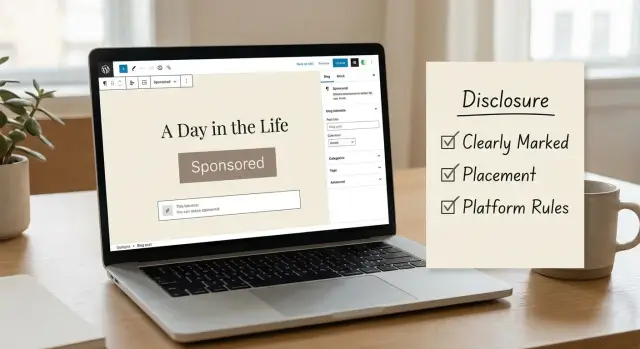
Why disclosure matters for paid link placements
If you pay for a mention or a backlink, readers deserve to know. Disclosure isn't a legal formality. It's a trust signal that protects your brand, the publisher, and the audience from feeling misled.
When disclosure is missing, what goes wrong is usually simple and public. A post reads like an independent recommendation. Later someone finds an invoice, an email thread, or a rate card. Then the story becomes “they tried to hide it,” even if your product is good.
The PR risk tends to show up in predictable ways: comment threads get derailed with “Is this an ad?”, screenshots get shared with a negative caption, competitors call it out, or the publisher quietly edits the post later, which makes you look like you were trying to be sneaky. Sometimes it lands closer to home, like a client or partner asking uncomfortable questions after they notice the placement.
Disclosure is also about tone. Small wording choices change how people react. “Sponsored” or “Paid partnership” is clear and neutral. Vague labels like “Thanks to our partners” can feel like you're dodging the point. Overly loud labels can backfire too, because they make the whole page feel like an ad.
The best outcome is when disclosure feels normal and upfront. A short label near the top of a tech blog post keeps readers oriented. The content can still be useful, but the relationship is clear.
This matters even when you purchase placements through a curated inventory service. Paying for access to authoritative sites can be a smart marketing move, but the reputational upside only holds if the placement is transparent and doesn't surprise the audience later.
What “sponsored disclosure” actually means
Sponsored disclosure is a plain-language note that tells readers a brand paid (or otherwise compensated) for a mention. The goal is simple: a normal reader shouldn't have to guess why the brand is featured.
It helps to separate three things that often get mixed up:
- The on-page label (what readers see): a clear cue like “Sponsored” or “Paid placement.”
- The link attribute (what search engines see): an HTML setting like
rel="sponsored"orrel="nofollow". - The agreement terms (what you and the publisher set in writing): what each side promises about labeling, edits, timing, and what happens if something goes wrong.
These pieces work together, but they aren't interchangeable. A link attribute doesn't inform readers. A label doesn't tell search engines how to treat the link. And an agreement doesn't help if the disclosure never appears on the page.
Not every paid relationship looks the same. A paid placement is direct payment for inclusion or a mention. An affiliate link pays only if someone buys (and still needs a clear disclosure). A gifted product or free trial can still count as compensation in many contexts, even if no cash changes hands. An editorial mention is different: no compensation, no control, and no expectation of a link.
A common trap is thinking a soft “thank you” is enough. “Thanks to Brand X for supporting this post” can sound like general appreciation, not a clear statement of sponsorship. If money, free service, or a perk influenced the content, use a direct label that says so.
Where to place the disclosure so readers actually see it
Disclosure only works when a real reader notices it. If someone has to hunt for it, you still have a compliance and PR problem, even if the words exist somewhere on the site.
The safest placement is right where the endorsement or link appears. A short label next to the mention keeps things simple: “Sponsored”, “Paid partnership”, or “Advertisement”. This matters most for list posts (“Top tools for...”) and product roundups, where readers scan quickly and may never reach the bottom.
A second option is a one-sentence disclosure near the start of the article, before the first paid mention. Keep it plain and specific, like: “This article contains paid placements.” If there are only one or two paid links, pair that top note with a small label near each paid mention so readers don't have to remember a single sentence from the intro.
Publisher disclosure pages (or an author bio note) can help as backup context and show a pattern of transparency. They fail when the only clear disclosure lives off-page, because most visitors won't go looking for it.
For social posts and newsletters, keep the label as close to the link as possible. People skim, screenshots travel, and context gets lost when content is forwarded.
If you're deciding what to require, the easiest placements to defend are the obvious ones: a short label beside the paid mention, a clear note near the top before any paid links, and repeated labels for each paid link in long articles. For email and social, put the label on the same line as the link (or immediately before it).
Practical labels that are clear and low-drama
A good disclosure label does two jobs: it tells readers what's going on, and it doesn't make the page feel like a legal warning. When you're paying for a placement, simple language usually reduces both compliance and PR risk.
Labels that readers understand
Use plain terms that match what happened.
- Sponsored: The most common. Signals money or other value was exchanged.
- Ad: Clear, but can feel louder and more salesy than you want for an article-style placement.
- Paid post: Very direct. Works well when the whole piece is paid.
- Partner content: Fine when there's a real partnership, but it can sound like editorial if it's not explained.
Avoid labels that look like normal site navigation, such as “From our partners”, “Featured”, “Recommendations”, or “Resources”, unless they also include an explicit paid disclosure. Those can confuse readers because they read like regular editorial sections.
Sample disclosure lines
Keep it short, near the start of the content, and written for humans.
- “Sponsored: This section was paid for by [Brand].”
- “Advertisement: [Brand] paid for this post.”
- “Paid placement: We may receive compensation for this mention.”
- “Partner content: This page includes a paid promotion from [Brand].”
Pick one wording and use it across similar placements. Consistency sets expectations. If every paid mention uses the same label, readers and publishers are less likely to argue about what “counts” as sponsored.
Link attributes: sponsored, nofollow, and what to ask for
A clear on-page label is only half of the job. The other half is the link attribute, because search engines read that even when readers don't.
What rel="sponsored" is for
rel="sponsored" is meant for links that exist because money (or something with value) changed hands. It's a straightforward signal: this link is part of an ad or sponsorship deal. If you're paying for a placement, this is usually the cleanest match.
When rel="nofollow" is used (and why some still choose it)
rel="nofollow" is older and more general. It tells search engines not to treat the link like an editorial recommendation. Some publishers use nofollow for all non-editorial links because it's their standard, their CMS defaults to it, or they want one simple rule for every paid mention.
Either option can be appropriate, but avoid mixed signals. The biggest mismatch is when the page clearly says “Sponsored” or “Paid” but the link is left as a normal dofollow link. That can look like you're saying the right thing to readers while hiding the relationship from search engines.
When you pay, ask for one of these outcomes:
- Best match: disclosure label +
rel="sponsored" - Common alternative: disclosure label +
rel="nofollow" - If they use both:
rel="sponsored nofollow"is fine
To make it easy for the publisher, you can share an example they can copy:
<a href="https://example.com" rel="sponsored">Brand</a>
How to confirm the attribute without turning it into a technical project
You don't need to read code all day. Use one quick check.
Ask the publisher for a screenshot of the link settings in their editor (many CMS tools show “Sponsored” or “Nofollow” as a toggle). If you're comfortable, right-click the link on the live page and use “Inspect” to see if rel="sponsored" or rel="nofollow" is present. And if you want a simple paper trail, ask them to confirm in writing what rel value they will use, before payment.
Step-by-step: set disclosure rules before you pay
If you wait until after the post is live, disclosure turns into an awkward negotiation. Set the rules first and you lower both compliance risk and the chance of a public complaint later. Treat disclosure like a deliverable, not a “nice to have.”
Here’s a sequence that works for most publishers and creators:
- Agree on what you're buying. Be specific: is it a short mention, a full review, a spot in a “best tools” list, or a fixed link placement inside an existing article? The format affects what readers expect and how obvious the relationship needs to be.
- Pick the disclosure label and exact wording. Decide the label before anyone drafts copy. “Sponsored” or “Paid partnership” is usually clear. If you need a sentence, keep it plain: “This section is sponsored by [Brand].” Avoid vague terms like “collaboration” if money is involved.
- Set link attribute expectations and how you'll verify. Confirm in writing whether the link will use the sponsored attribute, nofollow, or no followed link at all. Also agree on what “live” means: you will check the page source (or get a CMS screenshot) and confirm the attribute is present.
- Confirm edit rights and what happens if the page changes. Ask what happens if the publisher updates the article later, removes your mention, or changes the label. Decide whether you get approval on material edits and how quickly they must fix issues.
- Document everything. Keep the invoice, a short email summary of the terms, and screenshots of the disclosure and the link as published.
A real-world example: you pay for a spot in a “Top accounting apps” list. Before paying, you agree the entry will be marked “Sponsored,” the link will use the sponsored attribute, and you’ll get a heads-up before any future edits to that section. That one page of agreement prevents most problems later.
Common mistakes that create compliance and PR risk
Most disclosure problems aren't about one bad label. They happen when the disclosure is hard to notice, hard to understand, or treated like something to hide. That's when readers, publishers, and sometimes platforms start asking uncomfortable questions.
A frequent misstep is burying the note in a footer, a terms page, or a tiny, low-contrast font. If a reasonable reader can miss it, assume it will be seen as misleading. Put it where the paid mention appears, and make it easy to read on mobile.
Another issue is using soft language that never actually says money changed hands. Words like “partner” or “in collaboration” can be true and still unclear. If you're aiming for clarity, say it plainly: it was paid or sponsored.
The patterns that tend to create the most trouble are also the most avoidable: hiding disclosure in site-wide areas instead of near the content, using vague labels, trying to ban disclosure in the agreement, paying through a third party to “avoid” disclosure, or being inconsistent (some placements disclosed, others not).
A realistic example: you pay for a “Top tools” list mention on an industry blog. If the article has no clear label, and your brand is the only one with a dofollow link, readers may assume the ranking is editorial. If the relationship is later revealed, the story becomes about trust, not your product.
Agreement terms worth having in writing
If money changes hands, treat it like a small contract, even if it's just an email thread with clear terms. A simple written agreement reduces confusion, protects both sides, and makes disclosure far less risky.
A good starting point is to lock down five items in plain language:
- Disclosure requirement and exact wording: specify the label you want (for example, “Sponsored” or “Paid partnership”) and where it must appear. Ask the publisher not to rewrite it or move it below the fold.
- Link attribute requirement: state whether the link must use
rel="sponsored"(ornofollow), and confirm it applies to the specific URL you're paying for. - Approval flow and timing: define whether you see a draft, who can request edits, and how long each review step takes.
- Edit and removal policy: cover what happens if the page is updated later, the link gets removed, or the disclosure disappears.
- Responsibility and indemnity: clarify who is responsible for compliance with advertising and platform rules, and who covers costs if a claim or complaint happens.
For the approval flow, keep it time-bound. Example: draft shared by a set date, one round of edits within 2 business days, final proof sent before publishing. If the publisher won't allow pre-approval, require a screenshot or staging view of the final placement before it goes live.
Edits after publishing are a common surprise. Add a simple “page integrity” promise: the disclosure stays visible, the link stays live for a minimum term, and meaningful changes (headline, positioning, or link target) require your written OK.
Example scenario: a paid list mention done the safe way
A SaaS brand (say, an invoicing tool) pays to be included in a publisher’s “Top tools for freelancers” list. The goal is a relevant mention and a link that sends real readers, not a placement that blows up later.
Before paying, the brand asks for two things: a clear label and the right link attribute. The publisher agrees to add a short note near the top of the article and a small tag on the specific list item.
The publisher's wording is plain: “Sponsored: some tools below are paid placements.” It appears directly under the headline, before the list starts, in the same font size as the intro. On the brand's list item, there's a small “Sponsored” label next to the tool name.
Readers typically react well because nothing feels hidden. People can still use the list, and the disclosure doesn't read like a warning label.
After the article goes live, the brand does a quick audit and saves proof while it's accurate:
- Confirm the disclosure is visible before the list starts.
- Check the exact label text (no vague “partner” language).
- Verify the link uses the agreed attribute (
rel="sponsored"orrel="nofollow"). - Take screenshots of the top of the page and the specific list item.
- Save the invoice and the email that confirms disclosure and link rules.
One small wording tweak can prevent a negative thread. If the publisher originally wrote “Our partners,” the brand asks to change it to “Sponsored” or “Paid placement.” “Partner” can sound like the publisher is trying to make it feel editorial. “Sponsored” tells the truth in one word.
Quick checklist before and after a placement goes live
When money changes hands, treat each placement like a small release: you want clear disclosure, the right link settings, and proof in case anything is questioned later.
Before it goes live
Confirm expectations in one email or doc.
- Disclosure is planned where a normal reader will notice it (near the headline, intro, or the link itself), not buried in a footer.
- Wording is plain: it should say it's paid, sponsored, or an ad.
- The link treatment is agreed upfront (for example, sponsored or nofollow).
- You know who can fix issues after publishing and how quickly they respond.
- You define what “done” means: live date, duration, and whether changes need your approval.
After it's live
Open the page like a reader first, then verify details.
- Find the disclosure quickly without hunting.
- Check the exact disclosure text and placement match what you approved.
- Verify the link attribute in the page source.
- Save proof right away: a dated screenshot of the disclosure and link, plus a copy of the invoice or payment record.
- Set a reminder to recheck later in case the page is edited, noindexed, or removed.
Next steps: set a repeatable process for paid placements
The safest way to handle paid placements is to stop treating each one as a one-off. Write a simple policy, use it every time, and you avoid last-minute debates when an editor asks, “How do you want this labeled?”
Start with a standard rule set your team can reuse: what disclosure label you want, where it should appear, and what link attribute is acceptable. Keep it short and specific, including what happens if the disclosure is moved or removed.
A lightweight intake form also helps. Someone can fill it out quickly, and it gives approvals something concrete to check:
- Placement type (review, list, guest post, sidebar)
- Compensation type (cash, free product, affiliate) and amount
- Required label and where it will appear
- Required link attribute (sponsored, nofollow) and any exceptions
- Owner and deadline (who approves, who verifies after publish)
Choose partners who are comfortable being transparent. If a publisher resists clear labeling or tries to hide the relationship, the risk usually lands on you later.
If you're buying placements through a provider like SEOBoosty (seoboosty.com), bake disclosure and link-attribute requirements into your default instructions. That way, even when you're selecting from curated inventory, every placement follows the same visible, defensible rules.
FAQ
Do I really need to disclose a paid backlink or mention?
Because readers assume a recommendation is independent unless you say otherwise. A clear disclosure prevents the “they tried to hide it” narrative if someone later finds out the mention was paid, and it protects both the brand and the publisher from trust damage.
What’s the simplest disclosure wording that won’t cause drama?
Use plain words that match what happened: “Sponsored” or “Paid partnership.” If you need a sentence, keep it direct, like “This section is sponsored by [Brand].” Avoid soft labels that don’t clearly say it was paid.
Where should the disclosure go so readers actually notice it?
Put it where a normal reader will see it without hunting. The safest default is a label right next to the paid mention, and a short note near the top before the first paid link if the page has multiple placements or a scannable list.
Is an on-page “Sponsored” label enough, or do I also need a link attribute?
They solve different problems. The on-page disclosure informs readers, while link attributes tell search engines how to treat the link. You generally want both: a visible “Sponsored” label for people and an appropriate rel value for the link.
Should paid links use rel="sponsored" or rel="nofollow"?
For paid placements, rel="sponsored" is the most direct signal. Some publishers use rel="nofollow" as a blanket rule for any non-editorial link, which can also be acceptable. The main thing is to avoid a mismatch where the page says “Sponsored” but the link is left as a normal followed link.
How can I quickly verify the link attribute without being technical?
Ask for proof before or right after publication. A simple approach is to request a screenshot from the publisher’s editor settings showing the link is marked sponsored or nofollow, and then spot-check the live page by inspecting the link to confirm the rel value is present.
Do affiliate links or gifted products need disclosure too?
Yes, if compensation influenced the mention. Affiliate links and free products still create a material relationship that readers shouldn’t have to guess. Keep the disclosure straightforward so it’s clear the mention isn’t purely editorial.
What terms should I set before paying for a placement?
Get it in writing as a deliverable: the exact disclosure wording, where it will appear, and which link attribute will be used. Also clarify what happens if the publisher edits the page later, moves/removes the label, or removes the link, so you’re not renegotiating after it’s live.
What are the most common disclosure mistakes that create PR risk?
Burying disclosures in footers or off-page policies, using vague “partner” language that never says it’s paid, and being inconsistent across placements are common triggers. Another frequent issue is treating disclosure as optional and trying to “fix it later,” which often turns into an awkward public correction.
If I buy placements through a service like SEOBoosty, does disclosure still apply?
You should still require the same visible disclosure and link-attribute rules as if you negotiated directly. If you’re using a curated inventory service like SEOBoosty, provide default instructions up front so every placement follows the same labeling and rel expectations, and save screenshots once it’s live.
Share