Supporting Knowledge Panel with Links for Stronger Entity Trust
Learn supporting knowledge panel with links using authoritative mentions, consistent facts, and entity signals that help Google trust and verify your brand.
Why Knowledge Panel data can feel unreliable
A Knowledge Panel is the information box that sometimes appears on Google when you search for a person, brand, or organization. It can show basics like a short description, a logo, founders, social profiles, and key dates. Some brands see it often, others never get one, and some get a panel that changes week to week.
That inconsistency usually comes down to one thing: Google isn't fully sure which facts belong to which entity. Google tries to build a single, stable profile in its Knowledge Graph, but it needs clear, repeated confirmation from sources it already trusts. When different sites say different things, or say the same thing in different ways, Google hesitates.
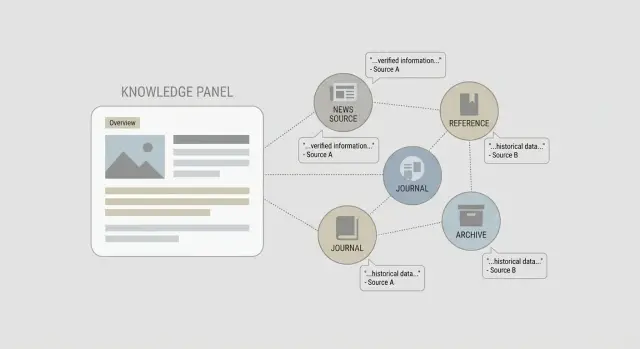
This is where supporting a Knowledge Panel with links matters. A link isn't just a path for users. It's also a clue that connects a name, a website, and a set of facts across the web. When those clues point in mixed directions, the panel looks unreliable.
Weak entity signals tend to show up in familiar ways: a missing panel for a well-known brand, a panel that only appears sometimes, the wrong logo or category, missing or incorrect founders and dates, confusion with a similar name, or multiple "official" websites showing up in different places.
Google is cautious for good reason. If your brand name, location, and ownership details vary across mentions, Google can't tell which version is accurate. Even small differences like "Inc." vs "Ltd," an old address vs a new one, or two bios that contradict each other can add doubt.
The practical fix is to corroborate the few facts you care about using credible, authoritative mentions. Not all mentions carry equal weight, so the goal isn't "more coverage." The goal is consistent, high-trust signals that repeat the same entity details in the same direction.
The basics: entities, Knowledge Graph, and trust signals
Google doesn't only look for keywords. It also tries to understand entities: real-world "things" like a person, a company, a product, a city, or a book. An entity is more like a profile than a phrase. It has attributes (name, website, founder, headquarters, social handles) and relationships (works for, located in, owned by).
That's why entity SEO often feels different from traditional SEO. Ranking for a query is about matching what someone typed. Building entity trust is about making sure Google can confidently say, "This is the same organization everywhere I see it."
Knowledge Graph vs search results (simple version)
Search results are mainly about returning the best pages for a query. The Knowledge Graph is about storing facts and connections so Google can answer questions quickly and consistently. A Knowledge Panel is one visible output of that system.
"Consistent signals" simply means the same key facts show up again and again across sources Google already trusts. The name is written the same way. The website is the same. The category doesn't swing between unrelated descriptions (for example, "marketing agency" in one place and "software company" in another). Small mismatches can be enough to slow things down.
Why mentions and links help (even without exact anchor text)
A mention is any place your entity is referenced. A link is a stronger type of mention because it creates a direct connection between a trusted page and your site (or a specific page about you). When you support a Knowledge Panel with links, the goal isn't to force exact-match anchor text. It's to reinforce identity.
For example, "Acme Analytics" mentioned on a well-known publication with a link to acme.com can still help even if the clickable text says "Acme" or "the company website." What matters is that the surrounding context clearly identifies the same entity.
Over time, trust tends to build when sources repeatedly use your official name, point to the same canonical website, match key facts (like location and leadership), and come from publications that already have strong reputations.
Pick the few facts you want Google to be confident about
If your brand shows up in different ways across the web, Google has to guess which details are true. The goal isn't to push every possible fact. It's to pick a small set of details that should be consistent everywhere.
Start with your entity name. Decide the exact spelling you want to win, plus 1-2 common variations you can live with (for example, "Acme Analytics" vs "Acme Analytics Inc."). Avoid creating new nicknames just for marketing if you don't already use them publicly.
Next, lock down your official website. Choose the one canonical domain you want associated with the entity, plus one preferred version of it. If some pages or profiles point to different domains, subdomains, or old company sites, you're asking Google to split trust.
Then choose only the people facts you can prove. A founder or CEO can be helpful when it's stable, public, and easy to verify across multiple sources. If the team changes often, keep this part minimal.
A simple way to define your "core facts" is to answer:
- What name should be shown to users?
- What site is the official home?
- What is the organization type and where is it based?
- What is the one-sentence "about" summary you want repeated?
- Which profiles should be treated as the same entity?
For that last point, be picky about the profiles you want connected. Only include profiles you control and actually maintain. A half-abandoned profile with an outdated logo or old URL can do more harm than good.
Example: a SaaS brand is listed as "BrightWorks," "BrightWorks.io," and "Bright Works LLC," with two different homepages and three slightly different descriptions. Instead of trying to fix everything at once, they choose one official name, one canonical domain, and one short description. Then they focus on consistent, authoritative mentions that repeat those exact details.
What counts as an authoritative mention (and what doesn't)
An authoritative mention is a page that helps Google trust a specific fact about your entity because the source looks real, stable, and accountable. When you're supporting a Knowledge Panel with links, the goal isn't to collect as many mentions as possible. It's to collect a few that send clean, consistent signals.
A quick test: would a person trust this site to get the detail right? If yes, Google is more likely to treat it as a dependable reference.
Signals that usually make a mention authoritative
Strong mentions tend to share traits that are hard to fake: a real publisher identity, visible editorial standards, topical fit, stable pages that remain indexed, and writing that reads like it was made for humans.
A good example is a respected industry publication profiling a SaaS company and stating its brand name, what it does, and where it is based. That single page can be more useful than hundreds of weak citations.
Mentions that look like noise
Some pages include your name and even link to your site, but still add little trust. Low-quality directories, scraped "company info" pages, auto-generated profile sites, and thin guest-post farms often create mixed signals. They also introduce errors (wrong category, old name, outdated address), which is exactly what confuses Knowledge Panels.
If a page exists mainly to list thousands of companies with the same template, it usually isn't a strong corroboration source. The same is true if the site has no clear ownership, no real content outside the listings, or pages that disappear and reappear.
How to structure mentions so they reinforce the same entity
Google is more likely to trust an entity when many sources describe it the same way. Small differences that feel harmless to people can look like separate entities to machines.
Start with the basics: pick one official name and stick to it everywhere, including spelling, spacing, and punctuation. If you sometimes write "Acme, Inc." and other times "ACME Inc" or "Acme," you risk splitting your signals.
Build a consistent fact pattern
A strong mention isn't just a name in a sentence. It's a short, factual description that helps Google connect the dots. Keep it plain and easy to verify.
In practice, good mentions include a few basics in normal language: what the entity is, where it's based or primarily operates, what it does (in one clear sentence), and the official website domain.
Keep the website signal clean
If you want Google to connect mentions back to your entity, the official domain should match across sources. Avoid mixing multiple domains, old domains, campaign-specific domains, or tracking-heavy URLs in your citations.
Also watch for subtle mismatches: using the bare domain in one place and a different subdomain elsewhere, or pointing to a redirected domain that still shows up in older profiles.
Write like a reference, not an ad
Entity reinforcement works best when the writing sounds neutral. Skip hype and hard-to-prove claims. Prefer statements that a reader could verify quickly.
For example: "SEOBoosty provides premium backlinks from authoritative websites. Customers select domains from a curated inventory and point the backlink to their site through a subscription." That kind of wording aligns details without sounding promotional.
Step-by-step: using links and mentions to support entity presence
If you want Google to trust an entity, give it the same story in multiple trusted places. The goal of supporting a Knowledge Panel with links isn't to create new claims, but to corroborate a few simple facts with consistent wording and clear associations.
Start by checking what Google already sees. Search your brand name, founders or spokespeople, product names, and common misspellings. Note which profiles rank, which names are used, and whether you're being mixed up with a similar entity.
Next, make a one-page facts sheet you can share internally. Keep it boring on purpose: official name, short description, founders, launch year, headquarters city, and a single canonical website. Decide on 3 to 5 facts that matter most for identity, not marketing.
A practical order of operations:
- Lock your top facts and the exact wording.
- Identify the pages that already rank for your entity and update bios and descriptions to match.
- Refresh your About page so it states the same facts in plain language.
- Use structured data only if it reflects what the page says.
- Earn a small number of authoritative mentions that repeat those facts and point to the same canonical site.
For authoritative mentions, prioritize sites that Google already trusts in your category. One good mention that states your official name, describes what you do, and references your homepage can beat dozens of low-quality listings.
Finally, monitor for drift. Set a monthly reminder to re-run the searches, check for new profiles, and fix inconsistencies fast. Entity SEO is less about one big push and more about keeping your facts consistent everywhere Google looks.
Common mistakes that weaken Knowledge Panel signals
A Knowledge Panel usually gets shaky for one reason: Google sees conflicting clues about who you are, what you do, and where you belong. Links can help, but only if they reinforce the same entity story.
1) Name collisions and "wrong you" confusion
If your brand or founder name matches a public figure, a local business, or another company, Google may blend signals. This shows up as the wrong logo, the wrong industry, or unrelated profiles appearing in results.
One reliable fix is to make authoritative mentions include extra identifiers like category, location, and a consistent short description.
2) Splitting signals across domains and old URLs
One of the most common issues is mixing multiple domains across bios and profiles. For example, your About page uses one domain, a founder bio points to an older site, and a press mention links to a campaign URL. That creates multiple "homes" for the same entity.
Keep one primary site as the main reference point, and treat old domains as redirects and historical artifacts, not current identity.
Common patterns that cause splits include different website URLs across bios, old domains still listed as "official," multiple About pages that describe the brand differently, and separate logos used across properties.
3) Inconsistent location details
Location sounds minor, but it's a strong entity clue. "Based in Austin," "headquartered in Texas," and "operating worldwide" can all be true, yet together they can look like uncertainty if repeated without a clear primary location.
Pick one standard wording for city and country, and use it everywhere that matters.
4) Over-optimizing anchors and repeating the same phrasing
When every mention uses identical anchor text and identical bios, it can look manufactured. Allow natural variation. Use the brand name often, but don't force the same keyword-rich phrase on every mention.
5) Chasing quantity over credible confirmations
Ten weak mentions rarely beat two strong ones. A couple of authoritative, well-edited pages that clearly describe the entity, point to the same primary site, and match your key facts can do more for trust than a pile of low-quality citations.
Example scenario: cleaning up a brand with mixed signals
Picture a small SaaS company called Northpeak Labs. Their product is called Northpeak, and the founder is Maya Chen. Over the last two years they've used different logos, and some articles call the company "North Peak" with a space.
What Google shows is messy: sometimes there's no Knowledge Panel at all, sometimes the logo is an old icon from a retired landing page, and sometimes the results look blended with another "Northpeak" in a different industry.
They decide to focus on three facts and make them consistent everywhere: the official website and brand spelling, the product category (for example, "customer feedback software"), and leadership (Maya Chen as founder/CEO).
The fix isn't "more content." It's making sure authoritative sources repeat the same story, with the same names, and point to the same entity.
Northpeak starts by tightening their own signals (site logo, About page, product page copy, Organization schema, and founder bio) so there's one clear version. Then they add a few high-trust mentions that echo those same three facts.
What to expect:
- Changes are usually gradual, often over weeks to a few months.
- Some volatility is normal as Google reconciles sources.
- A panel isn't guaranteed just because you got a few mentions.
- Logo swaps can lag if old images still circulate.
The win is when the same entity details repeat across trusted sources. Once that happens, Google has fewer reasons to doubt which Northpeak is which.
Quick checklist to sanity-check your entity signals
If you're supporting a Knowledge Panel with links, you want Google to see the same story about your brand in a few reliable places, again and again.
Start with five fast checks:
- One official domain used consistently.
- The same name and one-sentence description across your key surfaces.
- A few independent, reputable third-party pages that mention you and reference your official site.
- No conflicting core facts (founders, location, category).
- Branded search results that look clustered around one entity, not multiple versions.
A simple 10-minute test: search your brand name and write down the top results that look official (your site, top profiles, notable mentions). Compare the name, description, and core facts side by side.
Example: if SEOBoosty is described as an "SEO agency" in one place and a "backlink subscription service" in another, that mismatch can slow trust. Pick the most accurate wording and align it across your core pages first.
Next steps: a simple plan you can repeat
Pick a handful of facts you want Google to be confident about, then make those facts easy to verify in a few strong places. When the same details show up consistently, the signals add up and your entity becomes easier to trust.
Start small: choose 3 to 5 "always true" facts (exact brand name, primary website, what you do in one sentence, and one or two key people or locations). Then get those facts confirmed in a couple of reputable sources that have a history of being referenced.
Write down your preferred version of the basics and treat it like a style guide. Keep it simple: one official name, one short description, one canonical URL, and consistent logo and handle formatting everywhere you control.
If getting high-quality mentions is the bottleneck, services like SEOBoosty (seoboosty.com) can be useful when the placements themselves are on established publications and the surrounding text is written like a neutral reference. The key stays the same either way: consistent entity facts, repeated in credible places, pointing back to the same home on the web.
Share