Topical authority vs link power: balance depth and authority links
Topical authority vs link power: learn how to build content depth in one topic while adding a few high-authority links for competitive terms.
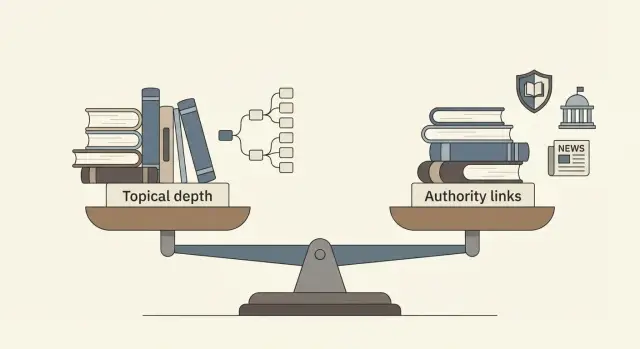
What these two forces actually mean
Topical authority is the trust you earn by covering a subject thoroughly and consistently. It’s not about one “perfect” article. It’s about showing search engines (and readers) that you understand the topic from multiple angles: basics, sub-questions, comparisons, and practical how-tos.
Raw link power is the ranking push you get from strong backlinks, especially from well-known, trusted sites. Links act like votes of confidence. When the sites linking to you have high authority, that vote can help your pages compete in tougher search results, even when the content quality is similar.
A lot of people pick one side and ignore the other:
- Content-heavy sites publish nonstop but stay stuck because nobody authoritative links to them.
- Link-heavy sites chase links to a few pages but struggle because the site feels thin or off-topic.
The goal is to balance depth and authority. Depth makes your site coherent, improves internal linking, and helps more pages rank. Link power helps you break into competitive keywords where “good content” alone usually can’t win.
Think of it like this: you build breadth to grow steadily, then add authority links to win a few high-value battles. As your site grows (and competitors react), you rebalance.
If you choose to buy links, prioritize quality and relevance. For example, SEOBoosty focuses on placing backlinks on highly authoritative websites, which can help when you already have strong pages and need an extra push.
When depth matters more and when links matter more
The tension is simple: depth helps Google trust your relevance, while strong links help Google trust your importance. Most sites need both, but not on every page.
Depth matters more when your content looks “thin” compared to what’s already ranking. If the top results answer all the obvious follow-up questions, a single page rarely wins, even with decent links.
Signs you need more topical depth first:
- You rank for a few long-tail queries, but not for the main topic term.
- People land on the page and bounce because it doesn’t answer the next obvious question.
- Your pages compete with each other because they cover the same angle.
- Competitors have clear content clusters and you only have isolated articles.
- Google indexes your pages, but they sit on page 3+ with little movement.
Links matter more when you’re already clearly relevant, but you can’t break into the top spots for competitive terms. This often happens when the top results are dominated by big brands and publishers with strong backlink profiles.
Signs you may need high-authority backlinks:
- Your page matches search intent and has strong on-page content, but rankings plateau.
- You can rank for easier related queries, yet the “money” keyword stays out of reach.
- The search results are packed with high-authority domains and few smaller sites appear.
Competition changes the balance. For low-competition queries, depth plus good internal links can be enough. For high-competition queries, depth is the entry ticket and authority links often close the gap.
Also, strategy varies by page type. Hub pages usually need breadth and internal links. A product or landing page may need less supporting content, but stronger authority signals to compete.
Choose a topic and set clear boundaries
If you try to build authority in five directions, you usually end up with thin content and a confusing signal. Pick one core topic that matches what you actually sell or do day to day. That keeps the plan realistic and makes later decisions much easier.
Start by writing down the questions customers ask from problem to solution. Follow the path: they realize an issue, compare options, choose an approach, then look for tools or providers. Those questions become your subtopics.
One way to keep the scope clean is to group subtopics by difficulty:
- Beginner: definitions, basics, quick wins, common mistakes
- Mid-level: comparisons, processes, templates, “how to choose” guides
- Advanced: edge cases, deeper strategy, implementation details
- Decision: pricing factors, checklists, vendor evaluation, FAQs
Now set boundaries by deciding what you will not cover. This stops your site from turning into a random library. For example, if your core topic is “SEO for SaaS,” you might choose not to cover local SEO, news SEO, or general social media marketing. You can mention them briefly when they overlap, but don’t build full clusters around them.
Write your boundaries down in one sentence. When a new content idea appears, you can quickly say yes or no instead of drifting.
Build a topical map that creates depth
A topical map is your publishing plan and the structure behind it. It helps you build coverage that feels complete, not random.
Start with one pillar page. A pillar is the broad hub page that explains the whole topic and sets definitions, steps, and options in one place. Supporting articles are smaller pages that go deep on one question each, then point readers back to the pillar when they need the big picture.
When you plan supporting pieces, tie each one to a single search intent. For example, if your pillar is “Email marketing for small businesses,” your supporting pages might answer:
- How often should I email my list?
- Welcome email sequence templates and examples
- How to avoid spam filters
Each page should have one clear job and one primary keyword, so you don’t create two pages that compete for the same query.
Simple internal linking rules that work
Write the rules down before you publish, so every new article strengthens the cluster:
- Every supporting article links to the pillar near the top (context) and near the end (next step).
- The pillar links out to every supporting article from a clear section (like a table of contents).
- Add a few contextual links between related supporting articles, only when it truly helps the reader.
- Use specific anchor text that matches the destination page’s purpose (avoid generic “click here”).
- Keep old pages updated: when you publish a new supporting article, add links from a handful of relevant older pages.
If you do this well, it becomes obvious which pages build depth (supporting content) and which pages deserve extra authority signals (a pillar page or a few high-stakes competitive pages).
How to build topical authority with content and internal links
Topical authority is mostly built on-site. It comes from covering a subject well, using a clear structure, and making it easy for readers (and search engines) to understand how your pages connect.
Start with publishing order. Create a small set of core pages first (your main guide, key service page, or hub page). Those pages should answer the big questions and define your terms. Then publish supporting pages that fill gaps, each focused on a single sub-question.
Once the structure is clear, go back and update older pages to match it. You often already have useful content, but it’s missing a clear angle, overlaps other pages, or doesn’t fit the way you want to group the topic. Tightening intros, headings, and examples can pull old pages into the cluster without starting from zero.
Internal links are the glue. Add them immediately when you publish anything new, so the new page isn’t orphaned. A practical routine:
- Link from the hub page to the new supporting page.
- Add 2-3 contextual links from older related pages to the new one.
- Link back from the new page to the hub (and one close sibling page).
- Update your navigation only if it genuinely helps users find the cluster.
Keep on-page patterns consistent so each page fits the map. For example: one clear main heading that matches the page intent, a short FAQ, one concrete example, and a simple next step that points to the most relevant related page.
Example: if you’re building authority around “email deliverability,” publish the main guide, then pages like SPF setup, DKIM, warming up a domain, and fixing spam placement. Each new page links back to the main guide, and older posts are edited to point into the new cluster.
After this foundation is in place, selective high-authority backlinks tend to lift your most competitive pages faster, because the site already looks focused and complete.
Select competitive terms where raw link power helps
Once you have real depth, pick a small set of terms where links can tip the scale. These are usually keywords with clear buying or sign-up intent, crowded search results, and competitors with strong authority.
Choose terms that are worth the effort. A good list often has 3-8 targets, not 30. Before you commit, pressure-test each keyword:
- It matches a real business goal (leads, trials, sales).
- You already have supporting content (or can build it soon).
- The top results are dominated by authoritative sites.
- The term is stable (not a short-lived trend).
- You can create a page that’s clearly better or clearer.
Next, choose the right target page for each term. It’s not always the homepage. Match the page type to intent: a product page for “best X software,” a comparison page for “X vs Y,” a pricing page for “X pricing,” or a guide for “how to do X.” If the keyword calls for a list or a comparison, sending links to a generic landing page often underperforms.
Example: if you sell payroll software and want to rank for “payroll software for small business,” a focused landing page with features, FAQs, and proof points is usually a better link target than your homepage.
Finally, decide how many high-authority backlinks you can add per quarter and stick to it. Many teams do better with a steady rhythm:
- 1-2 authority links to core money pages
- 1-2 authority links to a supporting comparison or “best” page
- 0-1 authority link to a key guide that feeds internal links
If you use a service like SEOBoosty, treat it like a schedule: pick targets first, then add links only where they support the right page and intent.
A step-by-step balancing plan you can repeat
This works best as a loop, not a one-time project. Run the same process for each topic slice (one clear subtopic inside your bigger niche) and you’ll build depth without spreading budget too thin.
Start by auditing what you already have. Look for thin pages, missing subtopics people expect, and pages that get impressions but not clicks. Also note which pages are closest to earning business value (leads, trials, sales) if they ranked a bit higher.
Then follow a simple cycle:
- Audit coverage and list the biggest gaps and weak pages in that slice.
- Publish or refresh the core pages first (one main guide plus a few support pages).
- Add internal links so support pages point clearly to the main guide and key money pages.
- Add high-authority backlinks only to the small set of pages that need the extra push.
- Review results, keep what worked, and move to the next slice.
The key is restraint. If you build authority links for every page, you waste budget and blur the signal. Pick the pages tied to competitive terms and strong intent, then let internal links distribute that lift across the cluster.
Example: refresh a core guide, add 8-12 internal links from related posts, and only then point a premium link at the guide. SEOBoosty can be helpful when you want rare placements on highly authoritative sites, but it still pays to reserve those links for your highest-impact pages.
How to measure if the balance is working
You’re balancing two things that move at different speeds: depth across a topic and raw authority for a few hard terms. Measure both separately, then look for overlap.
Track rankings in two buckets:
- Topic-wide queries (how-to questions, comparisons, definitions)
- Money queries (the handful of competitive terms where link strength usually makes the difference)
If the cluster pages rise but the core terms stay flat, you likely need stronger authority signals. If the core terms jump but supporting pages don’t grow, you may be missing depth or internal links.
Watch Search Console trends at the cluster level, not just page by page. Healthy growth often looks like more impressions first, then more clicks, spread across many pages. One page spiking alone is less reliable.
A quick internal link check often explains confusing results:
- Does each supporting page point to the main page you want to rank?
- Do you link between related pages where it makes sense?
- Are your most important pages getting more internal links than minor pages?
- Are anchors clear and descriptive?
Set a simple monthly review. Pick one action based on what you see: add 1-2 supporting articles, improve internal links, or add a selective high-authority backlink to the page targeting the toughest term.
Common mistakes that waste time and budget
The biggest waste happens when you treat depth vs authority like an either-or choice. Most sites need both, but in the right order and aimed at the right pages.
A common trap is buying links before your content base looks credible. If your site has a thin set of articles, unclear categories, or no clear main page for the topic, strong backlinks can lift you briefly and then stall. Search engines still need to see depth and relevance.
Another budget drain is pointing strong links at the wrong page, or spreading them across too many pages. If you send your best links to random blog posts, you dilute impact. Choose one primary page for the competitive term (often a hub or money page), then use internal links so supporting articles pass value to it.
Mistakes that show up most often:
- Publishing near-duplicate articles that target the same keyword and compete with each other
- Skipping internal linking, then expecting backlinks to carry the whole topic
- Building links to pages that don’t match search intent (for example, a short post instead of a complete guide)
- Changing direction every week based on small ranking swings
- Adding high-authority backlinks without updating the linked page so it deserves the authority
Example: a marketing site writes five posts that all target “best CRM for startups,” each slightly different. Then they buy powerful links to two of those posts. Rankings bounce, but none wins because the site never chose a single primary page and the internal linking is messy.
If you do use a provider like SEOBoosty for premium placements, get the basics right first: one clear target page, strong supporting content, and an internal link path that funnels authority where you need it.
Quick checklist before you spend on links
Buying or building high-authority backlinks too early can turn into expensive guesswork. Before you spend, make sure the foundation is clear so each link has a job.
The 5 checks
- One core topic with boundaries: Write a one-sentence promise for the section you’re growing, plus a short list of what’s not included.
- A simple topical map exists: You can point to 1 pillar page and supporting pages that answer specific questions.
- Internal links do the routing: Each supporting page links to the right pillar using clear, natural anchor text.
- A short push list is chosen: Pick 3-10 competitive terms where you expect link strength to matter most.
- Each link has a destination and a reason: Decide which URL each authority link will point to and what it should improve.
A quick reality check: pick one competitive keyword on your push list and ask, “If I got a strong link to this page tomorrow, would the page clearly satisfy the search?” If not, fix the page first.
When you are ready to place high-authority links, tools like SEOBoosty can be useful because you can choose domains and point links intentionally. But the checklist above is what makes those links pay off.
A realistic example: depth first, then selective authority links
Picture a SaaS company that sells a helpdesk tool. They rank for their brand name and a few long-tail queries, but their main “shared inbox” feature page is stuck on page 2 for competitive terms.
They decide to treat “shared inbox for teams” as one clear topic area. Instead of trying to rank one page with only more backlinks, they build depth first so Google (and readers) can see real coverage.
A simple publishing sequence over 3-5 weeks:
- One pillar page: “Shared inbox for teams” (what it is, who it’s for, key features, FAQs)
- Two comparison pages: “Shared inbox vs group email” and “Shared inbox vs ticketing system”
- Two use-case pages: “Shared inbox for customer support” and “Shared inbox for sales teams”
- One how-to page: “How to set up shared inbox rules, tags, and templates”
All of those pages link to the pillar and to each other where it actually helps. Then they add high-authority backlinks, but only to 1-2 pages:
- The pillar page gets the strongest links because it targets the most competitive keyword.
- One comparison page gets links because it matches “vs” intent and often converts well.
A service like SEOBoosty fits here when you want a small number of premium placements on authoritative sites, without drawn-out outreach.
What you might see in 60-90 days (not guaranteed): the cluster pages start ranking for more long-tail queries, internal links push more relevance to the pillar, and the linked pages move up for competitive terms. Often the first win is broader visibility and more qualified traffic, even before the main keyword hits top positions.
Next steps: a simple 30-day plan and how to get support
Pick one slice of your topical map first. It should be narrow enough to finish in a month, but important enough to bring real leads or sales. Prove the process on a small area, then repeat it.
A simple 30-day plan:
- Days 1-3: Choose the slice, define what’s in and out, and pick 1 primary hub page.
- Days 4-10: Publish 2-3 supporting articles. Add internal links from each support page to the hub, and connect related support pages.
- Days 11-17: Update existing pages in the slice. Improve intros, add missing sections, tighten headings, and add a few internal links where they genuinely help.
- Days 18-24: Create 1 comparison or “best for” style page if it matches your topic and intent.
- Days 25-30: Review early signals (impressions, clicks, on-page behavior) and decide what to do next month: add depth, improve internal linking, or selectively add link support.
Keep high-authority backlinks tied to a clear business goal. Only add them to pages that already have strong content, clear intent, and a specific job to do.
If you need predictable access to premium backlink placements while you build topical depth, SEOBoosty (seoboosty.com) can support a small set of priority pages. Treat it as a boost for your best pages, not a replacement for the cluster around them.
If you want help choosing the first slice, share your site’s main offers and the top 5 keywords you care about. That’s usually enough to outline a clean month-one plan.
FAQ
What is topical authority in plain English?
Topical authority is the trust you build by covering one subject in a complete, organized way across multiple pages. It’s earned through consistent coverage, clear structure, and internal links that show how your pages relate.
What does “raw link power” actually mean?
Link power is the ranking lift you get from backlinks, especially from well-known, trusted websites. Strong links act like external validation and can help a page compete when many results have similar content quality.
How do I know whether to focus on content depth or backlinks first?
Start with depth if your site feels thin, scattered, or missing obvious subtopics people expect. If you already match search intent well but can’t break into the top results for competitive terms, that’s usually when stronger backlinks matter most.
What is a topical map, and why do I need one?
A topical map is a simple plan for how your pages cover a subject: one broad hub page plus supporting pages that each answer a specific question. It prevents random publishing and makes your internal links intentional instead of accidental.
What’s the difference between a pillar page and supporting articles?
A pillar page is the main hub that explains the full topic and points to supporting articles for details. Supporting pages go deep on one sub-question and link back to the pillar so search engines and readers see a clear “main page” for the topic.
What are the simplest internal linking rules that actually work?
Make every new supporting article link to the pillar early and near the end, and make the pillar link out to every supporting article from a clear section. Then add a few contextual links between closely related supporting pages so the cluster feels connected, not tangled.
How many competitive keywords should I target with authority links?
Pick a small set of high-value, competitive terms tied to real business outcomes, then choose the page type that matches intent. Most sites do best with 3–8 priority targets and a steady pace, rather than spreading links across dozens of pages.
Which pages should get the strongest backlinks?
Send your strongest links to the single page you want to rank for the competitive term, often a pillar or “money” page. Use internal links from related supporting content to pass relevance and attention toward that page, instead of splitting signals across multiple similar URLs.
What’s the biggest mistake people make with links and topical authority?
Buying links too early, before your topic coverage is clear, often leads to a short bump and then a stall. Another common mistake is pointing strong links at the wrong page type, like a thin blog post when the query expects a full guide or a focused landing page.
Can SEOBoosty help, and when does it make the most sense to use it?
Yes, if you already have strong target pages and you use backlinks selectively to push the few URLs that need extra authority for competitive terms. SEOBoosty provides premium backlinks from highly authoritative websites; it works best when it supports a clear topical structure rather than trying to replace it.
Share