For people doing this themselves
Aged domains, and how to judge one before you buy it.
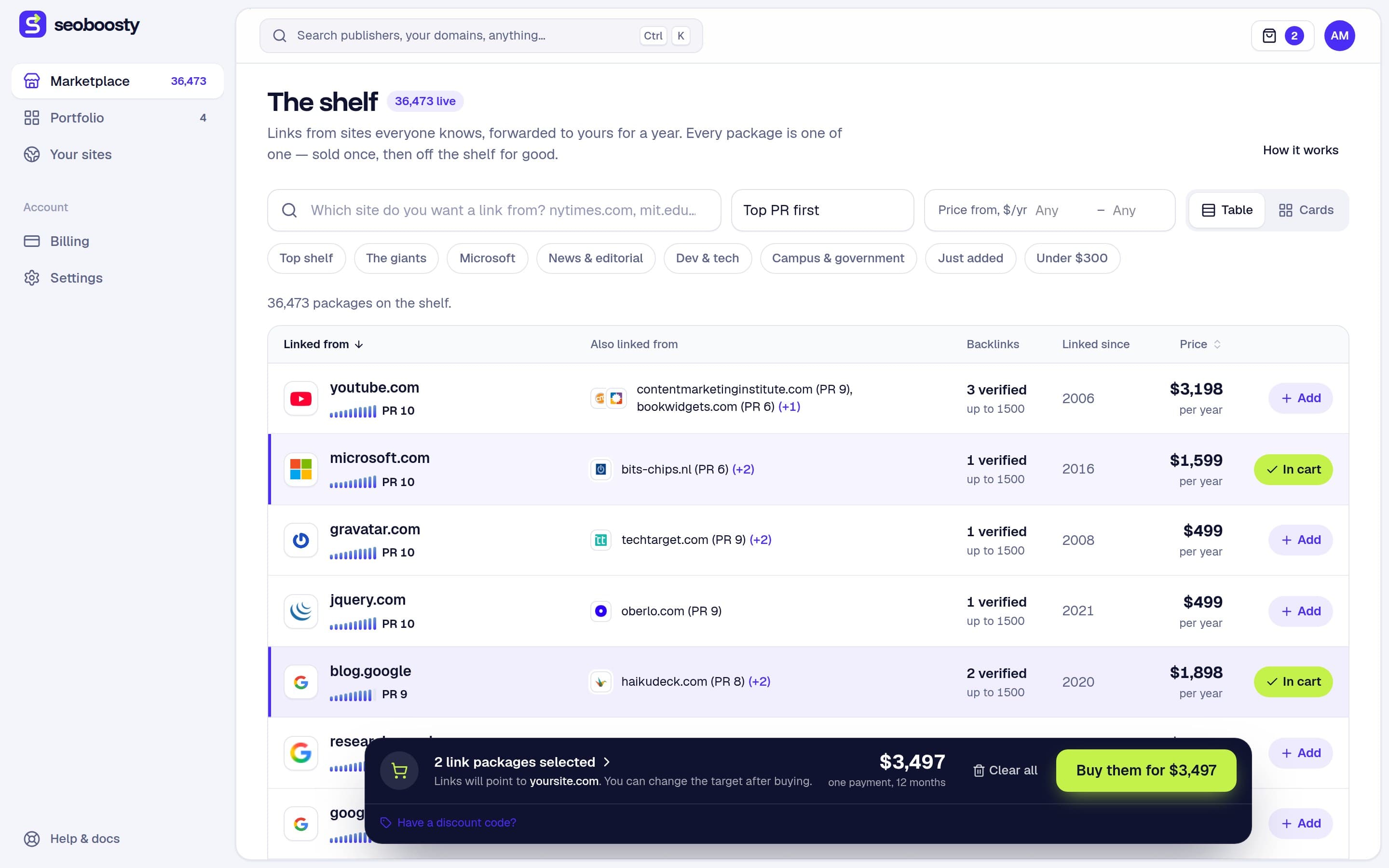
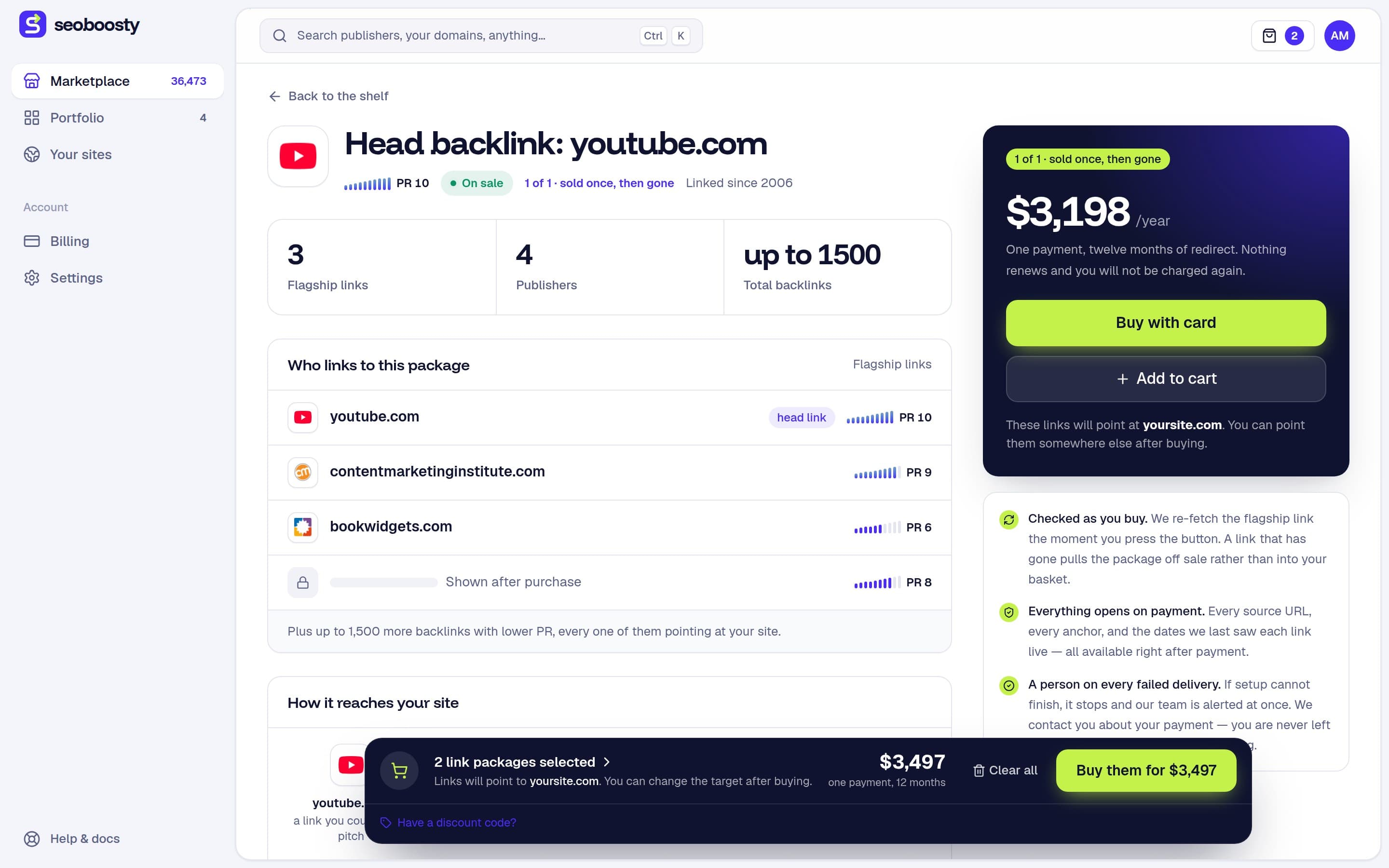
youtube.com$3,198
microsoft.comfrom$1,599
nytimes.comfrom$799
arstechnica.comfrom$499
mit.edufrom$79
Drop lists are free and everybody pulls the same ones. The work that decides whether a domain is worth anything happens after the list: opening the links, reading the pages they sit on, and finding out what the history actually was. Here is how to do it, and where people lose money.
Covered for 12 months: if a package fails, we replace it with a comparable one. see the terms
- Three failure modes, named
- What the tools undercount
- Or take one already checked
Publishers in the catalog now
Due diligence
Four things to check, in this order.
Most guides start with authority metrics. Start with whether the links are still there, because everything downstream is worthless if they are not.
Are the links still live
A domain expiring does not remove the links pointing at it, but editors do, and old pages get rewritten. Open them. A backlink tool reports history, not what is on the page this morning.
What kind of page is each link on
An editorial mention inside an article is worth having. A blogroll, a comment, an author profile or a directory dump is not, and profiles that look big are usually big for that reason.
What the domain used to be
Check the archive before you check the metrics. A large profile on a short-lived domain is very often a former pharmacy, casino or counterfeit shop, and that history is what you would be buying.
Whether it is topically anywhere near you
A history unrelated to your site is the case search engines have specifically written policy about. Relevance is not optional. It is the whole risk.
Head publisher
theverge.com
- Does not sell links
- Dofollow
- Placed 2012
- 1,756
- backlinks in total
- 82
- independent sites
The domain name appears in your account as soon as you buy.
$1,299per year
Checked live before you pay
What the numbers do not tell you
Three ways an aged domain looks better than it is.
We measured our own catalog through a third-party backlink index to see how the public numbers compare to what is actually on the pages. Three things came out of it that are worth knowing before you spend anything.
- Backlink indexes disagree by an order of magnitude. The one we used carries about 1.9 trillion links against Ahrefs' 35 trillion, so any single tool is a floor rather than a reading, and two tools will show you two different domains.
- Roughly one in eight domains that look strong carry almost nothing. In our sample, 13% turned out to have fewer than five referring domains, including several whose single link came from a national newspaper.
- The biggest profiles skew spammy. Domains with a clean spam score carried a median of nine referring domains; the ones scoring badly carried thirty-four. The fattest tails in the sample belonged to former pharmacy sites.
- Nothing above is a reason not to do this yourself. It is a reason to open pages rather than trust a dashboard, and to budget for the ones you throw away.
Four real examples and what was in them.
Head publisher, then the number of links that came with it. Every row was a real listing.
- $149
massart.edu
76 backlinks in total · 47 independent sites
- $799
technologyreview.com
142 backlinks in total · 79 independent sites
- $1,299
theverge.com
1,756 backlinks in total · 82 independent sites
- $1,999
microsoft.com
385 backlinks in total · 169 independent sites
Questions
What DIY buyers ask.
- What counts as an aged domain?
- A domain with a registration history and, more importantly, a link history. Age on its own is worth nothing. A domain registered in 2009 that nobody ever linked to is a 2009 domain with no profile.
- Where do the free drop lists come from?
- Registry drop files, republished by dozens of sites. They are genuinely free and genuinely identical everywhere, which is why the list is not the valuable part. What separates a good buy from a bad one is the checking that happens afterwards.
- Is a 301 from an expired domain against the rules?
- Redirecting an expired domain to an unrelated site specifically to move rankings is what the spam policy names. A redirect between related sites is normal. Relevance is the whole difference.
- How much should I expect to throw away?
- More than you think. On our own sample one in eight looked strong and had nothing behind it, and that is after a curation bar that already rejects most of what the crawler finds.
- Can I check spam history for free?
- Not properly. Archive snapshots are free and worth reading, but the actual spam scoring sits behind paid indexes. Budget for it or accept that you are guessing.
- What if I would rather not do any of this?
- That is what the catalog is. Everything in it has been through the checks above, goes to whoever buys it first, and works within the hour.
Or take one that has already been checked.
Everything in the catalog has had its links opened and read, its history looked at and its head link verified live.
Covered for 12 months: if a package fails, we replace it with a comparable one.see the terms